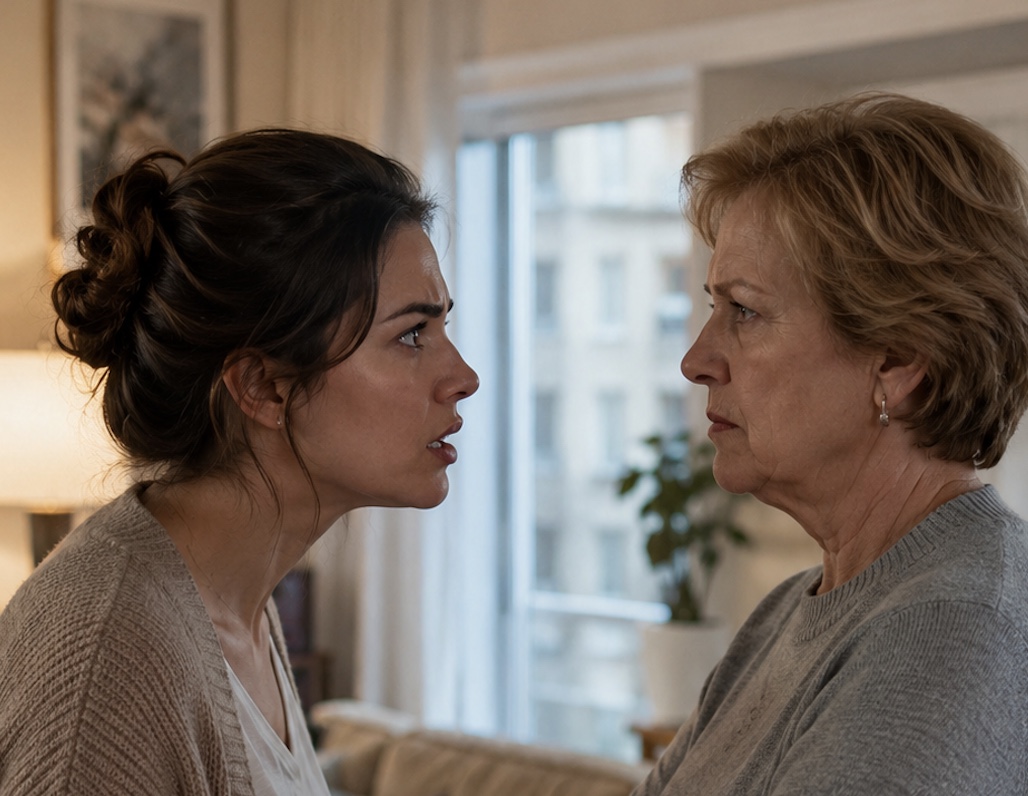
— My parents gave the apartment to me, not to your family. What exactly is unclear about that? — Daria asked, slowly lowering her cup onto the table.
Galina Sergeyevna, who was sitting opposite her, did not immediately find an answer. Until that moment, she had spoken with confidence, almost like the head of the household, waving her hand over the kitchen table as if she had a housing plan for an entire apartment block in front of her, not someone else’s home. But after her daughter-in-law’s words, her fingers froze above the saucer, her face went still, and only a thin vein at her temple twitched visibly.
Vitaly, Daria’s husband, sat to the side, looking from his mother to his wife and back again. He had clearly expected the evening to go the way it usually did: his mother would voice another idea, Daria would keep quiet, and later, in the kitchen, the two of them would quietly agree that “it was better not to pay attention.” But this time, Daria was not going to turn the conversation into a joke. She was not going to change the subject. She was not going to pretend she had not heard.
This conversation had been building for months. Not even a conversation, really — more like a crack that at first seems thin and barely noticeable, until one day you realize the whole wall has already begun to split along it.
The apartment had not come to Daria by chance, and it was not “just lucky,” as Galina Sergeyevna liked to say. Her parents had given it to their daughter shortly before the wedding. Not to impress the future in-laws. Not so the young couple would have a reason to consider themselves settled. They had done it so Daria would always have a place of her own, a corner where no one could come and make claims.
Daria’s father, Sergey Pavlovich, had said it plainly at the time:
— My girl, life can turn in many directions. Today there is love, tomorrow there is exhaustion, and the day after that someone may decide they have the right to control your fate. You must have a place where you are the one in charge.
Her mother, Lidia Viktorovna, was gentler, but she thought the same way. She spent a long time choosing the right apartment, checking the documents, going with Daria to viewings. Each time, she asked not about the neighborhood or transport, but something else:
— Can you imagine yourself here? Not us, not your future husband, not guests. Yourself.
Back then, Daria had laughed. It seemed to her that her parents were worrying too much. She was marrying Vitaly, whom she had been dating for almost four years. He was calm, tidy, disliked loud arguments, and always knew how to hug her in a way that made every doubt dissolve. She believed that in their marriage no one would pull the blanket to their side, no one would divide influence, and no one would start treating her property as common simply because she had become a wife.
The documents were drawn up as a gift deed. The apartment became Daria’s property before the wedding. It was a bright two-room apartment in a new building — not huge, but convenient: a separate bedroom, a spacious kitchen, and another room that Daria planned to keep as a workspace and guest area. She worked as a technologist at a small cosmetics production company and sometimes brought part of her work home: formulas, spreadsheets, process descriptions, emails to suppliers. She liked that in the apartment she could close the door and concentrate.
After the wedding, Vitaly moved in with her. He did not have many things: clothes, a box of tools, fishing books, a laptop, and a few old photographs. Daria herself suggested that he settle in properly so he would not feel like a guest. She gave him shelves, cleared space in the wardrobe, and bought a comfortable chair for the kitchen because he liked sitting by the window with his phone in the evenings.
At first, everything really was peaceful. Galina Sergeyevna came rarely and called more often. She might bring pickled cucumbers, a bag of apples, a jar of jam, talk about a neighbor’s health, complain about prices at the store — but she showed no obvious interest in the apartment.
— You live well here. It’s bright, — she would say, looking around the kitchen. — Your parents did well, of course. Not everyone helps their daughter like that.
Daria would answer politely:
— Yes, I’m very grateful to them.
And the topic would end there.
But about six months after the wedding, her mother-in-law’s tone began to change. At first, almost imperceptibly. She stopped saying “your apartment” and more often said “your place” in the plural sense, meaning both Daria and Vitaly. Daria did not nitpick. She and Vitaly were married, they lived together, and in a domestic sense, the apartment really was their home. She did not want to turn every phrase into a legal lecture.
Then one day Galina Sergeyevna lingered in the doorway of the room Daria used for work and said:
— By the way, this could be turned into a nursery. There’s enough space. Move the desk out, buy a different wardrobe, and a crib would fit here.
Daria smiled then, even though she and Vitaly had not yet seriously discussed children.
— When we need to, we’ll think about it.
Her mother-in-law looked at her closely.
— You need to think ahead. You have housing. Why delay?
Daria did not argue. She had already understood that Galina Sergeyevna liked giving advice as if it were not advice, but instructions that had simply not yet been carried out due to some misunderstanding.
Then Vitaly’s younger sister, Inga, appeared in the story. She lived with her husband Artyom and their son in a rented apartment on the other side of town. Daria did not see her often. Inga was sociable, loud, liked to come without naming an exact time, and could bring her child and immediately take over all the space around her. Inga’s six-year-old son, Timofey, ran through the rooms, opened drawers, checked what was on the shelves, while Inga usually laughed:
— He’s curious. Don’t scold him. Let him develop.
Daria did not scold him. She moved her work papers higher, closed her laptop, and made sure the child did not grab scissors or a glass jar with cream samples.
The first worrying conversation happened after one of those visits. Inga had left, Vitaly had gone to walk her to the car, and Galina Sergeyevna stayed in the kitchen with Daria.
— It’s hard for them, of course, — her mother-in-law sighed. — With a child, moving around someone else’s corners. The landlords demand one thing, then another. No stability.
Daria rinsed a cup and carefully placed the spoon beside the sink.
— I understand. With a child, people want their own place.
— Exactly, — Galina Sergeyevna brightened. — And you have a room standing unused.
Daria turned to her.
— It isn’t unused. I work there.
— What kind of work is that at home? You laid out some papers and now it’s an office? Inga and her family need that room much more.
For a second, Daria thought she had misheard. She even tilted her head slightly, trying to fit what had been said into normal human logic.
— Are you suggesting that Inga, her husband, and their child should live with us?
— Not forever, — her mother-in-law said quickly. — Just until they get on their feet. Family should help one another.
Daria dried her hands on a towel and answered evenly:
— Galina Sergeyevna, this is a two-room apartment. Vitaly and I live in the bedroom, and I need the second room for work. Four adults and a child cannot live here normally.
— When people want to help, they don’t count corners, — her mother-in-law said, offended.
At that moment, Vitaly returned. He immediately understood from their faces that the conversation was unpleasant. Daria was standing by the sink with a straight back, and Galina Sergeyevna was looking at her son as if she had just been unfairly thrown out onto the street.
— What happened? — he asked.
— Nothing, — Daria answered.
— Exactly, nothing, — his mother picked up. — I simply said that things are hard for Inga. And Dasha immediately built walls around herself.
Daria did not continue the conversation in front of Vitaly. Later, when they were alone, she explained to her husband that she was not ready to house his sister and her family in her apartment.
Vitaly rubbed his face with his palms and said tiredly:
— Mom is just worried about Inga. It’s not like she’s bringing them here tomorrow.
— But she is already discussing it as if it were a possible option.
— Don’t escalate. You know Mom. She speaks first and thinks later.
Daria stayed silent then. She did not want to quarrel over a hypothetical situation. She really hoped Galina Sergeyevna had simply said too much in the heat of emotion.
But her mother-in-law did not forget.
A couple of weeks later, she came over again. This time she brought homemade cutlets and salad in a container. Daria had not asked for food, but she thanked her. They sat down at the table. Vitaly laid out the forks, Daria placed napkins beside the plates, and Galina Sergeyevna looked around the kitchen and suddenly said:
— If Inga and Artyom move in with you temporarily, it would be better to give them the bedroom.
Daria looked up.
— Why the bedroom?
— Timofey needs a routine. A child must sleep calmly. You two are young; you can manage in the other room.
Vitaly coughed.
— Mom, we haven’t discussed this.
— What is there to discuss? It’s better to understand in advance what would be more convenient. I’m not doing this for myself.
Daria placed her palm on the edge of the table.
— Galina Sergeyevna, Inga is not moving in with us.
Her mother-in-law narrowed her eyes for a second.
— You say that as if I’m suggesting strangers.
— I’m talking about my apartment.
— Oh, Dasha, here we go. Yours, mine… You are husband and wife. Normal people share everything.
That was the first time Daria heard it so openly. Not as a hint, not as an accidental phrase, but as a fully formed position. The apartment that her parents had given her had already stopped being her personal property in her mother-in-law’s eyes. It had become a space that could be redistributed according to the needs of her husband’s relatives.
After his mother left, Vitaly again asked Daria not to take it seriously.
— She’s from the old school. That’s how they are: if someone has the means, they help the others.
— Vitaly, having the means is when I offer it myself. Not when someone decides for me who will sleep in my bedroom.
— No one is deciding.
— Your mother just assigned the rooms.
— She said it, that’s all. You refused.
— And you? — Daria looked at him more closely. — Did you refuse?
Vitaly looked away toward the window.
— I don’t want to fight with my mother.
That phrase stuck with Daria more firmly than anything Galina Sergeyevna had said. Because the situation was strange: Vitaly did not want to fight with his mother, but he apparently considered it acceptable to leave his wife alone against her pressure. It was as if he chose silence instead of fairness and called it peace in the family.
After that, Daria began noticing more.
Her mother-in-law could call and ask:
— Are you home this weekend? I told Inga she could come with Timofey, let the boy spend some time in a normal apartment instead of always being stuck in other people’s corners.
Daria answered:
— We’re busy this weekend.
— Busy doing what at home?
— Our own things.
Galina Sergeyevna would sigh heavily into the phone.
— You are difficult, Dasha. Everything has to be according to schedule with you, everything needs permission.
After such calls, Daria could not immediately return to her work. She would stand by the kitchen window, tapping her fingers against the windowsill, mentally choosing the reply she should have given earlier. Not rude, not scandalous, but precise. Yet each time it seemed that if she said it now, a major family conflict would begin. And Vitaly would look at her with tired eyes again and ask her not to turn a conversation into a tragedy.
One day, Galina Sergeyevna came with Inga. Without warning. Daria was just sorting through work materials in the room. Printouts, label samples, and a notebook with notes were spread across the desk. Vitaly was in the bathroom when the doorbell rang. Daria opened the door and saw her mother-in-law, sister-in-law, and Timofey.
— We won’t stay long, — Inga said cheerfully, stepping inside. — Mom said you were home.
Daria stepped aside, but an unpleasant feeling had already spread across her face in hot patches. Not because guests had arrived, but because once again she had been presented with a fact.
Timofey immediately ran toward the room. Daria followed him.
— Tim, you can’t go in there. I have documents there.
— He won’t touch anything, — Inga said from the hallway, taking off her son’s jacket. — Right, Timosha?
The boy was already holding a plastic sample bottle in his hands.
— Please put that down, — Daria said.
Timofey looked at his mother. Inga waved her hand tiredly.
— Put it down, since Aunt Dasha is so strict.
Aunt Dasha is so strict. The phrase was small, but it carried everything: Daria was interfering, Daria was not allowing things, Daria was spoiling everyone’s mood in her own home.
Galina Sergeyevna walked through the apartment, stopped in the workroom, and suddenly said to Inga:
— Look, if the desk is moved toward the window, a child’s bed would fit here. And the wardrobe could go into the hallway.
Daria slowly turned to her mother-in-law.
— Nothing needs to be moved from here.
Inga laughed as if Daria had said something funny.
— Mom is just imagining possibilities. We’re not moving in tomorrow.
— Or the day after, — Daria replied.
Inga stopped smiling.
Vitaly came out of the bathroom, saw everyone in the room, and froze in the doorway. Daria looked at him, waiting for at least one clear sentence. But he only said:
— Mom, Inga, let’s go to the kitchen. Why are you all crowding here?
Not “don’t discuss our apartment.” Not “Daria is right.” Not “this is unacceptable.” He simply moved people into the kitchen, as if the problem were that they were standing in the wrong place.
That evening, Daria told her husband:
— One more unannounced visit like that, and I won’t open the door.
— Dasha, why be so harsh?
— Because they don’t understand any other way.
— That is my mother and sister.
— And this is my apartment.
Vitaly was silent for a moment, then said something Daria remembered word for word:
— Sometimes you talk as if I’m nobody here.
She looked at him for a long time. At the man she loved, the man she had built a home life with, the man she had trusted with the keys to her home. And suddenly it did not even hurt — it felt strangely empty from the shock of it.
— I’m not saying that. But if being a husband means having the right to dispose of my property, then we understand marriage differently.
Vitaly went into another room. He did not slam the door or make a scene. He simply shut himself inside silence, as he always did when a conversation required him to take a position.
The next month passed tensely. Galina Sergeyevna called less often, but every conversation was filled with hints.
— Inga is completely worn out. The child is growing, and there’s no space.
— Artyom is tired of running back and forth.
— Your room is standing there uselessly.
— Dasha’s parents certainly settled their daughter well. But who will think about the others?
Daria answered briefly. She stopped justifying herself. Before, she could explain: work, personal space, inconvenience, crowding. Now she said:
— No, that option doesn’t work.
And she noticed how angry her mother-in-law became precisely at that “no.” Not at the reasons, not at the circumstances, but at the very fact that her daughter-in-law allowed herself to set a boundary.
One evening, Vitaly came home unusually thoughtful. He washed his hands for a long time, then opened the refrigerator, looked inside, and closed it without taking anything. Daria immediately understood: there was going to be a conversation.
— Mom asked us to think about something, — he began.
Daria was sitting at the kitchen table with her laptop, but the screen went dark the moment she moved. She closed the lid.
— About what?
— Not about Inga moving in. Don’t look at me like that. Something else.
— I’m listening.
Vitaly sat opposite her.
— Mom says the apartment could be rented out, and we could temporarily live with her. Or with your parents. The money could go toward helping Inga with a down payment for her own place.
For a few seconds, Daria did not even blink. She simply looked at her husband, trying to understand where, in this whole scheme, there was even one detail in which she had been asked.
— So my apartment would be rented out, I would move out, and the money would be given to your sister?
— Not given. Used to help.
— Vitaly, are you seriously presenting this to me as an option?
He frowned.
— I said Mom asked us to think about it.
— And what did you answer?
— That I’d talk to you.
Daria gave a quiet laugh, but there was no amusement in it.
— You couldn’t immediately say that it was impossible?
— I didn’t want to start a fight right away.
— But you could bring it home to me and place it on the table.
Vitaly clasped his fingers together.
— You take everything as an attack.
— Because it is an attack. Just wrapped softly.
— Dasha, no one is trying to take your apartment away from you.
— Of course not. First they wanted to move Inga into it. Then they assigned the rooms. Now they suggest that I move out so my apartment can “work” for someone else’s plans. What else should I call that?
Vitaly stood up.
— Fine, I get it. This conversation is useless.
— No, Vitaly. What’s useless is pretending these are normal suggestions.
He went into the bedroom. Daria remained in the kitchen. Her cup was on the table, and beside it lay a folded sheet with work notes. She looked at the familiar things and, for the first time, felt that in her own home she had to defend herself not from strangers, but from people who called themselves family.
After that, Daria decided to act not with words, but with order.
She took back the spare set of keys that had previously been kept in the hallway “for Mom, just in case.” Galina Sergeyevna had once asked for them when she was supposed to come before they returned home and leave a bag of groceries. Daria had allowed it for one time only, but the key had remained with her mother-in-law. She remembered that only now.
— Call your mother, — she said to Vitaly. — Ask her to return the keys.
He looked up from his phone.
— What keys?
— The keys to our door. The ones she took in March.
— She still has them? I thought she gave them back.
— She didn’t.
— Dasha, so what if they’re lying around there? She doesn’t come without us.
— I don’t like the keys to my apartment being with a person who discusses who should live here.
Vitaly wanted to object, but Daria looked at him so directly that he changed his mind. He called his mother in front of her. The conversation was short but unpleasant.
— Mom, please return the keys to the apartment… Yes, Dasha is asking… No, nothing happened… Mom, just return them.
Daria could hear Galina Sergeyevna’s indignant voice through the phone, although she could not make out the words. Vitaly flushed, frowned, stood up, then sat down again. Finally he said:
— I’ll come by tomorrow.
The next day, he really brought the keys back. Daria checked the set and put it in a drawer. Two days later, she called a locksmith and changed the lock. No announcements, no extra conversations — she simply arranged for a specialist, chose a reliable mechanism, and paid for the work. She told Vitaly that evening.
— I changed the lock.
He lifted his head.
— Why?
— So access to my apartment is clear. You have a key. I have a key. No one else does.
— Mom will be offended.
— That is not an argument.
— You could at least have discussed it with me.
— I did discuss it. For several months. You didn’t hear me.
Vitaly tiredly ran a hand through his hair.
— You’re turning my mother into an enemy.
— No. I’m turning my apartment back into my home.
The phrase hung between them. Vitaly did not argue, but Daria could see he did not agree. Not because he wanted to take her property from her. Rather, because it was easier for him to live in a world where unpleasant conversations somehow dissolved on their own. Where his mother did not have to be upset. Where his wife would “understand.” Where boundaries existed, but did not need to be spoken aloud.
Galina Sergeyevna found out about the lock a week later. She came on Saturday afternoon, when Daria was home alone. She rang the doorbell for a long time, insistently, then called her phone.
— Dasha, are you home? Open the door.
Daria opened it.
Her mother-in-law stood there with a bag in her hand and an unhappy expression on her face.
— I couldn’t open it with my key.
— Because the lock is new.
— I’ve already realized that. Why did you change it?
— I feel calmer this way.
— Are you protecting yourself from me?
Daria did not step away from the door and did not invite her in. She had already decided: no more hallway conversations with bags and grievances that later turned into new pressure.
— Galina Sergeyevna, you came without warning.
— I am your husband’s mother.
— I remember. But visits still need to be arranged in advance.
Her mother-in-law raised her eyebrows.
— Look what we’ve come to. I need an appointment to visit my son.
— Vitaly isn’t here right now.
— So you’re going to keep me on the doorstep?
Daria calmly looked at the bag in her hand.
— Did you want to pass something along?
Galina Sergeyevna stayed silent for a few seconds, then sharply held out the bag.
— I brought cutlets. Though apparently now even that needs prior approval.
— Thank you, — Daria said, taking the bag. — I’ll tell Vitaly you came by.
— You’ll tell him? — her mother-in-law gave a short laugh. — You speak as if I’m a courier.
— I’m speaking as things are.
Galina Sergeyevna looked at her heavily.
— You are pushing me out of the family, Dasha.
— No. I’m not allowing you to manage my home.
— Home? — her mother-in-law leaned forward sharply. — And what is my son here? A lodger?
Daria did not raise her voice.
— My husband. But that does not make the apartment yours.
Galina Sergeyevna left offended, stepping loudly on the stair landing. That evening, Vitaly came home gloomy. Of course, his mother had already called him and told him her version: the daughter-in-law had not let her in, humiliated her, left her standing with a bag, changed the lock “behind everyone’s back,” and now her son had no voice in his own family.
— You could have let her in, — he said.
— I could have. But I didn’t want to.
— She came with food.
— And also to check whether the old key still worked.
Vitaly opened his mouth, then closed it. Apparently, that thought had not occurred to him. Or it had, but he did not want to admit it.
— You’re too suspicious.
— I’ve become attentive.
From that day on, Galina Sergeyevna changed tactics. She stopped coming without warning, but began speaking through others. Inga wrote Daria a message:
“I didn’t think you were like this. We didn’t want anything bad.”
Daria replied:
“I don’t want anything bad either. But only the people I personally invite will live in my apartment.”
Inga did not answer, but an hour later Vitaly received a long voice message from her. He listened to it on the balcony, then returned to the kitchen with the expression of a person who had once again found himself between two fires, even though he himself had spent years feeding dry branches into them with his silence.
— Inga is crying, — he said.
Daria put the knife down beside the cutting board and turned around.
— Why?
— She says you think she’s a freeloader.
— I never said that.
— But that’s how she understood it.
— How convenient — to understand a refusal in exactly the way that makes the person refusing feel guilty.
Vitaly sat down tiredly.
— It’s hard for me to listen to all this.
— Then don’t make me live in a way that makes it easier for you to listen to them and harder for me to be at home.
He looked at her with annoyance.
— You’ve become harsh.
Daria nodded.
— Yes. Because softness here was mistaken for agreement.
Vitaly said nothing then.
Despite the tension, Daria still hoped the situation would calm down. She did not want to destroy her relationship because of an apartment. She wanted her husband to finally see one simple thing: this was not about greed, not about a lack of love for his relatives, not about wanting to humiliate his mother. It was about a boundary. About the right of the owner to decide who enters her home and what plans may be built around her property.
But Galina Sergeyevna did not see it as a boundary. She saw Daria’s refusal as a personal defeat.
Everything reached its decisive evening unexpectedly.
Vitaly said in advance that his mother would come over for dinner. Daria agreed. She did not want to forbid her husband from seeing his mother in their home if the visit had been arranged beforehand. She cooked chicken with vegetables, made a salad, sliced bread, and placed cutlery beside the plates. There was no festive mood, but she tried to remain calm.
Galina Sergeyevna did not come alone. Inga was with her. Without Artyom and Timofey, but with such determination on her face that it seemed she had come not for dinner, but for a family council.
Daria opened the door, saw her sister-in-law, and immediately understood: this would not be an ordinary dinner.
— We won’t stay long, — Inga said. — We just need to talk.
Vitaly came out of the room, noticed his sister, and frowned.
— Inga? You too?
— What? Am I not allowed? — she asked sharply.
Galina Sergeyevna took off her coat and went into the kitchen without waiting to be invited. Daria closed the door and kept her hand on the lock for a second. She needed a few moments not to begin the conversation right there in the hallway.
At the table, it did not begin immediately. First they ate almost in silence. Vitaly tried to talk about the weather, Inga answered in single words, and Galina Sergeyevna carefully examined the kitchen. Daria saw her gaze slide over the cabinets, the hallway door, and the passage toward the rooms. Not like a guest. Like someone still measuring the space for someone else’s needs.
Then Galina Sergeyevna put down her fork and said:
— All right. Since everyone is here, let’s calmly discuss this.
Daria looked up.
— Discuss what exactly?
— The apartment.
Vitaly immediately tensed.
— Mom, we agreed not to bring this up.
— No, Vitalik, enough hiding. Family problems must be solved openly.
Daria moved her hands off the table and placed them on her knees.
— Speak.
Galina Sergeyevna seemed to have been waiting for that permission.
— Inga and Artyom need normal housing. Timofey will start preparatory group in the fall, then school. They need to settle in a district where there is a clinic, kindergarten, transport. Your apartment is convenient. Two rooms. You two are alone. You don’t have children yet. So we need to look for a reasonable option.
— Reasonable for whom? — Daria asked.
Her mother-in-law pretended not to hear.
— No one is saying Inga should live here for free forever. Everything can be arranged properly. They can move into your second room for a year. Well, maybe two. They’ll help with groceries and cleaning. Timofey is a calm boy; he won’t bother anyone.
Daria shifted her gaze to Inga.
— Do you really think this is normal?
Inga lifted her chin.
— What’s abnormal about it? We’re not strangers. Your room is occupied by a desk and boxes. We have a child.
— I have a workspace there.
— As if you’re operating a factory machine at home, — Inga snorted. — You can open a laptop in the kitchen.
Daria noticed Vitaly wince. He did not like his sister’s tone, but once again he kept silent.
Galina Sergeyevna continued:
— There is another option. You rent out this apartment and temporarily move in with me. There’s enough space. The rental income can be saved for Inga’s housing. That way, the apartment will work for the whole family instead of just standing there for one person’s comfort.
There it was. Not a random hint. Not an emotional remark. A complete plan. With options. With arrangements. With decisions made by others before the owner had even been asked.
Daria felt her face grow hot, but her voice stayed even.
— Is there a third option?
Galina Sergeyevna brightened, deciding that her daughter-in-law had finally joined the discussion.
— There is. We can arrange temporary registration for Inga and Timofey so it will be easier for them with kindergarten and school. They’ll actually keep living where they live, but their documents will be here. Then we’ll see.
Daria slowly turned to her husband.
— Vitaly, do you hear this?
He sat with a tense face.
— I hear it.
— And?
— Mom, temporary registration is unnecessary, — he finally said. — Don’t do that.
Daria looked at him carefully.
— Only the registration is unnecessary?
He realized he had answered the wrong part. His fingers tightened on the edge of the table.
— That’s not what I meant.
— Then what did you mean?
Galina Sergeyevna interrupted sharply:
— What he means is that you keep forcing my son to choose! Between his wife and his mother, between you and his sister. Is that how people behave? We are not demanding that you gift the apartment to Inga. We are asking you to help like a human being.
Daria looked at her mother-in-law.
— You are asking me to give up my space, my documents, my possible rental income, and my peace. You’re simply calling it help.
— Because it is help!
— No. Help is when a person decides for herself what she is ready to share. When it has already been decided for her, that is pressure.
Inga abruptly pushed back from the table.
— I don’t need your apartment! Mom is just trying to find a solution. As if we dream of living under your nose.
— Then why are we discussing it?
Inga flushed.
— Because for once you could think about someone other than yourself.
Daria lowered her eyes to her cup. Before, at a moment like this, she would have started explaining: that she had helped, that she had hosted them, that she had bought Timofey gifts, that she was not obligated to solve someone else’s housing problems. But now she clearly understood: every justification would become a new hook for them. Once you start explaining, you admit they have the right to judge the reasons for your refusal.
She took her cup, drank a sip, then carefully placed it back on the table. She looked first at Inga, then at Galina Sergeyevna.
— I will not discuss anyone moving in, renting this place out, registration, or any other plans connected with this apartment.
Her mother-in-law leaned forward.
— Dasha, you don’t understand. The apartment should work for the whole family.
— My parents gave the apartment to me, not to your family. What exactly is unclear about that? — Daria asked.
The table instantly fell silent.
Even the refrigerator, which had been quietly humming in the corner, seemed to stop existing. Inga froze with a napkin in her hand. Vitaly stared at one point in front of him. Galina Sergeyevna visibly tensed: her shoulders lifted, her fingers tightened on the edge of the table, and her gaze turned sharp. For the first time, she heard those words without the usual softening, without “I understand,” without “let’s think about it,” without “not now.”
Daria had also said them that way for the first time. Not defending herself. Not justifying herself. Not trying to look like a good daughter-in-law. She simply named reality.
— So that’s how it is, — her mother-in-law said quietly. — We are strangers to you.
— You are my husband’s relatives, — Daria answered. — But the apartment belongs to me.
— And Vitaly? What is he here?
Daria turned to her husband.
— Vitaly is my husband. He lives here with me because we are a family. But that gives no one the right to manage housing my parents gave me.
Galina Sergeyevna suddenly stood up.
— Did you hear that, son? She has shown you your place.
Vitaly stood up after her.
— Mom, don’t.
— Don’t what? You sit there silently while your wife explains that you are nobody in her home!
Daria stood as well. The chair moved back quietly.
— I did not say that. But if that is what you want to hear so you can start a scandal, I won’t help you.
Inga grabbed her bag.
— Let’s go, Mom. Everything is clear here.
— No, — Daria said.
Everyone looked at her.
She stood straight, her voice steady, even though inside every muscle was gathered as if before heavy work.
— Now everything will be clear once and for all. No one is moving into this apartment. No one is being registered here. No one is getting keys. No rooms will be assigned. I will not rent it out for someone else’s plans. If someone needs help, you may ask in words, but the answer may be “no.” And that “no” will not be discussed behind my back.
Galina Sergeyevna turned pale with anger. Her lips trembled, but Daria did not let her insert another reproach.
— And one more thing. You may come here only by agreement. No sudden visits, no family councils, no attempts to present me with decisions already made.
— Are you throwing us out? — Inga asked.
— Yes. Today’s conversation is over.
Vitaly turned sharply to his wife.
— Dasha…
She looked at him in a way that made him stop.
— No, Vitaly. Don’t ask me to smooth this over. Not now.
Galina Sergeyevna slowly took her coat. Inga was already standing in the hallway, noisily fastening her bag. Her mother-in-law stopped at the door and said to her son:
— Think carefully about where you live and with whom.
Daria opened the door.
— Your keys have already been taken back. The new lock is installed. So at least that question is closed.
Her mother-in-law threw her a heavy look and left. Inga followed without saying goodbye. Daria closed the door and turned the lock.
The apartment became quiet.
Vitaly stood in the middle of the hallway, both confused and angry.
— You could have been softer, — he said.
Daria looked at him tiredly. She did not cry, did not shout. She simply removed the extra plates from the table and carried them to the sink. Then she came back and answered calmly:
— I was softer for several months.
— That is my mother.
— And this is my home.
— There you go again.
— Yes, again. Because you still hear that phrase as an attack on yourself, not as protection from someone else’s pressure.
Vitaly sat down and covered his face with his hands.
— I didn’t want it to turn out like this.
— How did you want it to turn out? For me to agree? For your mother not to be offended? For Inga not to cry? For you not to quarrel with anyone?
He was silent.
Daria walked to the table, gathered the napkins, and placed them to the side. Suddenly it became clear to her how long she had been trying to preserve a peace that had never truly existed. There had only been her silence, convenient for everyone else.
— Vitaly, I am not forbidding you from helping your sister. I am not forbidding you from communicating with your mother. I am not demanding that you choose between people. But I am demanding that my apartment not be used as a bargaining chip in your family’s problems.
He raised his head.
— And what if I can’t do that? What if, to me, family means everyone pulling each other out?
— They pull each other out with what belongs to them. Their own time, their own strength, their own money, their own decisions. Not someone else’s gift from her parents.
That phrase landed exactly where it needed to. Vitaly looked away. He understood. Perhaps for the first time, he truly understood. But admitting it aloud was difficult, because then he would also have to admit something else: all these months, he had allowed his mother to go too far.
Daria did not press further. She cleared the table, washed the dishes, and wiped the counter. Vitaly sat silently. Then he said quietly:
— I’ll talk to Mom.
Daria stopped.
— Don’t talk to her instead of me. First decide for yourself what you believe is right.
— I think she crossed the line.
— That is already a beginning.
He looked at his wife.
— But you were harsh too.
Daria nodded.
— Maybe. But when I was gentle, no one heard me.
The night passed almost without sleep. Vitaly lay for a long time with his eyes open; Daria could tell from his breathing. She did not sleep either. But for the first time in a long while, her insomnia was not anxious. Endless possible replies were not spinning in her head. There was no shame over her sharpness, no desire to write a conciliatory message to her mother-in-law.
In the morning, Galina Sergeyevna sent her son a long message. Daria did not read it, but Vitaly summarized it briefly himself:
— She thinks you destroyed the relationship.
Daria poured water into a glass.
— A refusal doesn’t destroy relationships. What destroys them is the certainty that someone else’s property can be treated as your own.
Vitaly looked at his phone for a long time, then turned off the screen.
— I’ll write to her that the apartment topic is closed.
Daria said nothing. But for the first time in a long while, she did not have to ask him to do it.
During the day, Inga sent a short message: “You can be happy now. We won’t come anymore.” Daria read it and put the phone away. She did not reply. Not because she wanted to punish her with silence, but because any new explanation would drag her back into the same circle where she had to justify her right to manage what belonged to her.
That evening, Vitaly came to the door of the workroom on his own.
— May I?
Daria nodded.
He entered, looked around at the desk, the shelves, the neatly stacked folders, the laptop, the samples, the boxes with materials. Before, he had truly seen this as just “a room with a desk.” Now, it seemed, he understood for the first time that it was not an empty space waiting for someone else’s bed. It was part of Daria’s life. Her work, her order, her silence.
— I didn’t think about it this way before, — he said.
— About what?
— That for you, this apartment isn’t just walls. That your parents gave you not convenience, but protection.
Daria looked at him carefully.
— Exactly.
— I’m sorry I stayed silent.
She did not soften immediately. That silence had cost her too much strength for too long.
— I need more than an apology, Vitaly. I need this never to happen again.
— It won’t.
— If your mother brings up the apartment again?
— I’ll stop her myself.
— If Inga asks for registration again?
— I’ll refuse.
— If they start saying I’m greedy?
Vitaly grimaced, but answered:
— I’ll say the apartment is yours, and it cannot be discussed.
Daria nodded. For the first time throughout the whole conflict, she saw not an attempt to hide, but a decision. Small, late — but real.
A week later, Galina Sergeyevna called Daria herself. Her voice was dry.
— I wanted to pick up my containers.
— Vitaly will give them to you tomorrow, — Daria answered.
— I can come by.
— Vitaly will bring them tomorrow himself.
A pause hung on the other end.
— Are you going to keep this distance forever?
Daria looked at the closed door of her workroom.
— Yes, as long as it is necessary.
— You’re proud.
— No. I simply no longer confuse kindness with permission.
Her mother-in-law said nothing and hung up.
Daria placed the phone on the table and calmly continued working. She did not feel happy about the conflict. She did not feel victory in the way victory is usually imagined from the outside — loud, impressive, with the final word. No. It was something else. As if she had finally closed a window through which a draft had been blowing for a long time, while everyone around her insisted she was imagining it.
Now she was not imagining it.
She knew there would still be resentment, conversations, attempts to return everything to its old course. Galina Sergeyevna would not become a different person after one evening. Inga would not immediately admit that she had demanded too much. Vitaly might still fall back more than once into his familiar “don’t escalate.” But the line had already been drawn.
Daria was no longer going to be the convenient owner of an apartment that others had mentally divided into rooms, options, and benefits. Her parents had not given her housing so she could learn to yield beautifully. They had given her a foundation. And finally, she had used that foundation not in words, but in action.
That evening, when her mother-in-law first heard her direct refusal, the silence at the table came not only from surprise. It came because everyone had been forced to see the obvious: Daria would no longer explain the elementary ten times over. She would no longer cover someone else’s arrogance with politeness. She would no longer give away her peace just so her husband’s relatives could conveniently make plans.
Galina Sergeyevna tensed then not because of rudeness. There had been no rudeness. She tensed because, for the first time, she had collided not with excuses, but with a boundary.
And in that very moment, Daria finally decided: her kindness would no longer be mistaken for permission to manage her property.