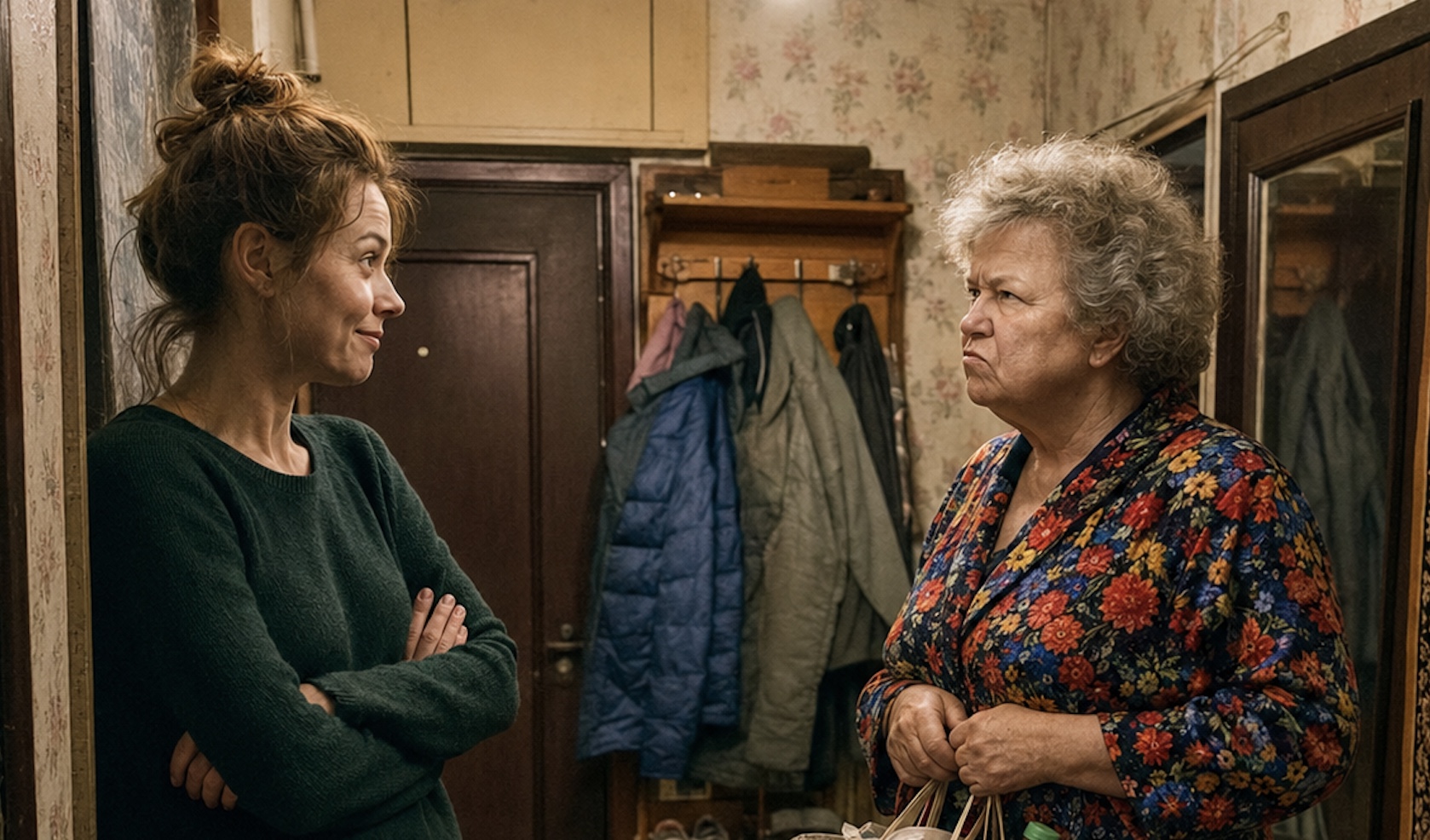
“All right, then. It’s settled. Tomorrow, by eight in the morning, you’ll be at Vitya’s place. I’ve already ordered the diapers. They’ll be delivered on Wednesday.”
My mother-in-law — or rather, my former mother-in-law, Tamara Ivanovna — was standing in my hallway in her colorful house robe, the same one she wore when visiting the neighbor across the street, if you can imagine that. And she said it in a tone as if I had already promised to make dumplings for her tomorrow.
I blinked. Once. Then again.
“Tamara Ivanovna. I don’t understand. Whose diapers?”
“Vitya’s, of course. Olya, are you completely lost? Vitya is bedridden. He had a stroke. His left side is paralyzed. We need a caregiver.”
“We?” I repeated.
“Well, who else?” She adjusted the bag on her shoulder. “You’re his wife.”
“Ex-wife,” I corrected her. “We divorced four years ago, just in case you forgot.”
“There’s no such thing as an ex-wife,” Tamara Ivanovna snapped. “You lived with him for ten years. He made a proper woman out of you. This apartment — who bought it? Vitya did. And now you’re turning up your nose?”
That phrase — “made a proper woman out of you” — was what finished me.
What made me a proper woman was my dentistry degree. And twelve years of work in a private clinic, where I first ran around as an assistant for pennies, and then grew into having my own office. As for Vitya… Vitya “made” me into depression, minus eight kilograms, and a regular visitor to a therapist’s office. Thanks, I suppose.
By the way, I bought this apartment myself. After the divorce. With my own money. At that time, Vitya was busy drinking away whatever was left of his brains with his new passion — Angela from the car dealership.
But it had all started half an hour earlier.
I had just come home from work. I kicked off my shoes, put the kettle on, sat down on a kitchen stool — and then the doorbell rang. So insistently, you’d think there was a fire.
I opened the door, and there stood Tamara Ivanovna. No call, no warning. She stepped straight into the hallway and announced from the doorway:
“Olya, we have a disaster.”
“We.” I hadn’t heard that “we” from her in four years. The last time she said “we” was when Vitya broke three crates of her homemade preserves in her garage, and “we” had to make new ones.
“What disaster?”
“Vitya is in the hospital. A stroke. They’re discharging him in a week, and the doctors say he needs care. Full care. And I’m not young anymore. I’m seventy-two. I have blood pressure problems myself.”
“I’m sorry,” I said sincerely. And I truly was sorry for Vitya. He was my ex, but I’m not a monster. “Where’s Angela?”
Tamara Ivanovna pressed her lips together so tightly they looked like a chicken’s backside.
“Your Angela ran away. As soon as she found out about the stroke, she packed her things and left. Went to her mother in Tambov. Said, ‘I’m still young. I don’t need to carry an invalid on my back.’”
“I understand Angela,” I nodded.
“What?!” my former mother-in-law flared up.
“I said I understand her position. She isn’t his wife. She isn’t family. She can do whatever she wants.”
“And you!” Tamara Ivanovna pointed a finger at me. “You are his wife! Ten years!”
“Ex-wife,” I repeated slowly, syllable by syllable. “For four years already.”
And that was when she delivered the line:
“You gave him ten years of your life — now go empty his bedpan.”
Do you know what I did at that moment?
I laughed.
Not on purpose. It just burst out of me.
I simply pictured it: me, after a twelve-hour shift, going to Vitya’s place. There, Tamara Ivanovna would greet me with instructions: “Change the diaper every three hours, cook the porridge thin, rub his legs with camphor oil.” And in between: “Olya, wipe the floor here, I can’t bend down anymore.”
“Tamara Ivanovna,” I stopped laughing. “Let me tell you a story. Do you remember when my father became bedridden in 2021? After Covid? Do you remember?”
She frowned. Pretended not to.
“You don’t remember. Then I’ll remind you. Back then, I called you and Vitya. I said my father had been discharged from the hospital and I needed to go to his village for a week. What did you tell me?”
Silence.
“You told me, ‘Olya, Vitya’s vacation is in a month. We’re going to Turkey. You can’t leave now. Who will help Vitya pack?’ That was one. And when my father died two months later, and I asked Vitya to come to the funeral with me — what did he say?”
“Olya, what does that have to do with anything…”
“He said, ‘I don’t want to drag myself to that backwater. Go by yourself.’ And then he went fishing with Seryoga. Remember?”
Tamara Ivanovna started breathing heavily through her nose.
“That was different. Your father was your father. And Vitya is a man. He needed rest.”
And right then — wait a second, I’ll stop smiling.
Right then, something inside me quietly snapped. You know how a lightbulb burns out? A soft pop, and then darkness.
For ten years, I had been the service staff in that family.
Ten years of “Olya, cook this,” “Olya, wash that,” “Olya, run to Mom’s place and take her medicine.” My mother-in-law lived in the next building, but somehow I was the one sent for her pills. Across the whole city. After work. With two bus changes.
And when I brought up having a child, Vitya said, “First, we need to save up for a bigger apartment.”
We saved for seven years. We saved enough. We bought one. Guess whose name it was registered under? Exactly. Vitya’s. “We’re a family, what difference does it make?”
We divorced six months later. He brought Angela straight into that apartment. I moved into a rented one-room place, saved for three years, bought my own apartment — and finally started living. For the first time. Like a human being.
“Tamara Ivanovna. I am not Vitya’s wife. I am nobody to him. On paper, I’m a stranger. In life, even more so.”
“You’re heartless!” she nearly choked. “I’ll tell Angela the same thing. Let her know what all of you are really like!”
“Tell her. She’s in Tambov. She has nothing to fear.”
“And what am I supposed to do? My pension is twenty-two thousand! A caregiver costs seventy!”
“Vitya has an apartment. Your apartment, the one that’s officially in Vitya’s name. Rent out a room. Or sell it, move in with him, and take care of him.”
“That’s his apartment! I’m not touching it!”
“Then hire a caregiver using his disability pension. He’ll receive one.”
“Are you mocking me?”
“No. I’m thinking logically.”
Then she took a deep breath and launched into her second attack.
“And I thought you were kind. I even told Vitya, ‘You shouldn’t have left Olya. She was pure gold.’ But look at you…”
Sarcasm woke up inside me before I could stop it.
“Tamara Ivanovna, could you repeat that? What exactly did Vitya say when he left me?”
“What?”
“Well, how did Vitya describe me when he went off to Angela? Remind me.”
She hesitated.
“Well… he said something…”
“‘A dried-up little fish.’ ‘A skinny roach.’ ‘There’s nothing even to talk about with you.’ You told me those words on the day of the divorce, by the way. Your quotes. I was crying in your kitchen, and you poured me tea and said, ‘Olya, you have to understand, you’re a dried-up little fish, and Angela is a juicy woman. Of course he left you for her.’ Remember?”
Tamara Ivanovna turned crimson.
“I never said that!”
“You did. I have a good memory for insults. Professional deformation — I look into people’s mouths eight hours a day. I remember everything.”
And then the doorbell rang. Again.
I opened the door. Sergei was standing there. My husband. Holding a grocery bag from Pyaterochka and a bouquet of chrysanthemums. He brings chrysanthemums every Friday. It’s our tradition.
“Hi, kitty. I bought potatoes, like you asked. Oh, we have guests?”
Tamara Ivanovna looked at Sergei. Then at me. Then back at Sergei. Then at the keys in his hand — he has his own set. We’ve been living together for three years.
“Who… is this?” she forced out.
“This is my husband,” I said calmly. “Sergei. We’ve been legally married for two years.”
Sergei offered her his hand.
“Very nice to meet you. And you are…?”
“This is Tamara Ivanovna,” I said. “Vitya’s mother. Remember, I told you about her?”
Sergei’s face lit up.
“Ah! Of course, of course! Tamara Ivanovna! I’m your neighbor, by the way. From the building across the street, fifth floor. That’s where I found Olya three years ago. We met in the elevator when I helped her carry boxes in. Remember, she was moving into apartment eight? You were sitting in the yard at the time. I walked past and said hello. You even said, ‘Good afternoon, young man.’”
Tamara Ivanovna was silent. For a long time. Then she said dryly:
“I don’t remember.”
“No problem,” Sergei smiled disarmingly. “The important thing is that now we all know each other. Would you like some tea?”
“I would not.”
She turned and headed for the door. Already holding the handle, she looked back.
“So you’re leaving Vitya to die?”
“Tamara Ivanovna,” I said gently. “Vitya is not dying. He had a moderate stroke. Rehabilitation will take three or four months, and then he’ll partially recover. I spoke to the doctor an hour ago — I called the hospital as soon as you told me about the stroke. I asked about the prognosis. So don’t exaggerate. And one more thing.”
I stepped closer.
“If Vitya doesn’t have money for a caregiver, call social services. There’s a home care program. Free, four hours a day. Plus, a district nurse through his medical insurance. In most cases, that’s enough. I looked into it before — remember, my father was bedridden. I know how the system works.”
She blinked.
“Why didn’t you say that right away?”
“Because you didn’t ask. You came straight in with orders.”
The door slammed.
I turned to Sergei. He was looking at me with such tenderness that my nose began to sting.
“How are you?” he asked.
“I’m good,” I said.
And I realized I wasn’t lying.
“Shall we fry the potatoes?”
“We shall.”
We went into the kitchen. Sergei turned on the radio, and I took out the frying pan. Our cat, Muska, rubbed against my legs.
And do you know what I thought?
I thought: for ten years, I was “Olya, do this.” But for the past three years, I have simply been Olya.
And apparently, that is enough for happiness.
You don’t need a bigger apartment, a more expensive car, or quieter in-laws. You just need someone who brings you chrysanthemums on Fridays and asks, “How are you?”
I truly feel sorry for Vitya. He wasn’t evil. He was weak. And weak people are the most dangerous, because they always drift with the current. The current carried him to Angela. Then it dragged him into a stroke. Now it will wash him back to his mother. Tamara Ivanovna will shout and shout, and then she’ll be the one cooking porridge for him. What else can she do?
As for me, I have already cooked my own porridge.
And I eat it calmly.
With my husband.
In my apartment.
In my kitchen.
And with no former mothers-in-law in colorful house robes.