“Lena, where do you think you’re going with your shoes on? We’ve just cleaned the veranda, and you’re dragging dirt in from the yard. Go around through the back door. There’s a mat there.”
Her sister-in-law’s voice sounded sharp, confident, and far too much like that of a woman who considered herself the mistress of the house.
Elena froze with heavy grocery bags in her hands, not even managing to step over the threshold of her own country home. On the brand-new rattan sofa, curled up comfortably with her legs tucked beneath her, sat Galina, lazily flipping through a glossy magazine. A cup of coffee steamed on the small table in front of her. The very same expensive coffee Elena had bought especially for herself.
From the kitchen came the cheerful murmur of the television and the clatter of dishes. Her mother-in-law, Antonina Vasilyevna, was busy there, acting as if she owned the place.
Elena slowly lowered the bags onto the wooden floor of the veranda. Inside her, a hot, suffocating wave of irritation began to rise — the same irritation she had been forcing down for several weeks.
This plot of land, with its cozy two-story timber house, was her personal pride. She had bought it before marriage, investing all her savings and several years of hard work into it. She had chosen the paint for the walls herself, planned the plantings herself, hired workers to drill the well and install the autonomous septic system. This was her place of strength, her refuge from the noise of the city and the pressure of her demanding job in the finance department.
Viktor had come into her life later. Calm and easygoing, he had fit smoothly into her routine and never tried to act like the sole master of the house.
But along with Viktor came his family.
At first, everything had seemed harmless. In May, his mother complained about high blood pressure and the stuffiness of her city apartment. Viktor timidly suggested taking her out to the countryside for a couple of days. Elena did not object.
Then Antonina Vasilyevna asked to stay “just one more week,” claiming that the pine-scented air was doing wonders for her health. After that, Galina joined her, saying that her apartment was suddenly being renovated and the smell of paint made it absolutely impossible to stay there.
Without Elena even noticing, a couple of days had stretched into a month. The house filled with other people’s belongings, other people’s habits, and other people’s rules.
Elena took off her sneakers, placed them neatly in the corner, and went into the kitchen. Antonina Vasilyevna was standing at the stove, stirring something in a large pot.
“Oh, Lenochka is here,” her mother-in-law said, turning around and wiping her hands on the apron Elena had bought at a handmade craft fair. “We’re making soup. Though, honestly, there wasn’t any proper meat in your freezer. Just one dry chicken breast. I had to make broth from that. Next time, you should buy some pork. Our Galya doesn’t feel full from dietary food.”
“Hello, Antonina Vasilyevna. That chicken breast was for my fitness meal plan,” Elena replied calmly as she began unpacking the groceries.
“Oh, don’t start with that fitness nonsense,” her mother-in-law waved her off. “Normal people need normal food. Did you buy cheese? Galya asked for that blue cheese.”
Elena silently placed milk, oatmeal, a dozen eggs, and vegetables onto the counter. There was no blue cheese.
Her mother-in-law pressed her lips together in disappointment and turned back to the stove.
That evening, when Galina and Antonina Vasilyevna had settled into the living room in front of the television, occupying the most comfortable seats, Elena led her husband upstairs to the bedroom.
“Vitya, how long is this going to continue?” she asked, trying to keep her voice low so it would not carry through the wooden house. “Your relatives have been living here for five weeks. They behave as if I’m the one visiting them. Today Galya told me I wasn’t allowed to walk in through my own veranda.”
Viktor rubbed the bridge of his nose tiredly. He hated conflict and always tried to smooth things over.
“Lenochka, just be patient a little longer. Mom really does have blood pressure problems in the city. She feels better here. And Galya has nowhere to go — they’re pouring floors in her apartment. Why are you making such a big deal out of it? There’s enough space for everyone.”
“There isn’t enough space for me,” Elena said firmly. “I work all week from morning till night. I come here to rest. Instead, I listen to complaints about buying the wrong meat and get told how to behave in my own house. Why don’t they buy groceries? Why are they using my things?”
“We’re all family,” Viktor said, trying to put his arms around her, but she stepped away. “Don’t be so materialistic. I’ll talk to Galya and tell her to be more polite. Let’s not ruin the weekend.”
But talking did not help.
The days blended into one long string of small conflicts and growing resentment. Her husband’s relatives had settled into the dacha completely, as if they had grown roots there. Galina brought half her wardrobe and took over the guest room. Antonina Vasilyevna began reorganizing the yard. Elena was horrified when she discovered that a section of her perfect lawn — the lawn she had spent so much effort and money on — had been ruthlessly dug up.
“I’m going to plant some greens here, and radishes too,” her mother-in-law announced happily, leaning on a shovel. “There’s all this land and no use for it. Just silly grass growing everywhere. Now we’ll have our own vitamins on the table.”
Arguing was pointless.
Whenever Elena objected, her mother-in-law clutched her heart, while Galina loudly complained about disrespect for elders and a lack of family values. At moments like that, Viktor preferred to disappear into the garage or tinker with the car, completely removing himself from the problem.
The breaking point came one evening in the middle of summer.
It had been an unbearably difficult week: annual audit, inspections, endless meetings. Elena had dreamed of only one thing — arriving at the dacha, pouring herself a glass of wine, sitting in the armchair on the veranda, and listening to the silence.
She drove up to her property at dusk and was surprised to see two unfamiliar cars parked by the gate. Loud music poured from the windows of the house. Bursts of laughter and the clinking of glasses carried through the air.
Elena unlocked the gate with her key and slowly walked along the paved path. A grill stood on the veranda, thick smoke billowing from it. Strangers were bustling around everywhere. Noisy men with beer bottles in their hands lounged in her rattan chairs.
The door flew open, and Galina appeared on the threshold in an evening dress, her cheeks flushed.
“Oh, Lena! We weren’t expecting you today. Vitya said you’d be staying late in the city because of your reports,” her sister-in-law said without the slightest embarrassment. “Come in, we’re having a little celebration. My friend Svetka had a birthday, and her restaurant booking fell through, so we decided to celebrate out here in nature. It’s so nice here!”
Elena pushed her way through the crowd of strangers into the living room. Chaos ruled there too. The table was covered in dirty dishes, and napkins were scattered across the floor. Antonina Vasilyevna sat at the head of the table, animatedly telling something to a heavyset woman with purple hair.
Viktor was found in the kitchen. He was guiltily slicing bread, avoiding his wife’s eyes.
“Vitya, what is going on here?” Elena’s voice sounded even, but there was steel beneath that calmness.
“Len, it just happened. Galya asked me. Sveta’s restaurant reservation fell through. We couldn’t just throw people out onto the street. They’ll sit until midnight and then leave.”
“Which of them will leave?” Elena nodded toward the window, where cars with out-of-town license plates stood in the driveway. “Are they planning to spend the night here?”
“Well, yes, a couple of them will stay. We made up the guest room for them,” Viktor mumbled, shifting from one foot to the other. “Len, listen. There aren’t any bedrooms left. Mom is in hers, Galya and the girls will sleep in our… I mean, in your bedroom. I put a folding cot for you in the summer kitchen. It’s warm now, you’ll sleep fine there.”
Something inside Elena cracked. Quietly, almost soundlessly.
She looked at her husband, who was seriously suggesting that she — the owner of the house — sleep on an old squeaky cot in a utility room while strangers wrinkled the sheets on her double bed.
She did not shout. She did not smash plates or make a scene in front of the guests.
Suddenly, absolute, crystal-clear clarity came over her.
“A folding cot. I see,” she said with a nod.
“Just don’t be offended, okay? It’s a one-time situation,” Viktor exhaled in relief, deciding the storm had passed. “Do you want a sandwich?”
“No, thank you. I’ll go change.”
Elena went upstairs. In her bedroom, there really were other people’s bags, and the air smelled of harsh, sweet perfume. She took a travel bag from the wardrobe and quickly packed the essentials, her cosmetics bag, and her laptop.
Then she went downstairs. The guests had already moved outside, and there was no one in the hallway.
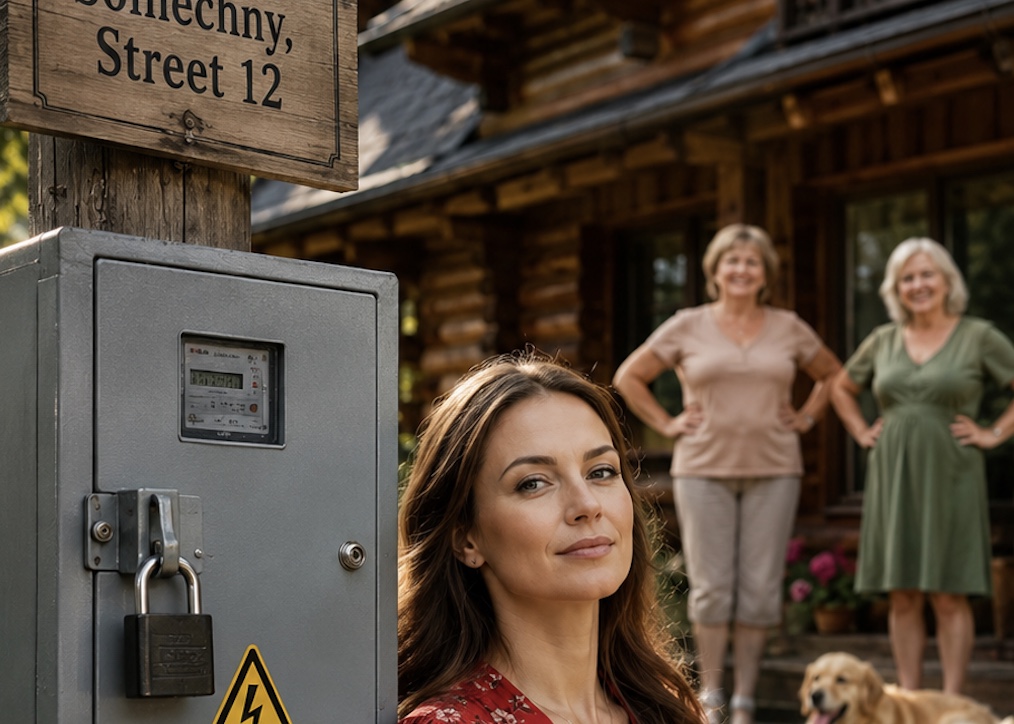
She left the house, but instead of heading to the summer kitchen, she walked toward the tall metal gate. Once outside, she approached the concrete utility pole where the gray metal electricity meter box was mounted.
The entire infrastructure of her house depended on electricity. Without power, the well pump would not work — which meant there would be no water in the house. Without water, the toilet and shower would be useless. The powerful modern refrigerator, now packed with marinated meat and delicacies for the party, would soon become nothing more than a useless cabinet.
Elena took a small triangular key from her keyring. She opened the panel door. Inside, the circuit breakers stood in an even row. She reached for the main two-pole switch that cut power to the entire property.
The click rang out in the night air, dry and sharp.
At that very second, the lights vanished from the windows of the house. The music on the veranda crackled and died. A dissatisfied murmur of voices spread across the yard.
Elena took a padlock from her pocket — one with a hardened shackle, which she had bought a couple of months earlier for the shed but had never used. She threaded it through the metal loops on the door of the electricity box and snapped it shut.
Now, without an angle grinder or a heavy crowbar, no one could open the panel and turn the power back on.
She got into her car, started the engine, and calmly drove back toward the city.
Her city apartment greeted her with silence and cool air. Elena made herself a cup of hot tea, curled up on the sofa, and turned on her favorite series.
Her phone vibrated on the table. Her husband’s name lit up on the screen.
She declined the call.
He called again. Then again.
Elena leisurely finished her tea before answering.
“Lena! Where are you?” Viktor’s voice was breaking with panic. “The power went out! In the whole house! And there’s no water! The pump isn’t working!”
“Really? How unfortunate,” Elena replied in a perfectly even tone.
“The neighbors have power. Only ours is gone! Galya can’t use the toilet because there’s nothing to flush with! The fridge is leaking, and there’s meat in there worth five thousand! I went to the pole, and the panel is locked with some huge padlock! Where are the keys?”
“I have no idea, Vitya. Maybe the electricians from the board put it there. They had an inspection last week.”
“So what are we supposed to do? The guests are sitting in the dark! Svetka is furious, her birthday is ruined! Call the chairman and tell him to send an electrician immediately!”
“Vitya, it’s eleven o’clock at night. Friday. The local electrician, Mikhalych, is probably already asleep with his phone turned off. You’ll have to wait until Monday.”
“Until Monday?” Galina’s outraged shriek came through the receiver, apparently standing right beside him. Then the phone was snatched away. “Lena, are you mocking us? How are we supposed to stay here for three days without water or electricity? We have a house full of people!”
“Well, you came to enjoy nature, didn’t you? So enjoy it. Fresh air, romance, candles. In an emergency, there are facilities in the forest beyond the fence. And I’m going to bed. I’m tired. Good night.”
Elena ended the call and switched her phone to silent mode.
Saturday morning began beautifully.
For the first time in a long while, Elena slept peacefully, without jolting awake to the sound of dishes clattering in the kitchen. She made herself breakfast at an unhurried pace, went to a beauty salon, and took a walk through the shopping center.
Her phone showed thirty-two missed calls from her husband, mother-in-law, and sister-in-law.
Closer to noon, a long message arrived from Viktor:
“This is unbearable. There’s no water at all. You can’t go into the bathroom — it stinks through the whole house. The food spoiled, we had to throw everything out. Sveta’s guests left angry in the middle of the night. Mom is crying, her blood pressure went up from the heat, and we can’t turn on the air conditioner. The electrician isn’t answering. We’re packing our things and going back to the city.”
Elena smiled.
She knew that pampered city people, used to enjoying every comfort at someone else’s expense, would not last even a full day without basic conveniences.
That evening, the key turned in the lock of the city apartment. Viktor stood in the doorway — gloomy, exhausted, and dirty. He smelled of smoke and sweat.
“You did it on purpose,” he said. It was not a statement. It was an accusation. He threw his bag onto the floor. “Mikhalych called me back today. He said he didn’t put any locks on anything. This was your doing. You humiliated us in front of everyone. Mom had to call an ambulance when we got back to the city.”
Elena was sitting in an armchair with a book. She closed it and looked at her husband with a long, steady gaze.
“Yes, Vitya. I did it. My husband’s relatives took over my dacha, so I simply turned off the power. I decided that if you all think it’s acceptable to send me to sleep in a shed in my own house, then basic comforts must not be necessary for you either.”
“You’re a cruel, selfish woman!” Viktor exploded. “They’re family! This could have been handled like normal people! With words!”
“I tried using words for a month and a half. None of you heard me. You only heard your own wishes. You trampled my lawn, ate my food, occupied my bed, and made me feel like a servant. That ends now.”
“And what now?” he asked, twisting his lips angrily. “Mom said she will never set foot there again!”
“Wonderful. That is exactly the result I wanted.”
Viktor breathed heavily, ready to unleash a flood of accusations, but when he saw his wife’s cold, determined face, he stopped. Suddenly, he understood that the old compliant Elena was gone. Sitting in front of him was a woman prepared to go all the way to defend her territory.
He turned around and went into the bathroom.
On Sunday morning, Elena drove back to the countryside.
The property greeted her with silence. The house looked messy after the invasion of guests; plastic cups were scattered across the veranda. But the air was clean, and no one was buzzing in her ear.
She walked to the concrete pole, opened the heavy padlock with her key, removed it, and flipped the main switch back on.
Inside the house, the revived microwave chirped happily. The pump hummed, filling the system with life-giving water.
Elena called the chairman of the dacha cooperative.
“Pyotr Ilyich, good morning. I need the number of the welding crew that installed the entrance gate for you. Yes, I want to cut off the old gate and install a new one — solid, thick metal. With a reinforced electronic lock.”
After getting the contacts, she called the head of the local private security company, whose post stood at the entrance to the settlement.
At noon, a sturdy man in camouflage drove up to her property. Elena handed him the signed contract for alarm monitoring and gave him a shiny magnetic key to the new gate, which the workers were scheduled to install the very next day.
“Listen carefully, Sergey,” Elena said, looking the guard straight in the eye. “This key stays only with you at the post, for emergencies. My house will be connected to the alarm system. Anyone who tries to open the gate, climb over the fence, or enter the property without my personal presence and without the alarm being disarmed by me is considered an intruder. Relatives, husbands, friends with excuses like ‘we only came to water the flowers’ — it doesn’t matter. You call the rapid response team immediately. Understood?”
The guard nodded seriously and put the key into his breast pocket.
Elena stood on the veranda and watched the security vehicle disappear at the end of the street.
Ahead of her lay a deep cleaning, the removal of other people’s belongings, and a long, difficult conversation with her husband about boundaries and the future of their marriage.
But right now, breathing in the fresh scent of pine warmed by the sun, she felt for the first time in a long while that she was the rightful owner of her home — and of her life.