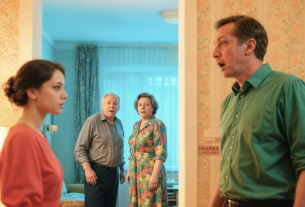
“You’ll stay with your mother for a couple of months. My brother needs the apartment,” her husband announced while carefully spreading liver pâté over a crisp slice of toasted baguette.
Vera froze beside the stove, a wooden spatula still clutched in her hand. Only a moment earlier, the kitchen had felt warm and comfortable, filled with the aroma of coffee, bacon, and fried eggs. Now the air seemed thick and oppressive.
At forty-two, Vera had spent fifteen years working as a pharmacist before becoming the manager of a large branch in a nationwide pharmacy chain. She was accustomed to emergencies, demanding customers, surprise inspections, and sudden shortages of essential medication.
But nothing in her professional experience had prepared her for a statement like this from her own husband.
Kirill, forty-five, sat at the breakfast table wearing a perfectly pressed pale-blue polo shirt. He always looked as though he had just stepped out of a menswear advertisement.
Kirill described himself as a serial entrepreneur and investor. In reality, that meant that every few years he became obsessed with another brilliant business idea. First came vending machines selling terrible coffee, then imported phone cases from China, followed by a failed attempt to distribute luxury bathroom fixtures.
Every venture ended the same way: collapse, unpaid bills, and new debts.
Throughout their marriage, Vera had carried the family financially.
“I’m sorry. What did you just say?” she asked calmly, switching off the burner. “You expect me to move into my mother’s tiny one-room apartment on the edge of the city so your brother Anton can live in my home?”
“Verochka, why do you always have to use that managerial tone?” Kirill complained, taking a sip from his oversized ceramic mug. “Anton is going through a difficult period. He needs a chance to reset his life and figure out what he wants. He can’t keep renting miserable little rooms.”
He leaned back as though his proposal were perfectly reasonable.
“Your mother has a sofa bed anyway. We’re family, Vera. Families are supposed to help each other during difficult times. I promise it’ll only be for two months at most. Anton will find a job, get back on his feet, and move out.”
Vera lowered herself into the chair opposite him.
The spacious, sunlit three-bedroom apartment belonged entirely to her. She had bought it before she ever met Kirill.
For ten years, she had paid the mortgage by working double shifts, weekends, and public holidays. She had gone without vacations, fashionable clothes, and countless small pleasures. She had personally selected every roll of wallpaper and every bathroom tile. She had also paid for the renovation team herself.
Kirill had moved in after their wedding with a single suitcase.
Since then, he had treated the comfort she had created as though it had appeared by magic.
“Kirill, my patience has limits,” Vera said, looking directly into his eyes. “Your brother is thirty-eight years old. His difficult periods seem to happen every spring and every autumn. I am not leaving my own home. If Anton has nowhere to stay, he can move back in with your mother in the suburbs. This discussion is over.”
She stood, picked up her handbag, and headed toward the hallway. She needed to open the pharmacy.
During the entire drive to work, Vera replayed the absurd conversation in her mind. The request itself was outrageous, but what angered her most was the effortless confidence with which Kirill had tried to dispose of her property and disrupt her life.
The pharmacy welcomed her with its familiar mixture of antiseptic cleanliness, medicine, and sweet iron-rich health bars.
Vera put on her spotless white coat, checked the cash registers, and greeted the employees beginning their shifts. Work had always calmed her. Outside, the city moved in constant noise and disorder. Inside the pharmacy, everything had its proper place among the neat rows of tablets, syrups, ointments, and medical supplies.
She advised elderly customers on affordable alternatives to expensive blood-pressure medication, accepted new deliveries, checked expiry dates, and reviewed the stock records.
Still, she could not stop thinking about Kirill’s strange behavior.
Kirill rarely cared about anyone except himself. His sudden devotion to his brother felt suspicious.
Anton arrived for dinner on Thursday evening without calling first.
He brought nothing with him except the smell of cheap cigarettes.
He was almost the complete opposite of his older brother. Anton slouched when he walked, rarely shaved, and wore faded jeans with a stretched-out sweater. Vera had prepared pork chops and roasted potatoes. Anton dropped into a chair as if he owned the place, loaded three enormous pieces of meat onto his plate, and began eating greedily.
“Hey, Kir,” Anton said through a mouthful of food as he poured himself some fruit drink. “Is the balcony insulated?”
Kirill’s fork paused in midair.
“I was thinking my corner sofa probably won’t fit in the living room,” Anton continued. “I might have to put it on the enclosed balcony. I’ll store my winter tires there too.”
Vera, who had been loading plates into the dishwasher, slowly turned around.
“What sofa, Anton?” she asked. “Why would you bring large furniture here when Kirill said you were only staying for two months with one suitcase?”
Anton stopped chewing.
He gave his brother a strange, uncertain look.
Kirill coughed quickly, and red blotches spread across his neck.
“Verochka, Anton is just imagining things,” he said, nervously twisting the edge of the tablecloth between his fingers. “He hasn’t decided what to do with his furniture. Maybe he’ll sell it. Right, Anton? You’ll probably sell it.”
“Yeah. Probably,” Anton muttered, lowering his gaze to his plate.
But Vera clearly saw the tense look that passed between the brothers.
That night, she remained awake for hours.
She lay in the darkness listening to Kirill’s steady breathing while analyzing everything that had happened. Years of managing employees and solving workplace crises had sharpened her instincts. Those instincts now told her that something much larger was unfolding behind her back.
Winter tires and a massive corner sofa had nothing to do with a temporary stay.
People did not move their entire lives somewhere for two months.
The answer appeared two days later on Saturday morning.
Kirill had gone to an auto shop for an oil change in the car Vera had purchased on credit and registered in her own name, even though her husband was the only one who regularly drove it.
While he was away, Vera decided to clean his office.
As she dusted one of the shelves, she accidentally knocked over his thick leather document folder. Its clasp was broken, and a pile of papers spilled across the parquet floor.
Vera crouched to gather them.
Then she noticed a familiar surname.
The first document was a handwritten acknowledgment of debt in Kirill’s sprawling handwriting. As Vera read it, an icy feeling spread through her body.
The document stated that Kirill had borrowed eight million rubles from his brother Anton to fund a business involving the parallel importation of foreign cars.
The repayment deadline had expired six months earlier.
Attached to the acknowledgment was a copy of a property-sale agreement.
Anton had sold his only one-bedroom apartment to provide Kirill with the money.
Then Vera discovered the third document.
It was an unsigned draft of a preliminary agreement to sell Vera’s apartment—the very apartment in which she was standing.
According to the document, the seller agreed to transfer ownership to the buyer within three months.
The pieces fell into place immediately, revealing the full truth with brutal clarity.
Kirill’s car-import business had failed.
Anton, now without a home and without his money, had begun demanding repayment.
Kirill had therefore invented what he considered a brilliant solution. He planned to move Anton into Vera’s apartment not for a few months, but indefinitely, hoping to keep him quiet.
At the same time, Kirill was preparing to sell Vera’s home.
He must have intended to persuade, deceive, or pressure her into signing the documents, perhaps by claiming that they were buying a country house or moving to a more prestigious neighborhood.
The proceeds would then be used to cover his enormous debt.
Meanwhile, Vera would be sent to live with her mother, conveniently removed from the apartment while the brothers completed their scheme.
Her hands trembled as she photographed every page with her phone.
She did not cry.
There was only a cold, controlled fury burning away the last traces of affection and every illusion she had ever held about her marriage.
She carefully returned the papers to the folder, placed it back on the shelf, and went to the kitchen to make strong coffee.
The following day, Vera took a few hours away from work and met with a lawyer.
The experienced older attorney examined the photographs on her phone and nodded with quiet satisfaction.
“You have no reason to panic, Vera Nikolaevna,” he told her. “The apartment was purchased before the marriage, which means it is your separate and indivisible property. No preliminary sales agreement has legal force without your personal signature.”
He enlarged one of the photographs and continued.
“Your husband’s debt is also his personal responsibility. He signed the acknowledgment alone, and you did not provide notarized consent for the loan. Legally speaking, you are protected.”
The lawyer removed his glasses.
“However, from a personal standpoint, I strongly recommend separating from a man who is willing to do something like this.”
On Sunday evening, Vera prepared an impressive dinner.
She baked fish with rosemary, made an elaborate seafood salad, and placed crystal glasses on the table.
When Kirill returned home, he rubbed his hands together happily. He loved elaborate meals, especially when his wife paid for everything.
Anton arrived soon afterward, drawn by the promise of another free dinner.
The brothers ate enthusiastically, joked, and discussed sports.
Vera did not touch her food.
She sat upright with her hands clasped together, silently observing them.
“Well, Verochka,” Kirill finally said, wiping his mouth with a napkin. “Have you spoken to your mother yet? When are you planning to move your things? Anton needs to know what date he can move in.”
Vera slowly rose from her chair.
She walked to the sideboard, retrieved a thick plastic envelope, and tossed it onto the center of the dining table between the half-finished plates of fish.
“I’m not moving anywhere,” she said in a calm, emotionless voice. “You are, Kirill. You and your brother. Preferably somewhere far away from my home.”
Kirill frowned in confusion.
He opened the envelope and pulled out the printed photographs of the debt acknowledgment and draft agreements.
The color drained from his face until his skin resembled old parchment. His fingers began to shake, and the pages slipped from his hands onto the tablecloth.
Anton stretched his neck to see them.
His eyes widened.
“What is this?” he rasped, pointing at the draft agreement for the sale of the apartment. “Kirill, you told me your wife had agreed to sell this place and repay me! You said she was only pretending to resist!”
“So that’s the story you told him,” Vera said with a bitter smile, crossing her arms.
She looked Kirill up and down with open contempt.
“You remind me of Samokhvalov from the film Office Romance. Always perfectly dressed, always smiling, always trying to impress everyone. But underneath it all, there is nothing except cowardice, dishonesty, and the desire to live at someone else’s expense.”
“Vera, listen to me. This isn’t what you think!” Kirill stammered as he jumped to his feet. His voice rose into a frightened squeak. “Those are only drafts. I was considering different options. I’m experiencing temporary problems with logistics. The suppliers betrayed me!”
He reached toward her.
“We’re a family. We have to stand together. You’re an intelligent woman. You understand what could happen to me if I don’t repay the money.”
“I don’t care what happens to you,” Vera replied coldly. “You took money from your own brother and left him without a home. Then you decided to repay him with my apartment—the apartment I bought with my labor, my health, and years of sleepless nights.”
Her gaze moved from one brother to the other.
“Both of you treated me like a resource. A free source of money, food, housing, and security.”
Anton leapt to his feet and grabbed Kirill by the front of his shirt.
“You lying piece of filth!” he shouted, spraying saliva. “You promised me a share in the company! You said I would live here like a king until we bought me a new three-bedroom apartment! Where are my eight million?”
A ridiculous fight erupted.
The brothers wrestled across the expensive rug, knocking over a chair and smashing a crystal glass. They cursed each other, dragged up childhood grievances, and blamed one another for every failure in their lives.
Vera watched the humiliating spectacle with disgust.
How had she spent so many years living beside this man?
How had she convinced herself that his laziness and selfishness were simply part of his journey to find his true purpose?
“Enough!” Vera roared so loudly that her throat hurt.
Both men froze, breathing heavily.
“You have exactly one hour,” she said. “Pack your belongings and leave. Go to your mother’s house, a hotel, the train station—I don’t care.”
She pointed toward the hallway.
“If you are still here in sixty minutes, I will call the police and report an attempted fraud. Tomorrow, I will also send copies of these documents to the tax authorities. They may be interested in discovering where Anton obtained eight million rubles.”
Kirill immediately changed tactics.
He dropped to his knees and crawled toward Vera, trying to grab her hands. He begged for sympathy, sobbed genuine tears, and swore he would take any job, even loading trucks, to repay everything.
But the old manipulations no longer worked.
The button that once activated Vera’s guilt had been permanently destroyed.
She stepped away from him in disgust and pointed toward the door.
An hour later, the heavy front door slammed behind both brothers.
Vera turned the key twice, walked into the kitchen, poured herself a glass of cold water, and approached the window.
An extraordinary, healing silence settled over the apartment.
The enormous burden of another person’s irresponsibility—the burden she had carried for years—had finally fallen from her shoulders.
Seven months passed.
Vera’s life changed completely.
The divorce was quick and uncomplicated. There was nothing to divide because the valuable property belonged to her, and the court ruled that Kirill’s debts were his personal obligations.
Vera redecorated the apartment and replaced the furniture that reminded her of her former husband.
After reviewing her outstanding performance, the pharmacy chain promoted her to regional director. She began traveling for business, earned an excellent salary, and finally allowed herself to take a real seaside vacation for the first time in years.
She looked younger and healthier. The chronic pain in her back disappeared along with the constant nervous tension, and a confident brightness returned to her eyes.
Her former relatives were not nearly as fortunate.
Kirill and Anton rented a tiny room in an old communal apartment on the outskirts of the city.
Anton sued his brother to recover the money. Kirill was forced to take a low-paying position as a delivery driver, and half of his salary went toward repaying the debt.
The brothers argued constantly and despised each other, but neither could afford to move elsewhere.
Kirill tried to contact Vera several times.
He waited outside her company’s main office holding cheap carnations in his hands. He complained about his miserable life, his stomach problems, and the fact that Anton would not let him sleep peacefully.
He tried to remind Vera of the supposedly happy years they had shared when they were younger.
Vera merely looked through him with complete indifference, stepped into her taxi, and continued with her day.
She had learned the most important lesson of her life:
Never allow parasites to feed on your labor while disguising their exploitation as family duty, loyalty, or some grand personal destiny.
Vera now lived entirely by her own rules, enjoying every day of her new, independent, and genuinely happy life.