Zlata sat at the kitchen table with a cup of cold tea and read the will again. Her grandmother had left her six hundred thousand rubles. It was not a fortune, of course, but for Zlata it was real money. For the past two years she had been saving every spare kopek from her salary as a teaching coordinator at an education center, but she had never managed to put away more than eighty thousand. And now, suddenly, she had a chance to make her long-standing dream come true.
Daniil walked into the kitchen, stretching after his afternoon nap. He worked as a sales manager at a large company and earned quite well, around ninety thousand a month, but money always seemed to slip through his fingers. They paid the mortgage on their two-room apartment together, although the apartment officially belonged only to him. It had been registered in his name before the wedding, back when Zlata had only just moved to Moscow from Kostroma.
“Listen, I’ve been thinking,” Zlata began, putting the papers aside. “Do you remember that dacha we looked at last year? The one in the Ramenskoye district, near the lake?”
Daniil poured himself some filtered water and shrugged.
“Yes, I remember. So what?”
“It’s still for sale. I called yesterday. They’re asking four hundred and eighty thousand. With my inheritance, I’ll have enough.”
Her husband grimaced and rubbed the bridge of his nose.
“Why do you need that wreck? You saw it yourself. The roof leaks, the veranda is about to collapse, the wallpaper is peeling off the walls.”
“I’ll fix it,” Zlata said, straightening her back as something tightened inside her at his tone. “I still have my own savings too. That’ll be enough for materials at first. Then I’ll do the rest little by little.”
“Little by little,” Daniil repeated mockingly with a snort. “Do you even understand how much work that is? I want to rest on weekends, not hammer nails.”
Zlata swallowed the hurt and tried to smile.
“I’ll do it myself. I’ll hire people for the difficult parts. Dania, please understand, it would be our place. Somewhere to relax. Somewhere for our future children.”
Daniil scoffed, but he did not argue further. That evening, Zlata called the seller and arranged a meeting. A week later, the dacha was officially registered in her name. She was the sole owner. Zlata insisted on that deliberately, remembering how her friend had lost half an apartment after a divorce, even though she had paid for it alone.
The plot really was in a beautiful place. A pine forest came almost right up to the fence, and a small lake shimmered just a five-minute walk away. The house was old, built in the 1950s, but solid. It had simply been neglected. Zlata walked through the rooms and could already see what it would become: light walls, new windows, cozy furniture on the veranda.
On the first weekend in May, Zlata arrived with tools and building materials. She hired a crew to replace the roof, because that was beyond what she could handle herself. Fifty-eight thousand went on the roofing alone, but at least she would no longer have to place buckets under the leaks. While the workers were busy above, Zlata stripped off the old wallpaper and scrubbed years of dirt from the floors.
Daniil came rarely. The first time, he glanced at the mess and said the smell of paint was giving him a headache. The second time, he did not even get out of the car. He called her while she was already at the dacha and said he had changed his mind because he was tired after the working week. Zlata did not take offense. Or rather, she tried not to. After all, it had been her idea, her dream.
Daniil’s parents, Nina Stanislavovna and Rostislav Valeryevich, lived in their own three-room apartment near Yugo-Zapadnaya. Nina Stanislavovna worked as the head of a kindergarten, carried herself with dignity, and loved giving advice. Rostislav Valeryevich had long been retired, a quiet man who preferred not to interfere in his wife’s conversations.
One day at the end of May, her mother-in-law came to see the dacha. Zlata was painting the window frames white at that moment. Nina Stanislavovna stepped out of the car in a light trouser suit and heeled shoes, looked around, and pressed her lips together.
“My goodness, Zlatochka, what a dump you have here,” she drawled, stepping around a puddle. “Do you seriously think anything good will come of this?”
Zlata wiped her hands on her old T-shirt and tried to smile.
“It will, Nina Stanislavovna. It just needs time. The roof has already been replaced, and the windows are next.”
Her mother-in-law walked across the veranda, trying not to touch the railing, then peeked inside the house.
“What a nightmare. Such a waste of money. You would have done better investing it in renovating our apartment. Danichka spent his childhood there, after all. It’s the family nest.”
Zlata tightened her grip on the paintbrush, feeling her temple begin to throb. But she said nothing. Nina Stanislavovna wandered around for another ten minutes, criticized the placement of the garden beds, and left without properly saying goodbye.
After that visit, Zlata worked even harder. Every Saturday and Sunday she went to the dacha at dawn. She had the old wiring replaced and paid an electrician eight thousand rubles. She painted the walls in the living room and bedroom herself in the evenings after the workers left. She bought linoleum, wallpaper, and paint at the hardware store, all with her own money, saved from her salary. Forty-two thousand a month did not leave much room for luxury, so Zlata cut back on everything. She stopped buying new clothes, gave up beauty salons, and cooked at home instead of ordering food.
Daniil appeared occasionally, usually in the evening, when the main work was already finished. He would sit in a deck chair, scroll through his phone, and say something like, “It’s coming along nicely.” Once, he helped bring new furniture into the house. Zlata had bought a sofa and two armchairs on sale. But for the most part, her husband excused himself with tiredness, important errands, or meetings with friends.
Daniil’s younger sister, Valeria, showed no interest in the dacha either. She was thirty, married, and had two children: five-year-old Artyom and three-year-old Veronika. She lived in a rented two-room apartment in northern Moscow. Her husband worked as a programmer and earned well, but they still did not have enough for their own property. Valeria asked Daniil a couple of times how Zlata’s dacha was coming along, but she never came herself. She said she had no time because of the children.
Three months of hard work passed. August had only just begun, but the dacha was unrecognizable. The walls of the house were freshly painted light blue, the window frames were snow-white, and the roof had new shingles. The veranda had been lined with wood, varnished, and now shone in the sun. In the garden, Zlata planted flower beds with petunias and marigolds, and hydrangea bushes along the fence. She bought a ready-made gazebo. Workers assembled it for five thousand, but the result was worth it. It was white, delicate, with benches and a little table inside.
Zlata stood in the middle of the yard, wiping sweat from her forehead, unable to believe she had done all this herself. Well, almost herself. Workers had helped with the roof, the wiring, and the heavy things, but she had done the main work with her own hands. Painting, wallpapering, cleaning, landscaping — all of it had cost her sleepless nights and weekends without rest.
Inside, the house smelled fresh and clean. There was new wood-patterned linoleum in the living room, pale wallpaper with a subtle pattern in the bedroom, and white tiles in the small kitchen. Zlata bought a set of bed linen, hung light curtains on the windows, and placed books and a few framed photographs on the shelves. Now it was a real cozy little nest.
On the first Saturday after finishing all the work, Zlata came to spend the night. She simply wanted to rest, enjoy the result, read in the gazebo, and listen to the sound of the pine forest. Daniil had promised to come in the evening, but later wrote that he was stuck at work. Zlata was not upset. She had grown used to it.
She was just unpacking a bag of groceries when she heard the sound of a car. She went out onto the porch and froze. Rostislav Valeryevich’s silver Volkswagen had pulled up to the gate. Nina Stanislavovna stepped out in a summer dress and hat, followed by Rostislav Valeryevich himself carrying two large suitcases.
“Zlatochka, hello, my dear!” her mother-in-law called, waving with a wide smile. “Well, would you look at this! It’s completely transformed! I hardly recognize the place!”
Zlata slowly descended the porch steps, feeling her heartbeat quicken.
“Hello, Nina Stanislavovna. Good afternoon, Rostislav Valeryevich. Are you… staying long?”
Her mother-in-law laughed and waved her hand.
“For a month, dear! Rostislav and I decided the city is unbearably stuffy. So we thought, why not live in the fresh air for a while? It’s so beautiful here! The lake is nearby, the pine trees. Just what the doctor ordered for our health.”
Zlata blinked, trying to process what she had heard.
“But I… I was planning to rest here myself. I just finished the renovation and…”
“Well then, rest!” Nina Stanislavovna said, already walking toward the house and admiring the flower beds. “There’s enough room for everyone. The house is big, three rooms, I think. One for us, one for you. Rostislav, bring the suitcases!”
Rostislav Valeryevich silently picked up the luggage and headed toward the porch. Zlata stood rooted to the spot, not knowing what to say. Everything inside her tightened into a hard knot. This was her dacha. She had worked herself to exhaustion for three months, invested all her money, spent every weekend here, and now her mother-in-law and father-in-law had simply arrived and announced they were moving in?
“Nina Stanislavovna,” Zlata said, trying to remain calm, “maybe you should have called first? Asked me? I truly wasn’t expecting guests…”
Her mother-in-law turned, and her expression changed. The smile became colder.
“Guests? Zlatochka, we are family. What guests can there be? The dacha is family property, isn’t it? Daniil is my son, you are his wife, and we are his parents. Everything in a family should be shared.”
Zlata felt her cheeks begin to burn. She wanted to object, to remind her that the dacha had been bought with her money, that only her name was on the documents, but her tongue seemed glued to the roof of her mouth. She had never known how to argue with Nina Stanislavovna. Her mother-in-law always found a way to make her feel awkward, accusing her of disrespect or selfishness.
That evening, Zlata called Daniil. Her hands were trembling as she dialed.
“Your parents came to the dacha,” she said sharply, without even greeting him.
“So what?” her husband replied indifferently. “Mom called this morning and said they were planning to go. I said I didn’t see a problem.”
“You don’t see a problem? Dania, I spent three months breaking my back here alone! I spent all my money! This is my dacha, bought with my inheritance!”
“Oh, here we go again,” Daniil sighed irritably. “Mine, mine, mine. Are we a family or not? My parents want to rest in nature. What’s so terrible about that? Their apartment is hot, they don’t have air conditioning. Do you want them to suffocate?”
Zlata closed her eyes and counted to ten.
“I want people to ask me. Or at least warn me in advance.”
“Consider yourself warned. I’ll come by tomorrow after work.”
He hung up. Zlata threw the phone onto the sofa and went out onto the veranda. Twilight was falling over the garden, and the string lights in the gazebo, which she had hung two days earlier, were glowing softly. It was beautiful. Cozy. But she felt no joy. Only a dull hurt and helplessness.
Meanwhile, Nina Stanislavovna had already settled into the large bedroom, the most spacious room with a view of the lake. The very room Zlata had prepared for herself. Her mother-in-law unpacked her things into the wardrobe, hung an icon on the wall, and came out to the kitchen looking pleased.
“Zlatochka, where do you keep your bed linen? And do you have any good towels? Everything here looks rather old.”
Zlata silently took a set of linen from the cupboard. It was new, the one she had bought on sale for two thousand rubles — blue, with white flowers. She had planned to use it herself, but now she handed it over to her mother-in-law.
The next day, Sunday, another car pulled up to the dacha. A red Kia Rio stopped at the gate, and the children tumbled out — Artyom and Veronika. Then Valeria and her husband Igor got out as well. They also had suitcases.
Valeria hugged Zlata and beamed.
“Zlata, you’re amazing! I’m honestly shocked! Mom sent pictures, but in real life it’s like a fairy tale! We’ll stay with you for a month, okay? It’s impossible in the city with the kids — the heat, the stuffiness. And here there’s a lake, fresh air. Paradise for children!”
Zlata stood with a frozen smile, not knowing what to answer. A month. Valeria and her family for a month. Plus Daniil’s parents. Where was there supposed to be room for Zlata herself?
“Valeria, but there aren’t that many rooms here,” she tried to say.
“Oh, come on!” Valeria said, already dragging a suitcase toward the house. “One room will be enough for Igor, me, and the kids. We’re not picky. Igor, bring the bags!”
Igor, a quiet man of about thirty-five, nodded and picked up the luggage. The children ran around the yard, squealing with delight and demanding a swing. Zlata watched it all and felt something hot and heavy slowly building inside her.
Her dacha. Her money. Her labor. And now everyone was settling in as if it were a shared resort.
That evening, Daniil arrived. He sat down at the table on the veranda, where Nina Stanislavovna had already laid out dinner made from the groceries Zlata had brought for herself. Her husband looked pleased. His parents were nearby, his sister was there with the children — a family idyll.
Zlata approached him when the others had gone to their rooms.
“We need to talk.”
Daniil looked at her tiredly.
“About what?”
“About the complete chaos going on here. Dania, this is my dacha. I bought it with my money. I renovated it. And I did not give permission for all your relatives to move in.”
Her husband frowned and rubbed his face with his hands.
“Zlata, are you serious? My relatives want to rest. Their apartments are boiling hot. My parents don’t even have air conditioning, and my father doesn’t tolerate heat well. Valeria is struggling in the city with the children too. There’s space here, nature. What, are you being greedy?”
“I’m not being greedy!” Zlata’s voice broke into a shout. “I want to be respected! I want my opinion to be asked!”
“Well, I’m asking now. Are you against my family resting here?”
Zlata clenched her fists. The question sounded like a trap. If she said yes, she would look cruel and selfish. If she said no, she would accept that everyone could simply walk all over her.
“I’m against decisions being made without me,” she answered quietly.
Daniil waved his hand and stood up.
“Fine, don’t make a drama out of it. Everyone will stay for a week or two, rest, and leave. Just put up with it for a little while.”
He went into the house. Zlata remained alone on the veranda. She sat in the dark, listening to the crickets, and understood that she had been tired of putting up with things for a very long time.
The next day, something began that finally pushed Zlata over the edge. Nina Stanislavovna woke up early, walked around the house, and began rearranging the furniture. She moved the sofa in the living room closer to the window and turned the armchairs in a different direction. She took down the pictures Zlata had bought in a small gallery and replaced them with her own cross-stitched still lifes.
“Zlatochka, you don’t mind, do you?” her mother-in-law asked when she noticed her daughter-in-law standing in the doorway. “I just think it feels cozier this way. You did well, of course, but your taste is… well, a little unusual. The place needs to be refined a bit.”
Zlata stood and watched as Nina Stanislavovna took down her curtains — light, white, with lace — and pulled out her own from a suitcase: heavy brown curtains with flowers.
“This is my dacha,” Zlata said quietly.
“What was that, dear?”
“I said this is my dacha. My house. And I don’t like you changing everything without asking.”
Nina Stanislavovna turned around, her eyes narrowing.
“Zlatochka, I only want to help. To put things in order. Surely you won’t be offended by good advice?”
“I will be offended,” Zlata said, feeling her voice tremble. “Because this isn’t advice. This is…”
She did not finish. She turned around and left the house. She sat in the gazebo, gripping her head in her hands. Everything inside her was boiling. She wanted to scream, but she was afraid of seeming hysterical. She wanted to throw everyone out, but how? Daniil would definitely take his mother’s side. He always did.
Meanwhile, Valeria hung children’s drawings on the veranda, attached an inflatable pool to the fence, and asked Zlata to watch the children while she and Igor went to the store. Zlata silently nodded. She spent the whole day with Artyom and Veronika — feeding them, playing with them, changing their wet clothes after the pool. Valeria and her husband returned in the evening without even saying thank you.
A week passed like that. Zlata felt like a servant in her own home. She made breakfasts, cleaned up after everyone, and washed the children’s laundry. Nina Stanislavovna gave orders: sweep here, water that, buy this and that at the store. Valeria left the children with her and went to the lake to sunbathe. Daniil showed up in the evenings, ate dinner, and went to bed without noticing that his wife was on the edge.
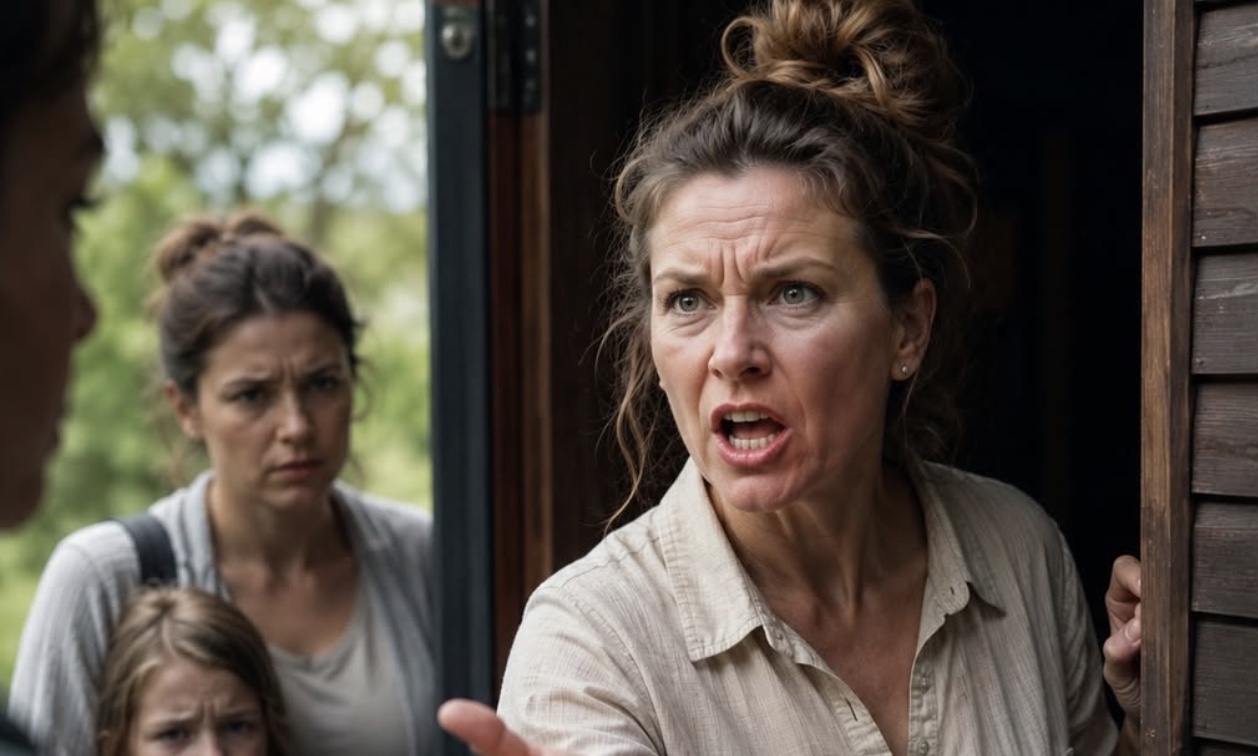
On Saturday, when everyone had gathered on the veranda for lunch, Zlata realized she could not take it anymore. She stood up from the table, straightened her back, and said loudly:
“I need to tell all of you something important.”
The conversations stopped. Nina Stanislavovna raised her eyebrows. Valeria looked up from her phone. Daniil grew tense.
“This dacha was bought with the inheritance my grandmother left me,” Zlata said, trying to speak firmly, though her hands were shaking. “I am the only legal owner. I spent three months renovating it. I invested all my money and all my strength. And I did not invite anyone to live here.”
“Zlatochka, what are you talking about?” Nina Stanislavovna frowned.
“I am asking all of you to pack your things and leave. Within the next few days. By Wednesday at the latest.”
Silence fell. Even the children went quiet, sensing the tension. Nina Stanislavovna slowly put down her fork, her face turning red.
“You’re joking, aren’t you?” her mother-in-law said in an icy voice.
“No. I’m serious.”
Nina Stanislavovna jumped up so sharply that her chair scraped backward.
“You have no right to throw out family!” she shouted, her voice rising to a shriek. “We are Daniil’s parents! We are your elders! You must respect us!”
“I do respect you,” Zlata said, standing still, although everything inside her trembled. “But this is my dacha. And I want to rest here myself.”
“Selfish!” Nina Stanislavovna jabbed a finger toward Zlata. “Greedy, heartless selfish woman! We are elderly people, we need fresh air, and you…”
“Nina Stanislavovna, you have an apartment in Moscow,” Zlata interrupted. “Buy an air conditioner. Or rent a dacha somewhere else. But this dacha is mine.”
Valeria jumped in, springing up from her chair.
“Zlata, are you out of your mind? We are family! The children feel good here. There’s fresh air, a lake! You want to force them back into the suffocating city?”
“I want people to ask me,” Zlata’s voice grew stronger. “I want my boundaries and my work to be respected. You came here without even asking my opinion. You rearranged the furniture, gave me orders, and dumped the children on me. I cannot do this anymore.”
Igor said nothing, staring down at his plate. Rostislav Valeryevich did not interfere either, only coughing quietly. Nina Stanislavovna was boiling with rage.
“Danechka!” she turned to her son. “Do you hear what your wife is saying? She is throwing us out! Your parents! Your sister with children!”
Daniil sat with his head lowered. Zlata looked at him, hoping that at least now he would support her. That just once, he would stand on her side.
“Mom, maybe it really wasn’t right to come like this… without warning,” Daniil muttered, but his voice was uncertain.
“What do you mean, wasn’t right?” Nina Stanislavovna exploded. “This is a family dacha! A shared one!”
“No,” Zlata said firmly. “It is not shared. It is mine. Only my name is on the documents. And I am asking you to leave.”
She turned and went into the house, leaving everyone on the veranda. A minute later, the shouting began. Her mother-in-law yelled, Valeria tried to prove something, and Daniil attempted to calm everyone down. Zlata locked herself in the small room she had originally planned to use as an office and sat on the windowsill. Her hands were shaking. Her heart was pounding. But inside, among the fear and hurt, there was something else. Relief. She had finally said what had been building up inside her for months.
By evening, the relatives began packing. Nina Stanislavovna slammed wardrobe doors demonstratively, threw towels into her bag, and shot hateful looks at Zlata. Valeria tried to persuade her sister-in-law to change her mind, but received a firm no. By night, everyone had left. Rostislav Valeryevich drove his wife away, and Igor took Valeria and the children. Only Zlata and Daniil remained.
The next day, her husband returned from work around nine in the evening. He entered the house, dropped his bag on the floor, and immediately attacked her.
“Are you out of your mind? Why did you put on that circus?”
Zlata stood by the window, looking out at the dark garden.
“I was protecting my territory.”
“Your territory?” Daniil came closer, his voice rising. “Do you understand what you’ve done? Mom is in tears! Valeria is offended! My parents have nowhere to rest now during the summer, their apartment is stuffy!”
Zlata turned around. Something inside her clicked. The last drop of patience had finally spilled over.
“Oh, they have nowhere to rest?” Her voice was quiet, but there was steel in it. “Then let them buy their own dacha instead of occupying mine!”
Daniil fell silent for a second, but then started again.
“You’re cruel! Heartless! They are family!”
“And what am I?” Zlata shouted, her voice breaking. “Am I not family? I worked here alone for three months! I carried bags of cement, painted walls, scrubbed floors! Where was your family then? Your mother wrinkled her nose at the dirt and left! Valeria never came even once! And you kept hiding behind your tiredness!”
“Oh, excuse me for working!” Daniil snapped. “Someone has to earn money!”
“I work too! And I bought this dacha with my own money! Not yours, not our shared money — mine! With my grandmother’s inheritance!”
Daniil clenched his fists, his face twisted with anger.
“There it is again! Mine, mine! Do you even understand what family means? Family means everything is shared!”
“Shared means everyone contributes,” Zlata stepped toward him. “Not one person working herself into the ground while everyone else shows up when everything is ready!”
The argument flared up again with new force. They shouted over each other, interrupted each other, and poured out everything that had accumulated over the years. Zlata spoke about how tired she was of carrying the whole household on her shoulders, how Daniil’s relatives did not respect her, how her husband never took her side. Daniil accused her of selfishness, greed, and disrespect for elders.
“You never support me,” Zlata finally exhaled, feeling tears rise in her eyes. “Never. You always take your mother’s side. She is always right, and I am always guilty.”
“Because you are guilty!” Daniil roared. “A normal wife would never throw out her husband’s parents!”
Zlata looked at him for a long moment. And suddenly everything became clear. Crystal clear. This marriage was built on inequality. Daniil would never protect her. He would never put her interests above his mother’s. She would always be second.
Without saying a word, Zlata went into the bedroom, took out a bag, and began packing his things. Daniil appeared in the doorway.
“What are you doing?”
She silently folded his clothes. Jeans. T-shirts. Everything neatly, methodically.
“Zlata, stop! What are you doing?”
“Leave,” Zlata said shortly, zipping up the bag.
“Don’t be hysterical!” Daniil tried to take the bag from her, but she pulled her hand away.
“This isn’t hysteria. This is a decision.”
“What decision?”
Zlata raised her eyes. Her face was calm, almost indifferent.
“There is no us anymore. I don’t need this marriage. Leave.”
Daniil froze. Then he laughed nervously.
“Oh, come on. Because of one fight?”
“Not because of one. Because of all of them together. Because you don’t see me. You don’t hear me. You don’t value me.”
“Zlata, wait! Let’s talk normally!”
“It’s too late to talk.”
“You’ll cool down, and then we’ll see.”
Half an hour later, Daniil got into his car and left. Zlata stood on the porch.
In the morning, she went to the city apartment, collected her things, and filed for divorce that same day.
Daniil called every day. At first, he demanded that she return, shouted, and blamed her. Then his tone changed. He started pleading, promising that everything would be different. He said he had talked to his mother, that she would no longer interfere in their lives. Zlata listened and understood that she did not believe him. How many times had he promised? Ten? Twenty? And every time, everything had gone back to the way it was.
“No, Dania,” she said calmly during yet another call. “I have made my decision. We are getting divorced.”
“But why? Because of the dacha?”
“Not because of the dacha. Because you don’t know how to be a husband. You only know how to be your mother’s son.”
She ended the call and blocked his number. Nina Stanislavovna also tried to reach her. She sent angry messages, accused Zlata of destroying the family, and demanded that she return her son. Zlata deleted all the contacts.
The divorce was finalized quickly, without property disputes. The apartment remained Daniil’s, because only his name was on the documents. The dacha remained Zlata’s for the same reason. Daniil tried to challenge ownership through a lawyer, claiming that the dacha had been bought during the marriage and should be divided in half. But Zlata’s lawyers proved that the money had come from her inheritance, and all receipts for the renovation were in her name.
When all the papers were signed, Zlata felt a strange relief. It was as if a heavy backpack had been lifted from her shoulders. She was no longer Daniil’s wife. No longer Nina Stanislavovna’s daughter-in-law. No longer a free babysitter for Valeria’s children. She was simply Zlata. Thirty-two years old, a teaching coordinator, and the owner of a small dacha in the Ramenskoye district.
While the legal process was going on, Zlata lived in a rented apartment. On the first Saturday after the divorce, she went to the dacha alone. It was autumn, the leaves had already fallen, but the weather was still warm. Zlata turned on the heating, brewed tea, and sat in the gazebo with a book. Silence surrounded her. Only the wind rustled through the pine trees, and birds called to one another.
For the first time in many months — no, in many years — Zlata felt true peace. No one was giving orders. No one was criticizing her taste. No one was dumping children on her and leaving for the lake. There was only her, her house, her garden, and her life.
She opened the book, but did not read. She simply sat there, listened to the silence, and smiled. Freedom turned out to be simpler than she had imagined. She only had to find the courage to choose it.