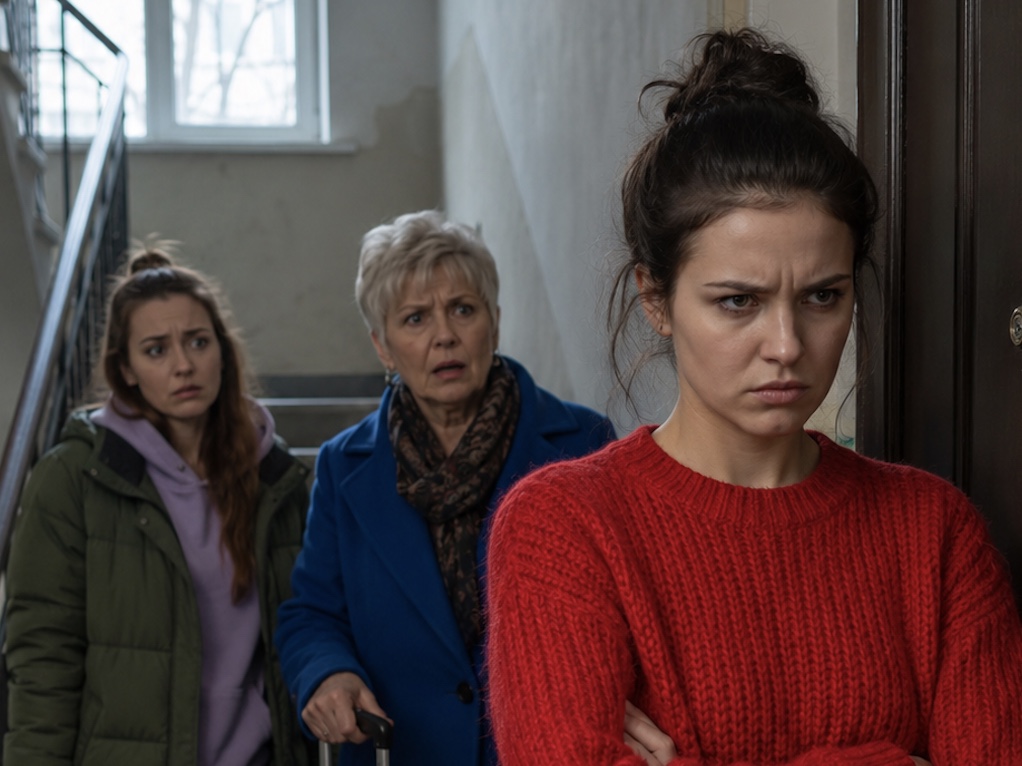
“Oh, so you finally showed up. Move aside, don’t stand there like a post. People are trying to work.”
Nadezhda didn’t move.
On the third-floor landing, two cardboard boxes were already stacked against the wall. A sofa had been rolled up and tied, and beside it stood a child’s writing desk covered with faded sticker marks. Elvira Ignatyevna, her mother-in-law, was directing the whole operation from below near the elevator, wearing a blouse with a ruffled collar and large amber clip-on earrings, as if she had come to a celebration rather than someone else’s staircase.
Nadezhda stepped out of her apartment, pulled the door closed behind her, and stood with her back against it.
“Bring it up, bring it up, men! Through the far door. The desk goes in the back room, by the window. Tyoma needs a place to do his homework.”
The senior mover, a man in a blue tank top who was already on his third trip up the stairs, set down a box and wiped his forehead.
“Ma’am, are you going to open the door or not? The key didn’t fit.”
“It will fit, it will,” her mother-in-law snapped, answering for Nadezhda. “My son lives here. She’s just with him.”
Nadezhda’s phone buzzed in her pocket.
Arkady.
“Nadya, listen… Mother called. She says Regina and the kids need to move in with us. Temporarily. I’ll come by and we’ll sort it out, yeah? The fish are biting like crazy here…”
Behind his voice, water splashed and someone laughed loudly. Her husband was “available” online, liking other people’s fishing photos, while strangers were unloading someone else’s sofa at his door.
Nadezhda put the phone away. She leaned against the door and watched unfamiliar men drag pieces of someone else’s life onto her floor.
The apartment was not “theirs.”
It was Nadezhda’s.
A three-room flat in a brick nine-story building, inherited from Aunt Klava five years before Nadezhda had even met Arkady. An inheritance. Properly registered. In one name only. Hers. A place like that in Ramenskoye was now worth around eleven million.
Arkady had moved in after the wedding with one suitcase and a temporary registration for three years.
Registration belongs at the door, not at the notary’s office, Nadezhda thought. Registration only says where a person sleeps. Ownership says whose place it is.
“Why are you standing there like an outsider?” Elvira Ignatyevna finally climbed onto the landing, breathing heavily and pressing one hand to her side. “Reginochka is cramped in Voskresensk, while you’ve got a whole palace standing half-empty. A woman of fifty, clucking over her papers in three rooms all by herself. No child, no grandchild. At least give the children some space. It won’t ruin you.”
Nadezhda lowered her hand into her pocket. Slowly.
“Clucking,” she repeated.
Not as a question. Just echoing the word.
“There, good girl, keep quiet,” her mother-in-law took it as agreement and immediately continued. “And move your refrigerator against the wall. Regina’s won’t fit otherwise. Tell Arkasha to take the wardrobe out of the far room. The children don’t need it.”
Elvira Ignatyevna was handing out rooms as if the landing had been issued to her by government order.
Her phone began to ring. She jabbed at the screen with a thick finger and lifted it to her ear, but her hands were unsteady — whether from the stairs or from excitement — and the call switched to speakerphone. Loud enough for the entire landing to hear.
“Reginochka! Where are you?” she shouted into the phone.
“I’m still at the bus stop, Mom!” Regina’s voice rang out across the stairwell. “The bus is late. You go in, don’t wait for me. When I get there, I’ll take the bedroom right away — the bigger one, the one with the balcony. My wardrobe goes by the window. Nadya won’t care anyway. She just sits there alone with her papers. Give her the storage closet and she’ll be happy.”
The landing went silent.
“Did you hear that?” Elvira Ignatyevna said, putting the phone away with satisfaction. “She said it herself. The bedroom is for Reginochka. You and Arkasha can manage in the small room for a while.”
“Move away from the door already!” Elvira Ignatyevna stepped forward and pulled a key from her bag. “We have our own! Arkasha made it six months ago. Just in case!”
She shoved the key into the lock.
Turned it.
The key didn’t move.
She tried again, harder this time, until her fingers turned white. The lock refused to give. The key kept hitting the cylinder and stopping, like a card rejected again and again by a turnstile.
“What did you do to the door?!” her mother-in-law cried, jerking the handle.
“I changed the lock cylinder three weeks ago,” Nadezhda said evenly. “After one family conversation. Your duplicate is just a piece of metal now.”
“Arkasha gave permission himself!” her mother-in-law shook the phone in Nadezhda’s face. “Look, he wrote it in the chat! Himself! In front of everyone!”
She stabbed at the screen and read aloud in triumph:
“‘Mom, start bringing things in slowly. Nadya will put up a show at first and then give in. She always does. I’ll come tonight and smooth everything over.’ You see? My son said so himself!”
Nadezhda looked at her own phone.
The same family chat.
The same message.
She took a screenshot without saying a word.
Regina came puffing up the stairs with a plastic bag in one hand, her face flushed. She walked past the boxes straight toward Nadezhda and stopped half a step away from her.
“Nadya, why are you being difficult?” she said right into her face. “The storage closet is more than enough for you. You just sit there with your numbers all day anyway. You don’t need much.”
Nadezhda did not answer Regina.
She took a key from her pocket, opened the apartment door, went inside, and returned a minute later with a thin document folder. She placed a sheet of paper on the windowsill by the elevator, face up.
“An extract from the property registry. Registration date: five years before the wedding. One owner. Me. Arkady’s registration is temporary and expires in October. Registration is only an address where a person sleeps. It can be cancelled.”
Regina bent over the paper.
Read the date.
Then stepped back.
Nadezhda took out her phone and made a call in front of both of them, without moving aside.
“Hello, Sergei Anatolyevich. This is Nadezhda from apartment thirty-four on Severnaya Street. There are strangers at my door with belongings. Their key didn’t fit, and now they’re demanding that I let them in. There’s a GAZelle parked in the yard. I am the owner. I did not give consent. I just wanted you to be aware. Just in case.”
She wasn’t calling for rescue.
She was putting someone on notice.
The difference between those two things was written across both women’s faces more clearly than any registry document.
Elvira Ignatyevna backed toward the boxes and lowered herself onto the one with the child’s desk inside, missing the edge at first before finding it. She stayed sitting there.
Then she changed tactics.
“Nadyushenka… how can you treat a mother like this…” Her voice sank, trembled, and slid into tears. “I only wanted what was best. My heart is weak, doctors told me I need peace, and Reginochka is suffering with the children… I’m a mother. A mother does everything for her children. I didn’t sleep nights, I raised them, stood them on their feet… and now you threaten me with the district officer.”
Nadezhda stood by the door.
She did not come closer.
She did not crouch beside her.
She did not bring her water.
“I have a heart too, Elvira Ignatyevna,” she said. “So load everything back.”
The senior mover looked at the paper on the windowsill, then at the old woman sitting on the box.
“So… who’s paying for this, ma’am?” he asked, addressing no one in particular.
No answer came, so he made the decision himself.
“Men, take it back down.”
And down they carried it all — the same boxes, the same rolled-up sofa, the same desk.
Going down was twice as fast.
Regina didn’t wait for the end. She hurried after them and caught up with the movers by the truck. When she saw her sofa back in the cargo bed, with the child’s desk on top of it, she exploded right there in the yard, under the blooming linden trees, in front of children on scooters.
“Mom! You said everything was settled! I already rented out my two-room apartment! The tenants move in on Monday! Where am I supposed to go with the kids now?”
“Reginochka, darling, I didn’t know Nadya would be so…” her mother-in-law babbled from the stairwell window above.
“You didn’t know?” Regina kicked the wheel of the GAZelle. “I took a deposit! Thirty thousand! Paid in advance!”
And that was how everyone found out: the apartment in Voskresensk had been rented out before anyone had asked the owner of the apartment in Ramenskoye.
Tyoma, the older boy, had been sitting on a bench by the entrance the whole time, headphones on, not once turning toward the scandal. Clearly, he had seen enough of that at home.
Aunt Zoya from the fifth floor, cracking sunflower seeds, watched the performance until the very last box disappeared. When the GAZelle drove away, she spat out a husk and said:
“Well, that’s something. Broad daylight, and people are dividing up an apartment they don’t even live in.”
Arkady arrived that evening.
With a brand-new fish finder worth eighteen thousand — the one he had bought instead of fixing the balcony as promised — and two perch in a bag.
“What did you all do here, huh?” he said from the doorway. “Mother is in tears. Regina won’t pick up the phone. Some family this is.”
Nadezhda placed a plate in front of him.
Beside it, she set her phone face up.
On the screen was his own message from the chat:
“Nadya will put up a show at first and then give in. She always does.”
“When are you fixing the balcony?” she asked.
Arkady looked at the screen.
Then at the plate.
Then dropped his eyes to his phone.
Two weeks later, Aunt Zoya caught Nadezhda by the elevator and, lowering her voice, reported the latest about Regina. The tenants in Voskresensk had moved in. The deposit was not returned. Four people couldn’t squeeze into her mother’s one-room apartment. Regina ended up renting a room in the same Voskresensk — for three times more than she would have paid in Ramenskoye. She was no longer speaking to her mother, offended that she had “ruined everything.”
Having delivered the report, Aunt Zoya went back to her sunflower seeds.
For a while, Elvira Ignatyevna kept calling — sometimes to cry, sometimes to reproach the “ungrateful daughter-in-law.” Arkady answered less and less often. Then he stopped altogether. Nadezhda saw it herself, right there in her own kitchen.
A month later, her mother-in-law tried a different approach: she asked Arkady to “talk to Nadya so she wouldn’t be angry,” and to tell her that she held no grudge and was ready to “forget everything.”
Arkady passed along nothing.
Not that time.
Not later.
He never fixed the balcony.
But the fish finder now gathered dust in the very storage closet that Regina had twice granted to Nadezhda — once over speakerphone and once to her face.
Nadezhda wrote down the license plate number of that GAZelle in the notebook she kept by the stove.
Just in case.