Anna was riding up in the elevator, feeling a dull, aching pressure squeeze her temples. The night shift in intensive care had drained her down to the last drop. The little girl they had brought in at three in the morning after she stopped breathing had never regained consciousness by sunrise. Anna had held that tiny hand in her own while the ventilator rhythmically pushed air into motionless lungs, and all she could think about was the silence waiting for her at home. Fresh renovations. The smell of new furniture. Dima, who had promised to unpack the boxes from the appliances.
She pressed her forehead against the cold mirror inside the elevator. She wanted only one thing: to lie down. To close her eyes.
The elevator jerked and stopped on the tenth floor. Anna stepped out onto the landing and took out her keys. The new keychain — her husband’s anniversary gift, a little silver fish — caught the light. She slipped the key into the lock of the expensive Italian door they had chosen just a month ago and tried to turn it.
The key would not move.
Anna frowned. She pulled it out, checked it, made sure it was the right one, and tried again. The lock was dead. She leaned closer and noticed fresh scratches on the shiny cylinder, as if someone had been digging at it with a screwdriver. Strange. Maybe Dima had broken his key and changed the lock? But why hadn’t he told her?
She rang the bell.
Behind the door came the chime, then footsteps. Slow. Heavy. Not Dima. Dima walked quickly, slightly dragging his slippers. These footsteps were confident, solid, deliberate.
The door opened.
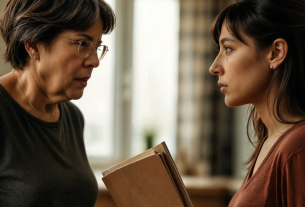
Tatiana Vasilyevna, her mother-in-law, stood on the threshold. She was wearing a bathrobe covered in large red poppies and holding a glass of red wine. Her hair was piled high, her lips painted, even though it was barely past noon. She smelled of that same “widow’s bouquet” — lily of the valley mixed with cigarette smoke. A scent Anna had hated from the very first time they met.
“Anya,” her mother-in-law sang, stretching the vowels. “What brings you here?”
Anna opened her mouth to answer, but her eyes were already darting past the woman’s shoulder. The hallway. On the coat rack, where Anna had hung her light coat yesterday, there now hung Tatiana Vasilyevna’s heavy wool overcoat, reeking of mothballs. Against the wall stood two huge checked suitcases — the very ones her mother-in-law used whenever she came “to stay for a week.” In the corner sat a box labeled, “Tanya, winter shoes.”
From the living room came the sound of the television. Some soap opera. A woman was sobbing on-screen, a man was making excuses.
“What is going on here?” Anna asked.
Her voice sounded hoarse, unfamiliar. Exhaustion drained away, replaced by a cold, ringing emptiness in her chest.
Tatiana Vasilyevna took a small sip of wine. She looked at Anna over the rim of the glass — calmly, appraisingly, the way one looks at an insect one has not yet decided whether to swat.
“You really don’t understand?” she said with a slight shrug. “This three-room apartment is mine now. And you, Anya, can go back to your parents. You and Dima have that communal flat in the center now, don’t you? Go live there. Dima agrees.”
Anna could hear her own breathing. Too loud. Too fast.
“Dima,” she called, and her voice cracked shamefully. “Dima, come out.”
Her husband appeared from the depths of the hallway. He came slowly, not looking at her. He stopped behind his mother and leaned one shoulder against the doorframe. Anna saw his face — the same face she had kissed every morning for eight years. The mole above his left eyebrow. The dimple in his chin. Now it seemed to belong to a stranger.
“Dima, tell her,” Anna said. “Tell her this is a joke.”
Silence.
Dima studied the pattern of the parquet floor. Anna followed his gaze. He was looking at the place where, yesterday, she had wiped up water after accidentally knocking over a vase of flowers. A faint stain remained. He was staring right at it.
“Dimon, answer your wife,” his mother said generously. “Why are you standing there like a stranger?”
Dima raised his eyes. Anna expected to see something there — shame, pain, pleading, defiance. But there was only emptiness. Smooth, calm emptiness. The emptiness of a man who had handed responsibility over to someone else and felt relieved by it.
“Mom is right,” he said quietly. “It will be better this way.”
Anna wanted to scream. She wanted to claw at that terry robe with red poppies, rip it off, and shove the woman out onto the stairwell naked. For a split second she imagined it — the shouting, the fight, the shattered glass. But her body, trained by years in intensive care to stay in control, reacted differently. Her hands dropped. Her face froze.
“Do you understand that this is my apartment?” she asked almost in a whisper. “My parents left it to me. You have no right.”
“Your parents are in the village,” her mother-in-law dismissed her. “What do they need a city apartment for? I’ll be here, close to Dima. I’ll look after my boy. You’re always at work anyway, Anya. What use are you? A barren flower.”
She stepped forward and, almost tenderly, moved Anna aside to clear her own path.
“By the way,” she added, glancing over her shoulder, “I called the district officer. And witnesses. Just in case. So you don’t start throwing hysterics and damaging property. I know all about modern wives.”
Behind Anna, the elevator doors opened.
She turned. A young district police officer with a dull, tired face stepped onto the landing. Behind him came a small man in a rumpled suit, apparently the witness. The man nervously twisted one of his buttons and tried not to look Anna in the eye.
“Anna Sergeevna?” the officer said, giving a half-hearted salute. “We received a call about possible disorderly conduct. It would be better for you to leave the premises, since the owner objects.”
“The owner?” Anna repeated.
The word cracked in her mouth like broken glass.
“Exactly,” Tatiana Vasilyevna said, adjusting her robe. “Dimon, see her out.”
Anna stood on the landing and watched the door to her apartment close. The Italian door. The expensive locks. The ones she had paid for with her own savings. The last thing she saw before the door shut was her husband’s hand resting on his mother’s shoulder. Gently. Almost intimately.
The door closed.
The new lock clicked.
Anna was left in the stairwell. In her jacket pocket lay a set of keys that no longer opened anything. In her palm was the keychain, the little silver fish. An anniversary gift.
She clenched it so tightly that the sharp fin pierced her skin. A drop of blood appeared.
No one noticed.
The district officer coughed politely and pressed the elevator button. The witness was already hurrying down the stairs, skipping steps. Anna did not move. She stared at the door and saw her reflection in it: a tired woman of thirty-three, in a wrinkled medical uniform, dark circles under her eyes and a drop of blood on her palm.
“Would you like me to call you a taxi?” the officer asked.
“No,” she said.
And she walked down the stairs.
Ten floors. One hundred and eighty steps. Each step hammered against her temples. On the third floor, she stopped, pressed her forehead to the cool wall, and stood like that for a minute. On the second floor, she took out her phone.
She did not call her parents.
She called work and said she was taking a day off.
In the car, parked outside the building, she sat behind the wheel and stared through the windshield. The courtyard was empty. The swings on the playground creaked in the wind. Anna sat and looked up at the windows of the tenth floor. The kitchen light was on.
She remembered moving into that apartment. She had been five. Her mother hanging curtains, her father assembling furniture. Her childhood had unfolded there. She had done homework sitting on the windowsill there. She had cried over her first love there. She had kissed Dima for the first time there.
She had thought that home was her fortress.
The fortress had fallen in a single morning.
Anna turned the ignition. The engine rumbled. She looked once more at the windows on the tenth floor and saw a shadow. A woman’s silhouette. Tatiana Vasilyevna stood by the window, looking down, and seemed to be smiling. Anna could not see her face, but she felt that smile on her skin. Sticky. Satisfied.
She pressed the clutch.
By the time the car pulled out of the courtyard, Anna had made a decision.
She would not cry.
She would not beg.
She would get back what was hers.
Or she would bring everything down to the ground.
The car sped along the ring road while memories flashed before Anna’s eyes. In eight years of marriage, she had learned to overlook many things. Or rather, not overlook them — only half-close her eyes. Enough not to see everything clearly, but still notice from the corner of her eye.
She remembered their first meeting.
A mutual friend’s birthday party. Dima had arrived with a bouquet for the birthday girl and the expression of a man who believed that bouquet was, at the very least, the key to the city. Tall, in an ironed shirt, with light stubble and a charming smile. He recited poetry from memory — not his own, but he delivered it as if he had just written it. Anna was finishing her residency then, exhausted and stretched to her limit. This handsome boy who spoke of lofty things had seemed like a breath of fresh air.
“I live with my mother,” he had said on their second date. “But it’s temporary. My mom is an iron lady. She threw my father out with nothing when he cheated. She achieved everything on her own. I respect her so much.”
The word “respect” had carried a special kind of reverence. Anna had thought it was wonderful. A grown man who valued his parents. A rare thing.
What an idiot she had been.
A month after the wedding, Tatiana Vasilyevna came “to stay for a couple of days” for the first time. A couple of days turned into three weeks. Her mother-in-law rearranged everything in the kitchen cabinets because, “Anya, you put things in such an inconvenient way. It’s all wrong.” She threw away Anna’s favorite cup because, “It was cracked, and cracked dishes bring poverty.” She cooked lunch, completely ignoring the fact that Anna was allergic to celery.
“I didn’t know,” she had shrugged when Anna broke out in a rash. “Dimonchik, look what’s wrong with your wife. Always some problem with her.”
Back then, Dima had spread his hands helplessly.
“Anya, she really didn’t do it on purpose. Don’t take offense. Mom is just like that. You have to accept her as she is.”
Accept her as she is.
Anna remembered that phrase.
It would become the refrain of their marriage.
Accept her as she is meant endure.
Accept her as she is meant stay silent.
She remembered how, three years earlier, Dima had quit yet another job. In eight years, he had changed jobs six times. In one place, “the boss was an idiot who didn’t appreciate talented people.” In another, “the team was full of schemers and fools.” Somewhere else, “the salary was an insult, not a salary.” His mother always supported him.
“Dimonchik, you are my golden boy. They’re just jealous. Don’t worry. The world will bend for us.”
The world did not bend.
Anna did.
She took extra shifts at the hospital. Worked nights. Picked up holiday duty. Meanwhile, Dimonchik was “searching for himself.” He lay on the sofa, watched motivational videos, and waited for his mother to bring him lunch.
The money for renovating the three-room apartment came from Anna’s parents. It had been their decision — to sell the old summer house and invest the money in their daughter’s home.
“This is for you,” her father had said then. “Your nest. Your mother and I will move to the village; the air is cleaner there. And you’ll build a family here.”
Build a family.
A year into the renovation, Anna realized she was building it alone. Dima “supervised the process” — meaning he sat in the kitchen with his mother while the workers drilled into the walls and discussed where to hang the television. Tatiana Vasilyevna showed up every weekend. She brought her own wallpaper. Her own tiles. Her own “design solutions” — tasteless, garish, but in her opinion, “how normal people do things.”
The climax had been the plumbing.
Anna had bought an expensive Italian sink and toilet. White, with smooth lines. She paid for them from her own salary. Three days later she came home and found cheap ceramic fixtures in the bathroom. Angular, with a bluish tint.
“What is this?” she had asked.
“Well, don’t be mad,” Dima had said, guiltily rubbing the back of his neck. “Mom said Italian plumbing is just paying for the brand. These are basically the same, just three times cheaper. She got them on sale and told me to return the other ones. I transferred the money back to your card.”
“You returned my purchase without asking me?”
“Anya, don’t start. Mom knows how to save money. It’s just a toilet. Let it go.”
Just a toilet.
“Just a toilet” had been the final straw after which Anna stopped arguing. But every time she entered the bathroom, it disgusted her. That bluish ceramic reminded her who the true owner of her home really was.
Now she sat in the car, staring at the road, replaying all those scenes like a worn-out record. How Dima had missed her father’s birthday because “Mom was lonely.” How at family dinners Tatiana Vasilyevna would loudly ask when grandchildren would appear. How once she had declared, “Anya, you’re over thirty. The clock is ticking. Dimonchik needs an heir.”
Children had not happened, and Anna suspected the problem was not with her. But her husband refused to see a doctor.
“I’m healthy,” he had snapped. “Mom says it’s all stress.”
Mom says.
Mom was always saying something.
And Dima listened.
He was not a bad person. He was empty. A shell from which some mollusk had sucked all life, leaving only the echo of his mother’s words inside.
Anna suddenly remembered something that had not seemed important at the time. About three years ago, in a rare moment when they were alone, Dima had suddenly said:
“You know, sometimes I think I’m nobody.”
Back then, she had laughed it off, turned it into a joke. She should have hugged him. She should have asked him what he meant.
Maybe then things would have turned out differently.
Or maybe not.
Because saving someone who does not want to be saved was the work Anna already did every day in the hospital. She did not have the strength to come home to a second shift.
She remembered lying awake after the plumbing incident, staring at the ceiling and thinking, “If we have a child, whose child will it be? Mine or hers? Whom will the child obey? Whom will the child smile at?”
She had never found an answer.
Now there was no need.
The car turned toward the old city center. Anna glanced at the navigator. The address her mother-in-law had mentioned led to a district of old tenement buildings. A communal apartment. The one where Tatiana Vasilyevna’s younger sister lived — a woman Anna knew only vaguely existed.
“The shame of the family,” her mother-in-law always said dismissively whenever the sister came up. “Drinks herself senseless. Don’t mention her. My heart is weak.”
A weak heart.
In a woman who had just thrown her daughter-in-law out of her own home with a police officer and witnesses.
Anna stopped outside an old, shabby building with crumbling plasterwork. The inner courtyard looked like a stone trap. It smelled of dampness and cats.
She turned off the engine, placed her hands on the steering wheel, and closed her eyes. In her mind, she saw the door to her apartment closing, and behind it — her husband and his mother. A family idyll.
“This three-room apartment is mine now.”
“We’ll see,” Anna whispered.
And she opened the car door.
The entrance hall greeted her with the smell of mold, fried fish, and something sour, like old rags. The walls had once been green, but the paint had peeled away, revealing gray plaster beneath. Worn linoleum covered the steps.
Third floor. High ceilings. A massive wooden door with a brass plate: “Communal Apartment 12.” There was no doorbell, so she had to knock.
For a long time, no one answered. Anna was already about to leave when shuffling sounded behind the door. A lock clicked. The door opened on a chain, and a face appeared in the gap.
A woman.
About fifty-five, but she looked older. A puffy face, bags under her eyes, thin dyed hair with gray roots showing. The smell of alcohol hit Anna’s nose even through the crack.
“Who are you looking for?” the woman asked, her voice hoarse and smoky.
“Are you Natalia? I’m Anna. Tatiana Vasilyevna’s daughter-in-law.”
The woman flinched. Fear flashed in her eyes, quick as a mouse darting across the floor.
“Did Tanya send you?” she backed away. “I didn’t do anything. I’m sober. Almost.”
“No,” Anna said, raising both hands to show she was unarmed. “No one sent me. I just need to come in.”
They looked at each other for a full minute.
Then Natalia removed the chain.
Inside, the communal apartment was a labyrinth. A long, dark hallway lined with doors, a shared telephone on the wall, a bicycle without wheels hanging under the ceiling for some reason, wired in place. It smelled of tobacco, old furniture, and that same sour odor.
“Come in,” Natalia said, waving toward the last door. “Quietly. The neighbors are sleeping.”
Natalia’s room was chaos: glass-fronted cabinets stuffed with dusty crystal vases, an old Singer sewing machine, a pile of old women’s magazines in the corner. On the table stood an opened bottle of cheap fortified wine and a faceted glass.
“Sit,” Natalia said, sweeping a stack of newspapers off a stool. “Want tea?”
Anna nodded.
She did not want tea.
She wanted information.
While Natalia fussed with the kettle in the shared kitchen, Anna looked around the room. On the wall hung a black-and-white photograph: two girls in school uniforms. One was tall, with an already commanding look. The other was small, frightened, hiding behind her sister’s back.
Tatiana and Natalia.
Fifty years ago.
Natalia returned with two mugs. The tea was cloudy and tasted faintly of rust.
“So Tanya got to you too,” the woman said with a crooked smile. “What did she do? Took your apartment?”
“How do you know?”
“Because she’s a maniac,” Natalia said, sipping the tea and grimacing. “She’s been like that since childhood. Anything lying around badly belongs to her. Anything lying around well also belongs to her.”
She coughed, wiping her mouth with the sleeve of her faded robe.
“You think this is the first time? Our three-room apartment in the Khrushchev building on the southwest side, where Tanya lives now — that was our parents’ apartment. There were three of us sisters. Me, Tanya, and Vera, the oldest. Vera died ten years ago. By then, Tanya had already had everything transferred to herself. Forged documents, bribed a notary. I tried to sue. Useless. She has connections everywhere. Then she had me sent to a psychiatric hospital for half a year. Said I was dangerous to society. An alcoholic.”
Natalia lifted her sleeve. Fresh bruises darkened her forearm, brown-yellow and clearly recent.
“That was Tanya yesterday. Came to check how I was settling in here. Told me not to welcome you if you showed up, or she’d rot me in the madhouse for good.”
“Why are you telling me this?” Anna asked quietly.
“Because I’m tired of being afraid,” Natalia slammed her mug onto the table. “I’ve been afraid for thirty years. Since childhood. When our father died, Tanya told me, ‘I’m in charge now. You obey, you live.’ And I obeyed. Everyone obeyed. Your Dimon isn’t bad, Anya. He’s empty. She drained him from childhood. From the womb, maybe. She breathes through him and feeds on him. He didn’t betray you. He just doesn’t have a self.”
Anna said nothing.
Her tea cooled in the mug.
“You won’t get the apartment back,” Natalia continued. “She has probably already started changing the documents. She has her own notary. But you can make her choke on that apartment.”
“How?”
Natalia stood. She went to the cabinet and rummaged through a drawer until she pulled out a yellowed folder tied with string.
“It’s all here. Copies. Contracts. Proof that Tanya forged Vera’s signature. Proof that she unlawfully had me declared incompetent. The whole scheme. I kept it in case I ever found the courage.”
“Why didn’t you take it to the police?”
“Who would care about me?” Natalia laughed bitterly. “A drunk from a communal flat? And she’s a respectable woman. Chairwoman of the building council. A single mother who raised her son. Who do you think they’d believe?”
She pushed the folder toward Anna.
“Take it. Maybe you’ll succeed.”
Anna took the folder. Inside were copies of documents, old letters, even an audio cassette marked: “Tanya. Conversation with the notary. 2008.”
“Why are you doing this?” Anna asked. “You understand that if I start this, Tatiana will come after you.”
Natalia looked directly into her eyes.
And for the first time during their conversation, she smiled — not with the bitter smile of an alcoholic, but with something alive, almost cheerful.
“Because before I die, I want to do at least one thing right,” she said. “I spent my whole life serving. First my father. Then Tanya. Then the bottle. Give me a chance to hit her back at least once.”
Anna tightened her fingers around the folder. The cardboard was rough and old. She felt something shift inside her. Pity? No. Something else. Something like respect.
“Thank you,” she said.
“Too early for that,” Natalia waved her off. “Go. And be careful. Tanya isn’t just a greedy woman. She’s a psychopath. She doesn’t need the apartment. She needs your pain. When you cry, she’s happy.”
Anna left the communal apartment with the heavy folder tucked under her arm. Evening was falling. A lonely streetlamp burned in the courtyard.
She sat in her car for a long time, looking up at Natalia’s lit window. Then she opened the folder, switched on the cabin light, and began to read.
By morning, she knew everything.
A week passed.
Anna did not rush into battle. In all her years in intensive care, she had learned one thing: the most dangerous patients are the ones whose blood pressure does not drop at once, but slowly, almost invisibly. If you want to win, you act the same way.
She rented a studio apartment on the other side of the city. She moved in the belongings that had been left in her parents’ basement. Documents, clothes, books. Friends called, offering help, but Anna brushed them off.
“I’m fine.”
She was not fine.
But she had no intention of explaining that to anyone.
She called her parents. Told them she and Dima had decided to live separately for a while, to “work on the relationship.” The lie made her sick, but the truth would have killed her mother. For now, she could not tell it.
A few days later, she called Tatiana Vasilyevna.
Her voice was calm. Almost affectionate.
“Tatiana Vasilyevna, it’s Anna. I’d like to come over.”
“Why?” suspicion cut through the older woman’s voice.
“I’ve been thinking. You’re right. I work too much, I’m never home. Dima deserves a better homemaker.”
Silence.
Clearly, Tatiana had not expected that. She had prepared herself for war, and here was unconditional surrender?
“I want to come and apologize,” Anna continued. “I’ll make jam. Cherry jam, the way Dima likes it. Remember, you gave me the recipe?”
That was a forbidden weapon. Tatiana was prouder of her cherry jam recipe than of her son. It had been passed down through generations.
“The secret ingredient is a pinch of cinnamon and a drop of cognac,” she loved to say.
“Well, all right,” Tatiana’s voice softened. “Come on Sunday. By lunchtime. We’ll see what kind of hostess you are.”
Sunday.
Anna stood before the familiar door with a jar of jam in her hands. Her heart was beating somewhere in her throat. She hated herself for this performance, for the lie, for the sweet smile she was about to paste onto her face. But strategy demanded sacrifices.
The door opened.
Tatiana Vasilyevna stood there in a new house dress. The apartment behind her was shining. Perfectly washed floors. Not a speck of dust. On the hallway wall hung a new photograph: Tatiana and Dima embracing. Anna was not in the picture. She was nowhere at all — as if eight years of marriage had evaporated.
“Come in,” her mother-in-law said, stepping aside.
Anna entered.
The smell hit her immediately — that same widow’s bouquet, lily of the valley and cigarette smoke. It had seeped into the new wallpaper, the furniture, the air. The apartment no longer smelled like home. It smelled like someone else’s territory.
Dima was sitting at the table in the living room. When he saw his wife, he jumped up.
“Anya! You came! Mom told me you called. I was afraid you’d never want to see me again.”
He looked disheveled, crushed somehow. Dark circles lay beneath his eyes. Anna knew those circles. They used to appear when his mother pressured him. Apparently, the week after the coup had not been easy on him.
“I came,” Anna said, embracing her husband.
His body answered with familiar warmth. Eight years were not a small thing.
“I came to make peace.”
“Well, well,” Tatiana commented. “Sit down. Let’s see your jam.”
Tea was poured into new cups. The tea set was Tatiana’s wedding gift. Anna had never liked it — too ornate, with gold rims — but now she looked at it almost tenderly. There it was in the cabinet they had chosen together. There was the tablecloth she had brought back from a conference in Italy. Everything was in place.
Only she was gone.
“Well, Anya,” Tatiana Vasilyevna said, stirring sugar into her tea, the spoon clinking against porcelain. “Have you realized your mistakes?”
Anna inhaled deeply.
“I have.”
“Tell us.”
At that moment, Dima raised his eyes to her. Something like pleading flashed in them. Please, that look said. Please, just agree, and Mom will calm down, and everything will be like before.
But there would never be a before again.
“I realized I didn’t give Dima enough attention,” Anna began, choosing each word carefully. “Work took too much of my time. The home wasn’t kept the way it should be. I understand, Tatiana Vasilyevna, that you only want what’s best for your son. And if you’re comfortable living here and taking care of him, maybe this really is a good solution.”
For a moment, the guardedness left her mother-in-law’s face.
She smiled.
Sincerely.
For the first time in all those years, Anna saw Tatiana’s genuine smile.
“You see, Dimonchik,” Tatiana sang. “I told you. She’s a smart girl. She just needed someone to explain who the master of the house is.”
“Mom, why say it like that?” Dima muttered, but without conviction. Like a man used to objecting only for form’s sake, never to change anything.
“What do you mean, ‘like that’?” Tatiana raised her voice. “I’m telling the truth. Our Anya worked from morning until night. The home was neglected. This renovation is just for show. I’ll cook borscht for Dimon, look after him. The apartment should be in reliable hands.”
Anna felt blood begin to throb in her temples.
The home was neglected.
The renovation was just for show.
She had invested one and a half million into that renovation. Her own money. Earned money. She had slept four hours a night to control every detail. She had chosen every socket, every tile. And this was the result: just for show.
She clenched her teeth.
And kept smiling.
“Tatiana Vasilyevna, you’re absolutely right. But I have one question.”
“What question?”
“You told Dima last time that I was a barren flower. And that once there were grandchildren, then we could talk about the apartment. Is that true? If we have a child, will you leave?”
Silence fell.
Dima froze with his cup in his hand. Tatiana slowly lowered her spoon.
“You give birth first,” she said. “Then we’ll see.”
“I will. But for that I need a husband. My husband. A man who lives with me. Are you ready to return him?”
“What do you mean, ‘return’?” her mother-in-law frowned. “I haven’t taken anyone. Dimon is a grown boy. If he wants, he lives with you. If he wants, he lives with me.”
“Dima,” Anna turned to her husband. “Do you want to live with me?”
He opened his mouth. Closed it. Looked at his mother. She sat with a stone face, lips pressed tight.
“I want everyone to be happy,” he finally forced out.
An answer worthy of a gold medal in avoiding responsibility.
Anna nodded.
She had expected it. But she needed to hear it out loud in order to bury the last of her hope. Now she knew for certain: her husband was not on her side. He was not on anyone’s side. His side was tucked under his mother’s wing. And it was impossible to pull him out alive.
“All right,” she said. “I understand.”
She reached for the teapot.
“Let me pour you some more tea. Then I’ll tell you what else I’ve realized.”
“What is that?” Tatiana pushed her cup forward.
“That you don’t need the apartment. And you don’t need grandchildren. You don’t even need Dima.”
Her mother-in-law stiffened. The smile slid off her face like water off oilcloth.
“What nonsense are you talking?”
“You need power. Complete, unlimited power. Everyone around you must dance to your tune. Husbands. Sisters. Children…”
“Shut up!”
“But you have no one,” Anna continued quietly, almost gently, which made the words sound even more frightening. “Your sister is drinking herself to death in a communal flat. Your husband ran away. All you have left is Dimonchik, your golden boy, who obeys you because since childhood you taught him he is incapable of anything without you. You are not a mother. You are a parasite.”
Tatiana sprang up. A cup flew to the floor and shattered. Tea spread across the new laminate. Dima started to rise, but his mother was faster.
“Get out!” she screamed. “Get out of my apartment!”
“My apartment,” Anna corrected, rising too.
“Dima! Say something!”
But Dima remained silent. He sat clutching the table, staring at the puddle of tea slowly creeping toward the edge of the tablecloth.
“You!” Tatiana grabbed at her chest. “You want to drive me into the grave! Dima, I’m having an attack! Call an ambulance!”
She began sinking theatrically to the floor, rolling her eyes.
Anna watched the performance and felt only emptiness. No pity. No shame. Nothing.
“Do you know what a real angina attack looks like?” Anna asked, looking down at her mother-in-law lying on the floor. “I see them every day. Want me to describe it? Blue lips, cold sweat, panic in the eyes. Your face is pink, and judging by your neck, your pulse is around eighty. You’re fine. You just want me to start defending myself. I won’t.”
“Ambulance!” Tatiana shrieked.
“Anya, leave,” Dima suddenly said.
She looked at her husband. For the first time all day, he was looking straight into her eyes, and there was something new in his gaze.
Not emptiness.
Fear.
“Leave,” he repeated. “Please.”
Anna turned and walked toward the door. Behind her came shouting: “Dima, do you see what she’s doing? Call the police! Call them!”
At the threshold, Anna turned back.
“Tomorrow I’ll send you the divorce papers,” she said. “And the property division documents. The apartment is mine. A gift from my parents. No one has canceled the deed. So get ready, Tatiana Vasilyevna. This is going to be fun.”
The door slammed shut behind her. Something crashed against it — probably a vase thrown by her mother-in-law.
Anna stepped out onto the landing. She leaned her back against the wall and closed her eyes.
“Forgive me for this,” she whispered.
And went to the elevator.
For three days, Anna did not leave the rented studio. She lay on the sofa, stared at the ceiling, and sorted through possibilities.
A legal war would take too long. While the courts dragged on, Tatiana could transfer the apartment to front men, Dima would testify in his mother’s favor, and Anna would not have the nerves for years of litigation.
She needed another way.
Fast.
Painful.
On the fourth day, she went to the hospital. Not to work — to the laboratory.
“Sergey Petrovich,” she said to an old acquaintance, a clinical chemist who still remembered her as an intern, “I need a consultation. Off the record.”
“I’m listening,” the chemist said, adjusting his glasses.
“Is there a substance that imitates the smell of decomposition but is completely harmless to health? Something that stinks so badly you can’t live with it, but can’t poison anyone?”
Sergey Petrovich looked at her over his glasses for a long moment.
“Anya, what have you gotten yourself into?”
“Family business. Very dirty family business.”
The chemist sighed.
“There are a few things. Pepsin and certain derivatives. The smell is like decomposing organic matter. Meat, fish, corpse-like odors. Used in scientific experiments. But Anya, if you’re planning anything illegal…”
“I’m planning a joke,” Anna interrupted. “A very bad joke.”
An hour later, she left the laboratory with a small sealed ampoule in her pocket. Inside sloshed a clear, odorless liquid.
Odorless for now.
The plan was simple to the point of brilliance.
Anna knew the ventilation system in her former apartment. When they were renovating, the foreman had shown her the diagram: a shared shaft connected to several apartments along the riser. If the substance were injected into the vent opening in the attic, it would settle downward. Not morally — physically. Air would carry it through the channels down into the apartment. Into the place where Tatiana now lived.
But there was a risk: the smell might spread to neighbors. Anna did not want that. So she chose another route.
Late in the evening, she drove to her former building. She entered the entrance hall and went up to the tenth floor. The stairwell was quiet. Behind Tatiana’s door, music was playing — something retro. Anna silently approached the garbage chute and opened the hatch.
The garbage chute. Old, Soviet-era. The shaft ran through all floors, and beside each apartment’s kitchen there was a small hatch.
The perfect delivery system.
She poured the contents of the ampoule into the chute. Closed the hatch.
And left.
The smell was supposed to appear after several hours. The reaction began on contact with air.
Anna went down to her car. Drove to a safe distance. And waited.
The call came at four in the morning.
“Anya,” Dima’s voice was frightened and pitiful. “Something happened here.”
“What exactly?” Anna asked in a sleepy voice, though she had not slept all night.
“The smell. A terrible smell. Like someone died. In the walls. In the ventilation. Mom is hysterical. We called emergency services, gas specialists, everyone. No one can find anything.”
“And how can I help?”
“You’re a doctor. Maybe you know what it could be?”
“No idea. My sympathies. Good night.”
She hung up.
For three days, Tatiana lived with the windows open. It was November, and the temperature dropped to freezing. Her mother-in-law wrapped herself in blankets but stubbornly refused to leave the apartment.
“This is my territory. I conquered it. I’m not leaving,” she told the neighbors.
On the fourth day, the smell faded.
Anna sat on a bench across from the building, drinking coffee from a paper cup and looking at the windows on the tenth floor. A shadow moved in the kitchen — Tatiana. Wearing a fur coat and a hat.
At home.
“This is only the beginning, Auntie Tanya,” Anna whispered.
And smiled.
Another week passed.
Anna kept going to work, kept pretending that life was moving as usual. She grew thinner, shadows settled under her eyes, but she held herself together. Work saved her — in intensive care there was no time to think about yourself. Other people’s children mattered more than your own problems. Other people’s pain drowned out your own.
One evening, someone rang the doorbell.
Anna looked through the peephole.
Natalia was standing outside.
Sober.
In a clean coat. Her hair gathered into a bun. She looked as though someone had replaced her.
“I quit,” she said from the threshold, catching Anna’s surprised look. “Three weeks without drinking. After you left, I sat there thinking: why am I destroying myself? So Tanya can be happy? Not a chance.”
She entered the apartment, took off her coat as if she belonged there, and hung it up.
“I came to say thank you. You shook me awake. And to ask what you’re planning.”
“I’m preparing documents for court.”
“That’s too slow. Tanya won’t wait. While you’re preparing, she’s preparing too.”
“For what?”
Natalia sat at the table and placed her hands in front of her calmly, confidently.
“I called her. Said I had stopped drinking, that I wanted to make peace. Tanya didn’t believe me, of course, but she invited me over. To the housewarming party. Imagine that — she’s throwing a housewarming party in your apartment. She’s gathering relatives. Distant aunts, second cousins. She wants to officially announce that the apartment is hers. With a notary, with papers, with a feast.”
Anna clenched her fists.
So vile.
So demonstrative.
To take her apartment, her renovation, her walls — and host a celebration there for her own relatives.
“When?”
“Saturday.”
“I have four days.”
“What do you want to do?”
Anna thought.
The housewarming was an opportunity. There would be people. An audience. And if she struck properly, she could knock the ground out from under Tatiana forever. But she needed a plan. Not just a scandal — a demolition.
“I need proof,” she said. “What you gave me are copies. I need originals. I need the notary who’ll agree to testify. I need something that will destroy her reputation in the eyes of the whole family.”
Natalia smiled.
“I have something else. I didn’t show you everything last time.”
She took an envelope from her bag. Inside were photographs. Old black-and-white ones and colored ones. In one, Tatiana stood beside a man in uniform. In another, she was signing documents.
“That’s Major Sergeev,” Natalia explained. “Tanya’s former lover. He helped her forge the documents for Vera’s apartment. He died five years ago, so he can’t be charged now. But I have an old letter from him where he admits he helped Tanya. He wrote it after they quarreled. He was planning to blackmail her. Never got around to it.”
“It’s not enough. We need her to admit it herself. In front of witnesses.”
“And how will you make her do that?”
Anna thought.
A plan began forming in her mind.
Dangerous.
Risky.
But there was no other way.
“You’ll go to that housewarming,” she said. “And I’ll go too. Separately. You’ll be inside. I’ll come when everyone has gathered. And we’ll put on a performance.”
“What kind of performance?”
“You’ll start a conversation about the documents. Say you have proof of her fraud. Say you’re ready to show it. She’ll begin to defend herself, maybe aggressively. That’s when I’ll appear.”
“And if she throws us both out?”
“She won’t. There will be people there. Saving face matters to her. She won’t start a scandal in front of relatives she has just told what a wonderful hostess and victim of circumstances she is.”
Natalia turned her cup of tea between her fingers.
“You understand that we’re not just taking a risk? We’re climbing straight into the tiger’s mouth.”
“I know. But I’m tired of being afraid. So are you. It’s time to change something.”
They sat until late into the night, discussing details. Who would say what. Where each of them would stand. What to do if Tatiana staged a fit. It became clear they would need professional legal help.
The next day, Anna went to see a lawyer. His office was in the city center, in an old mansion. His name was Mark Semyonovich — elderly, gray-haired, with tired eyes and old-school manners. He listened to Anna’s story and leafed through the documents.
“Interesting,” he murmured. “Very interesting. You understand this is complicated? Your mother-in-law is not a stranger. She is your husband’s mother. The court will consider family ties.”
“I don’t need a court. I need a bomb.”
“What kind of bomb?”
“I want her to renounce all claims to my apartment herself. In front of witnesses. In exchange for me not filing a police report for fraud.”
The lawyer removed his glasses and wiped the lenses.
“You understand that this is called blackmail. It’s a criminal offense.”
“And what she did to her sister’s apartment is not?”
“The statute of limitations has expired there.”
“And the documents for my apartment? She has already tried to transfer it. There are witnesses. There are recordings where she says the apartment is now hers.”
The lawyer smiled. Tiredly, but with interest.
“All right. I’ll help. But you need a recording of the conversation at the housewarming. Without a recording, it’s just words. Do you have a voice recorder?”
“I’ll buy one.”
“Buy one. And listen to me carefully…”
They worked through the plan for two hours. Mark Semyonovich laid everything out: what to say, how to provoke, how not to cross the line where pressure becomes a crime. It was a delicate game on the edge, but Anna was ready to risk it.
“One last question,” the lawyer said as she was leaving. “Are you sure you want this? Revenge is a dish served cold, but often it poisons the one who prepares it.”
“I’m sure,” Anna replied. “I’ve already been poisoned. It can’t get worse.”
On Saturday morning, she stood before the mirror in her rented studio. A black pantsuit, white blouse, minimal makeup. Strict. Elegant. Like for a funeral.
In the pocket of her jacket lay the recorder.
She pressed the record button and left the apartment.
The apartment was buzzing.
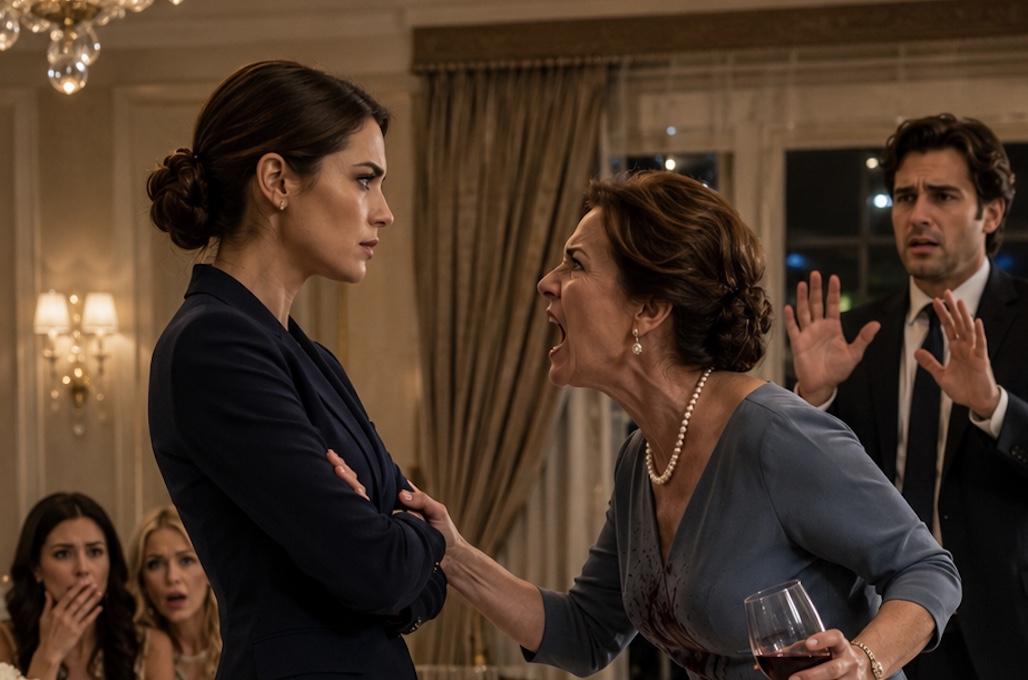
About fifteen guests had gathered — distant relatives Anna had never seen before. Second cousins from Tula, some cousin from Tver, an aunt from Kaluga. Tatiana Vasilyevna received congratulations in a new dress, with a high hairstyle and that same glass of red wine. She shone. She reigned. She accepted gifts.
The table was overflowing. Appetizers, salads, hot dishes. A real feast. Tatiana loved to display her generosity — especially when she was not the one paying for it.
“My dears!” she proclaimed in a toast, raising her glass. “I’m so happy to welcome you to my new home. This apartment is special. I deserved it. I worked toward it for a long time, and finally I got it. Justice has prevailed.”
The relatives nodded and hummed in approval. Dima sat at the corner of the table, pale, wearing a confused smile. He did not look like the son of the hostess. He looked like a random guest who did not understand why he had been invited.
Natalia sat at the other end. Sober. Composed. Collected.
Her eyes met Anna’s — Anna had entered uninvited, silently, and now stood in the doorway, unnoticed.
Anna waited until Tatiana drank. Waited until the relatives began eating.
Then she stepped forward.
“Good evening.”
The murmur died.
Every head turned.
Tatiana choked on her wine.
“You?” she jumped up. “How dare you? Get out!”
“I came to congratulate you on your housewarming,” Anna said calmly. “In my apartment.”
“Yours?” Tatiana laughed, but the laugh came out shrill and hysterical. “What nonsense. The apartment is mine.”
“May I ask a question? Have you already told all your guests how you got it?”
“What are you implying?”
“Nothing special. Just asking.”
Natalia rose from the table.
“I’ll tell them,” she said loudly. “If Tanya doesn’t want to.”
Tatiana went pale. Her gaze darted from her sister to Anna, and fear lit in her eyes. Not panic. Fear. Calculating, conscious fear — the kind a player feels when realizing the bluff has been exposed.
“Shut up,” she hissed.
“No, Tanya. Enough,” Natalia stepped out from behind the table. “Dear relatives! This apartment never belonged to Tanya. It belonged to this woman” — she pointed at Anna — “and her parents. Tanya threw her daughter-in-law out of her own home, changed the locks, and declared the apartment hers. And her son” — she looked at Dima — “supported her. Because he fears Mommy more than he loves his wife.”
Silence settled over the room.
Only the aquarium filter bubbled quietly.
“Lies!” Tatiana screamed. “She’s a drunk! She has delirium! Look at her — she’s insane!”
“I haven’t had a drink in three weeks,” Natalia said calmly. “And I can pass any test. Call a doctor, Tanya. Right now.”
“You!” Tatiana clutched her chest. “You want to send me to the grave!”
She began sinking to the floor again, but this time no one rushed to lift her. The relatives exchanged glances, whispered, looked at Tatiana sideways.
“Dimon!” she cried. “Tell them! Tell them I’m the owner here!”
Dima stood.
Everyone looked at him.
Anna looked too.
He opened his mouth. Closed it. Helplessly glanced around as if searching for someone who would make the decision for him. But his mother was lying on the floor, and there was no one to decide.
“I…” he began. “I don’t know.”
“What do you mean, you don’t know?” Tatiana screamed, dropping all theatrics. “You are my son! You must defend me!”
“But, Mom,” Dima blinked rapidly, “it really is Anya’s apartment.”
That was the blow.
No — not even a blow.
An execution.
Her own son, her golden boy, had questioned her for the first time in thirty-five years.
And he had done it in front of everyone.
Tatiana froze on the floor. Then slowly, very slowly, she got up. Her red face turned gray. Her hairstyle was coming apart, her dress wrinkled. She stood in the middle of her own celebration, and the celebration was collapsing before her eyes.
“Fine,” she forced out. “Fine, Anna. You won. Take your three-room apartment. Choke on it.”
“No,” Anna said.
“What do you mean, no?”
Anna smiled. For the first time in a long while, the smile reached her eyes.
“I’ve changed my mind. I don’t need this apartment. I don’t want to live here. Not in these walls soaked with your poison.”
“Then why did you arrange all this?”
“So you would know: everything has a price. And your price is shame. Today you have been disgraced before your whole family. Your son questioned you. Your sister betrayed you. And this is only the beginning.”
Tatiana looked at Anna with pure, undiluted hatred.
But fear still swam in her eyes.
“What do you want? Money?”
“I want a divorce. No division of property. You keep the apartment. I keep my life. A free life. Without you. Without Dima. Without all of this.”
Anna turned to the guests.
“I’m sorry I ruined your evening. But you needed to know the truth. This woman — your relative — is a fraud and a tyrant. She destroyed her sister’s life. She destroyed her son’s life. She tried to destroy mine. Don’t let her destroy yours.”
The relatives were silent. Someone pushed a plate away. Someone picked up a handbag. The aunt from Kaluga demonstratively stood and headed for the door.
“Where are you going?” Tatiana shouted. “Stand still! The party continues!”
But no one stopped. One after another, people left the room, left the apartment, left the celebration that had turned into catastrophe.
Anna walked over to Natalia.
“Shall we go?”
Natalia nodded.
In the hallway, Dima caught up with them.
“Anya, wait.”
She turned.
Her husband stood in the doorway, lost and pitiful, like an abandoned puppy.
“What about me?” he asked. “Where am I supposed to go?”
Anna looked at him. At the man she had lived with for eight years. The man who had shared her bed, eaten at her table, made plans with her — and at the most important moment had chosen not her.
“Anya, I’ve realized everything,” he babbled. “Mom was wrong. I love you. Let’s start over.”
Behind him came a rustle. Tatiana stepped into the hallway. She gripped the doorframe and looked at her son in horror.
Her son was choosing.
Her son was not choosing her.
Anna saw his face — wet, pathetic, frightened.
And felt nothing.
“This three-room apartment is hers now,” Anna said, nodding toward Tatiana. “And you… you belong to no one now.”
Then she left without looking back.
The elevator descended slowly. Natalia stood beside her in silence. When the doors opened on the first floor, she asked:
“How are you?”
“Alive,” Anna said. “For the first time in many years, alive.”
They stepped out into the street. The night was cold and clear. Somewhere high above, the windows of the tenth floor burned with light. Up there remained a shattered life, a shattered marriage, a shattered illusion.
“What now?” Natalia asked.
“Now — everything else,” Anna breathed in the frosty air. “I have work. I have time. I have myself.”
“And the apartment?”
“Let them live there. It’s only walls. The real prison isn’t in the walls. It’s in the head.”
They walked to the car. Anna got behind the wheel. Natalia sat beside her.
“You know what?” Natalia suddenly said. “I want to open a shelter. For cats. In our old communal flat. I have a share there. I’ll give it to the city. Let there be cats there instead of people.”
Anna laughed.
Sincerely, brightly, for the first time in a long while.
“That is the best idea I’ve heard all month,” she said.
The car pulled away. Behind them remained the building.
Ahead lay the city, the night, and a new life.
Six months later, Anna stood in the empty living room of her new apartment. The final renovation was done. No expensive Italian details — just simple, bright, peaceful.
She had chosen every socket herself. Every tile.
No one had stood over her soul.
No one had criticized her.
No one had changed her decisions.
In her pocket was a letter from Dima. She had found it that morning in the mailbox, read it, and not torn it up. She kept it as a reminder.
“Anya, Mom is sick. Her blood pressure is bad. I don’t know how to cook soup. Come back. I’ve realized everything. I’ll change. I swear.”
Anna reread those lines and slipped the letter back into her pocket. She was not angry. She even felt a little sorry for him.
He truly did not know how to cook soup.
He truly did not know how to live.
He had been taught to obey, but never taught to be himself.
But that was no longer her problem.
She went to the window and opened it wide. Fresh spring air rushed into the room.
No mothballs.
No mold.
No lily of the valley mixed with cigarette smoke.
Only wind.
Only freedom.
Only herself.
Anna smiled and closed the window.
A whole life lay ahead.
And now she knew for certain: a real home is not the place where nails are driven into walls.
A real home is the place where no one dares to steal your keys.