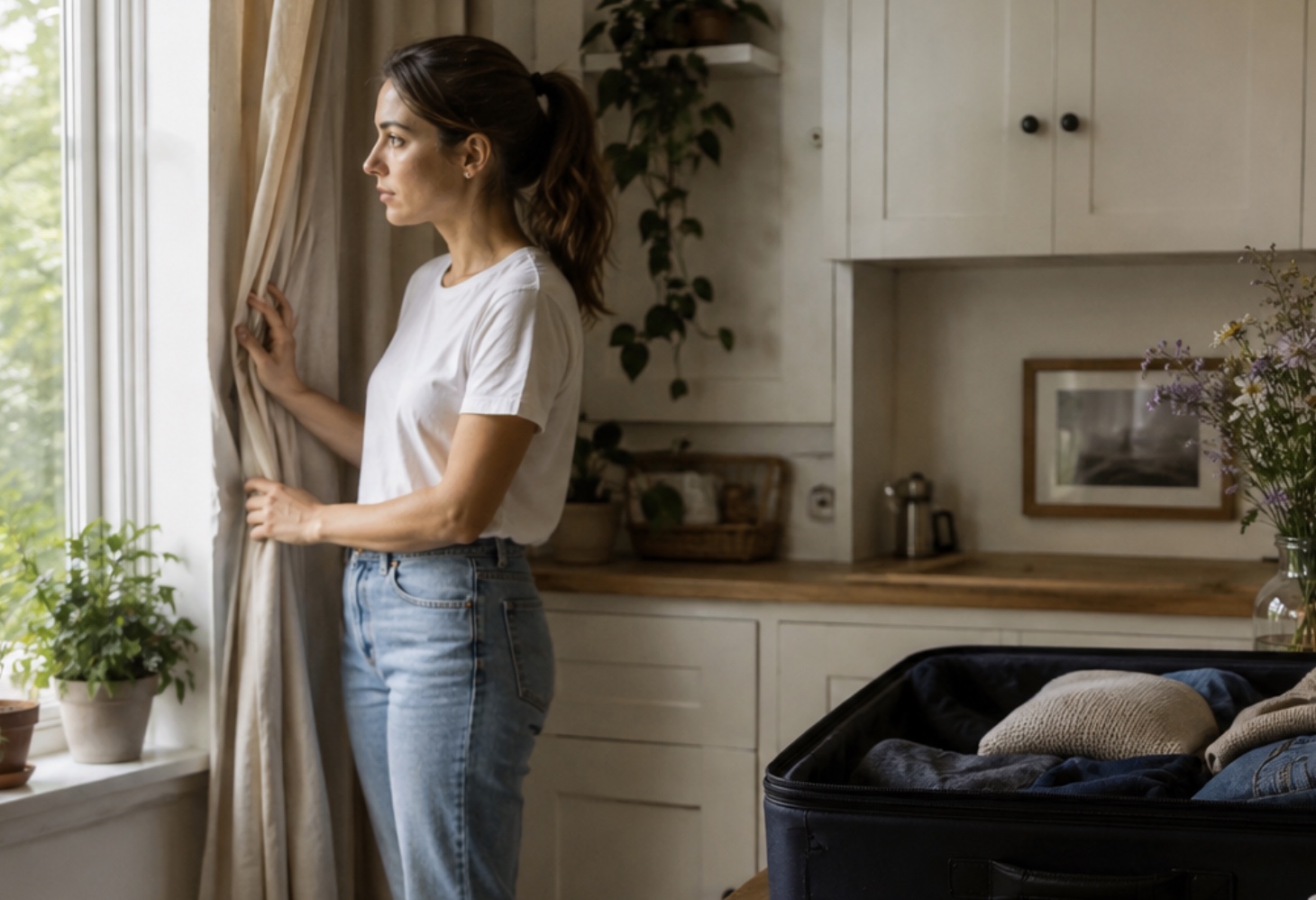
I was standing in the kitchen, taking a pot of buckwheat off the stove. The buckwheat was overcooked, the cutlets had gone cold, and my husband was speaking in the tired voice of a man who had prepared his excuse in advance.
“What’s wrong with her?”
“Her age, Marina. Her blood pressure keeps jumping.”
“Yesterday she spent two hours choosing tomatoes at the market. Her blood pressure seemed perfectly fine then.”
“Yesterday was yesterday.”
That was his universal phrase. It could explain anything: a delayed paycheck, the smell of unfamiliar perfume, a phone suddenly turned face down, and why, for the third month in a row, he had regularly been spending nights at his mother’s house even though there was nothing seriously wrong with her besides occasional blood pressure problems.
“Tell her I’ll stop by in the morning.”
“Don’t come in the morning.”
He answered too quickly.
“Why?”
 
“Because she’ll be sleeping. And honestly, can you stop checking up on me for once? I’m not going to a resort.”
That was the first time I felt something other than anxiety.
I felt cold.
Whenever Nina Petrovna was genuinely ill, Oleg would call me every half hour. He would ask me to buy medicine, find a doctor, check her temperature.
Now he was irritated.
That wasn’t how a husband spoke to his wife. It was how someone spoke to a person who was asking inconvenient questions.
“All right,” I said. “Give her my regards.”
“I will.”
He hung up.
Oleg was forty-two. I was thirty-nine. We had been together for fifteen years.
During those years, we had survived a mortgage, renovations, his knee surgery, my father’s death, and endless visits to my mother-in-law. I knew how he drank his coffee, how he behaved when he had a headache, and how he slammed the wardrobe door when he was angry, along with a thousand other little things I couldn’t even remember all at once.
But that evening, for the first time, I understood something frightening.
You can know a person for a very long time and still have no idea where he goes when he leaves the house.
Half an hour later, Oleg came back for his phone charger.
Then he returned again for his bank card.
“You’re really going to your mother’s?” I asked from the doorway.
Oleg looked at me as if I had accused him of robbing a bank.
“Where else would I be going?”
“I don’t know. You tell me.”
 
“Marina, I don’t have the energy to discuss your paranoia.”
Apparently, I had developed “paranoia” about a year earlier.
Before that, it had been called intuition, but Oleg found it more convenient to rename it.
He kissed me on the cheek and left.
His jacket smelled of cold air, cigarettes, and a sweet perfume that had never existed in our home.
I noticed it.
And said nothing.
At seven the next morning, my phone woke me.
The message was from Sveta, Oleg’s younger sister.
“Marina, have you seen this? Oleg’s completely overwhelmed. He’s even choosing the furniture and curtains himself now.”
There was a photograph attached.
Oleg was standing inside a curtain showroom.
In one hand, he held several fabric samples. With the other, he was adjusting a long gray curtain.
Beside him stood a blonde woman in a beige sweater.
She was laughing.
And Oleg was looking at her in a way he hadn’t looked at me in years.
Behind them was a sign:
“Curtains for a nursery — 20% off.”
I zoomed in on the photograph.
The screen of the phone in Oleg’s hand showed the time: 9:47 p.m.
At that exact moment, I had been putting the cold cutlets into the refrigerator.
He had been choosing curtains with another woman.
At first, I laughed.
Not because it was funny.
It was simply so absurd that crying somehow seemed too serious a response.
 
I imagined Oleg walking into his mother’s apartment with a roll of fabric under his arm.
“Mom, how’s your blood pressure? By the way, don’t you think this color is a little too gloomy?”
But the laughter disappeared quickly.
I called Sveta.
“Where was this taken?”
“At the curtain shop on Lesnaya Street.”
“Who is the nursery for?”
There was silence on the other end.
“I thought he had already explained everything to you.”
“He told me he was spending the night at his mother’s.”
“Well… technically, he really was at Mom’s.”
“Technically?”
Sveta sighed heavily.
“Marina, I don’t want to interfere.”
“You already interfered. You sent me the photograph.”
She said nothing.
“Who is that woman?”
“Yulia.”
“Who is Yulia?”
“Oleg’s… friend.”
“Sveta, don’t make me drag every word out of you.”
“She’s pregnant.”
I sat down on the edge of the bed.
“Pregnant by whom?”
I already knew the answer, but I asked anyway.
“Oleg.”
Behind the wall, a neighbor started drilling.
 
Water dripped somewhere in the bathroom.
On the chair lay Oleg’s T-shirt—the one he had been wearing the night before before changing clothes to “go see his sick mother.”
“How long?”
“Almost a year.”
Almost a year.
This was no fling. No accident.
An entirely separate life had managed to grow beside mine. It already had a timeline, an apartment, and curtains for a nursery.
“Does his mother know?”
“Yes.”
“And she’s helping him?”
“She thinks you should understand.”
I gave a short laugh.
“In this family, ‘understanding’ always seems to begin with everyone making a decision and informing me afterward.”
Sveta lowered her voice.
“Oleg said you two had been living like roommates for a long time.”
I looked around our bedroom.
Two bedside tables. A framed photograph from our trip to Kislovodsk. His charger tangled among the wires. My creams beside the mirror.
Roommates share utility bills and avoid each other in the elevator.
We had shared fifteen years.
 
Apparently, for Oleg, that no longer counted as a family.
“When was he planning to tell me?”
“After the baby was born.”
“Why?”
“So there wouldn’t be any stress.”
I laughed again.
“How thoughtful. He wanted to tell me about his child after he had already fully become someone else’s father.”
“Marina, don’t talk like that.”
“How am I supposed to talk?”
Sveta had no answer.
I ended the call and went to put the kettle on.
A person can discover that her husband has been living a double life for almost a year and still put the kettle on first.
The body doesn’t know how to move immediately into tragedy.
It still wants water, sugar, and a clean cup.
Oleg called at nine.
“Why did you call Sveta?”
“I wanted to ask how your mother’s blood pressure was.”
“Don’t start.”
“I won’t. You start.”
He went silent.
“I can explain everything.”
“Then explain.”
“This isn’t a conversation for the phone.”
 
“What kind of conversation is it? One that requires nursery curtains?”
“Who sent you the picture?”
“It doesn’t matter.”
“It matters to me.”
“A lot of things matter to you. Especially making sure I know nothing.”
“You’re behaving badly right now.”
I closed my eyes.
The worst part of conversations like that isn’t even the lie.
It’s how quickly the person who lied begins judging your reaction to discovering the lie.
“I’m behaving like a wife who has just been sent a photograph of her husband shopping for nursery curtains with a pregnant woman.”
“Yulia isn’t just some woman.”
“Yes, I understand that now. She’s a woman with an apartment and your child.”
“It’s more complicated than you think.”
“No, Oleg. You are the one who made it complicated.”
He exhaled heavily.
“Come home,” I said. “We’ll talk.”
“Now?”
“No, in a month. After you hang the curtains.”
He arrived forty minutes later.
He entered quietly and placed his shoes neatly beneath the cabinet.
A man could destroy his marriage and still carefully line up his shoes so he wouldn’t dirty the hallway.
I was sitting in the kitchen.
In front of me lay a printed copy of the photograph and a folder containing our documents.
“You’ve already investigated everything?”
“No. I just called Sveta. Apparently, one phone call is enough when everyone else has known for a long time.”
“Not everyone.”
 
“Your mother knows. Sveta knows. I was the only one who didn’t.”
“I was going to tell you.”
“When?”
“Soon.”
“Soon isn’t a date. It’s a way of keeping someone suspended until you find a convenient moment.”
Oleg sat down opposite me.
“I never wanted things to turn out this way.”
“What exactly didn’t you want? The baby? Yulia? The apartment? Or me finding out?”
He looked away.
“I wanted to protect you.”
“From what?”
“From a scandal. From unpleasant conversations.”
“You weren’t protecting me. You were protecting your own comfort.”
He said nothing.
And somehow, that silence told me more than all of his excuses.
“Yulia was there for me when things were difficult,” he finally said.
“And where was I?”
“You became distant.”
“When?”
“After your father died. You became completely absorbed in your own problems.”
“I became sad, Oleg.”
“You became different.”
“So you got yourself a mistress and a child?”
“I didn’t plan it.”
“Of course not. It just happened. Like mold in a bathroom.”
“Stop mocking me.”
“I’m trying to understand the process. How do you accidentally date someone for nearly a year, accidentally get her pregnant, accidentally rent her an apartment, and accidentally pick out curtains together?”
Oleg pressed his lips together.
“I never wanted to hurt you.”
“But you wanted everything else.”
Silence.
 
“I cheated on you,” he finally said.
He said it so casually.
As if he were admitting that he had forgotten to pay the internet bill.
I expected something inside me to collapse.
Nothing did.
Maybe because everything had already fallen apart long ago, and I had simply been walking barefoot over the pieces without realizing it.
“How long?”
“That doesn’t matter.”
“It matters to me.”
“Almost a year.”
“How often did you see her?”
“Regularly.”
“I see.”
“What exactly do you see?”
“That you didn’t make a mistake. You made a choice.”
“I wasn’t choosing her against you.”
“If a man chooses another woman every evening, then he is choosing her. Even if he tells his wife that he is going to visit his sick mother.”
Oleg stood up and opened the refrigerator.
He stared inside as though he hoped to find a less unpleasant conversation somewhere between the milk and the leftovers.
“I’ll help you financially.”
 
“With what?”
“I’ll keep paying part of the mortgage until you decide what you want to do.”
“You’ve already decided I’m staying in the apartment?”
“Where else would you live?”
“Here.”
“The apartment belongs to both of us. I’m not going to throw you out.”
“How generous.”
“Don’t be like that.”
“So your plan is for me to stay here while you live over there? Then you’ll come back on weekends for socks and tell me how your baby is growing?”
“I won’t tell you anything.”
“That’s the first truly honest thing you’ve said.”
He leaned both hands against the table.
“I can’t get divorced right now.”
“Why?”
“The loan. Work. My mother. Yulia is pregnant.”
“What does any of that have to do with divorce or your ability to choose curtains?”
“You don’t understand what things are like right now.”
“I understand perfectly. You have too many women you owe something to, and not one of them you’re completely honest with.”
Oleg looked at me.
“You really want to destroy everything because of one mistake?”
I nodded toward the photograph.
“A child isn’t a mistake. Buying the wrong yogurt is a mistake. A child is a consequence.”
He went quiet.
Then he said:
“I still love you.”
“Love without honesty is just attachment with good marketing.”
At that moment, his phone rang.
The screen displayed:
“Mom.”
 
Oleg declined the call.
Nina Petrovna immediately called again.
“Answer it,” I said. “Maybe it’s her blood pressure.”
He picked up.
“Yes, Mom.”
My mother-in-law’s voice was loud enough for me to hear.
“Oleg, what are you doing there? Yulia wants to know when the installer is coming. Is he hanging the curtains today or tomorrow?”
Oleg closed his eyes.
“Mom, I’ll call you back.”
“And have you told Marina yet? You promised you’d settle everything today! You can’t keep dragging this out until the baby is born. Yulia shouldn’t be stressed, and you need to sort out the apartment before prices go up again.”
His face went pale.
I took the phone from his hand.
“Hello, Nina Petrovna.”
Silence.
“Marina? Are you with Oleg?”
“Yes. We’re sitting in the kitchen. The same kitchen where he usually explains that he was late because of work.”
“I thought you knew.”
“That seems to be everyone’s favorite sentence today.”
“Oleg wanted to explain everything himself.”
“He wanted to do many things himself. Like choosing the curtains.”
“Don’t make a scene.”
“You made the scene. I simply joined the performance near the finale.”
“Yulia is expecting a baby. You’re all adults. You need to think about the future.”
“Whose future? Your son’s or mine?”
“Marina, after all these years, you should understand…”
“After all these years, I’ve finally understood something. Whenever someone tells you to ‘endure it for the sake of the family,’ you should first ask which family they mean.”
I placed the phone on the table.
 
Oleg stared at me.
“Why did you do that?”
“Because I wanted at least one conversation in this family to happen without everyone receiving a different version of the truth.”
I stood up and went into the bedroom.
I pulled out the suitcase we had bought before our trip to Turkey and began filling it with his things: shirts, jeans, a sweater, his charger, his razor.
“You’re throwing me out?”
“No. I’m giving you back your freedom. Apparently, it fits into one suitcase.”
“I can’t leave right now.”
“You can. You managed perfectly well yesterday.”
“I don’t have anywhere else to go.”
“There’s an apartment with a nursery.”
“It isn’t ready yet.”
“Then stay with your mother. She seems to need company.”
He stood up abruptly.
“You’ve become cruel.”
“No. I’ve simply stopped being a convenient fool.”
Oleg grabbed the suitcase handle.
“Do you really want to end everything?”
“No.”
He froze.
“I don’t want to end it. I want to stop continuing this cheap farce.”
He stood by the door for several seconds, waiting for me to change my mind.
This time, I didn’t help him.
A week later, he returned for the rest of his things.
“Can I take the coffee machine?” Oleg asked.
“No.”
“We bought it together.”
“So did we buy the apartment.”
“You’re turning everything into accounting.”
“You’re the one who turned fifteen years into a list of expenses.”
He took his boxes and left.
A month later, we filed for divorce.
Oleg called several times.
At first, he asked me not to rush.
Then he said I was the one who had destroyed everything.
Later, he sent me a long message about how people sometimes make mistakes.
 
I never replied.
A mistake can be corrected.
You can replace a lock, throw away a broken cup, buy new curtains.
But you cannot call an entire year a mistake when, night after night, a person consciously chose someone other than you.
On the day we signed the papers, Oleg asked me:
“Do you really feel nothing anymore?”
“I feel something.”
“What?”
“Relief.”
He turned away.
And I thought about the real horror of betrayal.
It isn’t seeing your husband standing beside another woman.
 
It’s looking back at your entire life beside him and realizing that you were the only person who believed that life belonged to both of you.
A few days later, I bought new curtains.
Simple ones. Light-colored. No patterns.
The saleswoman asked:
“Are they for a family apartment?”
I paused for a moment.
“No. They’re for the apartment of a woman who has finally decided to live without someone else’s excuses.”
Sometimes, after living through a long period of lies, what you want most isn’t a dramatic final speech.
It’s silence.
And a new life in which you are finally free.
Do you think the heroine did the right thing by making her husband leave immediately, or should she have tried to save the marriage first?