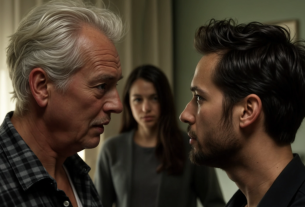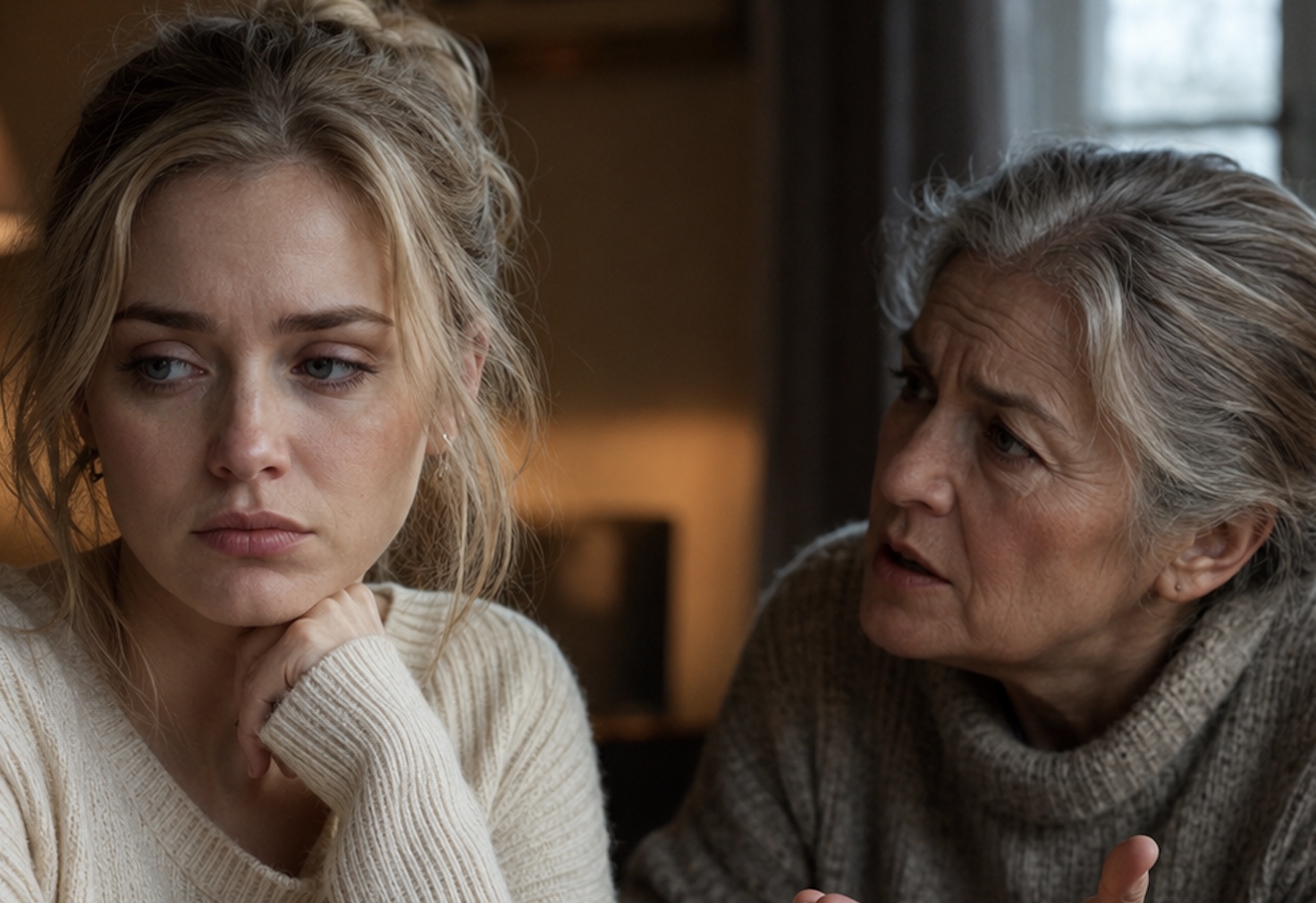
Vera had always known there was an invisible line in that house, one she was never allowed to cross. Not a forbidden boundary exactly, but a limit to how much warmth she was permitted to receive. Her mother could hug Dasha in front of everyone, kiss her on both cheeks, and call her “my little sunshine,” then turn her back on Vera and toss over her shoulder, “Go do your homework.”
She was eight when she first heard something no child was ever supposed to hear.
Aunt Lyuba was sitting in the kitchen, drinking mint tea and speaking in a voice unusually stern for her. Vera froze behind the half-open door, clutching a plush rabbit with one torn ear to her chest.
“Tamara, do you even see what you’re doing? Vera is walking around in a coat she outgrew two years ago, and you bought Dasha a fur coat.”
“Lyuba, stay out of it. Dasha is little. She gets cold.”
“And Vera doesn’t? Is she not your daughter too?”
“She’s the older one. She should understand.”
“Understand what? That her own mother doesn’t even see her?”
Tamara Nikolayevna set her cup down on its saucer with a loud clatter. Vera knew that sound — sharp, irritated. That was how her mother always marked the end of a conversation.
“Lyuba, I invited you here as a friend, not as a parenting instructor. I have two children, and I’ll decide for myself who needs what.”
“You’re not deciding, Tamara. You’re choosing. And you always choose the same one.”
Vera quietly backed away into the hallway. She didn’t cry. By the age of eight, she had already learned not to. Instead, she climbed up to the storage shelves, pulled out the box with the documents, and found her birth certificate. Parents: Tamara Nikolayevna and Boris Petrovich.
She was their biological daughter.
So it wasn’t that they had found her at a train station, as she sometimes imagined. It was simply that her mother did not want to love her.
The years passed, and that invisible line only grew thicker. Dasha got a beautiful canopy bed, while Vera slept on a sagging sofa with broken springs. Dasha went to English classes, while Vera was told, “You don’t need that. You’ll manage somehow.”
“Mom, can I go to English classes too?” Vera asked one evening over dinner. She was twelve.
“Verochka, we can’t pay for both of you. Dasha needs it more. She has talent.”
“And me?”
“You have other strengths. You’re practical.”
Boris Petrovich sat beside them, silently eating his soup. He always ate his soup in silence. In fact, he was always silent whenever attention, money, or fairness had to be divided. Vera looked at her father with hope, waiting for him to say at least something. But he only reached for the bread.
“Dad?”
“Your mother said no. That means no,” he muttered without lifting his eyes.
Dasha learned how to play that game very quickly. She lied with such an innocent face that Vera sometimes almost admired her. How could someone be so convincing at thirteen?
“Mom, Vera tore my notebook!” Dasha would shout, even though she had dropped it into a puddle herself.
“Vera! Come here! Why are you touching Dasha’s things?”
“I didn’t touch it. She did it herself…”
“Stop lying! Dasha wouldn’t make that up.”
Vera would fall silent. There was no point arguing. Her mother had already made her decision long before she heard both sides. The mechanism was polished and reliable, and there was no place for justice inside it.
After school, Vera scored high enough for admission to the regional institute, but she was three points short of a government-funded place. Tuition cost one hundred and twenty thousand a year. She came to her parents with a printout and placed it on the table.
“Mom, Dad, I need help. I can work part-time and cover half, but I can’t manage the full amount.”
Her mother didn’t even pick up the paper.
“Vera, you know we’re saving for Dasha’s education. She’ll be applying in two years.”
“And I’m applying now. Right now, Mom.”
“Go to college. Get a profession first, then finish your studies later if you want. Not everyone needs an institute degree.”
Vera looked at her father. Boris Petrovich was sitting by the television, watching football. He didn’t even turn around.
“Dad, say something.”
“Your mother is right. College is fine too.”
Vera took back the printout, folded it neatly in half, and put it into her pocket. She did not raise her voice. She did not slam the door. She simply understood — completely and finally — that asking was useless. Not because there was no money. There was money.
Just not for her.
She went to college. Six months later, she started working part-time. A year after that, she rented a room in a communal apartment on the other side of the city. On the day she packed her things, her mother stood in the doorway and watched indifferently as Vera folded two sweaters and a stack of books into a bag.
“Well, call sometimes,” Tamara Nikolayevna said.
“Of course,” Vera replied.
She did not call once in three months. Her mother did not call either. But one day Dasha sent a message: “Lol, they gave me your room. I turned it into a dressing room.”
Vera read it and deleted the conversation.
Life away from her parents’ home felt strange. Not hard — strange. For the first time, Vera ate what she wanted, not what was left after Dasha. For the first time, she went to bed without hearing her mother and younger sister laughing through the wall. For the first time, she fell asleep without feeling as though she was occupying someone else’s space.
She met Maxim by accident, in a queue at the public services office. He was standing in front of her, nervous, dropping papers everywhere, and Vera silently picked one up and handed it to him.
“Thank you,” he said, smiling in a way that made her breath catch. “This is my second time here. First time I filled out the wrong form.”
“It happens.”
“What are you here for?”
“Personal matters.”
“Got it. I won’t pry.”
But he did pry. Ten minutes later, they were already talking. An hour later, they were drinking coffee at the café across the street. A month later, Maxim knew everything about her — including the story of her parents.
He listened quietly, without interrupting, and when she finished, he said only one thing:
“I understand you. Mine was similar, only without a sister. My parents just believed a son was a burden they had to endure until he turned eighteen.”
“And how do you live with that?”
“I live. Not with them — and so I live.”
They registered their marriage eight months later — quietly, without celebration. Their witnesses were Maxim’s friends and Vera’s friend. Vera did not tell her parents. Dasha found out through mutual acquaintances on social media and wrote, “You could’ve invited me.”
Vera did not reply.
Aunt Raya — a distant aunt from her father’s side and the only relative who had ever treated Vera like a human being — called a week after the wedding.
“Verochka, congratulations! Lyubov told me. Is your husband a good man?”
“He is, Aunt Raya.”
“Do your parents know?”
“No.”
“Verochka…”
“Aunt Raya, I didn’t invite them on purpose. I didn’t want anyone at my happy day looking at me like I had stolen something.”
Aunt Raya was quiet for a moment.
“I don’t judge you, child. You deserve peace.”
The call came on a Saturday morning while Vera was frying pancakes and Maxim was choosing music on the speaker. The phone screen lit up with one word: Mother. Vera had not answered her calls in fourteen months.
“Hello.”
“Vera, it’s Mom.”
“I can see that.”
“Vera, we need help. Dasha was in an accident.”
Her mother’s voice did not sound frightened. It sounded businesslike — the voice of someone who had already made a plan and was waiting for everyone else to carry it out. Vera leaned against the kitchen counter and closed her eyes.
“What happened?”
“She was driving someone else’s car. She had been drinking and hit a person. A pedestrian. We need a lawyer, and we’re short three hundred thousand.”
“Wait. She got drunk, got behind the wheel of someone else’s car, and hit a person?”
“Vera, this is not the time for lectures. We need money. You work. You have a husband. Put it together and transfer it.”
Maxim heard the tone in her voice and came closer. Vera pressed the speaker button.
“Mom, you haven’t called me in fourteen months. You didn’t congratulate me on my wedding. You didn’t even ask whether I was alive. And your first call is, ‘Give me money.’”
“Vera, this isn’t about that! Dasha is in trouble!”
“Dasha put herself in that trouble. She got drunk and drove. She injured a person. And you want me to pay for it?”
“You are her older sister!”
“I am the older sister you pushed out of the house without a penny. I am the older sister you denied an education to because the money was for Dasha. I am the older sister who slept on a broken sofa while the younger one had a canopy bed. And now you’re calling me for money?”
“Vera, stop this hysteria!”
“This isn’t hysteria. This is the truth. You haven’t heard it for twenty-five years, and I understand you won’t hear it now either. But no. There will be no money.”
Tamara Nikolayevna fell silent. Then her voice turned icy.
“You are refusing to help your own sister?”
“I am refusing people who remember I exist only when they need something from me.”
“You’re ungrateful. We raised you, fed you, dressed you…”
“In hand-me-downs. And half-fed, because the best piece always went to Dasha. Mom, enough. I’ve said everything.”
“If you don’t help, I will disown you.”
Vera gave a short, bitter laugh.
“You disowned me when I was eight. You simply forgot to make it official.”
And she ended the call.
Maxim stood beside her, watching silently. Then he reached out and covered her hand with his.
“Are you okay?”
“No. But I will be.”
“You did the right thing.”
“I know.”
Two days later, her father called. His voice was hoarse and strangely lost, as if he didn’t know how to begin.
“Vera, it’s Dad.”
“Hello.”
“Your mother said you refused.”
“Yes.”
“Daughter, you can’t do that. Dasha is your blood.”
“Dad, am I not your blood? When I needed money for education, you sat and watched football. When Mom pushed me out of the house, you stayed silent. When Dasha lied about me, you never once took my side. Not once, Dad. In twenty-five years — not once.”
“Vera…”
“You were always there, and you were always silent. That was worse than shouting. Because you knew what was happening, and you chose not to interfere.”
Boris Petrovich sighed heavily.
“I don’t know how to… well, you understand…”
“I understand. You don’t know how to be a father. I figured that out a long time ago. Sell the summer house, the car, borrow from friends. Solve it yourselves.”
She hung up and looked at Maxim. He was standing in the doorway, waiting.
“He asked too,” Vera said.
“I heard.”
“It’s not the money I feel sorry about, Maxim. It hurts that they only call when they need money.”
“I know.”
Dasha was sentenced to two years. Their parents sold the summer house. Boris Petrovich began drinking — first in the evenings, then from lunchtime onward. Aunt Raya reported everything briefly, without judgment, like a radio broadcast. Vera listened and did not comment.
She simply lived — her own life, in her own home, beside a person who loved her not because of anything, but despite everything.
Six months later, Vera gave birth to Polina. It happened on a Thursday at seven in the morning. The little girl was tiny, red, screaming, with strong little fists, and when they placed her on Vera’s chest, something happened that Vera could not put into words. She cried — not from pain, not from exhaustion, but from the realization that this was the very feeling her mother should have had for her twenty-six years earlier, but never did.
Maxim stood beside her, holding her hand. His eyes were wet.
“She’s beautiful,” he said.
“She’s ours,” Vera replied.
The first three months passed in a haze of sleepless nights and quiet happiness. Polina grew like a stubborn little sun — demanding, loud, and absolutely loved. Every day Vera kissed the top of her head and made herself a promise:
“It will be different for you. You will never know what it means to be the unwanted one.”
Then her mother found their address. Aunt Raya swore she hadn’t given it. Aunt Lyuba swore the same. But one spring evening, the doorbell rang, and Tamara Nikolayevna stood on the threshold — thinner than before, carrying a bag with diapers and toys sticking out of it.
“Hello, Vera.”
Vera stood in the doorway without moving. Maxim was in the kitchen, making dinner. Polina was asleep in the bedroom.
“What do you want?”
“I came to see my granddaughter.”
“Who told you where I live?”
“I found it. That doesn’t matter.”
“It matters. You came without an invitation, without calling. How exactly did you imagine this would go?”
“Vera, I’m her grandmother. I have a right to see my granddaughter.”
“No. You don’t.”
Tamara Nikolayevna flinched. Apparently, she had expected a different reaction — tears, embraces, some melodramatic reconciliation at the door.
“Vera, I’ve changed. I’ve thought a lot. I understand I was wrong.”
“Did you understand that after Dasha went to prison and the money ran out? Or before?”
“That’s cruel.”
“Cruel is when an eight-year-old girl climbs onto a storage shelf to look for her birth certificate because she thinks she must be adopted, since her mother hates her that much.”
Tamara Nikolayevna turned pale.
“You… remember that?”
“I remember everything. Every single day. Every ‘give it to your sister,’ every ‘Dasha is little,’ every birthday of mine when you forgot to buy a cake because Dasha had a school performance.”
“I didn’t forget…”
“I turned ten, and you didn’t even congratulate me. But for Dasha’s eighth birthday, you threw a party with entertainers.”
“Vera, I didn’t come to fight. I came to make peace.”
Maxim came out of the kitchen, wiping his hands on a towel. He looked at his mother-in-law calmly, without anger, but without warmth either.
“Hello.”
“Hello, Maxim. I’m Vera’s mother.”
“I know. Vera, do you need help?”
“No. I’ll handle it.”
Vera took a step forward onto the landing and pulled the door partly shut behind her. Tamara Nikolayevna stepped back half a pace.
“Mom, I forgive you. Not for you — for myself. I don’t need to carry that weight for the rest of my life. But you will not enter my home, and you will not see my daughter.”
“But why?!”
“Because being a grandmother is not a right. It is a privilege. And you lost it. You lost it through eighteen years of choosing one daughter over the other every single day.”
“Vera, you can’t deprive me of my granddaughter!”
“You deprived me of a mother. I was a child and couldn’t do anything about it. Now I’m an adult. And I decide who gets to be in my daughter’s life.”
Tamara Nikolayevna tightened her grip on the handles of the bag and leaned forward, trying to peer over Vera’s shoulder into the apartment.
“Let me at least look at her!”
Vera placed her hand gently but firmly on her shoulder and moved her back.
“No.”
“You monster!”
“No, Mom. I’m a mother. A real mother. One who protects her child. Even from her own mother.”
Tamara Nikolayevna burst into tears. But there was something false and theatrical in those tears, as if she had rehearsed them in front of a mirror. Vera knew that trick. Her mother always cried when she wanted to get her way.
“Leave. Please.”
“I won’t leave! I’ll stand here until you open the door!”
“Then stand.”
Vera turned, walked back into the apartment, and locked the door. Tamara Nikolayevna pounded on it for ten minutes. Then she left.
Maxim was standing with Polina in his arms. The baby had woken from the noise.
“Is she gone?”
“She’s gone.”
“You did well.”
“I’m tired, Maxim. I’m twenty-six years old, and I’m tired of my mother as if I were sixty.”
“But Polina won’t grow up tired like that. Because she has you.”
Vera took her daughter into her arms and held her close. Polina quieted down and pushed a tiny fist into her mouth. That small gesture — trust, complete and unconditional — was worth every tear Vera had ever shed.
Her mother did not give up. Two weeks later, she appeared again — this time at the playground where Vera had taken Polina for a walk. Vera noticed her immediately on a bench, sitting with a bag of toys in her hands, staring toward the stroller.
“I told you not to come.”
“Vera, I am your mother!”
“Are you following me?”
Tamara Nikolayevna stood up and took a step toward the stroller. Vera blocked her path, placing herself between her mother and her daughter. Her face changed. The softness vanished, leaving only cold certainty.
“Do not come near her.”
“What are you pretending to be? I’m her grandmother! I have a right!”
“You have nothing!”
Tamara Nikolayevna tried to move around Vera from the left, stretching her hand toward the stroller. And then Vera — calmly, precisely, without swinging her arm — pushed her mother by the shoulder. Not hard, but firmly enough to make her step back three paces and freeze with her mouth open.
“You… you just pushed your mother?”
“I just protected my daughter. And I’ll do it again if you come any closer.”
Tamara Nikolayevna stood there gasping like someone who had been doused with ice water. She had clearly not expected physical resistance. For twenty-six years, Vera had been quiet, obedient, patient — and suddenly there was a wall.
“Vera, you’re sick!”
“No. I’m healthy. For the first time in my life, completely healthy. You are the sick one if you think you can come to someone you humiliated for twenty years and demand love.”
A woman on a nearby bench turned to look, but Vera did not care.
“I’ll tell everyone what you are! That you hit your mother!”
“Tell them. And I’ll tell them what you are. How you starved your older daughter of love for years. How you clothed one child and stripped the other. How you denied me education for Dasha’s sake. How you didn’t congratulate me on my wedding. How you remembered me only when you needed money. Tell them, Mom. Let’s see who people feel sorry for.”
Tamara Nikolayevna dropped the bag of toys. A plush bear with a red bow tumbled out. Vera looked at it and suddenly remembered the rabbit with the torn ear she had held in the kitchen when she was eight.
“Leave, Mom. And don’t come back. If you show up here again, I’ll move to another district.”
“You wouldn’t dare…”
“I already dared. Twenty-six years ago, you decided one daughter mattered more than the other. Today I decided that Polina does not need one grandmother. Choice for choice. A fair exchange.”
Vera turned the stroller around and walked home. She did not look back. After five steps, she heard Tamara Nikolayevna sob loudly and theatrically across the playground. But Vera no longer reacted to that sound. She had outgrown it, just as she had outgrown the childhood coat she had been forced to wear for two years too long.
At home, Maxim met her in the hallway.
“What happened? Your cheeks are burning.”
“My mother came to the playground.”
“What?!”
“I spoke to her. She won’t come again.”
“Are you sure?”
“Yes. I’m sure.”
That evening Aunt Raya called.
“Verochka, Lyuba called me. She said Tamara cried into the phone, claiming you hit her and chased her away.”
“I pushed her, Aunt Raya. She was reaching for the stroller, and I told her not to come near.”
“I’m not judging you, child. I called to tell you something else.”
“What?”
“Tamara filed a complaint so child services would inspect you. She said you’re an unstable mother and the child is in danger with you.”
Vera slowly sank into a chair. Maxim saw her face, came over, and sat beside her.
“Aunt Raya, did she really do that?”
“Yes. But don’t panic. Lyuba told me everything — how Tamara treated you all those years. I’m ready to confirm it. Lyuba is too.”
“Thank you.”
“Verochka, there’s one more thing. I don’t know whether you need to hear this, but… Dasha wrote to your mother from prison. She wants money sent to her account. There’s no money left — the summer house is gone, and your father is drinking away what remains. I think Tamara was hoping that if she got access to her granddaughter, she could later squeeze money out of you.”
“I thought so.”
“Take care of yourself, child.”
Vera hung up and looked at Maxim.
“She filed a complaint with child services.”
“I heard.”
“We need to prepare documents, certificates, proof.”
“Tomorrow morning. For now, go to bed. I’ll feed Polina if she wakes up.”
“Maxim?”
“Yes?”
“Thank you for existing.”
He leaned down and kissed her forehead.
The child services inspection came ten days later. A young woman with a folder looked around the apartment, checked the refrigerator, inspected the nursery, and spoke with Vera and Maxim. Everything was spotless — clean, warm, and orderly. The baby was well cared for and calm.
Then Vera showed the inspector printed messages from her mother and told the story — briefly, calmly, without tears. Aunt Raya and Aunt Lyuba wrote formal statements. Maxim provided footage from the security camera in the building entrance, showing Tamara Nikolayevna pounding on their door.
Tamara Nikolayevna’s complaint was deemed unfounded. But the opposite story — the one about a mother who had deliberately rejected her older daughter for twenty years — was included in the inspector’s report.
A month later, Dasha called Vera. Her voice was quiet, unusually quiet.
“Vera, it’s me.”
“I hear you.”
“Mom told me you threw her out. And that child services came.”
“That’s right.”
“Vera… I wanted to say… I understand why you did it. Here, where I am now, there’s a lot of time to think. And I… I’m guilty before you. For everything. For lying, for using the situation. For the notebook. Do you remember the notebook?”
Vera was silent for five seconds.
“I remember.”
“I dropped it in the puddle myself.”
“I know.”
“Forgive me.”
“Dasha, I can’t forgive you right now. Maybe someday. But not now.”
“I understand.”
“Take care of yourself.”
“Okay.”
Vera ended the call and walked over to Polina’s crib. Her daughter was asleep with her little arms thrown out to the sides — free, trusting, the way only a child can sleep when she has never known what it means to be unloved.
“It will be different for you,” Vera whispered. “I promise.”
From the kitchen came Maxim’s voice. He was humming under his breath, clattering a frying pan, making dinner. An ordinary evening. Ordinary happiness. The kind Vera had waited twenty-six years to have.
She caught herself smiling.
And she did not want to stop.
Two months later, Aunt Raya called with news that made Vera’s breath catch. Tamara Nikolayevna, trying to gather money for Dasha, had gotten into debt with old acquaintances who turned out not to be so kind after all. Boris Petrovich had left home — simply packed his things and gone to his brother’s village, leaving his wife alone in an empty apartment without the summer house, without the car, without money. And Dasha, released on parole, did not return to her mother. She left for another city without giving an address.
Tamara Nikolayevna was left alone. Completely alone. The daughter for whom she had sacrificed everything had not even said goodbye. The daughter she had rejected had built a family and become happy.
Aunt Raya said:
“You know, Verochka, life is not blind. It sees everything and remembers everything. It simply doesn’t send the bill right away.”
Vera said nothing. There was nothing to add. She put down the phone, took Polina into her arms, and walked into the kitchen — to where Maxim was already setting the table, and where the air smelled of warmth, food, and love.
The very warmth that cannot be bought, stolen, or demanded.
It can only be earned.