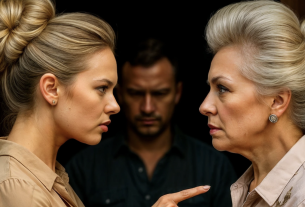
“You fool! A complete fool with no family, no roots, no name worth mentioning!”
Those were the last words Valentina Stepanovna hurled at my back as I walked away. She didn’t shout them, exactly. She threw them, the way someone throws a stone after you. Precise. Deliberate. Meant to hit.
I didn’t turn around.
The elevator in that building always smelled of old linoleum and other people’s cooking. I pressed the button for the ground floor and watched the doors close slowly, almost reluctantly. Behind them, my mother-in-law remained with her lips pressed into a thin line, and my husband stood by the wall with his arms crossed, saying nothing.
That was what I remembered most clearly. Not the insult. Not the shouting.
His silence.
“You’ll regret this, mark my words!” she yelled after me, but by then the elevator doors had already shut.
I did remember those words. More than once. Many times, in fact.
And every single time, I regretted nothing.
But I should start from the beginning. Because this story is much longer than one door closing behind me.
My name is Vera. Back then I was twenty-eight. I worked at a small law office on Liteyny, rented a one-room apartment overlooking a gray courtyard, and made coffee in a cezve because I didn’t own a coffee machine. What I did have was a habit of quiet mornings and the firm belief that no one should enter without knocking.
Oleg came into my life the way all troubles do: quietly, almost unnoticed, and with a charming smile.
He was tall, fair-haired, and knew how to listen. That is rare, and at the time I believed in it. We met at a mutual friend’s birthday party, danced to some old song, and he told me I laughed as if I didn’t care what anyone thought of me.
I took it as a compliment.
Now I understand it was a warning.
A year later, we were married.
Valentina Stepanovna had been against me from the very beginning. I could feel it in the way she looked at me across the festive table. Not with open hostility. No, it was worse than that. She looked at me with appraisal, as one looks at an object brought into the house without permission, something no one has yet decided where to put.
We lived with her.
That had been her idea, and Oleg agreed far too easily, because it was convenient for him, not for us. The apartment had three rooms, stood on Vasilievsky Island, had high ceilings and the smell of mothballs lingering in the wardrobes. A beautiful apartment. And completely foreign to me.
Valentina Stepanovna no longer worked. She had retired at sixty-two and devoted herself to what she considered her true calling: control.
She knew what time I came home. She knew what I bought at the store. Once, she rearranged my things in the wardrobe “just to bring some order,” and then explained to me how towels ought to be folded.
I listened.
I nodded.
I thought my own thoughts.
For the first six months, I convinced myself it was bearable.
Then came the incident with my job.
I was offered a promotion: a transfer to another department, more serious cases, and a salary almost twice as high. I came home with the news like someone carrying a gift. Oleg was pleased at first. He knew how to be happy for other people’s success right up until the moment it interfered with his own routine.
“And who’s going to cook?” he asked.
At first, I thought I had misheard him.
“You do understand that I have meetings in the evenings. Mom can’t manage everything alone…”
At that moment, Valentina Stepanovna was sitting in the armchair opposite us, pretending to watch television. But she lowered the volume. She was listening.
“I’ll find a way,” I said.
“You always find a way to make life inconvenient for everyone,” she replied without even turning away from the screen.
That was the first time I thought about leaving.
Not as a plan. More like something that had already been decided somewhere deep inside me, although I didn’t yet know when it would happen.
My new job began in September. I started coming home later, sometimes around eight in the evening. At the office, there was a new colleague named Roman. He handled a parallel case, and we crossed paths several times in the meeting room. Later, we began having coffee together during lunch.
There was nothing improper about it. Just conversations. About work, the city, books. He read a lot, and that surprised and pleased me.
One day, Valentina Stepanovna found another man’s business card in the pocket of my coat.
Roman had given it to me in case I needed to call urgently about a document we were working on together. An ordinary business card: name, phone number, position.
I did not immediately understand what followed.
At first, there was a conversation. Quiet, almost tender. My mother-in-law brought me tea, sat across from me, and said she wanted to speak “as one woman to another.”
That phrase should have warned me.
Whenever Valentina Stepanovna said “as one woman to another,” what she meant was: I know something you don’t, and now I am going to explain to you who you really are.
“I found the card,” she said simply. “A man’s name. I think Oleg should know.”
“He’s a colleague,” I answered just as simply.
“Of course,” she said.
And smiled.
That evening, Oleg was cold.
Not angry. Not accusing. Cold, like a window in winter.
He didn’t ask me anything. He simply stopped speaking to me.
That was her technique. She didn’t need to shout herself. She created the conditions in which others did what she wanted.
I looked at them during dinner — mother and son, similar in profile, equally silent — and thought: when did all this begin?
Not with the business card.
Much earlier.
I had simply refused to see it.
The end came in November, suddenly and almost ordinarily.
I was coming home from work. I bought a magazine in the metro, one I hadn’t read in a long time. I got off at my station, passed the flower kiosk where chrysanthemums were always on sale and filled the entire passage with their smell, rode the elevator up, and opened the door with my key.
Then I heard voices.
Not a quarrel.
A conversation.
But the kind of conversation that tells you immediately: you were not expected here.
Oleg was speaking on the phone in the hallway. When he saw me, he paused — only for a fraction of a second, but I noticed.
Then he said into the phone, “I’ll call you back.”
“Who was that?” I asked.
“Work.”
He didn’t look me in the eye.
Not because he was guilty. I understood that later. He didn’t look me in the eye because he was used to it. Used to not answering when the answer was inconvenient.
People are taught that from childhood.
Valentina Stepanovna had been an excellent teacher.
That night, I didn’t sleep. I lay there listening to the kitchen clock ticking.
I wasn’t thinking about him. Or about her.
I was thinking about myself.
About how, for a year and a half, I had returned every evening to someone else’s apartment and called it home. About how I had a job, money, and myself — and yet I was living as if none of that counted.
In the morning, I called a real estate agency.
I found an apartment within a week. A small one on Petrogradskaya. Second floor, windows facing the courtyard, radiators that worked properly. The landlady, a woman in her fifties with a short name — Ada — looked at me carefully and asked only one question:
“For long?”
“I hope so,” I answered.
She nodded and handed me the keys without unnecessary words.
I like people like that.
I told Oleg on Wednesday.
Calmly, without preamble.
I had found an apartment. I was leaving that Friday. I would file the paperwork the following month.
He looked at me as though I had said something in a foreign language — he understood the words, but not their meaning.
“You’re serious?”
“Yes.”
“Because of what?”
That was where I stopped.
Because the answer was long. A year and a half long. And he wanted something short. Something specific that could be denied, explained, or argued away.
But there was no single thing.
There was only the accumulated weight of every evening, every silence, every smile from his mother — that particular smile that meant: I have already won, you just haven’t realized it yet.
“Because of everything,” I said.
Naturally, he went to his mother.
Valentina Stepanovna appeared twenty minutes later in the doorway of our room, arms folded across her chest, looking at me as if I were standing trial. Behind her stood Oleg, with the expression of a man who had called the fire department himself and was now beginning to regret it.
“So this is how you repay kindness,” she began.
I was packing my things.
Not hastily. Not theatrically. Just packing.
Books in a stack. Clothes into a bag. From the shelf, I took my mug — a white one with a crack near the handle. I had brought it from my first apartment.
“We accepted you. We gave you a roof over your head…”
“Valentina Stepanovna,” I said without turning around, “I paid half the utilities and cooked four times a week. That is not charity.”
Silence.
She had not expected calmness. She had expected tears or shouting. She needed a mirror in which she could see herself as the victim.
I refused to become one.
“You fool! A complete fool with no family, no roots, no name worth mentioning!” she cried then. “You’ll regret this, mark my words!”
I zipped up my bag.
Took my mug.
And left.
The first weeks in my new place were strange.
Not bad, exactly. Strange.
The silence felt unusually large.
In the morning, I made coffee, and no one told me coffee ruined the stomach. In the evening, I could lie down with a book at ten, and no one turned the television up full volume through the wall.
Small things.
But it turns out peace is made of small things.
Work went well. Roman, the same colleague whose business card had cost me so many nerves, became something like a friend. Sometimes we had lunch at the café around the corner, discussed cases, argued about books.
Nothing more.
Just a person around whom I didn’t need to prove anything.
Oleg wrote to me for the first two weeks.
First resentfully, then conciliatorily, then resentfully again. That was his standard cycle, and by then I knew all three stages by heart.
In the third week, I wrote back briefly:
“Find a good lawyer. I’ve already found mine.”
After that, he went silent.
Valentina Stepanovna, however, did not.
It began about a month after I left, and it came from an unexpected direction.
Nina Borisovna, the head of our department, called me into her office. She was a dry, precise woman, like a Swiss watch. I respected her professionalism and feared her ability to look at someone in a way that made them want to confess to everything immediately.
“Vera,” she said, not offering me a seat, “do you know a man named Sergey Anatolyevich Gromov?”
At first, I didn’t remember.
Then I did.
Gromov was a client of the firm. We had handled his inheritance dispute several months earlier. Nothing unusual, a standard case.
“I worked on his case, yes. What happened?”
Nina Borisovna placed a printed sheet in front of me.
It was a complaint.
Detailed, two pages long. It claimed that I had allegedly disclosed confidential information to third parties, acted in the interests of the opposing side, and behaved “unprofessionally and with bias.”
Signed: Gromov.
Dated: the previous week.
I read it twice.
Then I raised my eyes.
“This isn’t true. Not a single word of it.”
“I know,” Nina Borisovna said. “But the complaint is official. I am obliged to investigate. Who could have initiated it?”
I thought for exactly three seconds.
Gromov was elderly, mild-mannered, one of those people who did not write complaints on their own. He could barely manage email. Someone had written it for him. Someone had convinced him to sign it.
Someone with time, motive, and no conscience whatsoever.
“I need to check something,” I said.
That evening, I went to Vasilievsky Island.
Not to Oleg.
To the neighbor across the hall, Zinaida Pavlovna, an old woman with a sharp mind and a phenomenal memory for faces. We had always gotten along. She used to offer me sunflower seeds in the elevator and tell me who had visited which neighbor and when.
Not out of malice.
She was simply observant by nature.
I rang the bell. Zinaida Pavlovna opened the door immediately, as if she had been expecting me.
“Vera! You’ve lost weight. Come in, I’ll make tea.”
Over tea, I asked carefully, without naming names, whether they had recently had any unfamiliar visitors.
Zinaida Pavlovna put down her cup.
“Oh, yes. Last week a man came. Not young, wearing a coat. He rang Stepanovna’s bell and stayed there a long time. Then she walked him out, and I heard her saying something about ‘settling things quietly.’”
“Had you seen him before?”
“No. But I remembered his face. The sort of face that looks dissatisfied with life.”
I walked home that night, even though it was already dark.
I walked along the embankment, looked at the water, and thought that Valentina Stepanovna was not merely an unbearable mother-in-law.
She was a person who knew how to act.
Methodically. Patiently. Through other people’s hands.
That changed the balance of power.
And it was only the beginning.
I found Gromov two days later.
He lived in Kupchino, in a five-story panel building, alone. His wife had died three years earlier, and his children lived in another city. I called in advance, introduced myself, and said I wanted to clarify something about his old case.
He agreed without asking too many questions.
His voice sounded tired and somehow guilty, like the voice of a man who had been pulled in different directions for too long.
He opened the door in house slippers, led me into the kitchen, and put the kettle on. A newspaper lay on the table, beside a pair of glasses and a half-read book. Everything was quiet. Everything had been lived in.
“Sergey Anatolyevich,” I said once we sat down, “did you write a complaint about me to the firm?”
He looked away.
That was the answer.
“Who asked you to?”
A long pause followed. He picked up his cup, then set it down again.
“A woman called me. She said you had handled the case dishonestly, that he lost because of you. She spoke very convincingly. So I signed it. She had already printed everything. I only had to put my signature.”
“Did she give her name?”
“Valentina. She didn’t say her surname.”
I nodded.
Inside, I felt something strange. Not anger. Not triumph. Something more like tired understanding.
There it was.
That was how it worked.
Other people’s hands. Other people’s signatures. In a quiet kitchen in Kupchino.
“Sergey Anatolyevich, would you be willing to write a statement saying that you signed the complaint under the influence of a third party and that you personally have no claims against me?”
He was silent for a while.
Then he said:
“Yes. I don’t need any of this. I never understood why she started it in the first place.”
He wrote the statement that same evening.
I took it to Nina Borisovna the next morning, placed it on her desk, sat across from her, and watched as she read it.
When she finished, she took off her glasses and rubbed the bridge of her nose.
“You understand this is serious? If this is confirmed, it is no longer just a family scandal.”
“I understand,” I said. “That is exactly why I’m here.”
Nina Borisovna looked at me for a long time, the way people look at someone they are seeing a little differently than before.
“All right,” she said at last. “I’ll handle it.”
And Nina Borisovna knew how to handle things.
Oleg called me himself three days later, late in the evening. I was already home, reading, and the phone vibrated on the edge of the sofa so unexpectedly that for a few seconds I simply stared at the screen.
Then I answered.
“Vera, I need to talk.”
His voice was different.
Not cold. Not offended.
Confused.
I had never heard him like that before.
“Talk.”
“I found out about Gromov. Mom told me herself. She thought I’d be pleased.” A pause. “I wasn’t.”
I remained silent.
Let him speak.
“Vera, I didn’t know she would do that. I didn’t know what she was capable of. This… this is too much.”
“Oleg,” I said calmly, “you always knew. It was just more convenient not to notice.”
He didn’t answer right away.
Then he said:
“Probably.”
That “probably” cost him something. I could hear it.
It was not my place to pity him. But still, I felt something almost like compassion. Not even for him, perhaps, but for the boy he had once been — a boy raised in such a way that silence became the main method of surviving in his own family.
“What now?” he asked.
“Now lawyers and paperwork,” I replied. “Just as we agreed.”
I hung up.
Outside the window, the city murmured. A car passed below. Somewhere, an entrance door slammed.
Ordinary sounds.
Living sounds.
As it turned out, Valentina Stepanovna had not acted this way for the first time.
After digging through the firm’s history, Nina Borisovna found another complaint — two years old — against another employee who had also handled Gromov’s case at the initial stage. That employee had resigned back then, deciding it was easier to leave than to fight.
The complaint had remained in the archive. No one had pulled on that thread.
Now they did.
When Gromov was shown the first complaint, he stayed silent for a long time. Then he said he had signed that one too. That the woman had called him back then as well, two years earlier, and he hadn’t even remembered it properly, because so much had fallen on him after his wife’s death.
He looked confused and a little frightened, like a man who had only just realized he had been used twice.
I sat beside him and thought: why had she needed this?
Not two years ago. Now.
What had she wanted to achieve?
My dismissal? My fear? Or simply proof to herself that her word was still the final one?
“You’ll regret this, mark my words.”
She believed it.
Truly believed it.
The divorce was finalized in February.
No trial. No division of property. There was nothing to divide. We had lived in her apartment, and I left with what I had brought.
Oleg signed everything in silence. Only at the very end, outside the multifunctional services center, he said:
“You’ll manage.”
“I know,” I replied.
We walked away from each other right there at the entrance.
He went left.
I went right.
Simple.
No unnecessary drama.
I walked down the street holding my copy of the documents and thought that now I would stop at the café on the corner, order a proper cappuccino, and call my mother. She had been waiting for that call for a long time, but she had never rushed me.
A wise woman.
Three years have passed.
I still live on Petrogradskaya. Only now I don’t rent the apartment — I pay the mortgage on it. The difference is fundamental, and not only financially.
When Ada, my former landlady, learned that I wanted to buy the place, she said, “I thought you’d stay,” and named a fair price. We still sometimes drink tea together when she comes to the neighborhood for something.
At the firm, I now handle major cases — the kind I once used to take to Nina Borisovna with questions, and now bring to her with answers.
Nina Borisovna once said I had become tougher.
I told her I preferred the word “more precise.”
She laughed, which was rare for her.
Roman, that same colleague, once invited me to a photography exhibition at the Manege. Just like that, without hidden meaning. We spent three hours there and talked about everything except work.
It was good.
What will come of it, I don’t know.
For now, it is simply good.
And that is enough.
I heard about Valentina Stepanovna only once, through mutual acquaintances. Oleg still lives with her. He still works at the same place. Everything is as it was. They say she is healthy and energetic.
I wasn’t surprised.
Sometimes, on an ordinary evening, when I sit by the window with coffee and the windows of neighboring buildings glow behind the glass, I remember that elevator.
The smell of linoleum.
The doors closing slowly.
And her voice, already muffled by metal:
“You’ll regret this, mark my words!”
I remembered.
Many times.
At different moments — when things were hard, when I was afraid, when it seemed maybe it had all been for nothing.
And every time, I understood the same thing:
No.
I don’t regret it.
Not once.
Not even a little.
She was wrong.
Perhaps for the first time in her life.
That happens even to people who are very sure of themselves.