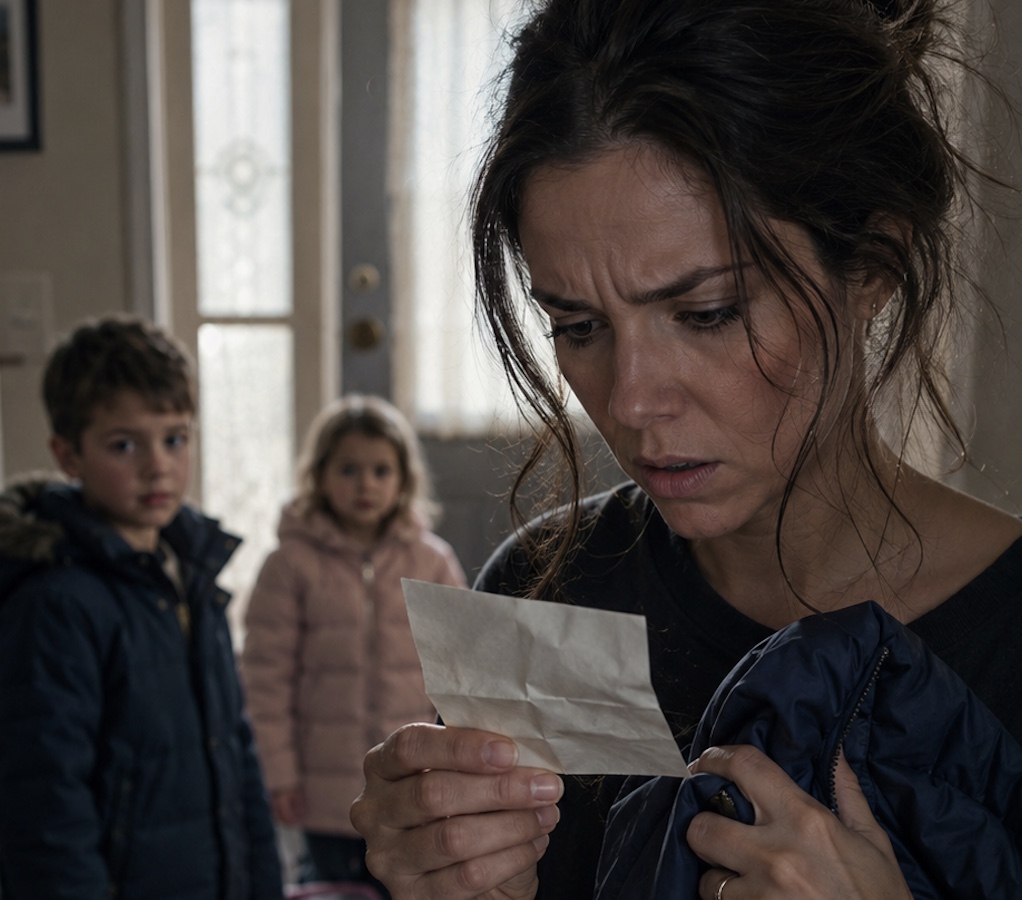
My sister-in-law dumped her kids on me for the weekend, but a note I found in my nephew’s jacket made me change the locks.
“Arina, if I don’t lie down right this second, you’ll be drawing up a posthumous deed of gift in my name!” Snezhana burst into my entryway with the grace of a damaged fighter jet.
Behind her stood Nikita and Sonya, frozen like two delayed-action missiles.
Nikita was clutching something that looked suspiciously like a half-melted lollipop, while Sonya was already reaching with terrifying determination toward my collection of porcelain cats.
“Snezhana, my weekend plan was silence and cucumber face masks, not a maximum-security kindergarten,” I said, blocking her way and feeling the peaceful comfort of my apartment shrink in fear.
“Arisha, you’re a rock. You’re the family’s granite foundation!” my husband’s sister declared theatrically, pressing the back of her hand to her forehead. “I have a migraine so massive I can hear the color of the walls, and my Yegor has gone on a business trip.”
She slipped past me with almost professional skill, leaving a sticky, sickly-sweet trail of cheap hand cream on my arm.
In Snezhana’s understanding, family ties were a one-sided contract: you owed her everything, while she simply had the privilege of existing beautifully.
“Just a couple of days, I swear on everything holy!” she sang, already producing two huge backpacks from behind her back — backpacks that did not exactly suggest a short visit.
The elevator doors clanged shut, and Snezhana vanished, leaving behind the scent of stale stress and a trail of promises she never intended to keep.
The entryway instantly became cramped, hot, and somehow suspiciously damp.
Nikita immediately planted his lollipop right onto the upholstery of my new armchair.
At that moment, I realized my home had been occupied without even a declaration of war, and my defense line had been breached at its weakest point.
“Aunt Arina, why is everything in your apartment so white? Do you work in a hospital?” Sonya asked, already testing the durability of my rug with her dirty sneakers.
I took a deep breath, trying not to release everything that had been building inside me for the past several years.
My husband, Oleg, carefully peeked out of his office, assessed the scale of the disaster, and instantly dissolved back into the space, hiding behind an “important call.”
“Oleg, come out! Your sister has once again used us as a storage unit for her life problems!” I shouted at the closed door.
In response, I heard only the cheerful but cowardly clicking of his keyboard.
In this family, being an “iron lady” meant only one thing: everyone felt free to hang any weight around your neck without worrying the structure might collapse.
I spent the entire evening in emergency-response mode: wiping walls, rescuing the cat from Nikita, and trying to feed them something healthier than chocolate bars.
Snezhana’s children had a phenomenal ability to generate chaos out of nothing.
“Aunt Arina, Mom said you never get angry because you have a calculator instead of a heart. Is that true?” Nikita asked, looking into my eyes while smearing leftover stew across his chin.
I said nothing, methodically picking up scraps of modeling clay from the floor — clay that had already managed to lodge itself deep into the gaps of the parquet.
Sometimes calmness is not a character trait. Sometimes it is the only way not to turn a family dinner into a thriller scene.
By midnight, when the little invaders finally surrendered to sleep, I started sorting through their things.
Nikita’s jacket was so dirty it looked as if he had spent the day digging up a neighbor’s vegetable garden.
I was shaking sand out of the pockets when my fingers touched a thick sheet of paper folded into four.
It was not a drawing. It was not a shopping list. It was something written in the broad, unmistakable handwriting of my sister-in-law.
“Survival Instructions for Arina’s Territory,” I read in a whisper, feeling a cold determination begin to pulse inside me.
The text was addressed to that same Yegor who had supposedly “gone on a business trip.”
Snezhana had cynically and in great detail described how she had tricked us in order to spend two weeks at the seaside.
“Oleg is spineless. He’ll grumble and then shut up. Arina will swallow it — she’s so proper it makes you sick. We’ll be in Sochi for fourteen days. I’ll turn off my phone and say there’s no signal in the mountains.”
I reread those lines, feeling my fingertips go numb from a strange, almost physical sensation of betrayal.
The ugliest thing about people is their confidence that your kindness is an unlimited resource.
Snezhana had never planned to return on Sunday.
She had simply dumped her children onto my territory like unwanted junk that interfered with her new romance.
I looked down at my hands. They burned from cleaning products and endless scrubbing.
At that moment, something clicked in my head — and it sounded exactly like the door of my patience locking forever.
I walked into the bedroom and switched on the bright light, not caring whether Oleg was asleep.
He jumped up, blinking in confusion and fumbling for his glasses.
“Get up, Oleg. It’s time to admit that your sister is not a ‘poor relative,’ but a calculating manipulator,” I said, throwing the note onto his pillow.
“Arina, why be so harsh? Maybe it’s just some kind of rough draft of a joke,” he mumbled after reading the first lines.
I looked at him in a way that made him instantly fall silent and start pulling on his trousers.
“Your sister thinks we’re idiots, Oleg. And the saddest part is that, until tonight, she was absolutely right.”
I knew very well that Snezhana had her own key to our apartment. She had begged for it “just in case” when we went on vacation the previous year.
My sister-in-law had dumped her kids on me for the weekend, but the note I found in my nephew’s jacket made me change the locks.
In the morning, I did not cause a scene in front of the children. They were only tools in their mother’s hands.
I called their father, Igor, whom Snezhana had forbidden them to see out of pure spite.
“Igor, the children are with me, and they miss you very much. Come take them for the full two weeks,” I said without looking at Oleg.
An hour later, the locksmith arrived — a gloomy man who assessed my door as “a miniature fortress wall.”
The sound of his drill was the most melodious sound I had heard in years.
“Putting in a good cylinder, ma’am? One you’d need dynamite to rip out?” the locksmith asked with a grin.
“Install the most reliable one you have. I want to sleep peacefully knowing that other people’s keys no longer work here,” I replied, watching the metal shavings fall.
Oleg tried to object. He paced around the entryway, called his sister, but her phone was, predictably, out of service.
His confusion was the logical result of years spent enabling someone else’s selfishness.
“Arina, this will be a lifelong scandal! What will Mom say? What will the relatives say?” he nearly shouted.
“Mom will say thank you when she realizes Snezhana is no longer draining money from her while hiding behind the children,” I said calmly, taking the new keys from the locksmith’s hand.
They were heavy, cold, and shiny — the perfect symbol of my new, protected reality.
I placed Snezhana’s suitcases outside the door and carefully taped that very note to them.
Three hours later, my phone began vibrating nonstop with calls and messages. Apparently, Snezhana had found “signal in the mountains.”
I answered only after Oleg and I had sat down for lunch in our perfectly clean, quiet apartment.
“What the hell are you doing, you psycho?! Where are my children? Why doesn’t my key fit your damn door?!” she shrieked so loudly that Oleg flinched.
“The children are with Igor. He’s delighted,” I replied, feeling an astonishing calm. “And your keys now fit only the doors of your imaginary world, where everyone owes you something.”
There was a pause on the other end, interrupted only by the noisy, uneven breathing of an offended “victim.”
“I won’t let you get away with this! I’ll tell everyone how you threw your niece and nephew out onto the street!” she screamed again.
“I’ve already scanned the note with your plan and sent it to the family chat, so your stories about mountains and Yegor’s business trips should be very entertaining,” I said, then ended the call.
Oleg silently stared down at his plate, and I could see the painful process of reassessment unfolding in his head.
For the first time in a long while, he did not try to defend his sister. The facts were too sharp to argue with.
That evening, the apartment smelled of freshness and silence — a silence I no longer intended to sacrifice for someone else’s convenience.
I sat in my favorite armchair, touched the new upholstery, and realized the world had not collapsed.
“You know,” Oleg said quietly, sitting down beside me, “I think I always knew she was like this. I was just afraid to admit it to myself.”
“Recognition is the first step toward recovery, Oleg. The second step is new locks,” I said, handing him one of the new keys.
We spent the evening simply talking to each other, without other people’s dramas and endless complaints interfering.
I looked at my hands. They were no longer sticky. They were clean — and they held my own life firmly.
Sometimes, to save a family, you first have to build a wall and fasten a reliable bolt onto it.
Snezhana still tried to attack us through other relatives, but screenshots of her “occupation plan” worked better than any shield.
Her image as a “poor little lamb” fell apart, revealing nothing more than ordinary, boring greed.
I understood something important: self-respect does not begin with loud declarations. It begins with quietly changing the locks on the doors of your soul.
The apartment felt larger, brighter, and somehow more right, as if we had finally thrown out old, rotting junk.
Life went on as usual, but now I was the one setting its rhythm — not the whims of my sister-in-law.
The next morning, I woke up to sunlight pouring through the window without meeting dust or chaos on its way.
Oleg was sleeping peacefully, and his face no longer looked so tense and guilty.
I went out into the entryway, touched the cold metal of the new handle, and smiled at my reflection in the mirror.
The fortress had been restored, and there was no longer any place in it for those who came only to destroy.
It was the best lesson of my life, and it cost me nothing more than one locksmith’s visit.
No one would ever again dare to use my patience as a doormat.
Now I knew for certain: being good for everyone means being no one to yourself.
My “no” had finally become as strong as the steel bolts on my new door.