The apartment was spacious — seventy-eight square meters, two bedrooms, an open kitchen-living room, and a well-planned layout. Nadezhda stood by the window, looking down at the courtyard with the children’s playground. It was the kind of place where a person wanted to live. The kind of place where she could imagine a future — children, family dinners, quiet evenings together.
“Are we taking it?” Oleg asked, wrapping an arm around his wife’s shoulders.
“We’re taking it,” Nadezhda nodded.
The apartment cost six million four hundred thousand rubles. Nadya contributed three million two hundred thousand — every bit of savings she had put aside over eight years of working as an economist. She had saved slowly, ruble by ruble, denying herself vacations, expensive clothes, and entertainment. Oleg also contributed three million two hundred thousand. More precisely, that money was given to him by Lyubov Fyodorovna, his mother.
“Mom, thank you so much,” Oleg said on the day of the transaction, kissing his mother on both cheeks. “You really saved us.”
“Oh, come on, Olezha,” Lyubov Fyodorovna waved him off. “I’m doing it for you. I just want you to live well.”
Nadezhda thanked her too, sincerely. The help was significant, and she appreciated it.
The first year in the new apartment was happy. Nadezhda made the place feel like home, buying furniture, curtains, dishes. She worked, took care of the household, and dreamed of having a child. Oleg earned eighty-seven thousand rubles as a manager at a construction company; Nadezhda earned ninety-five thousand as a chief economist in a retail chain.
Lyubov Fyodorovna visited often. She helped with cooking and gave household advice. At first, Nadezhda was grateful for her involvement. Then she began noticing odd things.
“Nadya, these napkins are a bit cheap, aren’t they?” her mother-in-law remarked one day, examining the package. “If I were you, I’d have bought better ones.”
“These are fine,” Nadezhda replied, continuing to chop vegetables for the salad.
“Well, you know best,” Lyubov Fyodorovna pursed her lips. “Though I did help you buy this apartment. I thought you’d live properly.”
Nadezhda froze with the knife in her hand.
“Lyubov Fyodorovna, what do napkins have to do with that?”
“Nothing, nothing,” her mother-in-law turned toward the window. “I’m just saying.”
Comments like that became regular. If Nadezhda bought inexpensive towels, Lyubov Fyodorovna sighed that better ones could have been chosen with her money. If Nadya didn’t go to an expensive restaurant with her husband, her mother-in-law hinted that her son deserved better, considering how much had been invested in him.
“Oleg, please talk to your mother,” Nadezhda asked one evening. “She keeps reminding me about the money for the apartment.”
“So what?” Oleg replied without looking up from his phone.
“What do you mean, ‘so what’?” Nadezhda sat down beside him on the sofa. “It’s unpleasant. I put money into this apartment too. Exactly the same amount.”
“Mom just wants us to appreciate her help,” Oleg shrugged.
“I do appreciate it,” Nadezhda clenched her hands into fists. “But reminding me every week…”
“Nadya, don’t make a big deal out of nothing,” Oleg said, patting her on the head. “That’s just how Mom is. She needs to feel that her contribution matters.”
“And mine?”
“Yours matters too,” he agreed. “Just don’t pay attention. She’ll calm down soon.”
But Lyubov Fyodorovna did not calm down. With every visit, her hints became heavier, more persistent. Nadezhda felt irritation building inside her, but she held herself back. Oleg stayed silent, changed the subject, avoided conflict.
A year and a half later, something happened that changed everything. Nadezhda received a call from a notary.
“Nadezhda Igorevna, you are listed as the heir of Sokolova Antonina Markovna,” a male voice said over the phone.
Nadezhda sank into a chair. Antonina Markovna was a distant aunt on her mother’s side, someone she had seen once every five years. The elderly woman had lived alone in a provincial town and had no children. Nadezhda had visited her a couple of times, bringing groceries and medicine.
“I’m… the heir?” Nadezhda asked again.
“Yes. An apartment and financial assets. The total value of the inheritance is about five million rubles.”
Five million. Nadezhda hung up and sat for a long time, staring at one spot. Money like that could change a life. She could open the business she had always dreamed of — a small café or a handmade goods shop. She could invest in education, travel. It was freedom.
Oleg found out that evening. Nadezhda told him over dinner.
“Five million?” he repeated, his eyes lighting up. “Nadya, that’s amazing!”
“Yes,” she nodded. “I’m thinking of putting part of it into a business. I’ve wanted to open something of my own for a long time.”
“Wait with the business,” Oleg said, setting down his fork. “You know, Mom was just saying she needs help.”
“What kind of help?” Nadezhda became cautious.
“Well, her apartment is old, it needs repairs,” he said, pouring himself some water. “And besides, she helped us so much. Remember how she saved us with the apartment?”
“Oleg, she helped you,” Nadezhda pushed her plate away. “Not me. That wasn’t personal help to me.”
“What do you mean, not you?” he frowned. “You live here too.”
“I do,” Nadezhda agreed. “In an apartment for which I paid half the price. Exactly the same amount as your mother gave.”
“Yes, but still,” Oleg hesitated. “Mom is my mother. We should help her.”
“Then help her,” Nadezhda stood up from the table. “With your own money. The inheritance is mine. Personal.”
Oleg wanted to argue, but his wife had already gone into the bedroom.
Two days later, Lyubov Fyodorovna called.
“Nadyusha, congratulations on the inheritance!” her mother-in-law’s voice sounded syrupy sweet. “Olezha told me. Wonderful news, isn’t it?”
“Thank you, Lyubov Fyodorovna,” Nadezhda replied carefully.
“Listen, I was thinking,” her mother-in-law lowered her voice. “You know my apartment is in poor condition. The plumbing is old, the wallpaper is peeling. Maybe you could help a little? Five hundred thousand would be enough for repairs.”
Five hundred thousand. A tenth of the inheritance.
“Lyubov Fyodorovna, I can’t,” Nadezhda said firmly. “That is my personal money. I plan to invest it in a business.”
“What business?” her mother-in-law’s voice turned cold. “Nadya, I helped you buy an apartment. You live there because of my money.”
“I live there because of my money too,” Nadezhda replied. “The money I put into that apartment. Equal to yours.”
“So you’re refusing?” Lyubov Fyodorovna asked in disbelief.
“Yes,” Nadezhda answered shortly. “I’m refusing.”
“Ungrateful,” her mother-in-law snapped, and hung up.
The following weeks turned into hell. Lyubov Fyodorovna called every day. She came over without warning. She cried about her terrible living conditions. She said she had to save money on food. She pressed on pity, conscience, and guilt.
Oleg supported his mother.
“Nadya, just help her a little,” he pleaded. “Two hundred thousand, then. Not five hundred — two hundred. With five million, that’s nothing to you.”
“Oleg, I already said no,” Nadezhda said, ironing clothes without lifting her eyes.
“You’re selfish,” he threw at her. “My mother is in need, and you only think about yourself.”
“I’m thinking about my future,” Nadezhda switched off the iron and turned to him. “About our future too, if you want. This money could give us stability.”
“Stability?” Oleg scoffed. “We’re stable enough. But Mom…”
“Your mother can ask you for help,” Nadezhda interrupted. “Why is she demanding it from me?”
“Because I don’t have money!” he raised his voice. “And you do! You’re just being greedy!”
Nadezhda turned and left the room. The conversation was over.
The pressure intensified. Lyubov Fyodorovna began coming over in the evenings. She sat in the kitchen, drank tea, and spent hours talking about her problems — leaking pipes, a freezing balcony, the shame of inviting friends to such an apartment.
“Nadya, surely you understand,” her mother-in-law would say, taking her hands. “I did everything for you. I worked my whole life for Olezha. I thought my children would support me in my old age.”
“I am not your child,” Nadezhda reminded her. “And you gave the apartment money to Oleg, not to me.”
“But you use it!” Lyubov Fyodorovna snapped. “You live in that apartment!”
“And I paid for it,” Nadezhda repeated tiredly. “Half of it.”
Oleg stayed silent. He sat nearby, staring at his phone. He did not defend his wife. He did not tell his mother to stop. He simply stayed silent.
One evening, Lyubov Fyodorovna came for dinner. Nadezhda was making chicken with vegetables. Her mother-in-law sat at the table while Oleg set it.
“Nadyusha, I wanted to talk to you once more,” Lyubov Fyodorovna began when they had all sat down.
Nadezhda tightened her grip on her fork.
“About what?”
“About the money,” her mother-in-law said directly. “I can’t postpone the repairs anymore. The apartment is falling apart. I need your help.”
“Lyubov Fyodorovna, I have already answered,” Nadezhda placed her fork on the table. “No.”
“But why?” her voice trembled. “I’m not a stranger to you! I’m your husband’s mother! I helped you buy a home!”
“You helped Oleg,” Nadezhda met her eyes. “Not me. I never borrowed money from you. I never asked you for help. And I owe you nothing.”
“You do owe me!” Lyubov Fyodorovna slammed her palm on the table. “You live on my money!”
“On my own money,” Nadezhda said without raising her voice. “On my three million two hundred thousand rubles, which I invested in this apartment.”
Oleg finally looked up from his plate. He looked at his wife, then at his mother, and said:
“You are obligated to invest in my mother’s home.”
Silence.
Nadezhda slowly turned her head toward him.
“What did you say?”
“I said you are obligated,” Oleg repeated, his voice firm. “Mom helped us. Now it’s your turn to help her.”
Nadezhda looked at her husband and no longer recognized the man she had lived with for four years. Obligated. The word echoed in her head. Obligated. Not “maybe we can help.” Not “let’s discuss it.” Obligated.
Without a word, Nadya got up from the table. Oleg and Lyubov Fyodorovna watched her.
“Nadya, where are you going?” her husband asked.
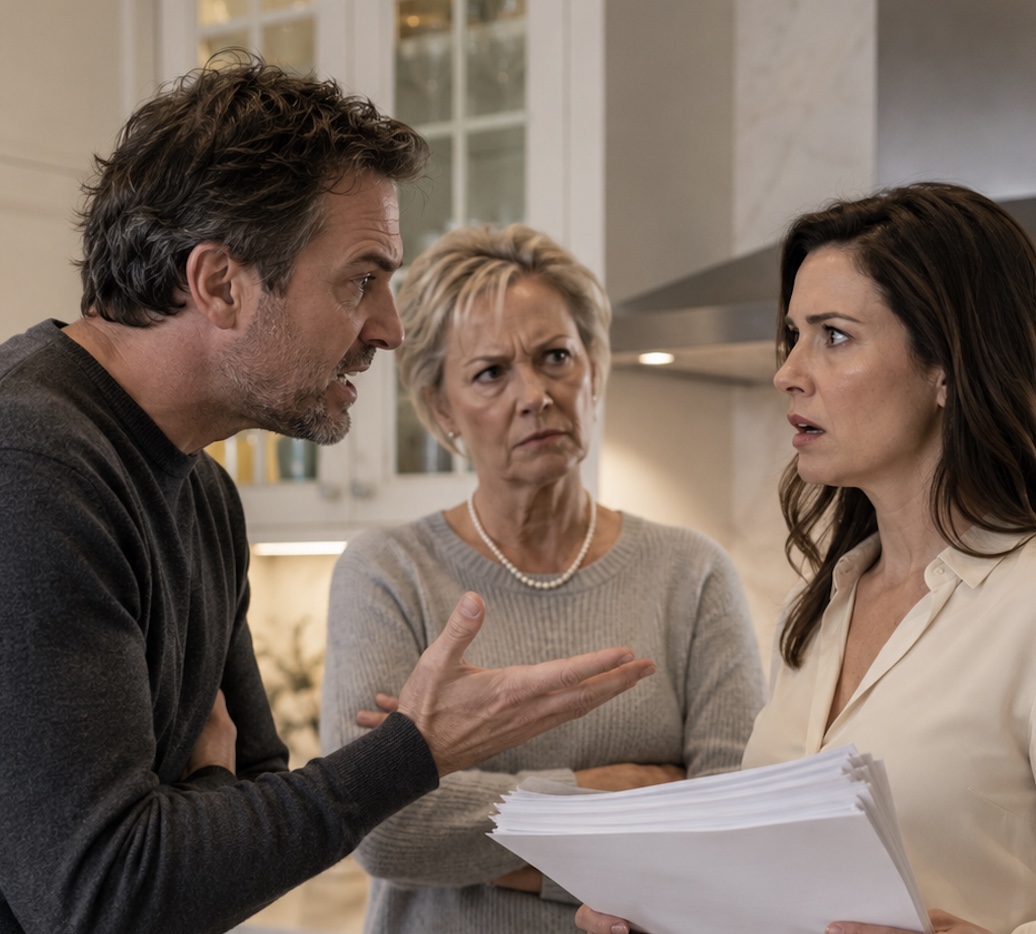
She did not answer. She went into the bedroom, opened the wardrobe, and took a folder from the back of a drawer. The very folder she had prepared two months earlier, when she realized the pressure would not stop. A divorce petition. Property division documents. Proof of the funds she had contributed to the apartment.
Nadezhda returned to the kitchen and placed the folder on the table in front of Oleg.
“What is this?” he asked, picking it up. He opened it — and turned pale.
Lyubov Fyodorovna leaned over to look inside. She gasped.
“This is a divorce petition,” Nadezhda said calmly. “And documents for dividing the apartment according to financial contributions. My share is fifty percent. Three million two hundred thousand rubles.”
“Nadya, have you lost your mind?” Oleg shouted, jumping up.
“No,” Nadezhda shook her head. “I’m just tired.”
“Tired?” Lyubov Fyodorovna also rose from her seat. “Tired of what? Of people helping you?”
“Of being reminded about that help over and over,” Nadezhda leaned her hands on the table. “Of being treated not as a person, but as a wallet.”
“You ungrateful egoist!” her mother-in-law yelled. “I helped you with housing, and you refuse me basic help!”
“You did not help me,” Nadezhda raised her voice, and Lyubov Fyodorovna fell silent in surprise. “You gave money to Oleg. Your son. Not to me. I never asked you for anything. I never borrowed from you. I bought this apartment with my own money too. And I have every right to my share.”
“Nadya, calm down,” Oleg tried to take her hand, but she pulled away. “Let’s talk about this calmly.”
“There is nothing to talk about,” Nadezhda took the folder back from the table. “I’ve made my decision. I’m filing for divorce.”
“Because of money?” Oleg could not believe it. “Because we asked you to help my mother?”
“Because you said ‘obligated,’” Nadezhda looked him straight in the eyes. “Because you never stood up for me. Because your mother has been pressuring me for two years, and you stayed silent.”
“I’m not pressuring anyone!” Lyubov Fyodorovna protested. “I’m simply asking for help!”
“You are demanding it,” Nadezhda answered coldly. “Demanding something you have no right to. The inheritance is mine. Personal. And legally, it is not subject to division in a divorce.”
“Legally?” Oleg repeated. “You’ve already been to a lawyer?”
“Yes,” Nadezhda nodded. “I checked everything. An inheritance received during marriage remains the personal property of the heir. Oleg has no right to it.”
Her husband sank into a chair, clutching his head. Lyubov Fyodorovna stood there with her mouth open, unable to say a word.
“So you planned all this?” Oleg whispered. “In advance?”
“I prepared myself,” Nadezhda corrected him. “Because I knew how this would end. I knew that sooner or later, the word ‘obligated’ would be said. And now it has.”
“Nadya, wait, let’s talk,” Oleg stood up and tried to embrace her. “I didn’t mean it like that. Forgive me. I lost my temper.”
“You meant exactly that,” Nadezhda stepped away. “You truly believe I am obligated to give my money to your mother. Because she once helped you.”
“Well… in a sense, yes,” he admitted. “Family should help each other.”
“Family should,” Nadezhda agreed. “But not at the expense of one person. Not under pressure and guilt. And not when that person has already said no.”
“So that’s it?” Lyubov Fyodorovna asked in a hollow voice. “You’re getting divorced?”
“Yes,” Nadezhda said firmly. “That’s it.”
The scandal lasted another two hours. Lyubov Fyodorovna shouted, accusing Nadezhda of destroying the family, of greed, of heartlessness. Oleg begged, swore he would change, promised he would never pressure her again. He promised to talk to his mother and set boundaries.
Nadezhda listened in silence. Then she went into the bedroom, took out a bag, and began packing her things.
“You’re seriously leaving?” Oleg stood in the doorway.
“Seriously,” she said, placing documents, cosmetics, and several sets of clothes into the bag.
“Where will you go?”
“I’ll rent an apartment,” she zipped the bag. “I have money.”
“Nadya, stay,” Oleg blocked her path. “Let’s discuss everything again. Calmly.”
“We have discussed it,” Nadezhda stepped around him. “Hundreds of times. The result is always the same — you are on your mother’s side. And I am tired of being alone.”
“You’re not alone! I’m your husband!”
“On paper,” Nadezhda picked up the bag. “Not in reality.”
She left the apartment without looking back. Lyubov Fyodorovna sat in the kitchen, sobbing. Oleg stood in the hallway, watching her go.
Nadezhda took the elevator down and stepped outside. She took out her phone and found the number of a real estate agency.
“Hello, I need to rent an apartment. Preferably today.”
They found a studio within an hour. Twenty-eight square meters, furnished, thirty thousand rubles a month. Nadezhda paid three months in advance and moved in that same evening.
That night, she could not sleep. She lay on a stranger’s bed in a stranger’s apartment and wondered whether she had done the right thing. Maybe she should have stayed. Maybe she should have tried again.
No.
The word “obligated” would not leave her mind. Oleg truly believed his wife had to give away her money. Not out of kindness. Not by choice. Out of obligation. And that meant he did not see Nadezhda as a partner. He saw her as a resource for his mother.
In the morning, Nadezhda called her lawyer.
“I’m filing for divorce. Can you start the process?”
“Of course,” the woman replied. “Come in, and we’ll prepare everything.”
The divorce dragged on for three months. Oleg tried to delay it, demanded a reconsideration of the property division, and challenged the apartment shares. Nadezhda’s lawyer submitted all the documents proving her contribution — the purchase agreement, bank statements, receipts.
The court ruled that the apartment would be divided according to the money invested. Fifty percent to each of them. Nadezhda received three million two hundred thousand rubles — her share. Oleg stayed in the apartment and took out a loan to buy out his ex-wife’s portion.
The five-million-ruble inheritance remained with Nadezhda as personal property, not subject to division. The court confirmed that money inherited during marriage is not considered jointly acquired marital property.
Oleg was furious. He called, sent messages, demanded a review. The lawyer answered briefly: the court decision was final.
Lyubov Fyodorovna spread gossip among mutual acquaintances. She told everyone how greedy and ungrateful Nadezhda was, how she had abandoned her husband over money. Nadezhda did not justify herself. Those who knew the truth supported her. The rest did not matter.
Six months after the divorce, Nadezhda opened a small café. She invested two million from the inheritance. The café was cozy — twenty tables, home-style food, pleasant music. The first months were difficult. Then regular customers began coming in. Then the café started making a profit.
Nadezhda worked hard — from morning to night, without days off. But it was her work. Her business. Her choice. No one said, “You are obligated.” No one demanded an account of where the money went.
One evening, a year after the divorce, Oleg walked into the café. Nadezhda was wiping the bar counter when her ex-husband sat at a table by the window.
“Hi,” he said when she approached with the menu.
“Hi,” Nadezhda handed it to him. “What would you like?”
“Coffee,” Oleg took the menu but did not open it. “And I want to talk to you.”
“About what?”
“About us.”
Nadezhda sighed.
“Oleg, there is no us anymore. We divorced a year ago.”
“I know,” he nodded. “I just wanted to say… you were right.”
Nadezhda raised her eyebrows.
“About what?”
“Everything,” Oleg rubbed his face with his hands. “Mom really was pressuring you. And I didn’t protect you. I thought she was just caring. But she was manipulating.”
“What changed?”
“She started pressuring me,” Oleg admitted. “After the divorce, she demanded that I sell the apartment and buy her a house. She said I was obligated. The same word.”
“And then you understood what it felt like,” Nadezhda said, sitting down across from him.
“I did,” Oleg nodded. “I’m sorry. Truly sorry. I was an idiot.”
“You were,” Nadezhda agreed. “But it’s too late.”
“I know,” he lowered his eyes. “I just wanted to say it. And… congratulate you. On the café. You did well.”
“Thank you.”
They drank coffee and talked a little more about work, life, and plans. Then Oleg left. Nadezhda watched him go and asked herself whether she felt regret.
No.
Sadness? A little.
But not regret.
That night, Nadezhda sat in her own apartment — a one-room place she had bought with the money from the property division and part of the inheritance. Her own. Only hers. No one could come in and say, “You are obligated.” No one demanded explanations. No one pressured her.
Her phone vibrated. A message from a friend: “How are you?”
“Good,” Nadezhda typed. “Really good.”
And it was true.
For the first time in many years, Nadezhda felt free. Free from other people’s expectations, demands, and manipulation. Free to live the way she wanted.
The café was doing steadily well. Two years later, Nadezhda opened a second one. Then a third. A small chain of cozy home-style cafés where people could sit comfortably, drink good coffee, and eat warm, homemade food.
Oleg remarried. Nadezhda saw the photos on social media — a young wife, a wedding, smiles. Lyubov Fyodorovna was beside her son in every picture. Nadezhda smiled faintly. She wondered how long the new daughter-in-law would last.
As for Nadezhda, she was in no hurry to start a serious relationship. She met people, went on dates, but did not let anyone get too close. Maybe it was still too soon. Maybe she simply had not met the right person. Or maybe she had learned to value solitude.
One evening, sitting in her café with a cup of tea, Nadezhda thought about what would have happened if she had given in back then. If she had handed the money to Lyubov Fyodorovna. If she had stayed silent when Oleg said she was “obligated.”
Most likely, the demands would have continued. Again and again. Until the inheritance was gone completely. And in return, there would have been no gratitude. Only new demands.
Nadezhda took a sip of tea and smiled.
It was good that she had not given in.
Good that she had found the strength to leave.
Good that she had finally put herself first.
The café filled with evening visitors. Soft music played in the background. Nadezhda looked around and thought: this was happiness.
Not marriage to a man who did not understand boundaries. Not pleasing a mother-in-law who confused help with control. But the freedom to choose her own life.
And that was priceless.