“Marinochka, don’t be offended, but Larisa needs it more.”
Those words, written in my mother-in-law’s neat handwriting on the back of an electricity bill, stood out white in the crack between the gate and the post.
I stood there staring at them. In my hands were bags of expensive hydrangeas, heavy and smelling of damp peat.
And above the note hung a new lock. Shiny. Arrogant. With a laser-cut keyhole. My old “crab” lock, the one I had oiled myself every spring, was lying in the dust. Cut through with an angle grinder.
Something short-circuited in my head. You know, like an old television: a pop, and the screen goes black.
“Galina Petrovna,” I whispered into the empty air, “you really shouldn’t have done this. I warned you: if it ever came to betrayal, I would take everything from here down to the last nail.”
“Marina, is that you?” Nyura suddenly popped up from behind the neighbor’s picket fence.
As always, she had a mug of tea in her hands and pure curiosity in her eyes.
“Well, Nyura, they changed the lock. My key doesn’t fit.”
Nyura took a sip, smacked her lips, and leaned closer.
“So they were here yesterday, running the place like they owned it. Petrovna, Larisa, and Larisa’s husband. Larisa kept touching your garden furniture in the gazebo, nearly fainting with delight: ‘Oh, we’ll sit here all summer!’ And Petrovna kept encouraging her: ‘Everything is ready. Move in and enjoy it. Marina polished every inch of this place.’ Good buyers, you know. Family.”
I looked down at my hands. A callus on my index finger from pruning shears. Nails that hadn’t seen a manicure in a month because of spring planting.
Ten years.
For ten years, I had poured every bonus I earned into this place. While my husband saved money by dodging child support, I built my own little world here. Manure at fifteen thousand per truckload. A German pump. A greenhouse for forty-five thousand.
Larisa needs it more.
I got into the car and called my mother-in-law.
The phone rang for a long time. Finally, her voice floated into the receiver, sweet and syrupy.
“Hello, Marinochka? Are you at the dacha? Oh, I forgot to warn you…”
“Galina Petrovna, what is this note? Why has the lock been changed?”
She sighed on the other end. Heavily. Martyr-like.
“Well, you understand, my dear. Larisa has a loan. And the dacha is registered in my name. I’m a mother, I had to help. Larisa bought it from me. Just symbolically. We’ve already signed everything. You’re kind, Marinochka. Larisa needs it more. Don’t be so petty. We’re family.”
“Family?” I straightened in my seat. “Galina Petrovna, I broke my back for this ‘family’ for ten years.”
“The dacha is mine on paper!” my mother-in-law’s voice instantly turned hard. “I have the right. And your things… Larisa said they’ll move them to the garage. If she remembers.”
The call ended with a beep. She had hung up.
I sat there listening to the engine cool down.
Tick. Tick. Tick.
Fine.
If Larisa needed it more, then let her use what belonged to her.
And what belonged to her here was bare land and an old rotten shed from God knows what year.
The Japanese Screwdriver
The cargo taxi arrived an hour later.
Two men in stained work pants watched silently as I climbed over the fence.
“Ma’am, are we stripping the house?” asked the older one, Sergei.
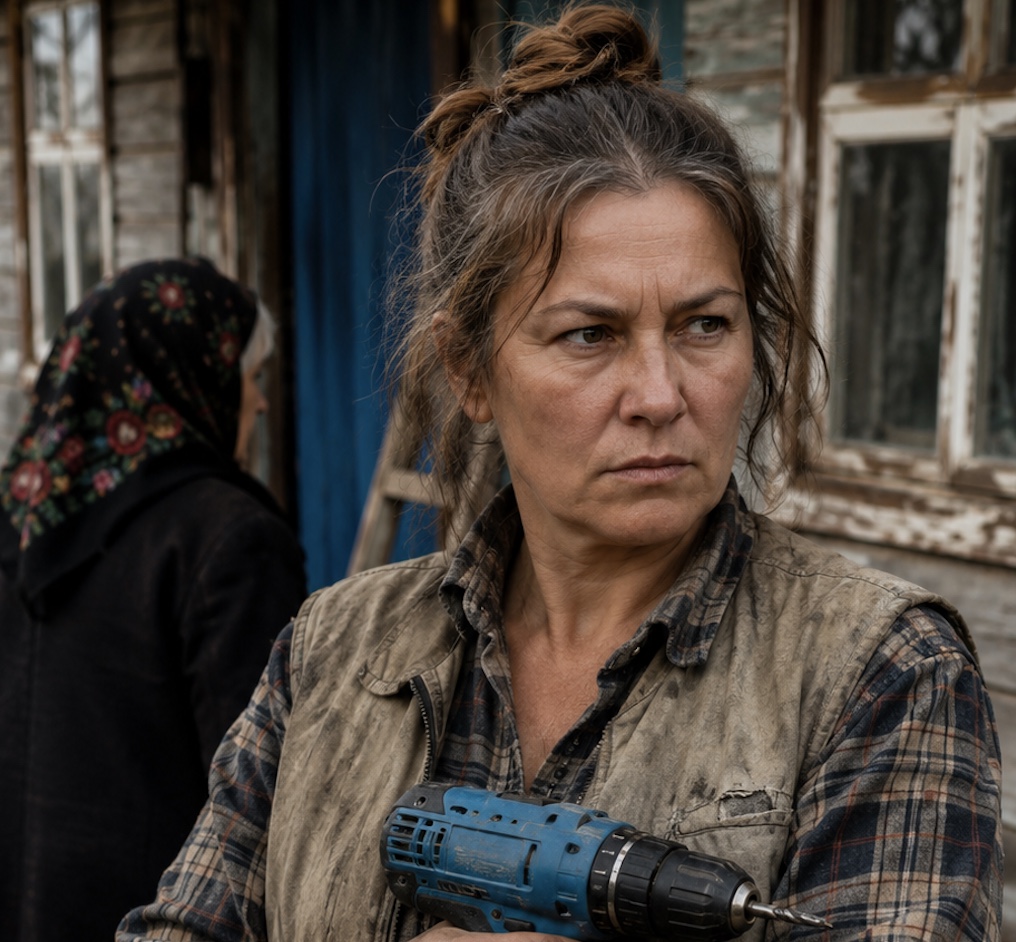
I pulled a blue case from my bag.
My faithful Japanese cordless screwdriver. I had bought it myself after realizing that waiting for a man to put up a shelf was like waiting for snow in July.
“We are taking my property, Sergei. I have receipts. Invoices for the structures. We work quickly.”
I started with the little house.
Whirr-whirr.
The first screw came out of the door hinge.
Whirr-whirr.
The second.
The door I had installed last year gave way gently. It was expensive, insulated, with a thermal break. Heavy.
“Listen, ma’am,” Sergei hesitated, looking at the empty doorway. “What if they call the police?”
“Let them. I have receipts for every nail. All they have are bare walls.”
We removed the windows.
The plastic resisted. The foam cracked like dry bone. I cut it myself with a knife, scraping my fingers raw.
Then we moved to the greenhouse.
Forty-five thousand. Premium polycarbonate.
The bolts had rusted tight. The hex key slipped. My palm burned from the pressure.
“Forget it, ma’am,” muttered the second worker. “We’ll kill ourselves trying to take this apart.”
Without a word, I grabbed the WD-40 and sprayed the rusty threads.
“I said I’m taking everything down to the last nail. Turn it.”
I saw Sergei look at me.
Maybe with respect. Maybe with fear. I don’t know.
But he picked up the wrench.
Factory Reset
The sound of tearing polycarbonate was pitiful, almost like a cry. The sheets came off and were rolled up.
“Take the pump out of the well too,” I ordered. “And the fittings. Every adapter. Everything.”
Nyura was no longer drinking tea behind the fence. She was gripping the pickets with both hands.
“Marina! You’ll give her a heart attack! This is vandalism!”
“No, Nyura. This is an inventory check. Larisa bought the land? Let her enjoy the land.”
I picked up a shovel.
The soil was heavy and dense. I dug.
First came the currant bushes. Special varieties I had nursed for three years. Into black bags they went, roots wrapped in wet burlap.
Then the hydrangeas. The ones already planted in the ground.
My lower back ached. Sweat ran into my eyes.
“Ma’am, should we take apart the gazebo?”
I looked at the gazebo.
My brother and I had built it together. I had varnished every board myself in three layers. I still remembered the smell of that varnish — sharp, resinous, biting. I remembered how my back had almost split in half afterward.
“Take it apart. Down to the foundation.”
By four o’clock, the plot looked like a film set after the cameras had left.
Empty.
Where the greenhouse had stood, there were black strips of dug-up earth. Instead of a cozy little house, there was a box with hollow eye sockets.
Even the pump was gone. A lonely piece of cable stuck out of the well.
One Final Detail
I stood in the middle of the wreckage.
In my hand was an old kitchen knife I had used to trim the hosta roots.
Then I went into the shed.
It was the only place I hadn’t touched. It had been there before me.
On the shelf stood a teapot. Enamel, with a chipped spout.
The very one Galina Petrovna had loved drinking tea from, saying, “Oh, Marinochka, it feels so lovely here.”
I took that teapot and carried it to the middle of the plot.
I placed it right on the ground, in the center of what used to be the flower bed.
And beside it, I planted a thistle.
A huge, vicious one.
There you go, dear relatives.
Your garden.
“That’s it, ma’am,” Sergei called out. “The truck is full. Where are we taking everything?”
“To the city. To storage.”
Karma With Delivery
I was already on the highway when my phone started screaming.
Larisa called.
Then Galina Petrovna.
I put it on speaker.
“WHAT HAVE YOU DONE?!” Larisa’s shriek hit my ears. “We arrived… we brought furniture… There’s nothing here! You stole the windows!”
“I didn’t steal anything, Larisa. I took what was mine. I have receipts. Witnesses will confirm that I didn’t break anything. I carefully dismantled it.”
“Mom fainted! The police are on their way!”
“Let them come. But first, explain to them on what basis you planned to use my windows. The dacha is yours? Use it. Plant potatoes in the clay. You’re young and strong. You need it more.”
I ended the call.
Ten minutes later, my ex-husband called.
“Marina, this is too much… Mom is crying. Her blood pressure is almost two hundred. Why did you do this? You could have left it. We’re family…”
“Vadik, family is when people value you. When they use you, that’s exploitation. Want to help your mother? Buy her a new greenhouse. You always had ‘extra money’ for everything — just never for child support.”
Blocked.
Silence.
A Garden on the Balcony
A month passed.
My city balcony turned into a jungle. The hydrangeas are doing wonderfully in tubs. I took the peonies to my sister — they’re loved there.
They say Larisa tried to plant something on that “bare land.”
But without the pump, without cover, without the ten-year layer of fertilizer I carried away together with the turf around the bushes, nothing grew.
The soil turned out to be heavy gray clay.
Galina Petrovna called everyone she knew, telling them about my “black ingratitude.”
But for some reason, half of those people stopped greeting her.
Apparently, everyone has had their own Larisa at some point.
Now I sit on my balcony and drink coffee.
In the corner stands a blue case.
My cordless screwdriver.
I look at my flowers and feel it clearly:
I am home.
A garden is not a place. It is what you carry in your hands. And no one can take your labor away from you unless you allow them to.
I took everything down to the last nail.
And that nail is no longer stuck in my heart.
What would you have done in Marina’s place? Stayed silent for the sake of peace with a former family, or taken back what was yours down to the last splinter?
Sometimes it is important to say these things out loud and feel supported when it seems like the whole world is against you.