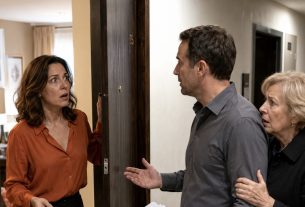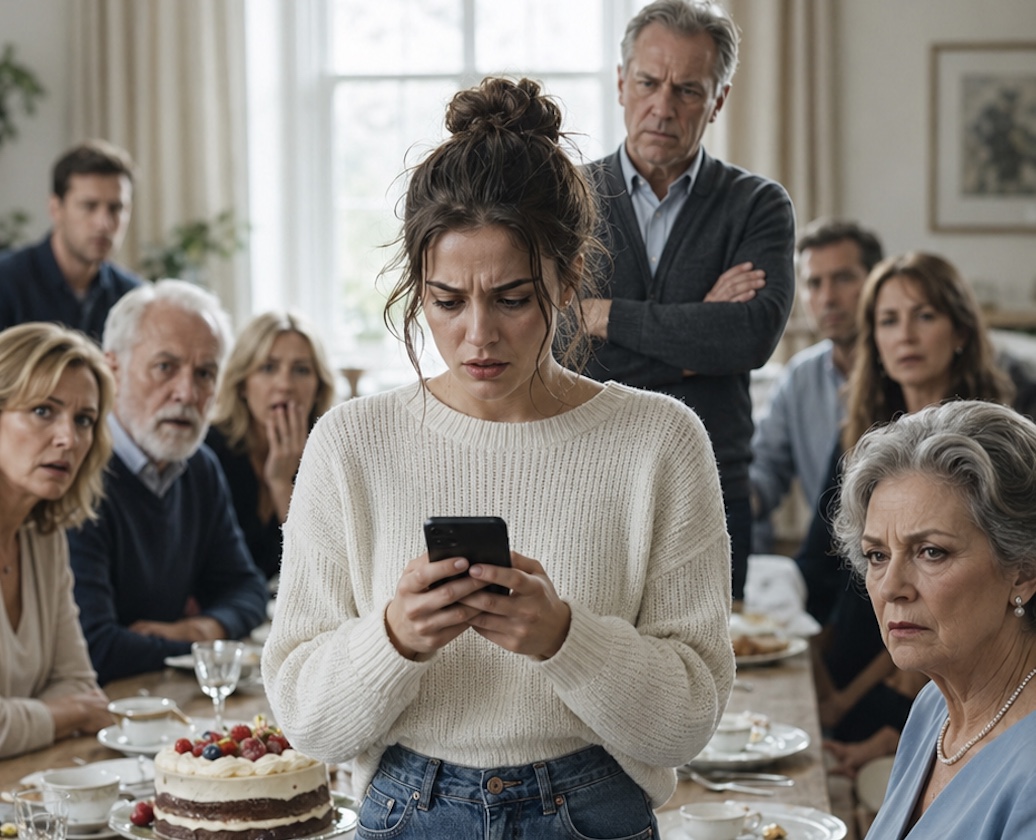
“Finally,” she said loudly enough for everyone at the table to hear. “I was beginning to think our daughter-in-law wasn’t going to show up at all.”
I had barely stepped inside. I hadn’t even taken off my coat yet. For twenty-two years, I had been hearing that voice, and every single time, it landed exactly where it hurt most.
Zinaida Petrovna stood in the doorway of the living room, broad-shouldered, wearing her favorite pale blue dress, her hair clearly done that morning. She was seventy-eight, yet her back was still straight. And her gaze was the gaze of a woman who had spent her whole life believing everyone owed her something.
“We’re not late,” Viktor said beside me.
He said it calmly, without irritation. That was a bad sign. When he was calm around his mother, it meant he had already started drinking that morning.
I hung my coat on the rack myself. No one offered to help.
There were about twenty-five people at the table: Zinaida’s neighbors, her friends from the garden community, a cousin from Ryazan whom I had seen maybe three times in my entire life. And our children with Viktor — Anton, twenty-six, who had come without his wife and was sitting by the window staring at his phone, and Natasha, twenty-three, who had settled next to her grandmother and was helping arrange the appetizers.
I walked to my seat — the far end of the table, between the cousin from Ryazan and old Semyon Arkadyevich, who only heard every other word.
That was how it always was.
I was always seated farther away.
For twenty-two years, I had been coming to this house. For twenty-two years, I had set tables, washed dishes, brought gifts. And for twenty-two years, I had sat at the far end while Zinaida Petrovna told her guests what a wonderful son she had.
“Vitenka, sit here, closer to me,” she called. “Ludochka has tied you to herself enough as it is.”
Two people laughed. The rest stayed silent.
Viktor sat next to his mother.
I picked up my fork and started eating salad.
The first toast was given by Semyon Arkadyevich — a long speech about health and long life. Then Viktor stood up and said something about “the best mother in the world.” Zinaida looked at him as if he had just returned alive from war.
“To Mom,” Viktor said, and drank.
That was his second glass in an hour.
I was counting.
Not because I wanted to. It was automatic now. In the fourteen years since the first time he hit me at home in the kitchen, I had learned to count glasses without thinking.
Two glasses meant loud.
Three meant unpredictable.
After four, I used to leave the room.
But here, there was no other room.
“Ludochka, aren’t you going to help?” Zinaida Petrovna asked when the women began clearing plates after the main course.
I was already carrying a stack of plates to the kitchen.
“I am,” I replied.
“I meant from the very beginning. Natashenka was here helping all morning, since ten. And you arrived right when it was time to sit down.”
Natasha blushed and stared at the tablecloth.
“Mom, I worked until one,” Viktor said. “Lyuda worked too.”
“Yes, yes,” Zinaida Petrovna said in a tone that meant, of course, I understand everything perfectly. “Work. Everyone works. But not everyone is so busy that they can’t come a little earlier for their own mother-in-law’s birthday.”
“We arrived on time,” I said.
Quietly, but clearly.
She looked at me. For a long moment.
“Of course,” she said, smiling at the guests. “Our Ludochka is always right.”
Someone giggled.
I carried the plates into the kitchen, set them by the sink, and stood there for a few seconds, staring out the window. Outside, it was December — gray and wet. I told myself that in three hours it would be over. We would get in the car, drive home, and I wouldn’t have to see this house again for another two months, until the next occasion.
That was how I had calmed myself for the last fourteen years.
Three more hours.
Two more hours.
One more hour.
I returned to the table.
Viktor was already pouring his third glass.
The cake was brought out at half past five. Beautiful, three tiers, decorated with little roses. Natasha carried it in both hands like a sacred relic, and everyone applauded.
“Oh, how lovely!” said the cousin from Ryazan. “Vitya, did you order it?”
“Lyuda ordered it,” Anton said from the window, without looking up from his phone.
And I had. I had called the bakery two weeks earlier, explained what we needed, and paid four thousand eight hundred rubles. Then I had picked it up myself and carried it in the car on my lap so it wouldn’t get ruined.
Zinaida Petrovna looked at the cake.
Then she looked at me.
“Lyuda, you know I don’t like roses,” she said.
Not loudly, but loudly enough for the table to hear.
“You never told me that,” I replied.
“I thought that after twenty years, one might remember.”
The table fell quiet.
Not completely silent — the conversations simply died down, and several people turned their heads.
“The sponge looks good, though,” said Semyon Arkadyevich, who apparently hadn’t heard anything.
“Of course, of course,” Zinaida Petrovna said, smiling again. “Thank you, Ludochka.”
That “thank you” was worse than any accusation.
Viktor said nothing during the entire exchange.
He just stared into his glass.
After the cake, Semyon Arkadyevich began telling some long story about his dacha, full of details. Zinaida nodded. Natasha was washing dishes in the kitchen; I could hear the water running.
Viktor stood up, took the bottle from the table, and poured himself a fourth glass.
I felt my hands go cold.
They always went cold first. As if the blood retreated somewhere deep inside, hiding.
Fourteen years.
Six times.
I counted every one.
The first time was in the kitchen, when I said I was tired and didn’t want to go to his mother’s house on Sunday. He didn’t shout. He simply hit me. An open-handed slap from the side. I fell against the refrigerator with my shoulder, then sat on the floor for a long time, unable to understand what had just happened.
Afterward, he cried and said it would never happen again.
I believed him.
For four years, I believed him.
The second time was when I found messages on his phone. That time he hit harder — with his fist, in the shoulder. I couldn’t lift my arm for three days.
The third, fourth, and fifth blurred together in my memory.
Always after drinking.
Always behind a closed door.
Always with the same words:
“You brought it on yourself.”
The sixth time was a year and a half ago. He shoved me on the stairs. I fell and struck my elbow against the railing. The bruise stayed for a week.
After the sixth time, I called Galya.
Galya was my friend from university. We had been friends for thirty years. She worked at a legal consultation office, and her husband was a retired investigator. When I told her everything — everything, including the first time in the kitchen fourteen years earlier — she was silent for a long time.
Then she said:
“Lyuda. Write down this number. It’s the district police officer for our area. If anything happens, call immediately. Not later. Not tomorrow. Immediately.”
I saved the number in my phone under the name “Galya-2,” so Viktor wouldn’t notice.
That was a year and a half ago.
Viktor suddenly stood up from the table so sharply that his chair scraped across the parquet.
“Mom, tell them about Ryazan,” he said.
Not to me.
To his mother.
Zinaida Petrovna blossomed and began talking about some nephew who had supposedly done very well for himself. Viktor listened while standing, holding his glass, looking at his mother with an expression I hated.
Soft.
Almost childish.
He always looked at her that way — as if, beside her, he became a little boy again, someone who didn’t need to explain anything and could never be held responsible.
“And our Ludochka works in accounting,” Zinaida suddenly said, switching from Ryazan to something else entirely. “She counts numbers. But there’s never any time left for family.”
“Grandma,” Anton said from the window.
“What do you mean, ‘Grandma’? I’m telling the truth. Vitenka has been carrying everything alone his whole life. She never once brought him lunch at work. I brought lunch to Vitya’s father every day. For twenty years.”
“Times were different,” Anton said.
“Times are always the same. Either you love someone, or you don’t.”
I looked at Zinaida Petrovna.
She was looking at me with the same smile — calm and triumphant.
Twenty-five people at the table.
Twenty-five witnesses.
“Zinaida Petrovna,” I said evenly, “I work full-time. Viktor works full-time. There is no need for me to bring him lunch. We are adults.”
“Of course,” she said.
“And I would be grateful if, on your birthday, you didn’t discuss my relationship with my husband in front of guests.”
The table fell silent.
Truly silent this time.
Even Semyon Arkadyevich stopped talking.
Zinaida Petrovna pressed her lips together.
“I’m only saying what I think.”
“I hear you,” I replied.
And I said nothing more.
I reached for my glass of water.
My hand was cold.
Ten minutes later, Viktor came over to me. I was standing by the window — I had stepped away from the table under the excuse that it was stuffy. Outside, it was already completely dark, and windows glowed in the neighboring buildings.
“Why did you do that?” he said quietly.
“Do what?”
“Talk back to my mother.”
I turned to him.
He had already finished his fourth glass. I could tell by the way he stood. His feet were planted a little wider. His chin was lifted just slightly.
“Viktor,” I said, “I asked her not to discuss our relationship in front of strangers. That isn’t rudeness.”
“Strangers? This is her home. Her guests.”
“All the more reason.”
“Do you even understand how old she is? Seventy-eight. It’s her birthday. And you decided to start defending your rights here.”
“I wasn’t defending my rights.”
“You were!” His voice rose. Not much, but in the silence after our earlier conversation, it sounded loud. Several heads turned. “It’s always like this. We come to visit, and you always have to make a scene.”
“Viktor.”
“What — Viktor? My mother is right about you. She has been right for a long time.”
I didn’t answer.
I just looked at him.
He hates it when I stay silent. To him, silence is a challenge. I didn’t know that before. Now I do — and sometimes I stay silent on purpose.
“What are you staring at?” he said.
And he stepped closer.
I didn’t move back.
I stood by the window and looked at him.
“Viktor, don’t.”
“Don’t what?”
“This.”
“What do you mean, ‘this’?” He no longer bothered lowering his voice. “Are you out of your mind? This is my mother, do you understand? My mother! And if you don’t like something, you don’t have to come here at all!”
“Fine,” I said.
He froze.
He clearly hadn’t expected that.
“What?”
“Fine. I won’t come here anymore.”
He stared at me.
Something changed in his face. That calm, childish look he had brought back from sitting beside his mother disappeared. Something else replaced it.
“You…” he began.
And then he raised his hand.
I didn’t have time to step away.
I only managed to close my eyes for a fraction of a second.
The slap landed across my cheek.
An open palm. A sharp motion.
Not strong enough to knock me down, but I stumbled and hit my elbow against the windowsill.
There were about twenty-five people in the room.
They all saw it.
The silence lasted maybe three seconds.
Then someone gasped.
I think it was the cousin from Ryazan.
Natasha came out of the kitchen with a towel in her hands and stopped in the doorway.
Zinaida Petrovna sat at the head of the table and said nothing.
Her face looked as if nothing had happened.
As if she were simply looking out the window at the snow.
Viktor stood in front of me.
His hand was still raised.
I didn’t cry.
I didn’t scream.
I took my phone out of my pocket and dialed the number.
“Lyuda,” Viktor said.
I didn’t answer him.
I listened to the ringing.
“Lyuda, put the phone away.”
“Hello,” I said when someone picked up. “This is Lyudmila Sergeyevna Krylova. I need help. My husband hit me. I am at the address…”
I gave Zinaida Petrovna’s address.
Clearly, syllable by syllable, so they would understand correctly.
Viktor took a step toward me.
Anton stood up from his seat and got between us before I even realized he had moved.
“Dad,” Anton said.
Quietly.
But in such a way that Viktor stopped.
I finished the call, put my phone away, and walked to my place at the table. I took my purse from the back of the chair. My coat was in the hallway.
“Lyuda,” Viktor said behind me, “you’re insane.”
I put on my coat.
Buttoned it.
All of it.
Zinaida Petrovna was still sitting at the table.
Watching me.
“You always said,” I told her, “that your son would never hurt a woman. You told me that in the first year after we got married. Do you remember?”
She said nothing.
“Today, twenty-five people saw him hit me. Now they know too.”
I went out into the hallway.
I didn’t slam the door behind me.
I simply pulled it closed.
Outside, it was cold. December. Wet snow. A streetlamp was flickering across the road. I stood by the entrance and waited.
Eleven minutes later, a car with a blue stripe pulled into the courtyard.
Two officers entered the apartment. Both were young — one of them very young, maybe twenty-five. The other was older, around forty, with a mustache.
I followed them inside.
Viktor was standing in the corridor. No glass in his hand now. He looked soberer somehow — or maybe just frightened. The guests were huddled in the living room. No one came out.
“Viktor Andreyevich Krylov?” asked the older officer.
“Yes,” Viktor said.
His voice had dropped.
“There has been a report of assault. Come with us.”
“This is a misunderstanding,” Viktor said. “It’s a family matter. My wife just…”
“Come with us,” the officer repeated.
I stood by the wall and watched.
Natasha was still holding the towel and watching too.
Anton stood beside me, shoulder to shoulder.
He said nothing.
The handcuffs clicked quietly.
Not loudly at all. I had expected it to sound like in the movies. But no. Just a soft metallic click.
Viktor looked at me.
For a long moment.
“You’ll regret this,” he said.
I didn’t answer.
They led him out.
The door closed.
There were twenty-four people left in the apartment.
And me.
Zinaida Petrovna was sitting in the armchair by the window.
For the first time in twenty-two years, I saw her confused.
“Why?” she said.
Not to me.
Just into the room.
“Because it was the sixth time,” I answered. “Fourteen years. And the sixth time.”
I took my purse, said goodbye to Anton with my eyes, and left.
Outside, the snow was no longer wet. It was dry and light.
The first real snow of that December.
I walked to my car, got in, and placed my hands on the steering wheel.
They were still cold.
Then I called Galya.
“Galya,” I said when she answered. “I called.”
She was silent for a second.
“How are you?”
“I’m fine. My cheek hurts a little. But I’m fine.”
“You did the right thing,” she said softly.
I sat in the car for another twenty minutes.
Just sat there.
Snow was falling outside.
The streetlamp across the road had stopped flickering. Apparently, someone had fixed it.
Then I started the car and drove home.
The next day, I changed the locks.
The locksmith arrived at nine in the morning, worked for an hour and a half, and charged me two thousand rubles. I stood beside him and watched as the old lock was removed.
Anton called that evening.
“Mom,” he said. “How are you?”
“I’m fine.”
“Dad is at Grandma’s now. He’s under a travel restriction.”
“I know.”
“Are you… are you going to withdraw the report?”
“No.”
He was silent.
“All right,” he said. “I understand.”
“Anton.”
“Yes?”
“You did the right thing. Back there, in the hallway. When you stepped in.”
He was silent for a long time.
Then he said:
“I should have stepped in sooner, Mom.”
I didn’t answer.
I hung up and went to the kitchen to put the kettle on.
Three weeks have passed.
Viktor is living with his mother. He called four times. I didn’t answer the first two. The third time, I picked up and said, “Through my lawyer.” He didn’t call back after the fourth.
Zinaida Petrovna sends messages through Natasha, saying I “ruined her son’s life.” Natasha repeats it to me with a face that says she feels terribly awkward.
I tell her, “It’s all right. She’ll get used to it.”
The case has been handed over to an investigator. My lawyer says it will most likely end with a fine and a suspended sentence. But it will still be a criminal record.
Forever.
I sleep peacefully now.
For the first time in many years, I don’t fall asleep with the feeling that I need to keep track of how much he has had to drink.
My cold hands went away.
On the second day, they were gone.
Just like that.
So tell me, ladies: did I do the right thing by calling right there, in front of all the guests, on my mother-in-law’s birthday? Or should I have simply left quietly and dealt with it at home?