“Look at the way he holds the pencil, Seryozha. Just look. No one in our family bends their fingers like that. That’s not the hand of a musician — it’s a shovel. Your grandfather had long, thin fingers, and what does he have? Short, broad ones. Flat nails. A completely foreign hand.”
Irina Viktorovna sat at the kitchen table with her back so straight it looked as if she had swallowed a ruler. Without blinking, she stared at five-year-old Pavlik. The boy, his tongue sticking out with concentration, was coloring some kind of tank in his sketchbook, paying no attention to his grandmother, who was studying him like some strange insect under a microscope. The kitchen smelled of fried onions and the faint trace of his mother-in-law’s expensive perfume — a heavy, sweet scent that always made Natalya feel slightly nauseous.
Natalya stood by the sink, rinsing foam from the plates. She tried to breathe evenly, silently counting to ten, but Irina Viktorovna’s calm, poisonous voice slipped into her mind like a thin needle.
“Mom, why are you starting again?” Sergey replied weakly. He was sitting across from his mother, turning an empty mug in his hands. There was no protest in his voice, only the weary obedience of a man who had been shown the same “obvious truth” a hundred times and was too tired to resist it. “Children grow. They change. I was chubby as a kid too.”
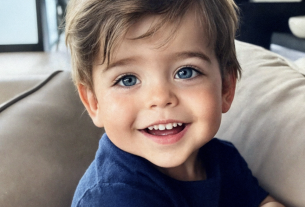
“You were chubby, but you had our eyes,” Irina Viktorovna said, carefully turning a page of the magazine in front of her without even looking at the pictures. “And him? Look at the shape. Deep-set, dark. Your eyes are gray. Natalya’s are blue. Where did that brownish-green shade come from? Genetics, my son, is an exact science. You can’t fool it with pretty words about love.”
Sergey raised his eyes to his son. For the first time that evening, he truly looked at the child. Until then, he had simply seen Pashka — a funny little boy in a stained T-shirt. But now, under his mother’s dictation, he began to see a collection of mismatches. His gaze moved over the boy’s dark hair, the shape of his ears that stuck out a little, the wide bridge of his nose. In Sergey’s mind, like pieces of a puzzle, an ugly picture began to form — a picture his mother had been helpfully supplying him with, piece by piece, for years.
“Natalya,” Sergey said, his voice dull, stripped of its usual softness. “Actually… whose ears are like that in your family? Your father’s were normal, weren’t they? Close to the head.”
Natalya turned off the water. The sound of the stream vanished, and the kitchen filled with the thick, sticky atmosphere of an interrogation. She wiped her hands on a towel, slowly turned toward her husband and mother-in-law, and looked at them. What bothered her was not even the suspicion itself — it was so absurd it almost failed to hurt. What hurt was how readily Sergey had joined this game of searching for flaws in his own son.
“His ears are perfectly ordinary, Seryozha,” she answered calmly, looking straight at him. “He’s a child. Cartilage is still forming. Are you seriously discussing your son’s ears while he’s sitting two meters away from you?”
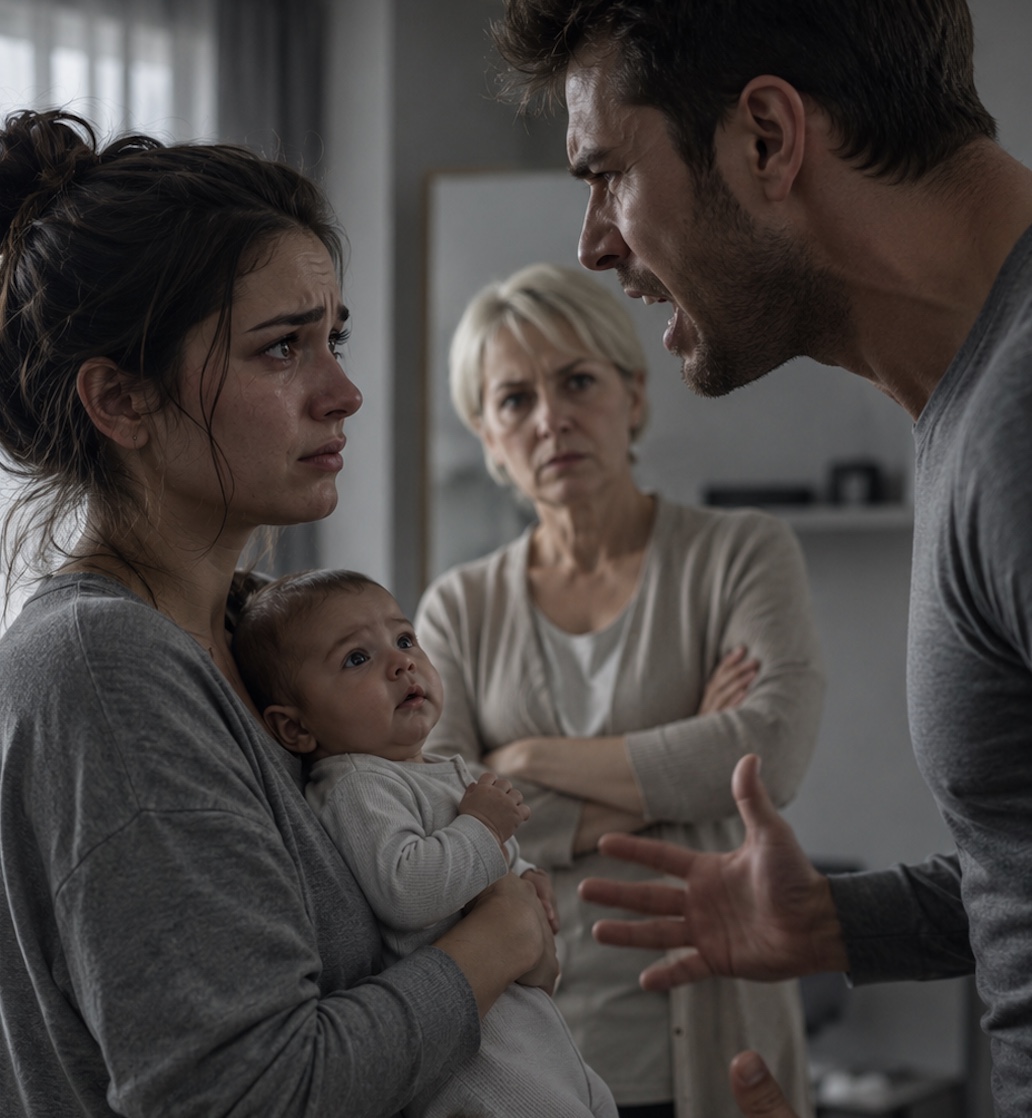
“And why shouldn’t we discuss it if there are questions?” Irina Viktorovna interrupted. She spoke softly and politely, as though she were asking someone to pass the salt. “Questions have been building up, Natalya. For a long time. Sergey is too delicate to ask directly, but as his mother, I can’t watch him suffer. He works himself to exhaustion, tries so hard, brings money into this home. And for whom? For the continuation of his bloodline? Or to feed the result of someone’s random affair?”
“What affair?” Natalya felt a cold anger begin to boil inside her. “Are you out of your mind, Irina Viktorovna?”
“I am perfectly in my mind, dear. But you, it seems, have forgotten how often Seryozha was away on business trips five years ago. Right around the time of this miraculous conception. Do you remember that month? He was in Surgut, and you were here, alone and bored. Or perhaps not alone? You had that ex-boyfriend with the motorcycle. What was his name? Vadim?”
Sergey pushed his chair back sharply. The legs scraped against the tile with an unpleasant screech. He stood and walked over to the window, turning his back on his family. His shoulders were tense. Natalya saw him clench and unclench his fists. She knew that gesture. He was searching for a decision, searching for a way out of his discomfort — and, as always, the easiest way was being handed to him by his mother.
“Vadim left the country two years before I got pregnant,” Natalya said sharply. “And Sergey knows that perfectly well.”
“Do I?” Sergey spun around. His face was pale, his lips pressed into a thin line. He looked at his wife as though he were seeing her for the first time under the harsh glare of an operating-room lamp — with disgust and alienation. “I only know what you told me. But what actually happened? Mom is right. I look at him and I don’t see myself. Not in his walk, not in his laugh, not in those damn ears. I’m like an idiot, paying for kindergarten, clubs, toys… and inside, there’s nothing. I feel nothing.”
Pavlik stopped drawing. He sensed the shift in the adults’ mood, even though he did not understand their words. The boy lifted his head, still holding a red pencil, and looked at his father with the frightened gaze of those very “wrong” brown eyes.
“Dad?” he called quietly.
Sergey flinched as if he had been shocked. He did not approach his son. He did not ruffle the boy’s messy hair the way he had done hundreds of times before that evening. His hand, which had already begun to move toward the child’s head, froze in the air as if it had struck an invisible electrified wall, then jerked sharply back. Sergey pressed his lower back against the cold windowsill, increasing the distance between himself and the little person who, just moments ago, had been his whole world — but who had now, under his mother’s venomous whisper, become living proof of Sergey’s masculine failure.
A ringing, cotton-heavy silence settled over the kitchen. The strained hum of the old refrigerator could be heard, along with Sergey’s heavy, whistling breathing. He looked at his son, but his gaze was unfocused, clouded by someone else’s will. He was searching. Feverishly, painfully, he searched Pavlik’s features for what, according to his mother, was not there. He tried to find himself — his own eye shape, his nose, his stubborn chin. But a false image had been laid over reality.
Pavlik, unaware of the storm gathering above him, kept moving his pencil across the paper, the tip of his tongue sticking out in concentration. He had no idea that, right there in the silence of that kitchen, his fate was being decided. He was simply waiting for his dad to praise his work as usual or pat him on the head. The boy finished shading, blew away the eraser crumbs, and lifted the sheet with shining eyes.
“Dad, look!” he said brightly, stretching the drawing across the table. “I added the cannon, like you said. Now we’ll definitely win!”
But Sergey remained silent. His gaze, usually warm and attentive, was fixed not on the drawing, but on the bridge of the child’s nose. He looked at his son with a heavy, scanning stare, as if trying to see the structure of the skull beneath the child’s skin, to measure some invisible dimensions his mother had just whispered about in the hallway. Her words about “foreign blood” and “hereditary traits” spun in his head like a worn-out record.
Natalya, sensing something was wrong, froze by the sink with the towel in her hands. The air in the kitchen turned thick and sticky, like the air before a storm.
“Seryozha?” she called carefully. “Why are you so pale? Dinner is getting cold.”
Irina Viktorovna, sitting opposite them with her perfectly straight posture, slowly set her cup aside with the dignity of a judge delivering a sentence. Her eyes flashed with triumph. She understood: the seed of doubt she had been planting for months had finally fallen into fertile soil and sent up its first poisonous shoots. All that remained was to water it.
“Well, my son?” she said quietly, almost tenderly, looking directly into Sergey’s eyes. “Do you see now what I’ve been telling you? Or do you still need documents before the veil finally falls from your eyes?”
Sergey swallowed convulsively. His ears rang; blood pounded in his temples. The world he had built over five years suddenly seemed like a house of cards, ready to collapse from a single breath of truth. He shifted his gaze from his son to his mother, and in that look there was a silent question mixed with fear.
“Dad, why aren’t you saying anything?” Pavlik asked again, more quietly now, feeling the cold coming from his father. He timidly reached out to touch Sergey’s sleeve. “Don’t you like the tank?”
Sergey did not answer his son. He did not even look in his direction, as though Pavlik had become transparent or had turned into an object in the room, like a stool. Instead, with a frightening gleam in his eyes, he reached greedily toward his mother’s handbag, which Irina Viktorovna had placed on the table with theatrical slowness, pushing the sugar bowl aside.
“I knew this conversation was coming, Seryozhenka. A mother’s heart cannot be deceived. I saw how you suffered, how you searched for your father’s features in this… child.” She unzipped the bag and took out a thick paper envelope. “Here. I brought this especially to refresh your memory.”
Old black-and-white and faded color photographs fanned out across the oilcloth tablecloth beside the half-eaten dinner. In them was little Sergey: on a tricycle, with a shovel in a sandbox, in his father’s arms.
“Look at the forehead,” Irina Viktorovna said, tapping one manicured nail against a photo. “Everyone in our family has a high forehead — a thinker’s forehead, as your father used to joke. And now look at Pavel. His hairline almost begins at his eyebrows. Forgive me, but that’s a sign of primitiveness. Whose breed is that? Certainly not ours. And not Natalya’s either — may her father rest in peace, his head was normal. So there must be a third person. Someone whose genetics turned out to be stronger.”
Natalya felt a lump rise in her throat. It was like a surreal nightmare. Educated adults were sitting in a kitchen, seriously discussing the skull shape of a five-year-old child and drawing conclusions of cosmic scale from it.
“Are you serious right now?” Natalya’s voice shook, but not from tears — from fury. “Are you measuring skulls? What is this, Germany in the 1930s? Sergey, wake up! You’re comparing thirty-year-old photos to a living child!”
But Sergey did not hear her. He was absorbed in the process of rewriting his own past. He picked up the photographs, brought them close to his eyes, then looked at frightened Pavlik, who had frozen with the pencil in his hand, sensing the threat coming from his father.
“Actually…” Sergey muttered. “Mom, do you remember when I came back from that business trip a day early? From Surgut. Natalya didn’t open the door for five minutes. She said she was in the shower. But her hair was dry. I was such a fool in love back then, I didn’t pay attention. Now the puzzle fits.”
“What are you talking about?” Natalya stepped toward the table, wanting to sweep those cursed photographs onto the floor. “I was in the shower, but I hadn’t washed my hair! Are you inventing betrayals on the spot just to justify your cowardice?”
“Cowardice?” Sergey lifted his eyes to her, filled with icy hatred. “This isn’t cowardice, darling. This is clarity.”
“What clarity? What are you even talking about?”
“Mom opened my eyes! Our son doesn’t look like me at all! You got pregnant by someone else while I was away on business trips, didn’t you? I’m not going to raise another man’s little bastard! Mom has already made an appointment for me with a lawyer and found me a normal girl from a decent family! I’m filing for divorce and a DNA test!”
“I gave you a comfortable life!” Sergey continued, his voice rising. “I remember that corporate party, the New Year one. You wore that red dress with the low neckline. I saw the way that creep from logistics looked at you. You danced with him. Twice.”
“That was seven years ago!” Natalya no longer tried to keep her voice down. “And we weren’t even married then! Pavel was born two years after that party! Do you have a problem with math or with your conscience?”
“It doesn’t matter when it was,” Sergey waved her off as if she were an annoying fly. “What matters is the tendency. The breed, as Mom says. A woman who allows herself to dance like that with strange men is capable of anything. You’re always the ‘life of the party,’ always laughing, always smiling at everyone. And I, like an idiot, thought it was just your easygoing nature. But it was simply availability.”
Irina Viktorovna nodded with satisfaction, adding fuel to the growing fire of paranoia.
“Exactly, my son. There is no smoke without fire. Remember how she insisted on having you at the birth? Perhaps she was afraid you would notice something wrong right away. Or how nervous she got when you wanted to test Pavlik for allergies? What if they checked his blood type too?”
“We did the allergy test!” Natalya shouted. “And you saw the results! He has your blood type — A positive!”
“That’s the most common blood type,” Sergey snorted. “Half the city has A positive. That proves nothing. The proof is sitting right in front of me.” He turned sharply toward his son. “Take your hands off the table! Don’t slouch! You’re sitting like some thug in a stairwell. Just like your real father, apparently. Who is he? A taxi driver? A loader? Or that pathetic biker of yours?”
Pavlik shrank into his chair, dropping the pencil. He had never seen his father like this before. His dad had turned into a strange, cruel man saying terrifying things.
“Don’t you dare shout at the child!” Natalya rushed to her son, shielding him with her body. “If you want to sort things out, let’s go into the other room. Don’t drag him into your madness.”
“I’m not going to raise someone else’s bastard!” Sergey roared, slamming his palm against the table so hard the cups jumped. “And I’m not hiding in rooms. This is my apartment, bought with my money before the marriage. I have the right to say whatever I think here. I endured it for five years. Five years I fed a cuckoo’s chick, listened to your fairy tales about ‘late development’ and ‘boys changing with age.’ Enough. I’ve had it.”
He stood up, towering over the table. His face twisted with disgust, as though he had found a cockroach on his plate.
“Mom has already booked me an appointment with a lawyer, do you hear?” he threw at Natalya, looking down at her. “And she found me a normal girl from a decent family — someone I won’t have to wonder about when the next generation’s genes start showing. And you… pack your things. I’ve already said I’m filing for divorce and a DNA test. But that’s not all. If I see you here any longer than it takes you to pack and get out, you’ll end up in prison too. Actually… why do I even need a test? One look at those ugly fingers is enough for me to understand everything.”
Irina Viktorovna, who had maintained icy composure all this time, calmly gathered the photographs back into the envelope. Her movements were precise and measured, like a surgeon who had just finished amputating an unnecessary limb.
“Don’t get too heated, Seryozha,” she said softly, although little demons of triumph danced in her eyes. “It’s late already. Let them spend the night. We’re not animals. And tomorrow morning, while you’re at work, I’ll make sure she packs her things. We don’t want her taking anything we bought. The appliances, for example. Or the silverware.”
Sergey looked at his wife as if he had finally seen her true nature — the one his inflamed imagination had painted under his mother’s careful guidance.
“Yes,” he said through clenched teeth. “Watch her, Mom. You can expect anything from people like that. First she brings another man’s child into my home, then she’ll clean out the apartment. That breed is rotten.”
Natalya stood there, holding her son against her, and felt the last hope die somewhere inside her, near her solar plexus — the hope that this was simply a bad dream. The man before her was not her husband. He was an enemy who had willingly surrendered himself to his own mother.
“Speaking of decent families, Seryozha,” Irina Viktorovna suddenly said in a soft, almost cooing tone, creating a monstrous contrast with the icy sentence she had just passed on her daughter-in-law. She carefully moved aside her unfinished cup of tea, as if placing a full stop on her son’s past. “Do you remember Lena? The daughter of my university friend, Lydia Petrovna. The girl has just defended her dissertation. A philologist. Very intelligent. She knows three languages.”
Sergey blinked as if coming out of a trance. The hatred that had filled his eyes a moment before became clouded, turning inward toward some pleasant memory or fantasy.
“Lena… Is that the one with the long braid? The one who played the piano at your anniversary party?”
“That’s her. A pure, bright girl. From our circle. Without all this…” Irina Viktorovna gave a disgusted little motion of her shoulder toward Natalya without even looking at her, “…without this dark past and questionable connections. She has been interested in you for a long time, you know. She asked how you were, whether family life was weighing you down. She was raised very differently. In her family, they value bloodline, tradition, honesty. With a woman like that, you would blossom, my son. You would have beautiful, well-bred children. No surprises in the gene code.”
Natalya stood there, clutching Pavlik to her, and felt the floor slip away beneath her feet. They were discussing Sergey’s new woman so casually, as though choosing new wallpaper to replace the old one that had faded and become boring. There was no place for her in that conversation, not even as a listener. She had become invisible — an annoying obstacle that would soon be removed.
“You know, Mom, I thought about her too,” Sergey said slowly. He turned to Natalya, and cold triumph appeared in his eyes. “I looked at Lena back then and thought: that is a woman I could talk to about books, about music — not about another collection for curtains at kindergarten. With her, I would feel like a man, not a wallet on legs obligated to support someone else’s offspring.”
He shifted his gaze to his son. Pavlik, sensing that something terrible was being said, quietly sobbed and buried his nose against his mother’s stomach. That sound, which would once have filled his father with tenderness or concern, now seemed only to confirm his theory of “defectiveness.”
“Look at him,” Sergey said with revulsion. “A whiner. Lena would never raise a child like that. The men in her family are officers, scholars. And this one… look at this drawing. A tank? It’s a crooked blot. At five, I was already drawing ship diagrams. I had fine motor skills, spatial thinking. And this is chaos. Genetic trash.”
“Seryozha, don’t waste your nerves,” Irina Viktorovna said soothingly. “We’ll fix everything. Tomorrow morning we’ll go to the clinic. You’ll provide the sample. I’ve already arranged it; they’ll do an urgent test. We need paperwork. Official paperwork, so no court can force you to pay a single kopeck in child support. You must not pay for your mistakes — especially if that mistake was a five-year-long deception.”
“Yes,” Sergey nodded, his face hard as stone. “Not a single kopeck. I’ve already spent a fortune on them. Clothes, food, toys… I want them gone by tomorrow.”
He walked around the kitchen, casting the assessing gaze of an owner over the space he had already mentally cleared.
“We’ll redo the nursery,” he declared decisively, addressing his mother. “Throw everything out. The climbing wall, the bed, the rug with the roads… all of it in the trash. It smells like someone else’s child in there. We’ll make it a study. Or a guest room. Lena likes reading; we’ll put shelves up to the ceiling. I want to erase that feeling of deception from the room.”
“And the belongings?” his mother-in-law asked practically. “She has a lot of junk.”
“She can take only what she’s wearing,” Sergey cut her off. “I bought the toys. I bought the clothes. Let his ‘real’ father provide for him. Or that biker. Whoever she had. Let her go to him and demand things. From me, she’ll get only the DNA test result and divorce papers. I’ll start my life over. With a normal girl from a decent family, just like you said.”
Natalya looked at her husband and did not recognize him. The man who had read their son a bedtime story just yesterday had turned into a calculator counting losses. His “love” had been nothing more than a thin film, instantly dissolved by one drop of maternal poison. He was not simply throwing them out — he was erasing their existence, replacing real people with a fantasy of a perfect, “well-bred” life.
“You won’t even let him take his favorite bear?” Natalya asked quietly. Her voice was dry and brittle, like an autumn leaf. “He’s slept with it since he was two.”
Sergey looked at the stuffed animal Pavlik was clutching desperately in his hand, peeking out from behind his mother.
“That bear was bought with my bonus,” he said coldly. “Leave it. I’ll burn it with the rest of the trash. I don’t want a single molecule left in my house that reminds me of your betrayal. Everything you touched here is infected with lies.”
He went to the window and opened the vent, letting in cold night air, as if trying to air out the room from the presence of his wife and son, even though they were still standing in the middle of the kitchen.
“Pack your things, Natalya,” Irina Viktorovna’s voice sounded like the metallic click of a lock. “Don’t push him too far. Seryozha is tired. He has work tomorrow — he needs to earn money for his future, real family. And it’s time for you to go. Your time here is over.”
Sergey did not even turn around. He stared into the darkness of the courtyard, already seeing his happy future there with the mythical Lena, with proper children and “thinker’s foreheads,” crossing out five years of life with Natalya as if they had been nothing more than an unfortunate typo in his flawless biography. He was absolutely certain he was right, because his mother was never wrong.
And his mother was already taking out her phone to call that very Lena and inform her that the place beside her son was finally vacant.
“You know, Seryozha, your mother is right after all. Bloodline really is a terrifying force. I’ve only just seen it in all its glory.”
Natalya laughed. It was not hysterical laughter, nor laughter through tears, but a dry, scraping sound, like a branch cracking under pressure. Slowly, she lifted her head and looked at her husband — not as the man she had once loved, but as a moldy piece of bread she had accidentally discovered in the breadbox. There was no pain in her eyes, no hurt. Only disgusted amazement. How had she eaten that bread for so many years without noticing the rot?
Sergey flinched at the sound of her laugh. He had expected begging, excuses, crawling at his feet so that he might allow her to stay at least until morning. But Natalya stood straight, and Arctic ice had frozen in her blue eyes.
“What are you grinning at?” he barked, feeling the confidence his mother had pumped into him begin to crack. “You think this is funny? Get out. Right now.”
“I’ll leave,” Natalya said calmly, taking Pavlik by the hand. Her palm was firm and warm. “I can’t breathe here anymore. This place reeks of incest. Not physical incest, no. Spiritual incest. You and your mother are one creature, a two-headed organism. You speak with her words, look through her eyes, hate with her hatred. You are not a man, Seryozha. You are your mother’s glove. She put you on her hand and does whatever she wants with you.”
“Shut up!” Irina Viktorovna shrieked, losing her aristocratic mask for the first time. Red blotches spread across her face. “How dare you, you penniless nobody! We pulled you out of the gutter!”
“What gutter?” Natalya stepped toward her mother-in-law, and the older woman instinctively recoiled. “I worked. I built this home. I loved this… son of yours. But you, Irina Viktorovna, you simply devoured him. For years. Piece by piece. And now you’ve finished the job. Congratulations. There is nothing left inside him. Just emptiness. The perfect vessel for your poison.”
Sergey grabbed Natalya by the shoulder and roughly shoved her toward the kitchen exit.
“Out!” he shouted, spraying spit. “I don’t want your shadow here in one minute! And take your little mutt with you!”
They stepped into the hallway. Natalya began dressing her son quickly, with almost military precision. Pavlik did not cry. He was in that state of shock when children suddenly turn into tiny old men: they understand everything, but their young minds refuse to accept a reality in which their father throws them out into the night.
“Pavlik, sweetheart, raise your arms,” Natalya said quietly, pulling his jacket onto him. Her voice was even, without the tremble that usually betrays approaching hysteria, and that frightened Sergey more than any scream could have. She moved like a machine whose emotions had been switched off, leaving only one basic function: save the child.
The boy obediently slipped his arms into the sleeves. He still did not cry. Only his eyes had grown huge and dark, like two openings into an abyss. In them, his father was reflected — twisted, unfamiliar, terrifying. Pavlik looked at his dad and said goodbye to him, though he did not yet realize it. His child’s mind was mercifully placing a barrier between him and the full horror of what was happening.
“My bear,” the boy suddenly whispered, glancing toward the dark opening of the kitchen. “Dad, can I take my teddy bear? I left him on the chair.”
Sergey jerked as if struck by electricity. For one second, something alive stirred inside him — pity, shame, an echo of the love he had once felt. But then his mother’s voice came from the kitchen, calm and commanding, like radio static drowning out conscience.
“Seryozha, close the door. There’s a draft. And check the locks. Who knows, she may still have duplicate keys. The last thing we need is for her to rob us in the middle of the night.”
That sentence became the final nail. Sergey twisted his face, burning the last trace of humanity out of himself so he would not feel the pain.
“I said no,” he snapped, looking over his son’s head at the wall. “Leave it. You’ll buy a new one. Let your real daddy buy it for you.”
Natalya straightened. She took her son’s hand, squeezed his small palm tightly, and looked at her husband with a long, unreadable gaze. There was no hatred in it, only boundless, icy disgust — the kind one feels when looking at a crushed insect.
“You know, Seryozha,” she said almost in a whisper, though in the silence of the hallway each word landed like a heavy stone. “Right now you think you’re throwing us out. You think you’ve won. But in truth, you are the one staying here completely alone. With her. And believe me, that is worse than any solitary prison cell. I will find a place for us to live. I will raise my son. And you… you will rot alive in this crypt, among your ‘bloodline’ and ‘traditions.’ Goodbye.”
She turned and opened the door. The smell of dampness and tobacco from the stairwell rushed into the suffocating apartment — the smell of freedom. They stepped over the threshold, and the door slammed shut behind them. The lock clicked. Two turns. The metallic sound rang out like a gunshot to the head of her former life.
Sergey pressed his forehead against the cold metal door. His heart was pounding somewhere in his throat. He waited for relief, for that feeling of triumph and cleansing his mother had promised him. But instead, a black, sticky emptiness spread through him. The silence in the apartment became unbearable. It pressed against his ears, ringing and demanding some kind of sound.
“Well, that’s that,” Irina Viktorovna said as she stepped into the hallway, glowing like a polished samovar. With the toe of her house slipper, she straightened the rug by the door. “See how much easier it is to breathe now? The air is cleaner. Now we can finally live properly, my son. Tomorrow we’ll call a cleaning service and have everything disinfected after them. And this weekend we’ll go choose new wallpaper for the study. That room will become your library now.”
Sergey looked at her and, for the first time, noticed how predatorily her eyes gleamed, how her thin lips stretched into a smile that looked more like the grin of a well-fed hyena.
“Yes, Mom,” he forced out, pulling himself away from the door. “It is easier to breathe.”
A week passed.
A week filled with the busy rituals of a “new life.” Irina Viktorovna threw herself into action. Natalya’s and Pavlik’s old things were ruthlessly packed into garbage bags. Even the very teddy bear the boy had asked for ended up in the dumpster, one paw sticking out of the black plastic as if begging for help. Sergey saw it from the window, but he did not go downstairs. In fact, he tried not to look anywhere at all. He lived as if in a fog, mechanically following his mother’s commands.
Natalya did not call.
She disappeared, dissolved, as if she had never existed. Her phone was unreachable. Her social media pages were silent. That silence irritated Sergey. He had expected scandals, demands, threats — everything his mother had prepared him for. But all he received in return was a deaf wall of indifference.
Then a notification came from the clinic.
“Excellent,” Irina Viktorovna said, rubbing her hands together when the courier handed Sergey a thick white envelope. “Open it quickly. Let’s put a final full stop to this filthy story. I’ve already called the notary. We’ll need to file a claim to have the marriage recognized as fraudulent. With this paper, we’ll crush her. We’ll leave her without a single kopeck of alimony.”
They were sitting in the same kitchen. The table was covered with a new tablecloth his mother had bought — “No vulgar plastic coverings, only linen!” Sergey held the envelope, and his fingers trembled treacherously. For some reason, he was afraid. Sickeningly afraid.
“Well? Go on!” his mother urged, sipping tea from a porcelain cup.
Sergey tore open the thick paper. The ripping sound seemed deafening, like a bone breaking. He took out a folded sheet with the laboratory logo, slowly opened it, and ran his eyes over the lines, skipping the complicated medical terms, searching for the main thing — the numbers.
His gaze stumbled upon the bold line at the bottom of the page.
Time stopped.
The hum of the refrigerator disappeared. The ticking of the clock froze. Only that one sentence remained, burned in black ink onto white paper.
“Probability of paternity: 99.9998%.”
Biological father.
His real father.
His blood. His genes. No mistake.
Sergey read it again. And again. The letters danced before his eyes, forming a sentence not against Natalya, but against him. For five years he had been raising his son. His own son. The boy who drew tanks for him, who slept with the teddy bear Sergey had bought with his bonus, who had looked at him like he was a god.
And he, Sergey, had thrown him out into the night with his own hands like trash, because he had believed a poisonous whisper.
Slowly, he lifted his eyes to his mother. Irina Viktorovna was tapping her fingers impatiently on the table, waiting for triumph.
“Well? What does it say? Zero percent? I knew it. Give it here.”
She snatched the sheet from his weakened fingers and scanned it. For a moment, her face froze. The mask of nobility cracked. But almost instantly, with unbelievable speed, she pulled herself back together. She snorted and tossed the paper onto the table as casually as if it were a pizza flyer.
“Nonsense. A mistake. Or she bribed the lab workers. She has those… connections everywhere. You know everything can be bought these days.”
“Mom…” Sergey’s voice broke into a hoarse whisper. “This is a federal laboratory. You can’t bribe them. He is my son. Pavlik is my son.”
“Don’t be ridiculous!” Irina Viktorovna snapped, rising sharply to her feet. Her voice rang like steel. “Even if he is — so what? Look at him! He still isn’t one of our kind. He’s all her, the same weak little whiner. You can’t crush genes with your finger; her rotten blood overpowered yours. You don’t need a defective son like that. We’ll have normal, healthy children with Lenochka. Forget that paper. It’s just statistics.”
Sergey stared at the woman standing before him and, for the first time in thirty years, truly saw her.
He saw not a loving mother, but a monster.
A monster that had devoured his life for the sake of her ambitions, her sick jealousy, and her hunger for control. She had chewed it up, digested it, and spat out the bones. She had not made a mistake. She had known there was a risk, and she had not cared about the truth. She had simply needed to destroy Natalya. At any cost. Even at the cost of her own grandson.
“You knew…” Sergey whispered, rising from the chair. His legs felt weak and numb, as if they no longer belonged to him. “You didn’t care whose child he was. You only needed me to belong to you. Like a little lapdog.”
“I did it for your own good!” his mother screeched, sensing that her lifelong control was slipping away. “You were unhappy! She was unworthy of you! I was saving our family!”
Sergey grabbed his phone. His fingers would not obey him, missing the icons on the screen. Natalya. He had to call Natalya. Beg her. Crawl on his knees. Give up everything — the apartment, the car, his kidneys — if only she would forgive him. If only she would let him see Pavlik.
Dial tones.
Long, indifferent dial tones.
Then a dry mechanical voice said, “The subscriber is temporarily unavailable or outside the network coverage area.”
He called again.
And again.
The same result.
Blocked. Or she had changed her number.
He rushed into the hallway and began frantically pulling on his shoes, tangling the laces.
“Where are you going?” Irina Viktorovna shouted, running after him and grabbing his sleeve. “Seryozha, don’t you dare! You’ll humiliate yourself! That’s exactly what she wants! Come back right now! We have dinner! Lena promised to come over with a pie!”
Sergey yanked his arm free with force. He threw open the same door he had shut behind his family a week earlier. Then he turned around.
His mother stood in the middle of the hallway — a small, spiteful old woman with a face twisted by rage, a face in which nothing human remained.
“There is no Lena, Mom,” he said dully. “And there is no me anymore either. You killed everything.”
He ran down the stairs, skipping steps and nearly falling. Outside, rain was falling. Cold autumn rain, washing away traces, turning the city into a gray, blurred stain. He ran toward the bus stop, not knowing where to go or where to search.
Suddenly, he froze in the middle of the wet sidewalk.
A terrifying realization pierced his mind.
He did not know the phone numbers of her friends.
He did not know exactly which kindergarten Pavlik attended — Natalya had always handled the number and the address.
He did not know where her parents lived in another city.
In five years of marriage, he had been so used to being “his mother’s son” that he had never become a husband or a father. He had only been decoration in their lives.
Sergey stood alone beneath the icy streams of water. Around him, people hurried past, cars hissed along the wet road, and the city continued living its own life.
And he stood there, clutching the soaked, crumpled test result in his pocket, and howled.
He howled silently, terribly, with his mouth open like a wounded animal caught in a trap it had set for itself.
Ahead of him stretched a long life.
A life with the “perfect bloodline,” with his mother, with flawless renovations and proper wallpaper.
And with a hole in his chest the size of the universe — one that nothing and no one would ever be able to fill.