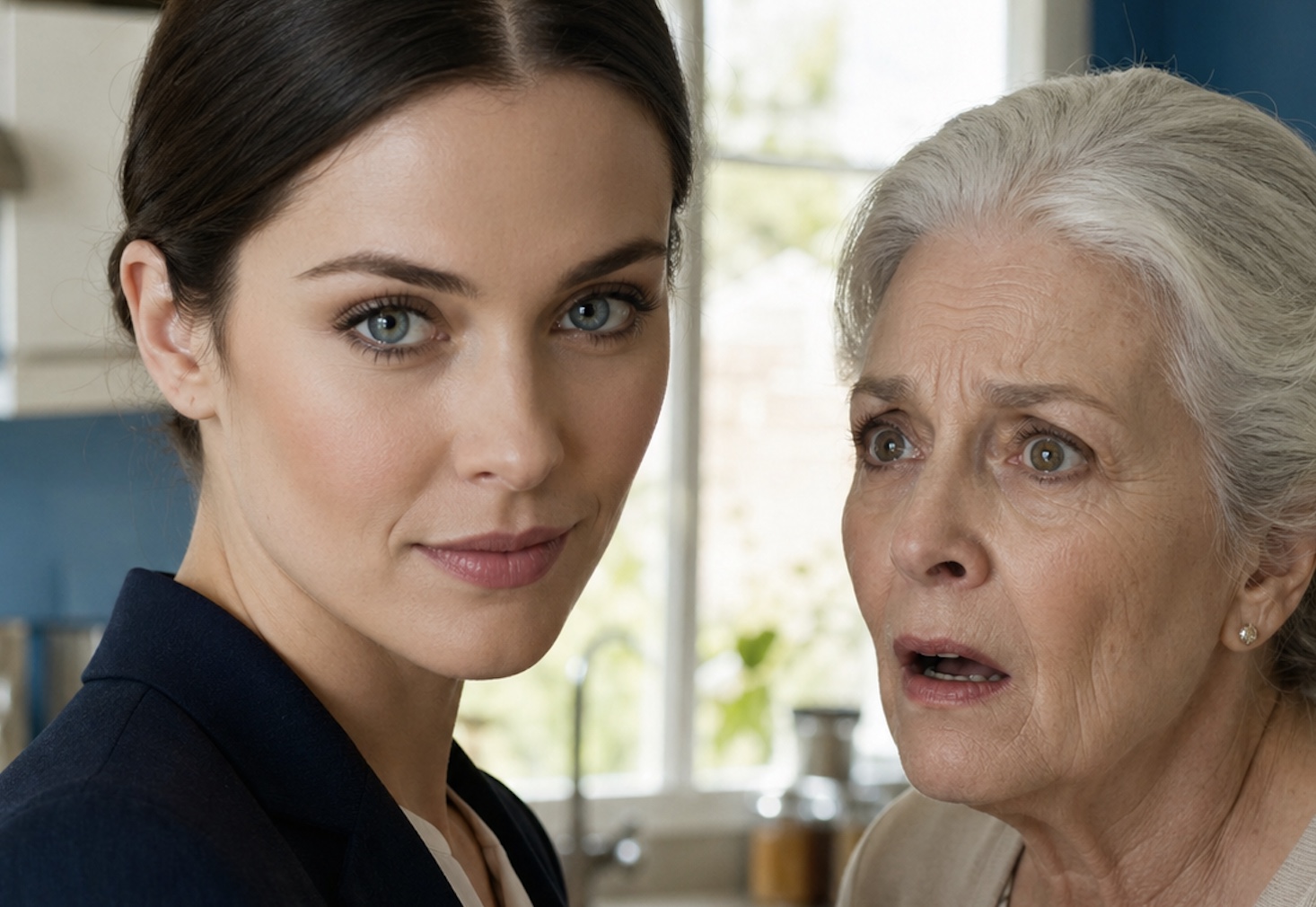
“The apples you bought are like wood again—completely tasteless. If you really cared about a sick person, you could have gone to the market and picked out proper homemade ones instead of dragging home this plastic supermarket nonsense. You always do everything the quickest, easiest way. No care for the family at all.”
Victoria stood silently at the kitchen counter, methodically chopping vegetables for a salad. She took a deep breath, forcing herself not to react to the familiar stream of complaints. In the living room, Antonina Petrovna sat enthroned on the sofa, surrounded by pillows. Her aching knees were wrapped in a пуховый shawl, and on the coffee table beside her stood a whole line of expensive ointments and medications.
Her joint problems had started years ago, but in the past few months they had worsened dramatically. The diagnosis was grim, and the treatment required was serious and long-term: costly injections of hyaluronic acid directly into the joints, PRP therapy, specialized massage, and one-on-one sessions with a rehabilitation therapist. At the public clinic, a free slot for procedures like that would take at least six months to get, and Antonina Petrovna had no intention of enduring the pain for that long.
There had been only one option—go to a private medical center. When the total cost of the first stage of treatment was announced at a family meeting, a heavy silence fell over the room. Sergey, Victoria’s husband, worked as an engineer at a factory. He was a decent, hardworking man and a skilled specialist, but his salary barely covered daily expenses, utility bills, and keeping his old car running. He had no savings.
Victoria, on the other hand, owned a small but steady accounting firm. She handled the books for several large trading companies, and her income was several times higher than her husband’s. Watching Sergey grow darker with helplessness and shame because he could not help his mother, Victoria made a decision she would later deeply regret. She paid for the entire course of treatment herself from her business account. Her only condition was that Sergey would not tell his mother where the money had come from. Victoria knew how proud her mother-in-law was and did not want to humiliate her husband in her eyes. Let Antonina Petrovna believe that her son had taken out a loan or somehow secured a bonus at work.
That act of generosity turned against her. From the very day treatment began at the elite clinic, Antonina Petrovna seemed to become a different person. Certain that her beloved Seryozhenka alone was bearing the enormous expense, she began acting in her son’s house as if she were the true mistress of it, while treating her daughter-in-law like unpaid staff whose only talent was wasting her precious boy’s money.
“Vika, are you deaf?” her mother-in-law’s voice snapped her out of her thoughts. “I asked you to make me some tea. And not that dusty stuff in tea bags—brew it properly, with thyme. Seryozha will be home from work soon, tired and worn out. He works himself to the bone for us, and you still don’t even have dinner ready.”
“Dinner is in the oven, Antonina Petrovna,” Victoria replied evenly, rinsing her hands and taking out the teapot. “Beef baked in the French style. It’ll be ready in ten minutes.”
“Beef in the French style,” her mother-in-law snorted with contempt. “You probably drowned it in mayonnaise. That’s bad for Seryozha. You could have made steamed cutlets. But of course that would mean standing over the grinder, and you’re too lazy for that. You’d rather stare into your laptop at your little papers.”
The front door clicked open, and heavy footsteps sounded in the hallway. Sergey came into the kitchen, kissed his wife on the cheek, and dropped wearily onto a stool. He looked exhausted. The factory was in the middle of equipment modernization, and he had been staying late often, trying to earn at least a little extra so he could reimburse part of what his wife had spent on his mother’s treatment.
Dinner passed in tense silence. After eating a hearty portion of the same meat she had just criticized, Antonina Petrovna launched into her usual lecture.
“Tomorrow I have injections at the clinic at ten,” she announced, dabbing her lips with a napkin. “Vika, pick me up at nine. And don’t be late like last time. My doctor doesn’t like to be kept waiting.”
“I wasn’t late last time, Antonina Petrovna. We arrived exactly fifteen minutes before your appointment,” Victoria replied calmly as she cleared the empty plates. “And tomorrow I won’t be able to take you. I have a tax inspection first thing in the morning for a key client. I’ll book you a very good business-class taxi and pay for it in advance. It will take you from the building entrance straight to the clinic.”
Her mother-in-law’s face broke out in angry red patches. She turned to her son for support.
“Seryozha, do you hear the way your wife speaks to me? I’m a sick woman—I have to go down the stairs with a cane—and she wants to shove me into a taxi with some strange man! Apparently her client matters more than her own mother-in-law!”
“Mom, honestly, Vika has a difficult day tomorrow,” Sergey tried to object gently, avoiding eye contact. “The taxi will come right to the building, and the driver will help. Nothing terrible is going to happen.”
“Nothing terrible?!” Antonina Petrovna’s voice rose to a shriek. “How can you let her behave like this? You slave away, paying for these outrageously expensive clinics, carrying this whole family on your back, and she can’t even drive me there! She’s settled on your neck and let her legs dangle, and I always knew she didn’t appreciate you!”
Victoria froze with a plate in her hands. She looked at her husband. Sergey sat hunched over, staring into his empty cup. He said nothing in his wife’s defense. He did not say that it was precisely because of her work that his mother could be treated at the best medical center in the city. He simply stayed silent, retreating into his usual strategy of staying out of things.
A sharp stab of disappointment pierced Victoria’s chest. Without a word, she set the dishes in the sink and went into the bedroom, closing the door behind her. The next morning she did exactly what she had said—she ordered her mother-in-law an expensive taxi, transferred the money to the driver’s card, and left for the office.
The treatment was working beautifully. A month later, Antonina Petrovna could already walk without a cane, the pain had faded, and her mood had visibly improved. But that improvement changed nothing in the way she treated her daughter-in-law. If anything, feeling stronger only made her more energetic in her criticism.
The situation finally reached its breaking point the following weekend when Sergey’s younger sister, Yulia, came to visit. She was a bright, well-groomed woman in her thirties who did not work, was raising a school-age son, and seemed to exist in a permanent state of half-divorce from her husband. Yulia was used to having her problems solved at someone else’s expense, and she regularly showed up at her mother’s and brother’s home with complaints about her difficult life.
She fluttered into the apartment smelling of expensive perfume and, right from the doorway, handed her mother a plastic box of cheap éclairs from the nearest bakery.
“Mama, look what I brought you! Your favorites!” she chirped as she walked into the kitchen and sat down at the table Victoria had just laid with freshly baked pies and roasted red fish.
“Oh, Yulenka, my darling girl, thank you! Now that’s what a caring daughter looks like,” Antonina Petrovna cooed, demonstratively pushing aside Victoria’s pies and pulling the éclairs toward herself. “Unlike the food we get here—everything bland and soulless. Sit down and eat properly. You’ve gotten so thin. That brute husband of yours is wearing you out.”
Yulia happily began eating the red fish her mother had just mocked so generously, while complaining about her life at the same time.
“Oh, Seryozha, my washing machine broke,” she sighed, fluttering her mascara-heavy eyelashes. “A repairman came and said it couldn’t be fixed—the bearing is completely gone. But I have to wash Dima’s school uniform every day. My ex doesn’t pay a penny in child support—says he doesn’t have work. Could you help me? There’s a nice machine on sale for only forty thousand.”
Sergey choked on his tea. He looked guiltily at his sister, then at Victoria, who sat silently sipping coffee by the window.
“Yul, where am I supposed to get that kind of money right now?” he asked quietly. “You know about Mom’s treatment. The amounts are huge. I’m completely wiped out, and payday is still a week away.”
Antonina Petrovna slammed her cup against the saucer in outrage.
“What do you mean, where from? You got a bonus last week—I know you did! What do you mean you won’t help your own sister? She’s raising a child alone! And your madam over there”—she jerked her head toward Victoria—“is strutting around in brand-new leather boots. You have money for clothes, but not for your own flesh and blood?”
Victoria slowly set her mug down on the windowsill. She had bought those boots herself, during a sale, with her own money, because her old pair had completely fallen apart. But there was no point explaining that here.
“Antonina Petrovna, I bought those boots with my own money,” she said calmly, looking directly into her mother-in-law’s eyes. “And Sergey’s budget really is very tight right now. We cannot buy Yulia household appliances. Her ex-husband should be the one dealing with the financial needs of his child.”
Her mother-in-law flushed dark red. She shoved her chair back and straightened, bracing both hands against the table. Her eyes were blazing. Yulia, meanwhile, suddenly fell quiet, chewing another bite of fish, though there was unmistakable satisfaction in her eyes—the conflict was unfolding in exactly the way that benefited her.
“How dare you tell my son how to spend his own money?!” Antonina Petrovna shouted. “You don’t bring a single kopek into this house—you just shuffle your little papers around! Seryozha works like a dog, pays for the best doctors for me, supports you, you parasite, and you still dare to raise your voice?”
“Mom, calm down, please, your blood pressure will spike,” Sergey tried to step between his wife and mother, but Antonina Petrovna shoved his hand away.
“No, let her listen!” she raged on. “You live here with everything handed to you, you eat at my son’s expense, you dress at his expense! I put up with your rudeness, your coldness, your lack of respect. But I won’t stay silent any longer! You owe me respect! And you owe respect to your husband’s family, the family that tolerates you! If I say Seryozha will buy his sister a washing machine, then he will go and buy it! And you will keep your mouth shut!”
A ringing silence fell over the kitchen. The only sounds were the hum of the refrigerator and Antonina Petrovna’s harsh, wheezing breath. Sergey had gone pale. He opened his mouth as if to stop the flood of undeserved insults, but Victoria moved before he could speak.
She did not shout back. She did not cry or make a scene. She was an accountant—a person of numbers and facts. In her profession, emotions always yielded to documents.
Victoria silently left the kitchen. Her footsteps sounded clear and measured in the quiet hallway. A minute later she returned. In her hands was a thick blue plastic folder. She walked to the table, pushed aside the half-eaten éclairs, and laid the folder directly in front of Antonina Petrovna with a quiet, deliberate thud.
“Open it,” Victoria said. There was not a trace of warmth in her voice. The icy tone made Yulia swallow nervously.
“What is this now?” her mother-in-law asked, lifting her chin arrogantly but not touching the folder. “Going to show me your little charts again?”
“I said open it,” Victoria repeated, and there was something in her voice that made Antonina Petrovna obey despite herself.
With fingers trembling from anger, she flipped back the plastic cover. On top was the thick contract for paid medical services with that very same elite clinic.
“Read clause 1.2. Client for the services,” Victoria instructed.
Antonina Petrovna pulled her glasses from the pocket of her cardigan, set them on her nose, and squinted.
“Client… Sole Proprietor Smirnova Victoria Aleksandrovna,” she read aloud, then looked up at her daughter-in-law in confusion. “So what? They put it in your name so Seryozha wouldn’t have to keep missing work. Big deal.”
“Turn the page,” Victoria said, relentless. “There are bank statements and payment receipts attached. Every single one.”
Her mother-in-law turned the page. Her eyes ran across the lines, where the enormous sums were printed in black and white: one hundred twenty thousand for the first course of injections, eighty thousand for PRP therapy, one hundred fifty thousand for the rehabilitation therapist. And on every payment slip, under “Payer,” stood Victoria’s business account details.
“This… this has to be some kind of mistake,” Antonina Petrovna muttered, and suddenly her voice had lost all its former certainty. She looked at her son. “Seryozha? Son, explain this to her. You were the one giving me money for treatment. You told me yourself you had arranged everything with the doctors!”
Sergey stood with his head lowered like a guilty schoolboy. His face was burning with shame.
“Mom… Vika paid for all of it,” he said hoarsely, unable to raise his eyes to either his mother or his wife. “I don’t have that kind of money. My salary only covers groceries and utilities. I asked Vika not to tell you so you wouldn’t feel awkward. I wanted to do what was best.”
Antonina Petrovna slowly sank into her chair. The folder slipped from her hands, and several receipts fluttered to the floor. The illusion she had lived in for months collapsed in an instant. Her successful, all-powerful son had not been able to pay even a fraction of her treatment. And the same daughter-in-law she had just publicly humiliated and called a freeloader had paid nearly half a million rubles out of her own pocket to get her back on her feet.
Yulia, instantly sensing the shift in power, rose quietly from her chair.
“Oh, I just remembered—I have to pick Dima up from practice,” she said, grabbing her handbag in a rush. “You all sort this out yourselves, I have to go. Mom, we’ll talk later!”
The front door slammed, announcing the sister’s shamefaced retreat. Only the three of them remained in the kitchen.
Antonina Petrovna sat staring at one point in space. A fierce internal struggle was playing out inside her. Admitting she had been wrong was almost physically painful for her. Her mind desperately searched for some loophole that would let her preserve the last scraps of dignity.
“So what?” she said at last, nervously picking at the edge of the tablecloth. But the old arrogance was gone from her voice. “You’re legally married. Your finances are shared. That means it was shared money. Sergey has a right to decide how it’s spent too.”
Victoria gave a bitter smile. She had anticipated exactly this reaction.
“You’re mistaken, Antonina Petrovna. Under the law, income earned by an individual entrepreneur through commercial activity and kept in a business account is not considered jointly owned marital property until it is transferred to a personal account as profit. Those were money I earned myself. My company earned it. And I paid for your treatment solely out of pity for Sergey, who couldn’t sleep at night watching you suffer.”
Victoria stepped to the table, carefully gathered the scattered receipts, slipped them back into the folder, and closed it.
“You demanded respect from me,” she said quietly, but every word seemed to drive itself into the silence like a nail. “Respect, Antonina Petrovna, is not something you obtain by shouting. It is something you earn. I tolerated your constant complaints, your rudeness, your contempt, because I believed an elderly sick woman deserved some allowance for her condition. But today you crossed the line. You trampled on my help and turned me into a nobody in my own home.”
“Vika, please,” Sergey said helplessly, taking a step toward her. “Let’s all calm down. Mom didn’t know…”
“Didn’t know what, Sergey?” Victoria turned sharply to him. “That you don’t insult people for no reason? That you don’t tell them how to live? You asked me to stay silent, and I did. I protected your ego in front of your mother. But you sat there and listened while she dragged me through the mud, and even then, when she started demanding obedience from me, you still couldn’t find the courage to tell the truth!”
Sergey fell silent, crushed at last by the justice of her words.
Victoria looked again at her mother-in-law, who sat hunched in on herself now, suddenly seeming old and pitiful.
“Your second stage of rehabilitation is supposed to begin next week,” Victoria said in the same calm, businesslike tone. “The clinic has reserved your appointments. But I am canceling that reservation and withdrawing my guarantee of payment. Funding from my side is now closed. If Sergey finds the money, he can pay for your continued treatment. If not, you will have to go back to waiting for public quotas and the free clinic. Now excuse me. I have work to do.”
She turned and left the kitchen. That evening Sergey drove his mother back to her own home. They packed in silence. Antonina Petrovna did not once look in her daughter-in-law’s direction; she simply stuffed her things into a bag with nervous haste. There were tears in her eyes, but they were not tears of remorse. They were tears of bitter, helpless resentment—the kind that comes when the perfect world inside your head is exposed as fiction and your power over another person crumbles into dust.
For the next few weeks, the house remained frozen in an icy atmosphere. Sergey tried to take out a loan to pay for his mother’s continued rehabilitation, but the bank refused him because of the debt burden connected with the company where he worked. Yulia, once she realized the free source of money had dried up, sharply reduced the number of calls she made to her mother, always claiming she was unbelievably busy.
Antonina Petrovna was forced to take her place in line at the district clinic. There were no leather sofas there, no polite administrators bringing coffee, no cutting-edge equipment. Instead there were stuffy hallways, tired doctors, and physical therapy appointments booked out a month in advance.
Sergey spent a long time asking Victoria’s forgiveness. For the first time in his life, he understood how his passivity and his desperate need to remain the good son had been destroying his own marriage. Victoria forgave him, but their relationship moved onto a new and more honest footing. She stopped playing the role of the ideal daughter-in-law and family savior. Their finances were strictly separated, and any problems involving Sergey’s relatives were from that point on his responsibility alone.
Antonina Petrovna never again came to their home without an invitation. During the rare phone calls she had with her daughter-in-law, her voice sounded unusually dry and careful. She no longer complained about tasteless apples or criticized dinners. And although real affection never grew between them, something much more important did appear: the kind of distance on which genuine respect—not imagined respect—can finally stand.