“Just don’t open your mouth, Lyuda. Smile and nod, that’s all. And don’t you dare blurt out anything about your tomatoes or how people milked cows back in your collective farm. There will be respectable people there tonight—the city’s elite. That dress already looks bad on you; you look like a dairymaid on a day trip. At least keep quiet for the sake of my promotion.”
Vadim nervously adjusted his tie in the hallway mirror. He was not even looking at me—he was staring at his own reflection, the version of himself he imagined as the company’s future vice president.
“Vadim, you bought this dress. And those shoes I can barely stand in? You chose them too,” I said, trying to stay calm even though everything inside me trembled with hurt. “And I’m not from some collective farm. I’m from a perfectly normal village. And, by the way, I have a degree from a teachers’ university.”
“A teaching degree!” Vadim gave a sarcastic laugh as he pulled on his jacket. “That’s only useful for stoking a stove in some rural school. Listen, I’m serious. My boss is a hard man, a man of breeding. He is the kind who values style and polish. And you… you’re natural. Far too natural for an evening like this. Stand in a corner, drink champagne, and pretend you’re some mysterious foreigner. There will be less chance of you humiliating me that way.”
I stayed silent. Again. After five years of marriage, I had gotten used to the fact that Vadim saw me as his “failed investment.” When we met, I was working two jobs to pay bills and help my family, while he was an ambitious intern. Now he had “moved up,” wrapped himself in shine and status, and begun to feel ashamed of the woman who had once fed him homemade pies while he memorized reports.
The restaurant, Olympus, was dazzling enough to make my eyes water. Crystal everywhere, waiters carrying themselves like palace guards, and women wearing diamonds worth more than my hometown’s entire budget for five years.
Vadim dug his fingers into my elbow.
“See that group over there? That’s the inner circle. The boss hasn’t come out yet. Let’s go greet the deputy. And remember—keep your mouth shut.”
The evening dragged like thick syrup. I nodded obediently and listened to gossip about stock prices and trendy diets. Vadim was blooming. He showered the right people with compliments, tossed out clever jokes, and made sure everyone saw that he belonged to the “top tier.” He only remembered me when he had to present me to another snob.
“This is my wife, Lyudmila. She’s a homemaker, a creative type, very quiet…”
In Vadim’s language, “creative and quiet” meant “a decorative accessory with no intellect.”
“Listen,” he whispered in my ear as we stepped over to the buffet table. “Alexander Viktorovich is about to come out onto the platform. The big one. The owner of the whole empire. They say he’ll announce the appointment tonight. If I get the position, we’ll replace your wardrobe with something more respectable than this knitted disaster.”
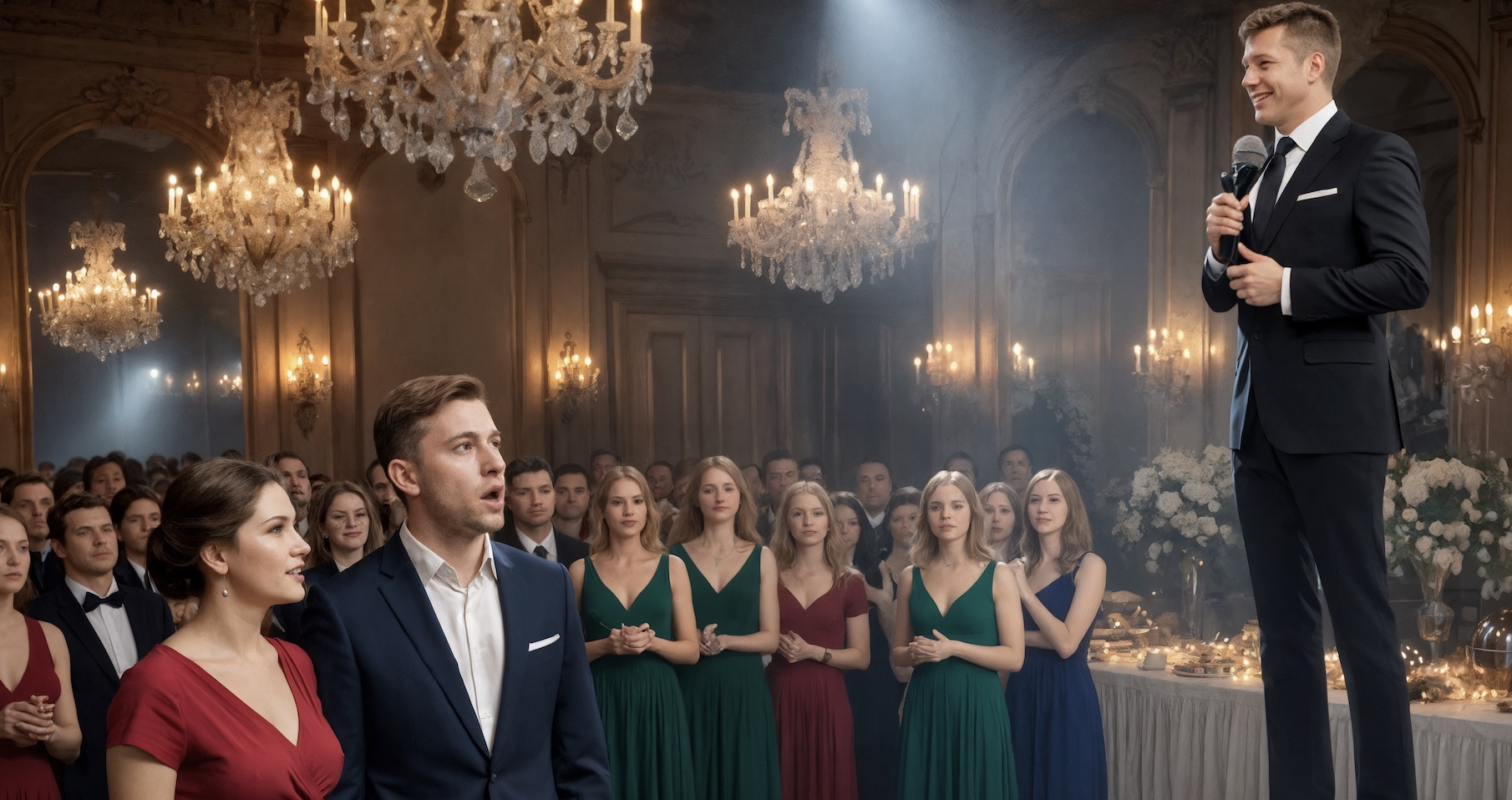
I looked toward the stage. The lights dimmed, and solemn music began to play. Vadim straightened like a soldier and even sucked in his stomach.
A man stepped onto the stage. Tall, wearing a perfectly tailored dark-blue suit. The gray at his temples only added to his presence. He walked confidently to the microphone and swept his gaze across the hall—cool, assessing, commanding.
Vadim held his breath.
“There he is,” my husband whispered. “That’s real class. You can tell at once—he’s a man who built himself from the ground up.”
I stared at the man and felt my breath catch. But not from admiration. From the wild, surreal shock of recognition. Those dimples in his cheeks when he gave the deputy a faint smile. That scar above his right eyebrow—the one he got when he fell from the apple tree in our garden back in 1995.
“Sashka?” I whispered before I could stop myself.
Vadim pinched my arm painfully.
“What Sashka? Have you lost your mind? That’s Alexander Viktorovich Gromov! Be quiet right now!”
Alexander Viktorovich began to speak. His voice was deep and assured. He thanked the partners and talked about strategy and growth. But all I could think about was how this “strategist,” dressed years ago in my late father’s worn hand-me-downs, had sat at our kitchen table and cried because we had no money for his entrance exams to a university in the capital.
I remembered working triple shifts at the farm and in the village store. I remembered selling my only gold chain—my mother’s gift—so I could buy him his first decent suit for an interview. I remembered sending him nearly all my wages and living on plain potatoes so he could study and become “somebody.”
“And now,” Alexander Viktorovich paused, “I would like to invite onto this stage the person without whom there would be no company—and no me.”
Vadim leaned forward, clearly hoping his name would be called as some kind of top employee recognition.
“The person who believed in me when I had nothing except ambition and a pair of worn-out shoes. The person who sacrificed her youth so I could get an education.”
Alexander Viktorovich narrowed his eyes and looked into the crowd. Then suddenly his gaze landed on us. More precisely, on me. His face changed instantly. The hard mask of the business predator cracked and gave way to the bright, genuine joy of the boy I had always known.
“Lyuska!” he shouted right into the microphone, breaking every rule of the evening’s polished protocol. “I spotted you in the crowd half an hour ago! Why are you hiding in the corner? Come here!”
A dead silence fell over the hall. Hundreds of heads turned in our direction. Vadim stood frozen, mouth open, looking from me to his boss and back again. The color drained from his face.
“You… you know him?” he stammered, letting go of my elbow.
I did not answer. I simply walked forward. The shoes Vadim had “chosen for me” were torturing my feet, but I could no longer feel them. I walked past motionless ladies and gentlemen, past waiters holding silver trays, straight toward the man who had been my family long before Vadim and his ambitions ever entered my life.
Sashka jumped down from the stage instead of waiting for me to come up. He swept me into his arms and spun me around just like he used to when we were kids, not caring about his outrageously expensive suit or his status.
“Little sister!” he boomed into the top of my head. “I sent you the invitation myself, in a sealed envelope! Why didn’t you answer? I thought maybe you were angry with me for something!”
“Invitation?” I sniffed, pressing my face into his shoulder. “I never got anything, Sash. Maybe the mail… or maybe someone decided I didn’t belong here.”
Sashka pulled back and studied me carefully. Then his eyes shifted to Vadim, who was standing a short distance away trying to force a polite smile onto his face while his whole body shook with nervous tremors.
“And who is that?” my brother asked, his tone turning instantly icy—the same tone that made top managers feel like they were about to have heart attacks.
“That’s my husband, Vadim,” I said quietly.
Alexander Viktorovich slowly walked over to him. Vadim seemed to shrink into himself.
“So you are Vadim… Kravtsov, I believe, from the development department?” Sashka looked him up and down as if he had just noticed a dirty stain on his shoe. “I’ve read your reports. The numbers are decent. But judging by what I see, you have serious problems with human capital.”
“Alexander Viktorovich… I… we… this is all a misunderstanding…” Vadim stuttered. “Lyudochka is just very modest, she never said…”
“Lyudochka?” Sashka gave a cold little smile. “To you, she is Lyudmila Andreyevna. And if it were not for this ‘modest’ woman, you would not be standing in this restaurant tonight. At best, you would be hanging flyers near a subway station. Because she paid for every one of my textbooks and every meal I ate for five years.”
Then Sashka turned to the hall.
“Ladies and gentlemen, allow me to introduce Lyudmila—my older sister. And if anyone here believes that ‘good breeding’ means knowing how to choose the right wine or the proper tie, you are mistaken. True class is when you are willing to give away your last piece of bread for someone you love. From this moment on, Lyudmila Andreyevna is an honorary member of the board of directors of our charitable foundation.”
The evening ended early for Vadim. Sashka personally ordered that “Mr. Kravtsov” be called a taxi. An ordinary economy-class one.
Later, we sat in my brother’s office on the top floor of the restaurant. I had taken off those cursed shoes and was curled up in an armchair with my feet tucked under me. Sashka poured me tea—real tea with herbs, the kind he specially ordered from our village.
“Well, tell me, Lyuda,” he said, sitting across from me. “How did you live with that… specimen? The way he looks at you, it’s like you’re empty space.”
“He thought I was just some country bumpkin, Sash,” I said with a bitter smile. “He was ashamed to be seen with me. Said I embarrassed him because of where I came from.”
Sashka grunted and looked into his glass.
“A country bumpkin, huh? Well, tomorrow morning will be very interesting for him. I’ll give him a choice: either he transfers to our farthest branch—in the Trans-Urals, where we’ve got an agricultural complex, cattle barns, the whole thing, everything you supposedly ‘love’—or he resigns voluntarily with no severance package. Let him learn some wisdom from the soil, since polish has blinded him.”
“No, Sash,” I said, shaking my head. “Don’t bother. Just help me get a divorce without a scandal. I don’t want anything to do with that glossy world anymore.”
“As you wish, little sister,” he said, taking my hand. “But I’m buying you an apartment downtown. And a car. And that teaching degree of yours… you know, we’re opening a corporate academy for employees’ children in the holding company. I need a director. Someone who knows the value of hard work and isn’t ashamed of where they came from. Will you do it?”
I looked at my brother—successful, wealthy, but still the same Sashka who had once shared the last crust of bread with me.
“I will,” I said with a smile. “But only on one condition: I’m still planting tomatoes on the balcony. For the soul.”
“Plant potatoes too, if you want,” he laughed. “Now it will just be called ‘premium eco-design.’”
When I walked out of the restaurant, Vadim was waiting by the entrance. He rushed toward me and tried to grab my hand.
“Lyudochka, forgive me, please! We can start over, I understand everything now!”
I looked at him—at his expensive suit, his fake smile, his panic at losing the hand that fed him. And suddenly I found him laughable.
“You know, Vadim, you were right. I really am a country woman. Because where I come from, we were taught how to separate grain from chaff. And you—you’re the chaff. Now step aside. You’re blocking my light.”
I got into my brother’s car, and we drove away, leaving Vadim standing on the sidewalk—a small, pathetic man who never understood that the true elite are not the ones who look down from above, but the ones who lift others up from below.