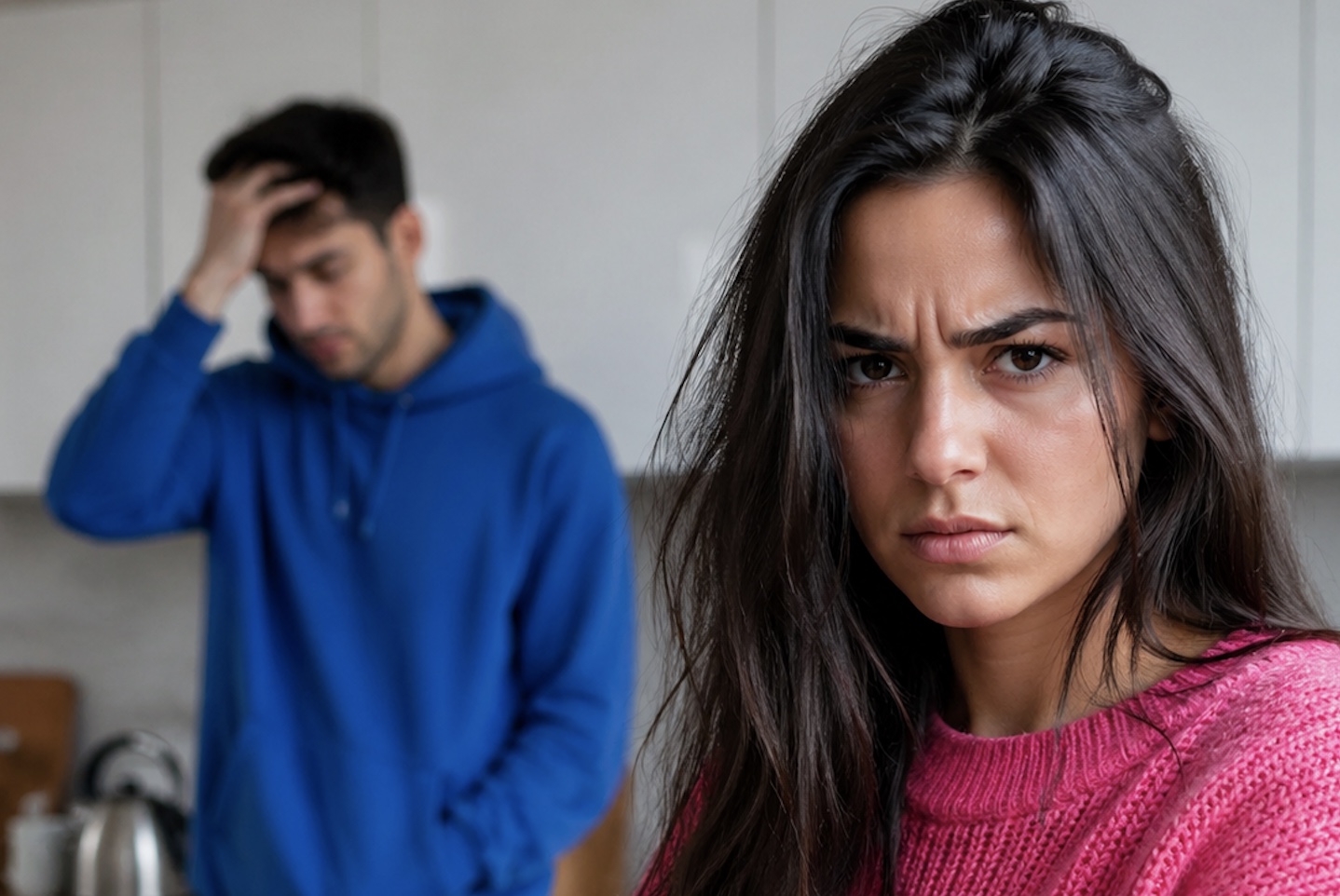
“Have you completely lost it? I’m not your mother’s unpaid extra set of hands.”
Marina did not even open her eyes right away. She said it to the ceiling, hoarse, bitter, automatic, as if the sentence had been standing in her throat all night just waiting for permission to come out. Behind the wall, dishes clattered. The kettle wheezed in the kitchen. From the hallway came that constant morning smell of cheap coffee that already made her irritation itch under her skin.
“It’s starting already,” Igor replied. “I haven’t even come in yet, and you’re already complaining.”
“Then don’t come in. It’s actually a very useful skill for family life — not coming in, not hearing, not understanding.”
He appeared in the doorway, as always, wearing the face of a man who had been handed someone else’s guilt first thing in the morning and instructed to carry it carefully. Old sweatpants, a T-shirt with a stretched-out collar, phone in hand. He looked strangely upbeat, like an entertainer at some office party, but after ten years together Marina knew what that energy meant: some particularly delightful chore had already been prepared for her.
“We’re leaving in forty minutes,” he said. “Mom asked us to come early. The greenhouse needs to be taken apart, the soil leveled, the seedlings set out. She’s counting on us.”
Marina opened her eyes and slowly sat up in bed.
“On ‘us’? No, Igor. On you. She isn’t counting on me. She orders me around. Those are two different things, even if your little family club of commanding voices can’t tell the difference.”
He let out a loud breath.
“Here we go again. What’s so hard about it? Helping once a season.”
“Once a season?” Marina gave a short laugh. “Your season lasts all year. In spring it’s the soil. In summer it’s canning, watering, and weeding. In fall it’s ‘come help harvest everything.’ In winter it’s ‘pick Mom up from the mall, drive Mom to the market, bring Mom a wardrobe, hang Mom a shelf, haul away Mom’s old sofa.’ You don’t have a marriage, Igor. You run a branch office of the Valentina Pavlovna Domestic Emergency Service.”
“Don’t exaggerate.”
“Me? You’re the one standing here telling a grown woman how she’s supposed to spend her only day off. Although wait, let me guess. It’s not me who has to. Mom said it, and you’re just passing the message along. You’re not involved at all, right? You’re just a discount messenger pigeon.”
Igor frowned, but he was still holding himself together.
“Don’t talk about my mom like that.”
“How should I talk about her? With a soundtrack? A curtsy? Maybe I should hang up a sign too: ‘Careful, sacred ground, do not touch’?”
“Marina, enough. Seriously. We were living just fine.”
“Who was ‘we’?” she said, throwing off the blanket and getting up. “You were living just fine. Very conveniently, too. Wife at home, mother nearby, both of them doing things, and you walking between them with a wise expression talking about how much you want peace. Funny thing is, your peace always seems to come at my expense.”
He narrowed his eyes.
“You’re home more than I am anyway. You could tear yourself away from your shows once in a while and go help.”
Marina froze, then even laughed — short and joyless.
“Oh, that was good. Really strong. So if I work from home, in your opinion I don’t work? If I’m not stuck in an office under air-conditioning, eating buckwheat from a plastic container at lunch, then I’m automatically lazy?”
“That’s not what I said.”
“No, that is exactly what you said. You just have this trick of saying cruel things as if they accidentally fell out on their own. Very convenient technique. Almost a talent.”
Igor looked away and scratched his neck.
“Mom just doesn’t understand why you get tired. At your age she worked, ran the house, and still had time for all of us.”
“Oh, there it is. The favorite song. ‘Well, Valentina Pavlovna…’ Igor, at this point I could continue for you from memory. Valentina Pavlovna painted ceilings herself at my age. Valentina Pavlovna never complained. Valentina Pavlovna made compote in industrial quantities. Valentina Pavlovna probably stopped trains with her bare hands if they were running off schedule.”
“Don’t be sarcastic.”
“Then don’t compare me to your mother. I’m not married to her.”
He stepped into the room, irritation already starting to show.
“Listen, I don’t understand why you’re making a scene this early. We always go in spring. This is normal.”
“Normal for whom? For you? For her? Because what’s become normal for me is waking up already knowing that someone else has planned out my day without asking me. And for some reason that someone never wonders what I want. Tell me honestly, Igor, has it ever even crossed your mind that I might simply not want to go?”
“Everybody does things they don’t want to do sometimes. That’s family.”
“No. That’s manipulation dressed up as ‘family.’ Family is when people consider each other. Not when one woman gives orders and the other one is supposed to quietly adjust because the first woman has spent years being treated like the center of the universe.”
“Mom is not the center of the universe.”
“No? Then why does every decision in our life get checked through her? Why do you talk to her before me when it comes to vacations? Why, when I said I didn’t want to spend New Year’s at her apartment with her friends and salads by the bucket, did you sulk for a week like someone had taken away your constitutional rights?”
“Because it upset her!”
“And what about me? Do you think it feels good for me when last time she said in front of everyone, ‘Marina is a modern girl, of course, but modern girls are hopeless when it comes to running a household’? Does it feel good when she asks why we still don’t have a child in a tone that makes it sound like I’m personally delaying a shipment? Or when she reminisces right in front of me about your ex, who ‘ironed shirts better and never raised her voice’?”
Igor grimaced.
“You’re lumping everything together again.”
“Of course I am. Because it is all one pile. One big, old, rotten pile of grievances that you’ve spent years pretending not to notice.”
He turned sharply and walked into the kitchen. Marina pulled on her robe and followed him. His mug was on the table, next to an open jar of coffee, bread, a knife, crumbs. The usual scene: in eight minutes he had already managed to create a small disaster zone in the kitchen and still somehow retained the moral authority to lecture about who did nothing in this house.
“I’m not going,” she said calmly.
He did not even turn around.
“Then explain it to Mom yourself.”
“Me? Why would I? She’s your mother. You explain it. Actually, it might be an interesting experiment. Say to her in a grown man’s voice, ‘Mom, Marina isn’t coming because she has her own plans.’ I’d love to watch. I might even buy popcorn, except we don’t have any.”
“Don’t make me out to be an idiot.”
“I’m not making you into anything. You handle that perfectly well on your own.”
He turned around.
“So you have plans? What plans? Lie around half the day, then meet up with Lena, then go around telling everyone how awful I am?”
“Oh, finally. An audit of my schedule. Go on. Maybe you’d also like to check how much I paid for water and whose photos I liked online?”
“Don’t push it!”
“I’m not the one pushing. You came to me first thing in the morning not with a ‘good morning,’ but with an assignment from management.”
Igor pressed his lips together.
“Fine. Don’t come. Just don’t say I didn’t warn you.”
“Warn me about what? That your mother will be offended? Igor, if I got a hundred rubles every time she found a reason to be offended, I’d have bought myself an apartment with no mortgage by now.”
“You’ve become unbearable.”
“No. I just stopped smiling in places where I’ve been used for years. Do you understand the difference?”
He snatched the keys off the table.
“That’s it. I’m going. Alone. We’ll talk later.”
“Of course. After your mother’s board meeting.”
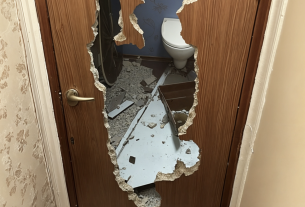
The door slammed as if he wasn’t leaving but trying to prove his masculine righteousness to the entire apartment. Marina stayed in the kitchen, leaned against the counter, and closed her eyes.
“One day off,” she thought. “One damn day off. I’m not asking for the Maldives, a palace, and a personal massage therapist. I just want to be left alone. But no. In this family, any peace and quiet is treated like an attack on sacred family values.”
She made herself real coffee, from actual beans, switched on the grinder, and the steady hum felt almost therapeutic. While the water heated, her phone beeped. A message from Valentina Pavlovna.
“Igor said you’re in a bad mood. Such a pity. We were all counting on your help.”
Marina looked at the screen and drew in a slow breath.
“We.” Such a wonderful word. So communal, so convenient. Perfect for hiding someone else’s pressure behind, like a curtain.
She did not reply. She drank her coffee on the balcony, looking out over the yard: some neighbor woman was shaking out a rug, a few teenagers with scooters were arguing by the entrance, and below, a man in slippers was walking a dachshund and somehow looked happier than half the married people in the country.
An hour later, a photo arrived. Igor in an old jacket, standing by the greenhouse with a shovel. Caption: “When you have to do everything yourself.”
Marina stared at the screen for three seconds, then snorted.
“Well, would you look at that. The man has discovered the existence of his own hands.”
She typed, “Congratulations. Evolution.” Deleted it. Typed, “Tell your mother her medal for heroism is waiting at city hall.” Deleted that too. Then she tossed the phone onto the couch.
“No,” she thought. “Not today. Today I’m not feeding this circus.”
But as always, the circus came to her anyway by evening.
Igor came home after seven. Muddy sneakers, an angry face, dirt on his hands, phone pressed to his ear. He was still talking in the hallway.
“Yes, Mom, everything’s fine. Yes. No, she’s home. No, I don’t know. Yes, we’ll talk later.”
Marina was sitting in the kitchen scrolling through her phone. He walked in, washed his hands with the air of a man rinsing off public humiliation itself, and said:
“Mom thinks you put on this whole performance on purpose.”
Marina looked up.
“And what do you think?”
“I think you could have come and not made a problem out of nothing.”
“Out of nothing?” She set the phone down. “Let me explain something to you about nothing. Nothing is when a grown man decides for himself how to live with his wife. What we have is the opposite. Everything is crooked. Because in every room of this apartment, your mother is invisibly sitting there, commenting on everything.”
“Don’t start again.”
“This is not ‘again.’ This is still the same thing. Still, Igor. For years. I’m tired of explaining the obvious.”
He sat down across from her.
“All right. Let’s be specific. What do you want?”
That actually surprised her.
“Oh? Really? Specific? Fine. I want you to stop living as if you owe your mother every minute and every decision you make. I want you, just once, to tell her, ‘Stay out of it.’ I want you to open your mouth when I’m being humiliated in front of you, and not only when there are cutlets to eat.”
“Mom doesn’t humiliate you.”
Marina laughed.
“No? Then what would you call it? When she says, ‘Marina, you should learn how to run a home better — Igor has gotten so thin’? Is that concern? Or when she gave me a book called Helpful Notes for Housewives on my birthday and said, ‘No hidden meaning, just useful’? Was that refined humor? Or when last month, in front of the neighbor, she announced, ‘Wives nowadays only want comfort’? What was that — stand-up comedy?”
“She’s from another generation.”
“I don’t care if she’s forged from old steel. Rudeness doesn’t become acceptable just because someone is over sixty.”
He slapped his palm against the table.
“Can you not attack for once?”
“Attack? Me? Igor, are you serious? For ten years I tried to be gentle. I kept quiet when she interfered with our renovation. I kept quiet when she picked our curtains and then got offended because I hung different ones. I kept quiet when she inserted herself into our mortgage decisions as if she were paying for it. I kept quiet when she rummaged through our kitchen and rearranged everything because it was ‘more convenient’ for her. Do you know what it feels like to live in your own apartment and still feel like a guest?”
He was silent for a moment.
“She meant well.”
“Of course she did. Every cheerful nightmare begins with that phrase.”
Igor rubbed his face tiredly.
“Marina, I’m torn.”
“No. Don’t lie, at least not right now. You’re not torn. You made the easiest choice a long time ago: tell me to be patient, tell Mom not to pay attention, and pretend you’re some kind of peacemaker. But in reality you’re just too scared to take a side.”
“I shouldn’t have to choose between my wife and my mother.”
“If your mother behaves decently, then no, you shouldn’t. But when she systematically invades our life, you’re not choosing sides — you’re deciding whether you’re a husband or still a little boy from the apartment across the hall.”
He went pale.
“You’re going too far.”
“No. I’m finally calling things what they are. And it makes you uncomfortable not because it’s false, but because it’s too true.”
He stood up and paced around the kitchen.
“So what are you suggesting? That I tell Mom to disappear?”
“Don’t be dramatic. That’s my department. I’m suggesting something basic: stop dragging me around every time she calls. Stop discussing our life with her. Stop letting her comment on my appearance, my work, my cooking, our plans — really, anything her tongue can reach. It’s not hard. What’s hard is putting up with it all the time.”
Igor stared out the window.
“She said today that you don’t respect me.”
“And you? Do you respect me?”
He turned back too quickly.
“What does that have to do with me?”
“With everything. Always. Respect isn’t some pretty word you say on an anniversary. It’s a very ordinary thing. It’s when you don’t trade me away for your mother’s comfort. When you don’t carry her complaints home like some postman from hell. When you don’t send me photos implying I’m a bad person because I didn’t run over there to dig in the dirt.”
He sat back down, already looking deflated.
“I’m just tired. Work is enough for me as it is.”
“And what about me? Am I not tired? Have you ever once wondered why lately I barely speak to you normally anymore? Because every conversation ends with either your mother or me ‘being unhappy again.’ But maybe I’m not just unhappy. Maybe I’ve been unhappy in this marriage for a very long time.”
That sentence hung in the kitchen so thickly that even the refrigerator seemed to hum more quietly.
Igor looked at her intently.
“What exactly are you saying?”
Marina stood up slowly.
“I’m saying it’s not going to stay like this.”
“What does that mean?”
“It means exactly that.”
She went into the room, opened the wardrobe, and pulled out a suitcase. The medium gray one with the chipped wheel — the one they usually took on vacation. Igor followed her, already unsettled.
“What are you doing?”
“What does it look like?”
“Marina, stop putting on a show.”
“Very funny. Especially after I’ve spent my entire life here under the slogan ‘Mom said it, so everyone run.’”
She threw jeans, a sweater, her charger, a makeup bag onto the bed. Her movements were calm, and somehow that was more frightening than any hysterics would have been.
“You’re not going anywhere,” he said more quietly.
“Interesting. Once again you’re telling me what I’m going to do.”
“I didn’t mean it like that.”
“How did you mean it then? Softly? Velvet-wrapped? Igor, even now you still don’t hear yourself.”
He grabbed the back of a chair.
“Just wait. We had a fight. It happens. Why jump straight to the suitcase?”
“Because this is not ‘straight away.’ This has been happening for a very long time. You just thought if you pretended nothing serious was wrong, it would somehow sort itself out. It didn’t.”
“Over one day? Seriously?”
“It is not about one day!” she shouted for the first time. “It’s about hundreds of identical days! About the fact that for you I always come after your mother — after her mood, after her opinion, after her phone calls, after whatever she wants! About the fact that we never had a separate life together. There has always been a third person in this marriage, and that person has somehow been allowed to decide far too much.”
He froze.
“I didn’t realize you saw it that way.”
Marina let out a quiet, bitter laugh.
“And that is exactly the problem. You never thought. At all. As long as things were comfortable for you, that was enough. What was happening inside me only interested you in the form of, ‘Come on, don’t be upset.’”
He sat down on the edge of the couch.
“I don’t want you to leave.”
“And I don’t want to keep staying under these conditions.”
“I can talk to Mom.”
“Too late. No — not too late forever, but too late for tonight. Because right now you’re not saying that because you finally understood. You’re saying it because you saw the suitcase. It wasn’t my words that scared you. It was the realization that I might actually leave.”
Igor stared at the floor.
“So that’s it? Just like that?”
“No, not ‘just like that.’ ‘Just like that’ would be if I woke up one morning and suddenly decided to run away for no reason. I’ve been knocking on a locked door for years. It’s just that on your side, the television was always blaring with your mother’s voice.”
He gave a crooked smile, then dropped it immediately.
“That’s cruel.”
“It’s honest. Try it sometime. It helps.”
The phone on the nightstand vibrated. Igor glanced at the screen, and Marina knew immediately who was calling.
“Don’t even think about answering,” she said.
He didn’t answer, but he didn’t decline the call either. He let it ring out. Already an achievement. Someone should have handed him a certificate for a timid attempt at separation.
“Where will you go?” he asked dully.
“To Lena’s. I’ll stay there tonight. After that I’ll rent an apartment. Or a room. Or even a tiny studio the size of a television box. At least there nobody will inspect how I slice cucumbers or ask why I don’t leap into the car to go to someone else’s garden plot at the first whistle.”
“You’re exaggerating about Mom. She’s not a monster.”
“I never said she was a monster. Monsters at least don’t disguise themselves as concern. She wraps everything nicely: ‘I only want what’s best,’ ‘I’m just worried,’ ‘I’m doing it for the family.’ Very convenient packaging for control.”
He looked up at her.
“And what about us? What happens to us now?”
Marina zipped the suitcase shut. The zipper ran fast and dry, like it was cutting across nerves.
“As for us, Igor, it’s been clear for a long time. You just refused to look. We lived together, supposedly, but I always felt like a person on probation. And you know what’s worst? Not once — not once — did you tell your mother, ‘Enough.’ Not once. Not even when she crossed every line.”
He stood and stepped toward her.
“I loved you.”
Marina nodded.
“Maybe. In your own way. But love and protection, as it turns out, are two different skills. You may have had the first one. The second one was never there.”
“Are you trying to finish me off on purpose?”
“No. I’m just no longer rescuing your comfort.”
She took the suitcase by the handle. He tried to help, but she pulled it away.
“No need. I’ll manage this myself. Otherwise you might get used to the idea that I can do more than just ‘sit at home.’”
They walked into the hallway. It was cramped, stuffy, with his car keys, old receipts, and a broken umbrella scattered on the shoe shelf. The most ordinary hallway. And somehow it is exactly in places like that that lives fall apart — not at resorts, not in restaurants, but between coats, shoes, and a plastic grocery bag.
“Marina…” he began.
“Please, not the beautiful words right now. I’m practically allergic to them.”
“I can fix this.”
“You could have. A long time ago. Tonight isn’t about fixing anything anymore. Tonight is about the fact that I refuse to keep living in a state of permanent surrender.”
He leaned against the wall.
“So you’ve decided everything.”
“Yes.”
“And nothing is stopping you? Not the years together, not the apartment, not—”
“The apartment?” She looked at him with something close to pity. “God, Igor, that is exactly why everything between us turned out so pathetic. I’m talking to you about respect, about loneliness inside a marriage, about exhaustion, about having my identity rubbed away piece by piece — and you’re talking to me about an apartment.”
He fell silent.
“That’s it,” Marina said quietly. “That’s our entire marriage right there. I speak from the heart, and you answer with a budget sheet.”
She opened the door.
“Marina, wait. Let’s at least talk tomorrow.”
“Of course. Tomorrow. After your mother explains to you what a monster I am and how expertly you’ve been deceived. That should be a wonderfully productive conversation.”
She stepped out onto the landing. The door behind her stayed open for two seconds longer, as if he still hoped she would turn around. She didn’t.
The elevator was slow, as always. The phone in her hand trembled with a new message.
From Valentina Pavlovna.
“So at last you’ve shown your true face. Igor has needed a calm, normal woman for a long time, not a constant scandal.”
Marina read the message twice. Then suddenly she gave a quiet, almost amused laugh.
“Well, of course,” she said aloud to the empty stairwell. “The final chord. Wouldn’t be complete without it.”
The elevator arrived. She stepped in, pressed the button for the first floor, and looked at the screen again. No anger. No tears. Only a clear, cold understanding.
“There it is,” she thought. “I wasn’t exaggerating all this time. I wasn’t difficult. It really was exactly like this. They just spent years convincing me that if I was hurting, it meant I was being childish.”
Outside, the air smelled of wet asphalt, exhaust fumes, and that early spring scent that belongs to a city — not postcard spring, but the real kind, with puddles, a plastic bag caught in a tree, dog walkers by the entrance, and people carrying home huge bottles of water. Marina set the suitcase down by a bench, lifted her face to the dark sky, and exhaled more freely than she had in a long time.
Her phone lit up again. Igor.
“Come back. Let’s not do anything stupid.”
Marina looked at those three lines and, for the first time all day, smiled for real.
“Anything stupid,” she repeated. “Exactly.”
Then she typed back:
“The stupid part was earlier. When I thought you would someday become my husband instead of an attachment to your mother’s opinion.”
She paused for a second, then added:
“I’ll leave the keys with Lena. I’ll come back for the rest later. Alone. No delegation.”
She sent it. Slipped the phone into her pocket. Picked up the suitcase.
And walked toward the gate of the courtyard as calmly as if she were not leaving a marriage, but simply stepping out of a stifling room where no one had opened the windows for far too long.