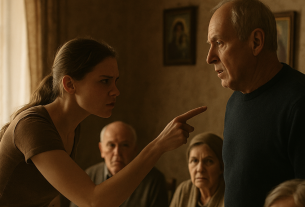
“Can you pick Varya up from kindergarten tomorrow? Katya’s on shift until eight, and I’ll be at the site from early morning till late. I won’t make it.”
Marina turned around. She had just seen off her client — four hours on her feet, but the woman had left happy — and was now winding up the cord of the hair dryer in her tiny studio. A chair, a mirror, shelves lined with products. Anton stood in the doorway, already in his jacket, keys in hand.
“I’ve got Inga Vladimirovna tomorrow. A major repair treatment. Five hours at least.”
“Just sit Varya down with cartoons. Kids know how to entertain themselves.”
“Anton, her kindergarten is on Veteranov. That’s an hour there and back. And I’ll have a client in the chair with treatment on her hair.”
He shrugged.
“You’ll figure it out. You’re at home anyway.”
The door slammed. Marina stood there holding the dryer, staring at her reflection in the salon mirror. You’re at home anyway. Three words she had started hearing almost every day now.
A year and a half ago, he had used very different words.
They met in a coffee shop near her building. Marina was waiting for a friend, scrolling through her phone, when a guy with an easy smile sat down beside her.
“Excuse me, are you vegan by any chance? I’m the last normal person left — everyone around me is drinking oat milk.”
She laughed. He was lighthearted, confident, funny. He didn’t look her over like he was sizing her up, didn’t try to impress her with money or a car. He just talked, joked, asked about her work.
“So you do hair? What, you smear people with chemicals all day?”
“Keratin, Botox treatments, restoration. Not chemicals — rescue for damaged hair.”
“Think you can rescue me?” He ran a hand through his haircut. “Or am I beyond saving?”
On their third date — dinner at a simple but nice restaurant — he suddenly grew serious.
“You know, I like that you have a daughter. Really. It means you’re someone serious, not the type who runs when life gets hard.”
Marina had nearly burst into tears right there at the table. How many times had she seen men’s faces change the second the word child came up? Some lost interest immediately. Some pretended for a few more dates, then vanished. But this one had said it himself — that it was a plus.
“I have a daughter too,” Anton added. “Varya, six years old. She lives with my ex in another city. I barely get to see her, but I miss her.”
Four months later, he moved in with her. Packed all his things into three bags, dropped them by the door, looked around her three-room apartment.
“Not bad. You bought this yourself?”
“My parents helped, and I paid the mortgage myself for five years.”
“Respect. Good for you.”
That first week, he fixed the shelf in the hallway that had been hanging by a single screw for half a year. He bought Liza a giant stuffed rabbit. He cooked breakfast on weekends — omelets with tomatoes, avocado toast.
“Mom, is Uncle Anton going to live with us forever now?” Liza asked.
“I hope so, sweetheart.”
Marina would watch him read bedtime stories to her daughter and think: Finally. Finally, someone beside me. Finally, I won’t have to carry everything alone.
That shelf, by the way, remained the only thing he ever repaired.
A year later, Anton’s ex-wife moved back — she’d been transferred to a local branch, her mother lived here, and Varya was starting school soon. Anton came home glowing.
“Can you imagine? Katya’s back! I’ll finally get to see Varya properly now, every weekend, maybe even more often!”
“That’s wonderful,” Marina said, hugging him. “Really wonderful.”
And she meant it. Back then, it truly did seem like good news.
The first few weeks after Katya returned, Anton handled everything himself. He picked Varya up from kindergarten, brought her over for weekends, took both girls out for walks. Liza and Varya became friends quickly — watching cartoons together, sharing hair clips and markers, whispering before bed.
“Look at our girls,” Anton would say, putting an arm around Marina. “They’re almost like sisters.”
Then the requests started.
One evening, he called from work.
“Listen, I’m stuck here and I can’t make it to pick up Varya. Katya’s on shift until nine. Can you help me out?”
Marina glanced at the clock. Four o’clock. She had a client at six.
“Her kindergarten is on Veteranov, right?”
“Yeah. But you’ve got a car, you’ll get there fast.”
“Anton, that’s on the other side of the city.”
“Please,” he said, his voice warm and soft. “I’ll owe you one. Seriously.”
Marina went. Forty minutes each way, then back again with Varya, who was cranky and wanted her mother. Marina had to move her client back by an hour. The woman wasn’t thrilled, but she understood — life happens.
That evening Anton came home with flowers.
“You’re the best,” he said, kissing her. “I don’t know what I’d do without you.”
Marina smiled. Fine. One time was just one time.
A week later, it happened again.
“Katya asked if you could keep Varya for a couple of hours. Something urgent came up. I’m stuck at the site and can’t get away.”
Marina went without a word.
Three days later:
“Can Varya stay overnight? I have to leave for the region early tomorrow, so it’s easier if I start from here.”
Marina agreed. After all, the little girl wasn’t to blame for the adults’ chaotic schedules.
Anton thanked her. Kissed her temple, wrapped his arms around her, said all the right things. You’re helping me so much. I’d be lost without you. Varya and I are lucky to have you.
Marina listened and felt generous, good, needed. She liked being important.
She didn’t notice when the gratitude got shorter. When kisses on the temple turned into quick nods. When Can you help me out? became simply Will you pick her up?
And then even that disappeared.
The front door slammed — he had left.
Marina hung the dryer back in place, wiped down the chair, put the products back on the shelf. Her hands moved automatically while one thought spun through her head: tomorrow was Inga Vladimirovna, who had been waiting a month, a difficult procedure, and Varya needed to be picked up from the other side of the city.
She switched off the light in the studio and went into the room. Liza was on the couch watching cartoons.
“Mom, where did Uncle Anton go?”
“Out on business, sweetheart.”
“Are you done working now?”
“Yes. We’re having dinner now.”
Marina sat down beside her and hugged her. Outside, evening was falling. An ordinary night. Except that inside, the thought of tomorrow had her chest tightening.
She fed Liza, bathed her, tucked her into bed. Then she sat in the kitchen for a long time, scrolling through tomorrow’s appointments on her phone. Inga Vladimirovna at two in the afternoon. A difficult restoration treatment, four hours at least — which meant until six. And Varya had to be picked up at five from the opposite end of town.
She went to bed close to midnight. Anton still wasn’t home.
The next morning Marina woke to the sound of water running in the bathroom. Anton was already up, getting ready. She looked at the clock — seven thirty.
She went into the kitchen and put the kettle on. Ten minutes later he appeared, fresh-faced, already in his work jacket.
“Want coffee?” she asked.
“No, I’ve got to run.” He grabbed the car keys off the table.
“Anton, wait. I meant it yesterday. I have Inga Vladimirovna today, her appointment is at two, and the procedure will last until six. I can’t pick Varya up.”
He stopped in the doorway and turned around.
“We already settled this yesterday.”
“You settled it. I said I couldn’t.”
“Marina, come on. One little favor and suddenly it’s a tragedy.”
“It’s not one little favor. It’s every week.”
Anton sighed, walked back to her, put his hands on her shoulders, looked into her eyes — the way he used to when he wanted something.
“Listen, I know you work. But Katya’s on shift, and I’m at the site all day. There’s no one else.”
“What about her mother? She lives here.”
“Her blood pressure’s up. She’s not feeling well.”
Marina said nothing. There was always a reason. Katya was on shift, Anton was busy, the grandmother was sick. And only Marina — Marina was at home.
“I’ll lose a client,” she said quietly. “Inga Vladimirovna waited a month for this.”
“So reschedule her.”
“She won’t wait. She’ll go somewhere else.”
He shrugged.
“Tell me how much and I’ll make it up to you.”
Marina almost laughed. How many times had she heard that? I’ll make it up to you. Not once had he actually done it. He never even asked how much she had lost.
“I have to go,” he said, pecked her on the cheek, and left.
The door closed. Marina stood in the kitchen staring at the kettle, which had been boiling for some time.
She took out her phone and called Inga Vladimirovna. Better now than dragging it out.
“Hello, Inga Vladimirovna, good morning. It’s Marina. I’m terribly sorry, but I have to cancel your appointment today…”
“Cancel?” The woman’s voice turned cold. “I’ve been waiting a month. I even took time off work.”
“I understand, I’m sorry. Family circumstances…”
“You know, Marina, I thought you were a serious professional. But you’re just like everyone else — always some excuse. Don’t bother rescheduling. I’ll find someone else.”
The line went dead. Marina lowered the phone and stood there for a few seconds. Inga Vladimirovna had sent her three clients over the past year. Now all four of them would go to someone else.
Liza came out of the bedroom, sleepy, wearing pajamas with rabbits on them.
“Mom, I’m hungry.”
“Right now, sweetheart. Go wash up.”
Marina made her breakfast, braided her hair, took her to kindergarten — five minutes away, just across the yard. Then she came home, tidied the studio, laid out the products.
At ten o’clock Alyona arrived — a regular client, with waist-length, thick, heavy hair. A Botox treatment on that kind of hair took at least three and a half hours. Marina worked while they chatted; Alyona talked about her vacation in Turkey.
At half past one Alyona left happy. Marina cleaned up the studio, put the products away, then drove to pick up Liza from kindergarten. She buckled her into the car and drove to Veteranov for Varya. Forty minutes across town, then back again with both girls in the back seat.
She got home at five. Liza and Varya sat in the children’s room drawing. Marina gave them a snack, then sat at the kitchen table herself. She didn’t want to calculate the losses. What weighed on her more was the feeling that her entire day had once again been canceled for her.
That evening she tried to talk to Anton calmly. Liza was already asleep, and after dinner he had driven Varya back to Katya’s himself. They sat in the kitchen, Marina with a cup of tea in front of her.
“Anton, we need to talk.”
“About what?”
“About Varya. About how we’re going to organize all this.”
He looked up from his phone.
“What’s wrong?”
“The fact that I keep wrecking my work schedule. This isn’t a hobby, it’s my income. Clients pay me money. They expect quality. I can’t keep dropping everything and driving across the city.”
“You’re exaggerating.”
“I lost a client today. And the three people she referred to me.”
Anton set the phone down and looked at her the way adults look at a child complaining about a scratch.
“It’s temporary. Katya will change her schedule soon, and it’ll get easier.”
“You’ve been saying that for three months.”
“Marina, I’m not out partying. It’s my child. Do you really not get that?”
“I do get that. But I work too. I earn money too. And there are two of you — you and Katya. Figure it out between yourselves. Why does it all land on me?”
Anton gave a short laugh.
“So that’s how you’re talking now. And when I spend time with Liza, that doesn’t count? Playing with her, taking her for walks, watching cartoons together — that’s all nothing?”
“You play with her when it suits you. I’m rearranging my whole life around Varya.”
“You’re exaggerating.”
“Come on, I’m not asking you to build a house. Just sit with a child for a couple of hours. Is that really work — spending time with a little girl?”
Marina went silent. There it was. He truly believed it. To him, her work was just sitting at home. And looking after children wasn’t work at all. Explaining anything was pointless.
“Forget it,” she said, getting up from the table.
A week later Nadezhda Kuzminichna came by. She had called ahead to say she’d stop in for half an hour. She brought fruit, a pie, and a truckload of opinions.
“Anton told me you’re unhappy,” she said, looking around the apartment. “That little Varya is a problem for you. But she’s his daughter, his own blood. What, are you against the child?”
“I’m not against Varya,” Marina said, trying to stay calm. “I just want things to be fair. I don’t want it all to fall on me…”
“And who else should it fall on? Katya works, Anton works. You sit at home.”
Her mother-in-law peered into Marina’s studio and wrinkled her nose at the smell of the hair products.
“Oh dear, all those chemicals. Doesn’t it make your head hurt?”
The doorbell rang — a client had arrived, Sveta, one of Marina’s regulars. Marina sat her down in the chair and got to work. Nadezhda Kuzminichna did not leave. She stayed in the kitchen drinking tea.
Half an hour later she poked her head into the studio.
“Marinochka, will this take long? I wanted us to have tea together.”
“Another three hours,” Marina said without looking up from her work.
“Three hours?” her mother-in-law said, shaking her head. “How long are you going to torture that poor girl’s hair?”
Sveta coughed awkwardly in the chair. Marina felt heat rise to her cheeks.
“Nadezhda Kuzminichna, let’s talk later.”
“I’m just saying what’s true,” the older woman spread her hands. “Anton spends all day on construction sites, morning till night. And here you are, sitting at home, curling hair.”
She went back to the kitchen. Sveta said nothing. Marina said nothing either, though her hands had begun to tremble.
When the client finally left, Marina stepped into the hallway. Nadezhda Kuzminichna was already putting on her shoes.
“Don’t be offended,” she said. “I only want what’s best. Anton has taken you both on, and not every man would agree to that. The question is: do you appreciate him? Think about that.”
The door shut. Marina stood in the hallway thinking: Taken us on? This was her apartment. Her work. Her daughter, whom she had raised alone for five years. And he had taken them on?
Two days later, she overheard a conversation. Evening. Anton was in the kitchen on the phone with a friend.
“No, everything’s great,” he said, laughing. “Varya’s nearby now, so I get to see her properly. Everything at home is handled — Marina never says no. She works from home, so it’s easier for her. I dump the kid on her and go take care of my stuff.”
He said it so lightly, so casually. As if he were bragging about a smart purchase.
Marina quietly stepped back into the room. Never says no. I dump the kid on her. To him this wasn’t family — it was a convenient arrangement.
The next day she was driving to the grocery store. She turned onto Sadovaya and stopped at a red light. Then she looked to the side and saw a café right by the road, its windows almost flush with the sidewalk. A familiar face and familiar smile jumped out at her immediately.
Anton sat at a table by the window. Across from him was a woman with blonde hair and bright lipstick. They were laughing. He was showing her something on his phone; she touched his hand.
That morning he had said, “I’ve got an important meeting with Sergey about logistics, then I’m heading to the site.”
The light turned green. Cars behind her honked. Marina pressed the gas and drove on.
She didn’t stop. Didn’t jump out. Didn’t make a scene.
She just drove and thought: Even if she is a colleague, even if nothing happened — what difference does it make now? She had already understood exactly who he was. She had just refused to admit it.
She picked Liza up from kindergarten, came home, unpacked the groceries. Liza went to play in her room while Marina cooked dinner on autopilot — chopping, stirring, setting pans on the stove. The same thought kept circling in her head: how had everything turned into someone else’s routine, how had he gone from loving partner to user, and why was she still tolerating it?
Anton came home at nine, cheerful, pleased with himself.
“Hey! How was your day?”
“Fine,” Marina said.
Inside, everything felt cold and quiet. Like an empty apartment after all the furniture has been taken out.
A few more days passed. Marina kept it all inside — the café, the blonde woman, the lie about Sergey. She moved through everything mechanically: work, Liza, dinner, sleep. Anton noticed nothing. Or pretended not to.
On Friday morning she had an important appointment — Tatyana, a new client, coming in for intensive repair after a terrible dye job. She had been referred, and if all went well, she would bring friends.
Marina got up early and made breakfast. Liza sat eating porridge, swinging her legs under the table. Anton came out of the bathroom already dressed.
“Listen, Varya’s with us today. Katya’s got something to do, and I’m going to the site.”
Marina set her cup down.
“No.”
“What do you mean, no?”
“No, I can’t today. I have a client.”
Anton frowned.
“Marina, I just explained. Katya’s busy, I’m busy…”
“And I’m not? I have an all-day appointment. An important one.”
“There you go again with your appointments,” he grimaced. “Reschedule.”
“I won’t.”
He looked at her as if he didn’t recognize her.
“What’s gotten into you? I’m not going out drinking — I’m going to work.”
“And I work. Varya is your daughter. Figure it out with Katya, with her mother, with anyone you want. But not with me today.”
Anton opened his mouth, then closed it. He yanked his jacket off the hook and walked out, slamming the door so hard the hallway mirror rattled.
Liza looked up from her porridge.
“Mom, is Uncle Anton angry?”
“A little, sweetheart. Finish eating, we’ll be going to kindergarten soon.”
An hour later Nadezhda Kuzminichna called. Marina saw the name on the screen and hesitated for a second, thinking about not answering. Then she picked up.
“Marina, what is this supposed to mean?” her mother-in-law snapped. “Anton just called me and said you refused to take Varya. How can you do that? She’s a child!”
“Nadezhda Kuzminichna, I have work.”
“What work? Hair? Is that more important than a child?”
Marina gripped the phone tighter.
“And why didn’t you take Varya yourself?”
Silence.
“I… I’m at the clinic today. My health is terrible. My blood pressure is all over the place.”
“Well, I have my own responsibilities too. In case you haven’t noticed.”
“How dare you speak to me like that?” the older woman flared up. “I’m Anton’s mother!”
“Goodbye, Nadezhda Kuzminichna.”
Marina hung up and muted her phone. Her hands were trembling a little, but inside there was something new. Not fear. Not guilt. Something closer to anger. Or freedom.
The day went well. Tatyana was pleased, booked another appointment, and promised to bring her sister. Marina picked Liza up from kindergarten, they had dinner together, watched a cartoon. An ordinary, peaceful evening.
Anton came home around ten. Marina had already put Liza to bed and was sitting in the kitchen with tea.
He walked in without taking off his shoes and stopped in the doorway.
“So what was that supposed to be?”
Marina looked at him silently.
“My mother called me hysterical. Says you were rude to her. Is that normal to you?”
“I wasn’t rude. I told her I had my own things to do.”
“Your own things!” He raised his voice. “You always have your own things! Isn’t family a thing too?”
“What family, Anton?”
“Ours! We’ve been living together for a year and a half, I treat your daughter like my own, and you can’t take mine for even one day?”
Marina put down her cup.
“You treat Liza like your own? You play with her when it suits you — which is practically never. I pick your daughter up from the other side of the city, cancel appointments, lose clients…”
“Here we go again! Your appointments, your appointments! How about you stop making everything into a melodrama?”
“This is not melodrama. This is my work.”
“Work?” He laughed harshly. “Sitting at home and doing hair is work? I’m out on construction sites from morning till night, and you’re lecturing me about appointments?”
“Morning till night?” Marina stood up. “Were you working when you were in that café on Sadovaya? With the blonde?”
Anton froze.
“What?”
“I saw you. Three days ago. You told me you had an important meeting with Sergey about logistics. Instead you were sitting there laughing with some woman.”
“That… that was a colleague. Work-related…”
“I don’t care who she was.” Marina’s voice had gone low and steady. “I don’t care anymore.”
Anton took a step toward her.
“Listen, you misunderstood. I can explain…”
“No. Don’t. I understand perfectly. I’ve understood for a long time. I just didn’t want to admit it.”
“What exactly do you think you understand? What are you even talking about?”
“That you use me. That to you, I’m convenient. Reliable. Dump the kid on me and go about your day. Your words, by the way.”
Anton went pale.
“What? How did you…”
“I heard you talking to your friend on the phone.”
“So now you follow me around? Eavesdrop on me?”
“You were shouting in the kitchen loud enough for the whole apartment to hear. Hard to miss.”
Silence fell. He stood there with clenched fists, not knowing what to say.
“That’s it,” Marina said. “I don’t want to live like this anymore. Pack your things and leave. Today.”
“You’re serious?” He looked at her as if he couldn’t believe it. “After everything we’ve had, you’re throwing me out?”
“You did this to yourself. I put up with enough. I thought you’d understand eventually. But you never did.”
“Where am I supposed to go at this hour?”
“To your mother. To Katya. To your colleague. I don’t care.”
He stood there another minute, then turned and went into the room. Marina heard him throwing things into a bag, cursing under his breath.
Twenty minutes later he came into the hallway with a duffel bag. He stopped by the door and turned back.
“You’ll regret this. When you’re alone with a child, you’ll remember me.”
“I already was alone,” Marina said. “Just with your child added on top.”
He flinched as if he wanted to say something, but stayed silent. The front door slammed.
Silence.
Marina sat back down at the table. Her tea had gone cold. Streetlights glowed outside, and somewhere below a car drove by. She sat and waited — for it to hit her, for the pain, for tears.
It never came.
In the morning Liza came into the kitchen sleepy and rumpled in her rabbit pajamas.
“Mom, where’s Uncle Anton?”
“He left, sweetheart.”
“For good?”
“Yes.”
Liza was quiet for a moment, then sat down at the table.
“Is there any porridge?”
Marina smiled and put the pot on the stove.
After breakfast she took Liza to kindergarten. On the way back she stopped at a hardware store and bought a new lock cylinder. At home she pulled up instructions online, took out a screwdriver, and changed it herself. It took her half an hour, but she managed. It turned out not to be that hard.
She walked through the apartment — he had left a few things behind: a couple of T-shirts, a charger, a razor in the bathroom. Marina put everything into a bag and left it in the hallway. He could come back for it.
Then she took her favorite mug — the one she had shoved into the back of the cupboard when he moved in — and put it back in its rightful place.
In the studio, everything was ready for work. She opened her appointment book — the week ahead, all perfectly scheduled. Not one note saying pick up Varya. Not one line saying move because of…
Just work.
Her work.
Her apartment.
Her life.
Marina looked out the window. The sun was shining, children were playing in the yard. An ordinary morning.
For a year and a half she had feared this moment. Feared being alone. Feared she wouldn’t manage. Feared people would say she “couldn’t keep a man.” Feared her daughter would grow up without a father.
And now she stood in the middle of her own apartment and felt only one thing:
She was finally home.
Not in someone else’s life.
Not in the role of a free babysitter.
Not in a relationship where her value was measured by how “convenient” she was.
At home. On her own terms. With her daughter.
And it felt right.
The doorbell rang — her first client had arrived. Marina tied on her apron and went to answer it.