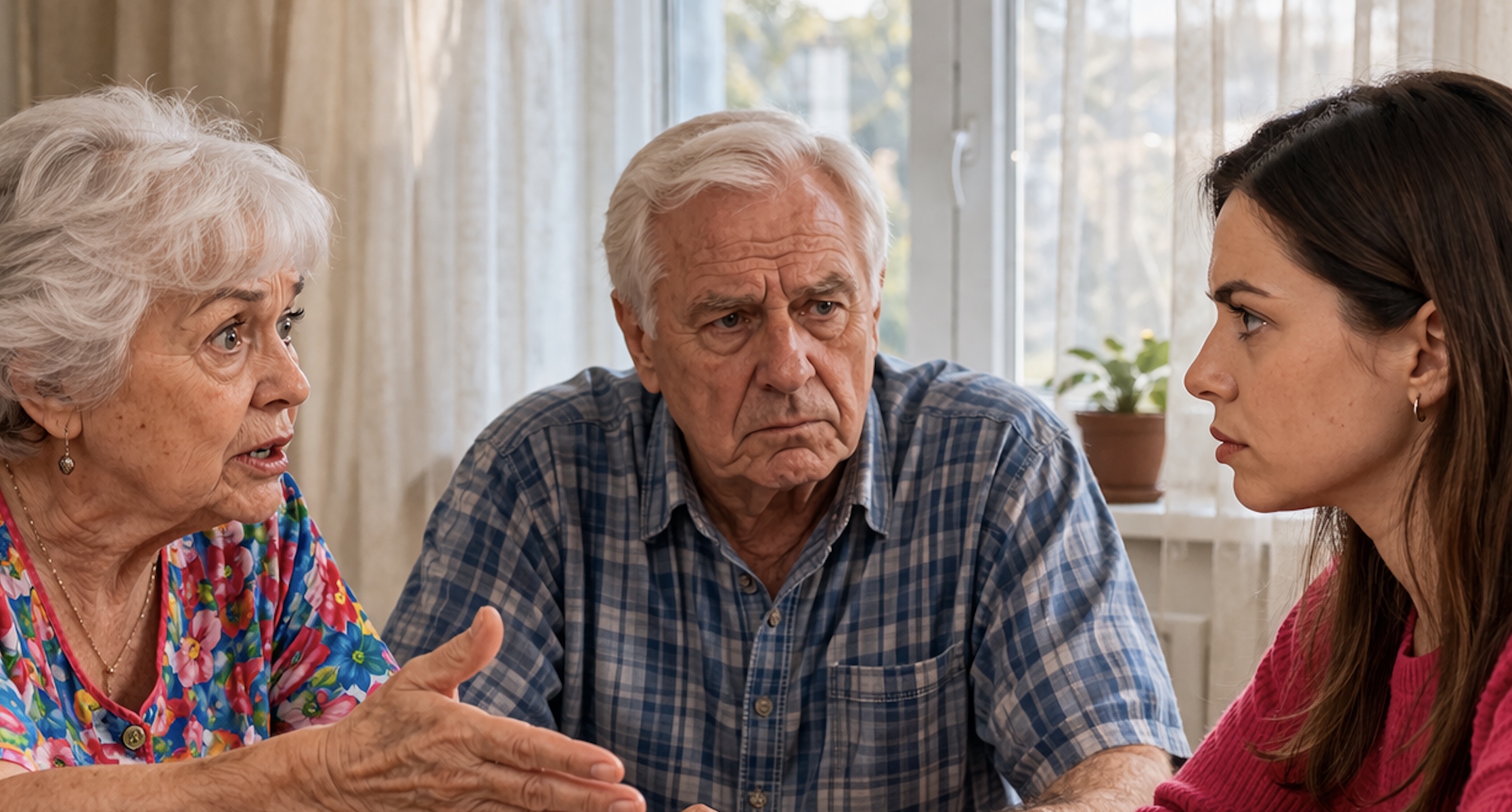
Olya had been careful with money since childhood. Not because her family had been poor—they lived like everyone else, neither rich nor desperate—but because she understood early on that money does not appear by magic. While Rita, in high school, begged their mother for new jeans and makeup, Olya washed dishes in a café, babysat other people’s children, and later worked a supermarket cash register. The sisters were only four years apart in age, yet sometimes it felt like ten. Rita was bright, loud, lucky—the kind of person life seemed to favor without asking much in return. Olya was quiet, stubborn, and the sort who always wanted to get to the bottom of things.
After school, their lives split in different directions. Rita married Sergey, a man who loved to start fixing things and almost never finished them. Olya moved to the city, studied accounting, and later picked up extra work handling financial records for small businesses. She worked from home, hunched over spreadsheets past midnight, denied herself unnecessary purchases, and saved every bit she could. Not because she was stingy, but because she needed the certainty of knowing there was solid ground beneath her feet.
Their parents stayed in the same small town, in the same apartment where both daughters had grown up. The family also had a dacha—an old property that had once belonged to their grandmother: twelve сотки of land, a crooked little house with a sagging porch, and a well that flooded every spring. Olya had never felt especially attached to it. She had gone there as a child, dug in the vegetable beds, eaten currants straight from the bush—and that was all. No sentimental feelings. Just a place.
Like so many stories of this kind, it began with something small.
Her mother called one Wednesday evening just as Olya was finishing a quarterly report for a client.
“Olenka, could you help us a little? Just until pension day. Your father’s blood pressure is acting up again, and the medicine is expensive.”
Olya helped. She transferred the money that same evening without counting, without questioning. Parents were sacred to her; that was simply how she was built.
A month later, there was another call.
“Sweetheart, the pipes started leaking, so we had to call a plumber. You know we wouldn’t ask if we had any other choice.”
“It’s fine, Mom. I’ll send it.”
Then again. And again. Olya began to notice a pattern, but she pushed away the uneasy thoughts rising inside her. Elderly people had plenty of expenses. Their pension was small, their health was failing. If you were a daughter, you helped.
One weekend she came home just because she missed them. She brought groceries and a cake. Her parents were happy to see her, and her mother bustled around in the kitchen. During dinner, they were chatting casually when her father suddenly said, as if it were the most ordinary thing in the world:
“Rita and Sergey already replaced the roof. Says they’ll start working on the inside by autumn.”
Olya looked up from her plate.
“What roof?”
“At the dacha, of course. They’re building there now. Tore down the old house and started putting up a proper one. Sergey’s doing most of it himself, with help from some friends. Good for them.”
Olya set down her fork.
“At the dacha? Our dacha?”
“Yes,” her mother said without lifting her eyes. “We signed it over to Rita. Quite a while ago, actually. They had nowhere decent to live, so we decided it made sense.”
Silence dropped over the kitchen like a heavy lid.
“You transferred the dacha to Rita,” Olya repeated slowly. Not a question. Just words she needed to hear aloud before they could feel real.
“Olenka, you understand. You’re doing well. You manage. Rita has it harder. She and her husband aren’t settled, their work is always uncertain…”
“I’m doing well,” Olya repeated. Her voice stayed even. “I see.”
She said nothing else. She finished dinner, helped clear the table, slept in her old room, and left the next morning. Her mother walked her downstairs wearing a guilty expression, trying to explain something about how “it just happened” and “you’ve always been our sensible one.” Olya nodded and smiled.
Once she got into the car, she sat motionless for five full minutes before turning the key.
The drive was long, and her mind kept moving while her hands stayed on the wheel.
She remembered. A year earlier her mother had said medicine was too expensive, and Olya had sent money. A few months later: bathroom repairs. She had sent more. Then: they had helped the neighbors and now needed to repay them. Once her father had casually mentioned that lumber was getting expensive these days, according to Sergey. At the time, Olya had thought nothing of it. Just a passing comment.
Now those comments lined themselves up one after another, and the picture that emerged was so plain, so ugly, that she almost laughed.
The money had been going into the construction. Maybe not all of it—perhaps some really had gone to medicine, she couldn’t know for sure—but at least part of it, and maybe most of it, had gone toward the dacha that had already been signed over to Rita. Building materials. Tools. All the things people buy when they are putting up a house and do not have stable official income. And Olya had been sending the money faithfully, without asking questions. Because they were her parents.
No one had said: Olya, we’re building Rita a house—will you help? If they had asked openly, she might even have agreed. Maybe. But they had not asked. They had told her stories about pipes, blood pressure, neighbors. And she had believed them, because she had never been given a reason not to.
The bitterness rose from somewhere deep inside her. Not anger—no, not exactly. More like bitterness. And weariness. The weariness of realizing that people saw you as a dependable resource instead of a person who also wanted, sometimes, to be consulted.
Her friend Natasha, whom she had known since their student days, listened to the whole story over coffee on Saturday.
“So what are you going to do?” Natasha asked, resting her cheek on her fist.
“I don’t know,” Olya admitted. “Being angry at my parents feels… wrong. They didn’t do it out of malice. This is just how they think: one daughter is struggling, the other is fine, so you redistribute.”
“Right. Except nobody asked you.”
“No. They didn’t.”
“And the dacha didn’t go to you.”
“No.”
“And your money went toward the dacha you didn’t get.”
Olya looked at her.
“Are you making it sound that blunt on purpose?”
“Absolutely,” Natasha said, without smiling. “Because right now you’re in that stage where you’ll start convincing yourself that everything is fine and you’re being unfair for feeling hurt. I know you.”
Olya said nothing. Natasha, as usual, had hit the mark.
“I don’t want to fight with them.”
“You don’t have to fight. You just have to tell the truth once. Calmly. No drama. They’re adults. They’ll understand.”
“Or they’ll be offended.”
“Or they’ll be offended. That’s their right. Just like it’s your right to say what you think.”
Olya looked out the window at the gray street, at the nearly bare trees, and thought that Natasha was right, as always. Uncomfortably right.
Her mother’s next call came soon enough.
A few weeks passed. Olya had learned to live with what she knew, to file it away neatly on the inner shelves of her mind, the way she did with everything. She kept working, kept tending to her spreadsheets, went to the market on Saturdays, read before bed. Life continued in its orderly rhythm.
Then her mother called.
“Olenka, we have a small problem…”
The voice was familiar. The tone even more so. Olya could almost predict the rest before it came.
“We owe a little money. Your father borrowed from our neighbor, Viktor Ilyich, back in the spring—you understand, things were tight then. Now he wants it back, and we have no way to pay at the moment. Could you help us out? We’ll return it as soon as—”
“Mom,” Olya said.
“Yes, sweetheart?”
Olya took one slow breath.
“Mom, you signed the dacha over to Rita, didn’t you?”
A short pause.
“Well… yes. We told you.”
“You did,” Olya said. “So the dacha is Rita’s now?”
“Well, legally yes, but it’s still family property, it’s not—”
“Mom.” Olya’s voice remained perfectly calm; even she was surprised by that. “If the dacha went to Rita, then let Rita cover your debts.”
Silence.
A long silence. So long that Olya could hear her mother breathing into the phone—confused, startled.
“Olya,” her mother said at last, in a different voice. “Are you offended?”
“No, Mom. I’m just saying things as they are.”
“But Rita has it hard right now. They’re building, every kopeck counts…”
“I know they’re building. On the dacha that now belongs to them.” Olya paused. “I’m glad things are moving forward for them. Truly. But I’m not going to keep covering debts when I’m not even told honestly what they’re for or whom they benefit.”
“You know we didn’t mean anything bad by it…”
“I know.”
“Your father will be upset…”
“Mom.” Olya paused again because she wanted to keep her voice gentle, free of blame, free of tears. “I love you. I have always helped you, and I always will when it’s about your health, or when there’s a real emergency. But I’m not going to finance a construction project I was never told about, on land that wasn’t given to me. This isn’t anger. It’s honesty.”
Her mother said nothing more. She ended the call shortly and hung up.
Olya placed the phone on the table and looked out the window.
A fine autumn rain was falling. Leaves from the poplar tree were flying almost sideways in the wind.
She had expected to feel worse. She had expected guilt to twist somewhere inside her, that awful feeling that she had done something wrong, that good daughters do not speak this way. But none of it came. There was only a quiet tiredness, and something like relief—fragile, not yet fully grown, but unmistakably alive.
Rita called three days later.
Olya was not surprised. She had been waiting for it.
“Hi.” Rita’s voice was dry, though not angry. Rita had never been good at staying angry for long; it was one of the few things Olya had always genuinely liked about her. “Mom said you were upset about the dacha.”
“I’m not upset,” Olya replied. “I was just surprised that nobody told me.”
A pause.
“Well… we didn’t think it mattered to you. You always said you didn’t care about that place.”
“That’s true. I don’t care about the place itself.” Olya chose her words carefully. “But that doesn’t mean I don’t care about knowing how family property is being handled. And it certainly doesn’t mean I’m fine with my money going into your construction while people are telling me stories about leaking pipes.”
The silence this time was different from the one with her mother. Tighter.
“You think we did it deliberately?”
“I think nobody really thought about it at all. Not you, not Mom, not Dad. I’m convenient. I pay. No one explains anything—why bother, if it works anyway?” Olya stopped. “Rita, I don’t want to figure out who’s guilty. I want only one thing: when it comes to my money, ask me.”
“We do pay it back,” Rita said softly, almost ashamed.
“No,” Olya answered, just as quietly. “You don’t. Not once.”
Rita had nothing to say to that.
They spoke a little longer—not about anything important. About the weather. About how the construction was going. About their mother’s cough and how she should probably see a doctor. They parted on decent terms. Olya even asked about the roof—not out of politeness, but because she actually was a little curious. She had never watched a house being built.
“Sergey installed the rafters himself,” Rita said, and for the first time there was warmth in her voice. “I stood below and helped hold everything. My arms nearly fell off.”
“Well done,” Olya said. And she meant that too.
Her father called a week later. His voice was serious and slightly wounded—the way he sounded when he wanted to scold someone but preferred to pretend he was simply checking in.
“Olya. How are you?”
“I’m fine, Dad. Working.”
“You upset your mother.”
“I know. I didn’t want to.”
“She’s worried.”
“So am I. But I said what I think. Is that such a bad thing?”
Her father fell silent.
“You’ve always been like this,” he said at last. It was impossible to tell whether there was reproach in it or pride. “Straightforward.”
“You raised me that way,” Olya answered.
Again, he was quiet. Then he cleared his throat.
“As for the dacha… we didn’t think you’d feel hurt. We thought you didn’t need it.”
“Dad, I’m not hurt because of the dacha. I’m hurt because nobody asked.”
“Well…” He sounded like he was groping for the right words. “We’re not used to explaining ourselves. You know what our family is like.”
“I do,” Olya said. “That’s exactly why I’m saying something now. So it can be different.”
The conversation was awkward, like taking your first steps after sitting too long. But it happened. And as they were ending the call, her father said something unexpected:
“You did the right thing by saying it.”
Olya sat for a long time afterward with the phone in her hands.
Life did not change dramatically. It never does. Her mother still called, her father still called, Rita sometimes sent photos from the construction site—here the windows were in, here the floor had been laid. Olya looked at those pictures and thought the house was turning out rather well. Not showy, not oversized—just sturdy, built by hand, with all the unevenness and honesty that hand-built things carry.
She stopped sending money. Unless someone told her plainly what it was for and why, the answer was no.
Once, her mother hinted again, very cautiously, about some expense. Olya asked directly: “Is this for you, Mom, or for the construction?” Her mother hesitated, then admitted, “Well, Sergey needed money for materials.” Olya replied, “Then let Rita ask me. It’s her house.”
And her mother seemed, at last, to understand. Not agree—understand. Those are different things, but understanding is enough to begin with.
In November, Olya took a few days off and went nowhere in particular—just to a nearby city she had never visited before. She rented a small room, wandered unfamiliar streets, ate in strange cafés, and finished a book that had sat half-read on her shelf for a year.
On the last day, she sat by the window, looking out at an unfamiliar square with a fountain already shut down for winter, and thought about how she did not really know how to rest. How she was always calculating, planning, controlling. Perhaps that was the price of being self-sufficient: this constant labor inside herself, this inner counting machine that never switched off.
But she also thought she had done the right thing. Not elegantly. Not painlessly. Not without the discomfort of her mother not calling for several days, or her father sounding distant the next time they spoke. But right.
There are things that must be said. Not because you want to put someone in their place, or prove yourself right. Simply because silence costs more than you can afford to pay. Because if you stay silent long enough, you begin to believe that this is how it is meant to be—that your money, your time, your effort are simply supposed to flow somewhere by default, and that you have no right to ask where or why.
She had that right. Now she knew it for certain.
Shortly before New Year’s, Rita sent another picture: she and Sergey standing in front of the unfinished house, now with windows and a door, snow already settled across the roof. Both of them were red-cheeked from the cold. Rita was laughing. Sergey looked at the camera with the expression of a man who was exhausted but satisfied. Under the photo she had written: “We made it to the first winter.”
Olya looked at the picture for a long time.
Then she replied: “That’s wonderful. Truly wonderful.”
And that was honest too.
Not everything in life is divided neatly or fairly. Dachas go to the daughter who asks more loudly, or the one who needs it more, or simply to whoever ends up with it because of circumstance and the strange logic parents sometimes follow. Old hurts remain hurts, even when you try to rename them as understanding. Family is not a contract; there are no clauses and signatures in it. And precisely for that reason, it is so easy in a family to violate the things no one ever said aloud.
But sometimes one sentence, spoken calmly at the right moment, is enough to shift something. Not fix it—shift it. Just enough to feel solid ground beneath your feet.
Olya turned off her phone and went to bed.
Tomorrow, work would begin again.