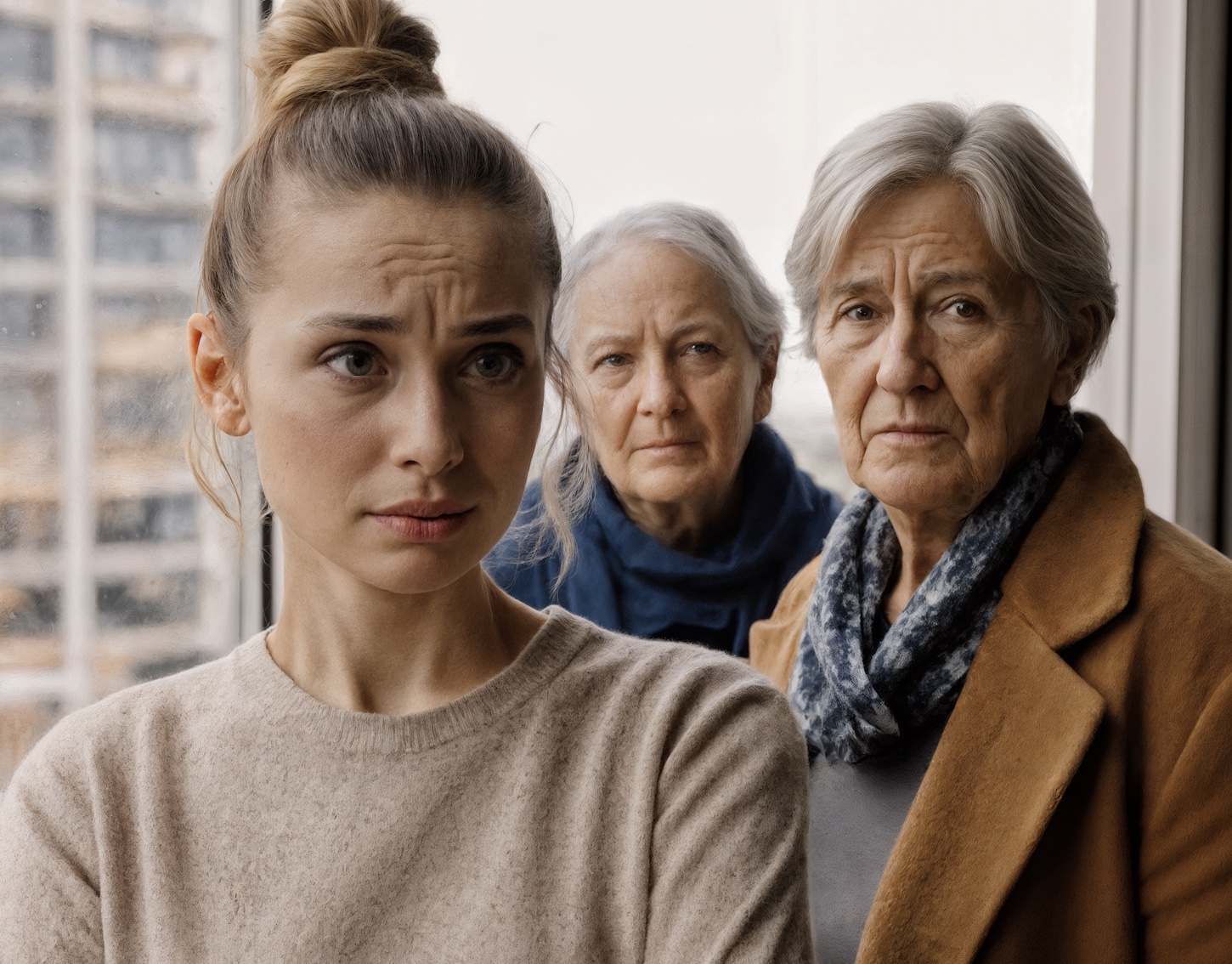
“Are you mocking me or something?” Sasha’s voice was tight as a drawn wire. “I come home, and you haven’t even made a meal? Not a thing, Katya. Nothing.”
Katya stood by the window, watching the drizzle blur the lights in the courtyard below. Her fingers still smelled of medicine and adhesive bandages — during her shift at the medical station, she hadn’t even had the chance to properly sit down.
“Sasha, I told you this morning — I was on duty until eight. I literally just got home. There’s pasta in the fridge, and there are yesterday’s cutlets. Heat them up.”
“Pasta…” he echoed with a crooked smirk. “Pasta, like I’m some broke student in a dorm.”
He tossed his jacket onto a chair, pulled a bottle of beer from a bag, and popped it open with his bare hand, hissing through his teeth. Katya flinched — not because of the sound, but because of the habit itself. There had been a time when she found it masculine. Now it only looked crude, the gesture of a man who simply didn’t care.
“Sasha, I’m exhausted. Truly exhausted. I had three injury cases today, and one girl fainted right at the front desk. My legs are aching, my hands are shaking. Can we just not do this tonight?”
“Not do this?” He gave a short, bitter laugh. “You never do anything but stay silent. Honestly, listening to you is boring now — you’ve got nothing to say except complaints.”
Katya turned, bracing one hand against the windowsill.
“And you, apparently, only care about being admired. You want the apartment spotless, dinner like a restaurant meal, and a wife who smiles on command.”
“And that’s too much to ask?” he snapped. “For the record, I work hard so you can sit here in comfort.”
“In comfort?” she said with a dry smile. “This is my father’s apartment, in case you forgot.”
“There it is again!” he exploded, slamming his fist onto the table. “Every time you don’t know what else to say, you throw that in my face. ‘My father’s apartment!’ You should be grateful I even moved in here. Any other man would’ve dumped you a long time ago!”
She just looked at him. There had been a time when she loved that fire in him — it had seemed like strength, ambition, proof that he would make something of himself. Now she saw only a resentful man who needed everything and everyone around him to orbit his ego.
Her phone buzzed on the windowsill — a text from her friend:
Where are you? Everything okay?
She didn’t answer.
Meanwhile, Sasha was already stomping around the kitchen, yanking open cabinets and banging plates around.
“Where’s the regular salt? Why is everything poured into these jars?” he grumbled. “It’s always chaos with you. Even the spices are lined up crooked.”
Katya closed her eyes and counted to ten.
“Sasha, please, don’t start. I really cannot fight right now.”
“So I’m just supposed to put up with this?” He came right up to her, smelling of beer and irritation. “For six months you’ve been promising things would get better. That you’d stop staying late. That you’d start paying at least some attention to the house. Where is all of that?”
She looked straight into his eyes.
“And for six months you’ve been promising to stop drinking on weekdays. How’s that going?”
It landed like a slap. He recoiled, gave a contemptuous little snort, opened another bottle, and headed for the television.
“I’m not a drunk, if that’s what you’re implying,” he muttered. “I just relax after work.”
Katya wanted to say something back, but she didn’t.
When the fridge door slammed, and the sour smell of beer mixed with smoke filled the room, she quietly stepped out onto the balcony. Down below came the hum of traffic, the rustle of someone dragging market bags, the cry of a child somewhere in the dark. It was an ordinary October evening outside Moscow — gray, damp, sticky. And standing there in that miserable weather, she suddenly understood with painful clarity: she could not go on living like this.
The next morning began in silence.
Sasha left without saying goodbye. A dirty plate and a crumpled napkin covered in crumbs were left on the table. Katya picked up her phone and sent him a short message:
I’m on a twenty-four-hour shift. Don’t wait for dinner.
There was no reply.
At the medical station, the day dragged on forever. People coughed, someone argued over paperwork, someone got into a shouting match with the security guard. But deep inside Katya, a strange calm was already beginning to settle. As if everything had already been decided — she just hadn’t said it aloud yet.
After lunch, Natasha, her coworker, called.
“Katya, I don’t want to pry, but are you really okay? You look like someone who hasn’t slept for three nights.”
“I’m fine,” Katya answered wearily. “Just thinking about some things.”
“About Sasha?” Natasha asked immediately.
Katya said nothing.
“I know you,” Natasha continued. “When you go quiet, it means it’s all piled up. Why don’t you come over tonight? We can talk, take your mind off things.”
“I can’t. I think I need to stay home tonight. I need to think everything through.”
By the time she got back home, it was already dark outside. A strange umbrella lay on the mat by the door — black with a blue stripe. Katya frowned. The lights were on inside.
She opened the door — and stopped cold.
A young blonde woman was sitting on the couch, her nails so long they looked almost unreal. Sasha was standing beside her, wearing the shirt Katya had given him for his birthday last year.
“Oh, there you are,” he said as if nothing unusual was happening. “We’re just looking through some things.”
“What things?” Katya’s voice was low, but there was something dangerous underneath it.
“My things. I decided to stay with Alina for a while,” he said, nodding toward the girl. “But I need some documents and a few other things…”
Katya walked past them and stopped in the middle of the room.
“You brought her here? Into my home?”
Alina gave a shrug, looking at Katya as if she were some dull, inconvenient neighbor.
“I didn’t even want to come,” she said to Sasha, pouting. “You insisted.”
Katya turned to her.
“Then leave. Now.”
“Hey, take it easy!” Sasha cut in. “This is my home too! I lived here, remember?”
“No, Sasha,” Katya said evenly. “This is my home. My apartment, bought long before you showed up in my life. And now, as far as this place is concerned, you are nobody.”
“Have you completely lost it?” he shouted. “You think you can just throw me out?”
She stepped right up to him and looked him dead in the eye.
“I already have. You have three minutes to collect your things. After that, I’m calling the police.”
He sneered at her face, as if waiting to see whether she would crack. But Katya stood there like stone.
“Fine,” he spat. “I’ll take my stuff. But you’ll regret this.”
“Maybe,” she replied. “But not nearly as much as I’ve regretted all the time I spent with you.”
Alina hovered by the door, clearly not knowing what to do. In the end, Sasha grabbed a couple of bags, muttered something under his breath, and stormed out after her. Katya shut the door. Turned the lock. Then slid the chain into place.
Only then did she allow herself to sink to the floor and breathe.
After that, everything moved quickly.
The next day she called a locksmith, changed the locks, stuffed the rest of Sasha’s belongings into trash bags, and left them downstairs by the building entrance. Then she called her mother.
“Mom,” she said into the phone. “It’s over. Completely over.”
Her mother was silent for a second.
“I knew it would end this way,” she finally said. “And I’m proud of you. Just don’t let him come back. Not under any circumstances.”
By evening, Katya and her mother, Valentina Pavlovna, were sitting in the kitchen drinking tea and making a list: lawyer, divorce papers, close the shared account. Katya listened, nodded, followed every step — but in her head, only one word was ringing:
Freedom.
But Sasha was not ready to give up. Two days later, he called.
“Katya, I understand everything now,” he said into the phone. “I was an idiot. Forgive me. We can start over, can’t we? I swear, it was all a misunderstanding.”
“A misunderstanding is mixing up salt and sugar,” she answered calmly. “What you did was a choice.”
“I was just confused! I’m miserable without you!”
“Sasha, enough. Don’t call me again.”
She ended the call.
But that evening he was standing outside the building.
“Katya, I’m not leaving until you hear me out!”
“Then I’ll call the police.”
He stepped closer, trying to catch her by the hand.
“Listen, I love you!”
“No, Sasha,” she said, pulling away. “You only love yourself.”
He remained standing there in the rain while she walked away without turning back.
A week later, the doorbell rang. On the doorstep stood a woman in her sixties, with a dry face and a superior expression.
“Good evening,” she said, not even pretending to smile. “I’m Sasha’s mother. We need to talk.”
Katya nodded.
“Come in.”
The woman surveyed the apartment like an inspector.
“It’s rather cramped here,” she remarked. “My son has always been used to order and comfort. You drove him to the edge.”
“Really?” Katya asked calmly.
“Of course!” the woman continued. “He worked, while all you did was complain. And besides, a woman should know how to forgive. You’re destroying this family for nothing.”
Katya gave a faint smile.
“A family isn’t destroyed by the one who leaves. It’s destroyed by the one who lies. Your son made his choice. And trust me, life will be easier for him without my forgiveness than it ever was with me.”
“So now you’re being insolent too?” her mother-in-law went pale with outrage. “We’ll see who wins this yet! This apartment isn’t yours — you’re just living in it!”
“Would you like to see the documents?” Katya offered calmly. “I can even give you a copy of the marriage contract. Everything is official.”
“You shameless little—” the woman began, but Katya had already opened the door.
“Goodbye, Vera Ivanovna. The exit is right there.”
The woman left, sniffling loudly with outrage. Katya closed the door and, for the first time in a long while, laughed. Quietly, but sincerely.
The divorce was finalized a month later.
Sasha didn’t even show up to the hearing. His lawyer tried to mention “renovations paid for with joint money,” but Katya’s attorney — an older, reserved man — laid out the documents point by point, and the case was closed in her favor.
When she stepped outside the courthouse, the air was cold, full of autumn, smelling of wet leaves and something clean and new. Katya stood there, looking at the gray sky, and felt something she had not felt in years — not pain, not fear, but lightness.
In November, she rearranged the apartment.
She moved the sofa, bought new bedding, placed a ficus on the windowsill — green, firm, alive.
Sometimes Natasha would call her.
“So, have you gotten used to living alone?”
“Not alone,” Katya would reply. “With myself. And for the first time in my life, I’m not bored.”
Then one day, coming back from the store, she happened to see Sasha at a bus stop. He was standing there with a shopping bag, talking loudly and irritably on the phone. Beside him was Alina — the same Alina — smirking, her arms folded. They were arguing. Sasha barked something sharply, and Alina threw the bag to the ground and stalked off.
Katya walked past them. He didn’t notice her. And that was a good thing. Because inside her there was no anger anymore, no pain. Only calm. It was over.
At home, she made tea and took a new mug from the cupboard — blue, with the words:
Live the way you want.
She sat by the window. Outside, the rain drizzled down, neighbors’ windows glowed, somewhere someone was arguing, somewhere someone was laughing.
She drank her tea, listened to the soft tapping of water along the sill, and thought:
Now this is silence.
Not empty silence.
Real silence. Living silence.
Katya smiled.
She no longer had to prove anything to anyone.
She was simply living — in her own home, in her own life, by her own rules.
And it wasn’t victory.
It was return.