The table was set so beautifully that even the finest restaurants would have been jealous. There was rassolnik with pickles, sharp and tangy like my son-in-law’s expression; Olivier salad layered so carefully it reminded me of all the years I had spent trying to smooth over conflict; and golden roasted chicken, glowing as if life itself had been singing its praises.
I fussed pointlessly with the napkin beside my plate and caught my daughter’s eye — that same look she had always given me, full of pity and unspoken thoughts. I knew better than anyone that behind such glances there was a whole diary of questions no one ever dared to say out loud.
“Mom, salt the pickles,” Tanya whispered. It sounded like a request, but also like a reminder: you’re still here, you haven’t vanished.
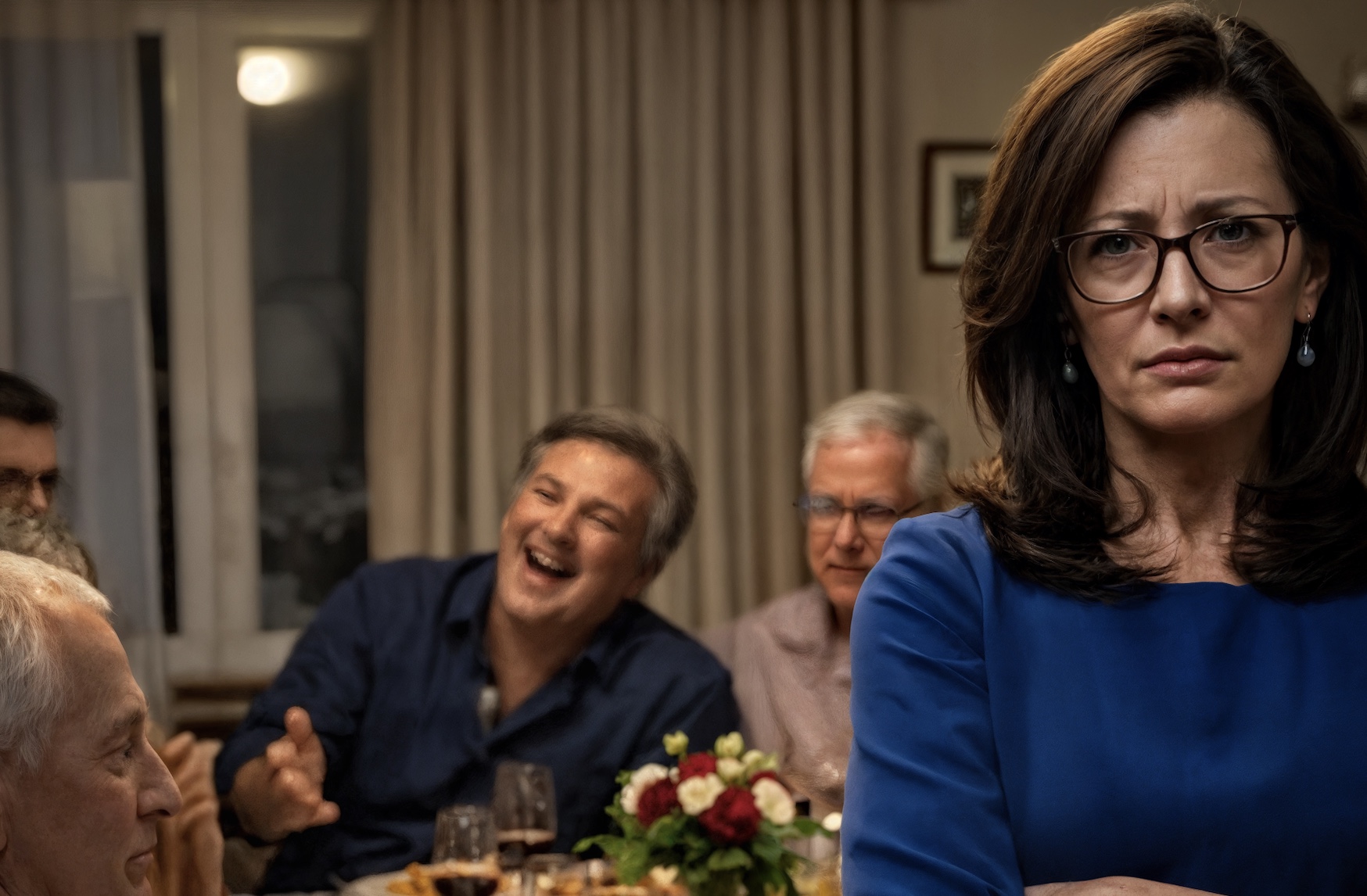
Somewhere nearby my son was laughing, the grandchildren were chattering — all their Fortnite and TikTok talk drifting through my mind like someone else’s song playing at my own celebration. And only Viktor, the self-appointed conductor of this family theater, poured compote into glasses and narrowed his eyes with smug anticipation. His performance was about to begin.
“Well then,” he said loudly, for the whole kitchen to hear, “Valya! You really are a proper librarian. Your books are old, and from the looks of it, time hasn’t treated you kindly either. Who better than you would know what moldy books and stale women look like?”
The laughter spread like too much salt through borscht — not sharp enough to stun, but enough to sting. Even Tanya’s husband laughed, though he knew perfectly well how I reacted. My younger daughter laughed too. And suddenly I understood that everything I had been storing inside for years — all the silence, the patience, the swallowing of pain — in a single second turned into one great heavy pool of hurt.
“Don’t be upset,” Viktor added at once, waving a dismissive hand. “You know I’m only kidding!”
And I wanted to shout: Kidding? This? These little humiliations, these cheap jokes you’ve used to wear me down for twenty-five years? But instead, I smiled.
You know that kind of smile? The kind that comes when your heart feels like a porcelain cup — cracked all the way through, yet on the outside not a single fracture shows. Everyone laughed, and I sat there wondering: Am I really ridiculous? Or am I simply someone people have decided it is safe to humiliate? Maybe I’m just tired.
My grandson dropped his fork. Tanya covered my hand with hers and gave me a smile that was far too strained. Everyone behaved as though nothing unusual had happened — as though Mother was used to this by now, as though she could live with it for another ten years if necessary.
By seven in the evening everyone had gone home. The kitchen fell silent. I stayed behind like the lonely keeper of a ship, gathering plates, brushing away crumbs, wiping up the sticky puddle of spilled compote.
Then I went into the bathroom and looked at myself in the mirror. Wrinkles? Yes. Age? Impossible to hide. But surely it wasn’t only that… something inside me had suddenly cracked and buckled.
Why am I still enduring this?
Irony? There it was, lined up neatly on the shelf — face creams I still used in the hope of somehow erasing time. Exaggeration? Certainly. My love of peace had crossed the line of reason years ago.
I listened as Viktor grumbled from the other room:
“Valya, don’t sulk now. What are you so quiet for, hmm?”
And then he laughed again.
His voice rolled through the apartment like a ball in a maze — never stopping anywhere, yet always somehow making its way back to me. I closed my eyes and heard my own heartbeat:
thump, thump, thump.
Again.
And again.
How much longer are you going to put up with this?
I lay down in bed. Viktor was already asleep, snoring softly, wrapped in the blanket like a baby — only an oversized one, with gray stubble and a permanently grumbling disposition. I stared up at the ceiling where the plaster formed strange patterns, like tear marks on an old sign no one had dusted in years. And suddenly there it was: a sharp pain in my chest.
Not physical pain. No.
The kind that tears you open from the inside when you finally understand:
That’s it. Enough.
I remembered my school years, when people used to call me “Kind Valyusha.” I was always trying to help everyone, always trying to be convenient. That was how I had lived my whole life: the important thing is that everyone else is okay. But who had ever asked how I was?
The laughter at dinner, the quiet shattering inside me, the aching stillness of the room — all of it twisted together into one giant knot of resentment. And I thought: What if…? What if I took the risk? What if, just once, I did something not for someone else, but for myself? A rhetorical question? Maybe. But for me, it was the only one that mattered.
I opened my eyes wider. And for the first time in years, I felt something alive inside me. Desperate. Small. Almost invisible. But warm, like a tiny ember buried under ash.
Part 2
The next morning was unexpectedly bright. Soft summer light poured through the sheer kitchen curtains so generously that for a moment I almost forgot everything Viktor had said the night before. I shuffled across the floor in my slippers and made coffee, dark and strong, as if that bitterness might somehow set me right. Outside, sparrows chattered noisily. People walked toward the bus stop — women in neat scarves, older men carrying bulging shopping bags. Everything looked exactly as it always did.
Vika, the neighbor from the third floor, waved at me from her window and gave me a knowing wink, as if she somehow sensed I was about to do something. Or maybe there was simply something different in my eyes.
My daughter’s words flashed through my memory like cheap little fireworks — not painful exactly, but leaving a trace:
“Mom, stop playing along with him.”
And I thought that if someone had shown me years ago how to say enough, maybe I would have dug some dusty old courage out from behind the wardrobe and used it. But as it turned out, no one ever gave me that advice.
“Valya, come here!” Viktor’s voice came from the room.
There it was: the musical pause had ended, and the conductor wanted his audience again.
I didn’t rush. I counted to ten, slowly. Then I opened the door and felt something shift inside me. Not fear. Not the usual anger. Something else.
Resolve.
A funny word to use at fifty-eight.
“Yes, Viktor?”
He sat at the table, tapping at his tablet, muttering something mocking under his breath. His eyes were sly, his lips already curved into that familiar half-smile, as if another joke was about to be born.
“Why are you so serious?” he snorted. “Still offended?”
Normally, I would have sighed, shrugged, and found something else to do. But this time the words came out on their own, without all the usual machinery of overthinking.
“I’m not listening to your jokes anymore. They hurt me. And honestly, I think it’s time you started thinking about the words you throw around every time we sit at the table.”
Silence.
He even turned off the tablet.
I was startled by my own courage, as if this were not my life at all and someone invisible were standing behind me whispering, Go on, Valya. You can do this.
Viktor looked at me carefully. For the first time in many years, he had nothing to say. A moment later his eyebrows lifted again.
“So now you’re making a scene? Been watching too many women’s soap operas?”
And strangely enough, nothing inside me tightened. No panic. No trembling. I just shrugged.
“No, not a scene. I’m simply tired of pretending that any of this is funny. I’m not required to be Mother Teresa for your sense of humor.”
He fell quiet and looked away. Let him misunderstand. Let him think I was just having one of my moments. For me, even that small sentence felt like taking a wet stone out of a backpack I’d been carrying for years.
Some sane, steady spark had woken up in my chest. I was not decoration. Not furniture. Not background scenery for someone else’s holiday mood. I was alive.
For a couple of hours, I wandered through the apartment with an old book pressed against my chest. I reread the letters my mother used to write me. Every line felt like a reminder:
Valyusha, you deserve happiness.
By lunchtime Viktor’s tone had changed. He was grumbling more softly now, almost as if trying to make peace.
“Maybe… later today we could go buy your favorite lemon pie?”
Well then, I thought, the idea of change frightened him more than all my years of silence ever had. I smiled gently, without anger, but only with my eyes. I didn’t rush to hug him or forgive him. Things needed time to settle.
That evening Tanya called. There was something tender in her voice.
“Mom, how are you? Were you very upset after yesterday?”
And suddenly I realized: I wasn’t upset. I felt free.
“I’m okay, Tanya. Sometimes it’s just so important to say something for yourself out loud… even if it happens only once in a lifetime.”
Tanya and I laugh in the same way — quietly, softly, like silver bells heard from a distance. She was silent for a long time, and then she simply said:
“I’m proud of you.”
I put the phone down and looked out the window at all the bright, restless movement of life. My heart ached, but not from pain. From tenderness. Toward myself. Toward every day I had lived through.
That evening I took out a sheet of paper and wrote:
Valya, at last you allowed yourself…
Allowed yourself what?
To be yourself.
And that courage, small as it was, like the first green shoot after a heavy rain, felt worth more than all the polished table linens and clever jokes in the world.
Part 3
After that came days of strange calm. No thunder, no lightning, no dishes flying across the kitchen. Viktor suddenly became more careful with his words, as though he were walking on thin ice — listening to tone, gently placing his spoon down on the saucer as if even that mattered.
And I noticed that saying no was not frightening at all.
In fact, it was… pleasant.
“Valya, will you come to the store with me?” he asked on the third day, glancing at the strawberry plants lined up on my windowsill.
“I can’t today. I have plans,” I replied.
And I felt absurdly proud of that answer — prouder, even, than when Tanya became an adult, or when I used to wash and iron neat baby cloths for the household year after year.
Because now my plans belonged to me.
I went down to Vika’s apartment on the third floor for tea. We chatted about cucumbers, strange money reforms, grandchildren. We laughed — not like conspirators, but like two schoolgirls tasting chocolate for the first time.
“You’ve changed, Valya,” Vika said, nodding at me as if admiring a fresh jar of homemade jam.
“Oh, stop,” I said, pretending not to understand.
“Don’t pretend. It’s in your eyes. Before, everything in you seemed folded inward. Now you’ve opened up.”
“Maybe that’s just age, Vika,” I brushed it off.
But I knew it wasn’t age.
It was freedom.
Later, in the dusk, I walked home slowly, looking at the pink shadows on the walls the way I used to in my youth. The city lived its ordinary life — someone frying potatoes, someone’s television murmuring behind thin walls — and for the first time in a long time I felt that evening fully, letting its light happiness run through my fingers without fear that it might slip away.
Viktor met me in silence. He only watched me, intently, with a puzzled softness in his eyes. Perhaps he didn’t recognize me anymore. He sat beside me and sighed — not in that tired, irritated way of old age, but honestly, almost like the young man he had once been when we first met.
“I’ve been thinking…” he began. “Maybe you were right.”
The words scratched awkwardly at the air. I did not give in to my old reflex of smoothing everything over. I waited.
“I got used to you always being there for me… I never thought it might be… hard for you.”
I didn’t answer right away. I looked at him — the gray hair falling across his forehead, the wrinkles at the corners of his eyes, that uncertain look like a boy who has done something wrong and is waiting, shyly, to be forgiven.
“It’s hard for me too sometimes, Viktor,” I said simply. “I just used to keep quiet.”
He gave a small nod.
“You’re a good one, Valya. Honestly.”
The words were quiet, not dramatic — like a strip of lamplight stretching across the pavement.
That evening I took out my old letters again, crumpling an envelope in my hands as I reread my mother’s trembling handwriting:
Don’t lose yourself, even if it seems easier for everyone else.
How much power there could be in a few simple words.
Suddenly I wanted tea. I wanted to hold my grandson close. I wanted to call my daughter for no reason at all — not to discuss problems or errands, but simply to talk about little things.
“Mom,” I heard her say over the phone, “you really are different today.”
And I laughed, breathing in the warm evening air through the open window.
Maybe this happiness was tiny. Domestic. Quiet. No fireworks, no applause.
But it was mine.
Part 4 — The Turning Point
Soon summer was in full bloom. The air was thick with the scent of rough-skinned apricots, heavy leaves, and the faint salty smell windowsills get after evening rain. Life itself seemed to have slowed down a little, become softer, deeper. More and more often I found myself standing at the window for long stretches, watching clouds drift lazily behind the neighboring roof. I kept returning in my thoughts to myself — to the real Valya, the one I had once misplaced somewhere and forgotten to tend.
The grandchildren came to visit unexpectedly: joyful, tousle-haired, loud, as if the wind itself had burst into the apartment with them. With them I laughed almost to tears — bright, ringing laughter, so full and alive that Viktor would come out of his room, first frowning, then unable to stop the corner of his mouth from lifting.
“Graaandma, come eat ice cream with us!” they cried, pulling at my hand.
“And what about all my important business?” I teased.
“What business could you possibly have besides us?”
I laughed and tickled their sides, feeling, for once, that I owed nothing to anyone.
That same evening, after everyone had left, I found myself drawn toward my notebook, back to the old habit of speaking to myself on paper.
What would you choose if you weren’t afraid?
I wrote beneath it:
What do you really want?
It was funny, but for the first time in years I honestly did not know the answer.
“Valya, would you like to go to the Volga in August? Remember how it was back then…” Viktor suggested suddenly over dinner. His voice trembled a little, uncertain.
I looked up. There was something bright and genuine in his eyes. Before, I would have immediately started fussing — packing bags, rearranging plans, dropping myself from the equation just so he would be happy. But now I paused.
“All right,” I said. “Let’s try. But only if it’s something I’ll enjoy too. Not the way it always used to be. Do you hear me?”
He simply nodded.
And in that moment I understood something: I did not have to be a strong wall for others to hide behind. Sometimes it was better to become an open window — to let in fresh air, new habits, even if the fear of change still itched strangely beneath the skin.
That night, when the apartment had gone still, Viktor came quietly to my room and sat down at the foot of the bed.
“Forgive me… if there were times when… well, you understand…”
His voice was tight, almost choked.
I didn’t answer right away. I just placed my hand over his.
“It doesn’t matter now,” I said softly. “Everything is all right now. Truly.”
And for the first time in a long while, I slept deeply, without fear, as if someone had finally lifted off me the old heavy blanket of everyone else’s expectations.
Part 5 — Resolution
The morning smelled of warm milk and slightly burnt toast. Viktor was puttering around in the kitchen, humming something under his breath in that thin little voice people use only when they think no one can hear them. I lay in bed and listened to this new rhythm between us — no frantic rushing, no race toward perfection, no constant tension that I might fail to meet someone else’s expectations.
When we sat down for breakfast, the sunlight stretched golden stripes across the tablecloth, and suddenly I noticed how tenderly soft my husband’s hands had become, how the wrinkles around his eyes made him seem almost especially dear to me.
“Well, would you look at that,” I said with a quiet laugh. “Forty years together, and it feels as though we’re only just getting acquainted.”
“Yes,” Viktor nodded slowly. “I think I’ve only now really learned how to listen to you.”
And we both laughed — not looking away, not shutting down, not hiding inside ourselves.
I found myself no longer staring anxiously into the future. I simply lived — one day after another: a walk in the park, warm bread in a paper bag, silly chatter with my granddaughter, quiet evening tea under a blanket. Sometimes I even allowed myself to do nothing at all — just look out the window, listen to the birds, and feel sad.
But that sadness no longer crushed me. It warmed me, like a wool shawl across my shoulders, reminding me that I knew how to be both sorrowful and happy at once.
In August we really did go to the Volga. This time there was no fuss — just a couple of dresses, a book for the evenings, a jar of jam for tea. The little lights skipping across the water reminded me of youth, of the truth that happiness is never loud or triumphant. It is quiet, translucent, like dusk settling over a river.
One evening we sat on the pier, our shoulders touching, and I suddenly understood that believing in yourself is not about defeating someone else. It is about accepting yourself whole — your fears, your hopes, your old habits, your inability to explain everything at the right moment or to open your heart in time.
“Thank you for putting up with me,” I said to Viktor with a wink.
“And thank you for putting up with me,” he replied.
And inside me there was such peace that all I wanted was to exist — here, now, exactly as I was.
That is how we live now. Not perfectly, but truthfully. Sometimes I think that if I could go back, I would not change a thing. Every mistake, every timid moment when I tried to choose myself, has become part of this vast, complicated, tangled, beloved self I now call me.