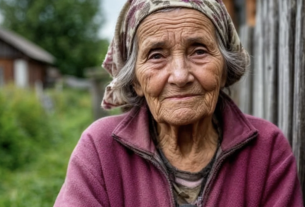
I was standing at the stove, stirring Sunday borscht, when the phone on the table began to vibrate. The number was unfamiliar — a landline.
“Lidia Sergeyevna? Good afternoon. This is Savelyeva’s notary office. You need to come to us as soon as possible to review an application regarding the allocation of a share in your apartment.”
The ladle almost slipped from my hand.
“What apartment?” I asked, feeling a chill spread through me. “I have one apartment. I’ve lived in it for thirty years. And I am the only owner!”
“The documents state otherwise,” the voice replied dryly. “New circumstances have come to light. We expect you tomorrow at ten.”
I slowly sank down onto the stool. Viktor, my late husband, and I had received that two-room apartment on the embankment back in the nineties. After his death five years ago, I had transferred everything into my name. My son, Igor, had insisted on it himself back then.
“Mom, live peacefully. I don’t need anything. Alyona and I have our own mortgage.”
My son.
The thought burned through me. I immediately called Igor.
“Igoryok, the notary office just called me… They say someone is claiming my apartment. Do you know what kind of nonsense this is?”
A heavy, sticky silence hung on the other end of the line. Then I heard my daughter-in-law Alyona’s voice. She was clearly standing near the phone and spoke loudly, distinctly:
“Tell her the truth, Igor. Stop playing cat and mouse. We have just as much right to those square meters as she does.”
“Mom…” My son’s voice trembled. “We’ll be there tomorrow too. Let’s talk at the office. It turns out Dad signed a certain paper before he died… one you apparently ‘forgot’ about.”
I listened to the short beeps and could not believe my ears.
What paper?
Viktor had adored me. We had lived soul to soul. Or had I spent thirty years beside a complete stranger?
I spent the entire evening searching through an old folder of documents. My hands were shaking. Only at three in the morning, at the very bottom, behind our marriage certificate, did I find a yellowed envelope I had never noticed before.
Inside was a note from my husband, written in his broad, familiar handwriting:
“Lida, forgive me. I had no other choice. When you find out, don’t blame our son. He is only protecting what is his…”
I was already at the door of the notary office by half past nine. My legs felt like cotton, and the note from my husband, hidden in my bag, felt like a burning coal.
I kept turning the same thought over in my head:
“Viktor, why? What could you have hidden from me for thirty years?”
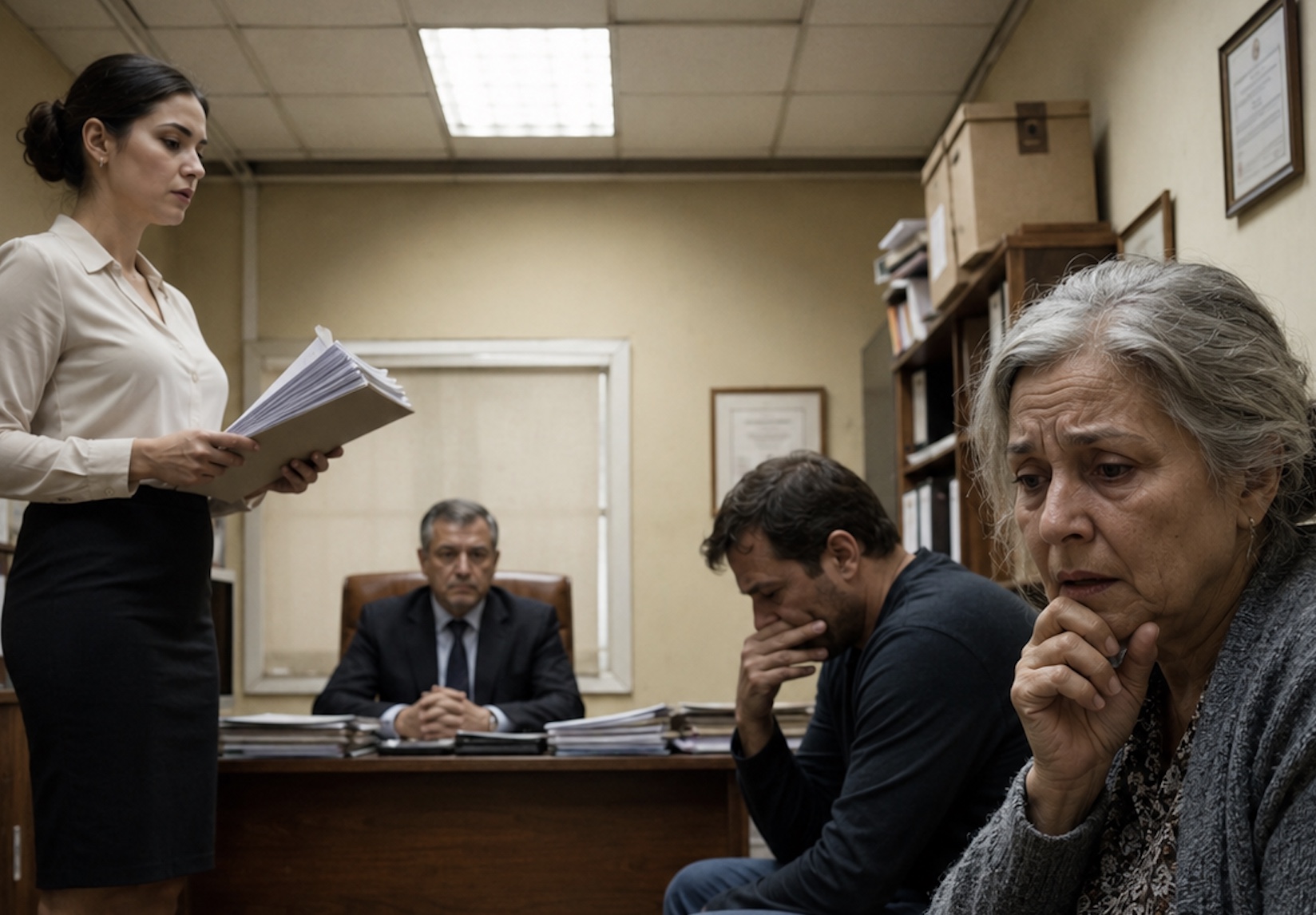
Igor and Alyona arrived exactly at ten. My son avoided my eyes, nervously adjusting the collar of his jacket. But my daughter-in-law walked with her head held high, clutching a thick leather folder in her hands. She did not look like family. She looked like a shark that had smelled blood.
“Hello, Mom,” Igor said dully.
“Hello, son. Will you explain what is going on?” I tried to keep my voice from trembling, but I failed.
“Lidia Sergeyevna, let’s not make a drama out of this,” Alyona interrupted, pushing Igor aside with her shoulder. “We’re here on business. Your apartment did not originally belong only to Viktor Mikhailovich. You do remember his aunt from Samara, don’t you? The one who left him an inheritance before your marriage?”
I froze.
I vaguely remembered that aunt. She had died a month before our wedding. Viktor had always said that the money had gone toward our first payment, toward our shared housing cooperative.
We were invited into the office. The notary, a strict man in glasses, laid the papers out in front of us.
“So,” he began, “we have an application from Igor Viktorovich requesting the allocation of a mandatory share. This is based on newly discovered circumstances, namely a deed of gift with deferred rights, which your late husband executed six months before his death.”
“What deed of gift?” I almost shouted. “He couldn’t gift anything. The apartment was our joint property!”
“That is where you are mistaken,” Alyona said with a triumphant smile, placing a copy of an old document on the table. “Viktor Mikhailovich separated his share ten years ago, since part of the funds used had belonged to him before marriage — inherited funds. And he gifted that share to Igor. But with one condition: our son could claim his rights either after his father’s death, or… if you decided to sell the dacha.”
I felt the ground disappear beneath me.
Last month, I had mentioned that I was no longer strong enough and wanted to sell our old dacha to help Igor pay off part of his mortgage. I had wanted to do something good.
“So,” I looked into my son’s eyes, “you arranged all of this behind my back? While I was caring for your father in the hospital, while I stayed awake night after night, you were drawing up deeds of gift?”
Igor finally raised his eyes. There was no remorse in them — only some sharp, bitter resentment.
“Mom, did you ever think about us? The four of us are crammed into a one-room apartment! You have two rooms and a dacha. Alyona is right. Dad wanted me to have security. He knew you’d start giving everything away to some ‘peace fund.’”
“What security, Igor?” I whispered. “This is my home. I know every nail here. I chose those curtains myself when you were still in school…”
“We’ll change the curtains,” Alyona cut in. “Notary, tell her the main thing. We are not just allocating a share. We are demanding that the utility accounts be divided. Igor has the right to move into one of the rooms. Or… we can buy out your share at cadastral value. It’s pennies, as you know. The building is old. It will be enough for a room in a dormitory somewhere on the outskirts.”
There was no air left in the office.
My son — my own boy, whom I had raised, investing every last coin into his education and clothes — sat there silently nodding while his wife tried to throw me out of my own home.
“Igor,” I reached my hand toward him. “Do you understand what you’re doing? You’re putting me out on the street.”
“Mom, why are you saying it like that…” he muttered. “We just need more space. You can squeeze into the small room, and Alyona, the kids, and I will take the big one. Or take the money and buy yourself something smaller. Why do you need two rooms all alone?”
I remembered Viktor’s note:
“Don’t blame our son. He is only protecting what is his…”
Now the phrase sounded different.
It was not Viktor who had been protecting Igor. It was Igor who had forced his sick father to sign those papers, probably promising that “no one would hurt Mom.”
I stood up. My bag suddenly felt unbearably heavy.
“So, the small room?” I looked at Alyona. She merely crossed her arms over her chest in victory. “Fine. But before we sign even one paper here, in this notary office, I want to show you something. Something your father hid so deeply that even you ‘bloodhounds’ failed to find it.”
I pulled out the yellowed envelope.
But inside there was not only the note. There was a second sheet — a certificate whose existence Igor clearly knew nothing about. And judging by the way Alyona turned pale when I began to read it aloud, their “perfect plan” had just collapsed.
“Read it, Mr. Notary,” I placed the paper on the table. “Read it out loud, so my son can clearly hear whose money actually built this apartment.”
A silence fell over the notary’s office so deep that the ticking of the wall clock became audible. Alyona smugly adjusted her hair, certain that victory was already in her pocket. Igor kept studying his shoes.
I looked at them and felt something inside me begin to change. Instead of pain, an icy calm started to rise.
I no longer wanted to cry.
I wanted to defend myself.
The notary took my yellowed paper, adjusted his glasses, and began to read carefully. First his eyebrows lifted. Then he looked at Igor. Then he returned to the document.
“Lidia Sergeyevna,” he said slowly, “where did you get this?”
“In my husband’s old folder,” I replied evenly. “In the place where my son apparently did not look when he persuaded his sick father to sign gift papers for ‘premarital property.’”
Alyona could not hold back.
“What could possibly be written there? We checked all the archives! Viktor Mikhailovich inherited money from his aunt before marriage. It was his personal money, and he used it to pay for the cooperative. That means his share is his share, and he gifted it to his son. It’s all legal!”
“Legal,” the notary nodded, “if not for one detail. You are right about one thing, Alyona Igorevna: there was an inheritance from the aunt. But you are deeply mistaken about what it was used for.”
He turned the paper so that Igor and Alyona could see the text.
It was a receipt, certified back in Soviet times, along with an old savings bank payment slip.
“According to these documents,” the notary continued, “Viktor Mikhailovich did receive a large sum. But a week before joining the housing cooperative, he transferred the entire amount to his mother’s account — your grandmother’s account, Igor Viktorovich — so she could buy herself a small house in the village. And the payment for this apartment, the very apartment whose square meters you now wish to divide, was made from Lidia Sergeyevna’s personal funds, which she received from selling her parents’ house in the city center. And here is a counter-receipt from your father, in which he acknowledges that the apartment was purchased with his wife’s money and is her separate property.”
Alyona’s face turned ashen. She snatched the paper and quickly ran her eyes over the lines.
“This is fake!” she shrieked. “This can’t be true! Igor, do you hear this? Your father deceived us! He signed a deed of gift for something that didn’t actually belong to him?”
Igor sat there, white as a sheet.
“Mom…” he whispered. “Dad said he had settled everything. He said he had the right…”
“Your father, Igor, was a decent man, but a weak one,” I said, standing and looking down at my son. “Apparently, when you pressured him in the hospital, he did not have the strength to say no. He signed that worthless deed for his ‘share’ just so you would leave him alone and let him live out his final days in peace. But he knew the truth was in that folder. He left me protection against his own weakness. And against your greed.”
The notary cleared his throat.
“Since the property was, in fact, the separate property of the spouse, the deed of gift executed without her consent for a share that was never legally separated from her funds is void. Igor Viktorovich, your application for allocation of a share cannot be satisfied. Lidia Sergeyevna is the sole legal owner of the entire apartment.”
Alyona jumped up, knocking over her chair.
“We won’t leave it like this! We’ll go to court! We’ll find lawyers! Igor, why are you silent?! Say something! We have children! We need that space! We already ordered a wardrobe for the big room!”
I looked at her — this strange woman who had already “ordered a wardrobe” for my bedroom while I was still alive.
“You can keep the wardrobe, Alyona. And go to court if you want. But keep in mind: for attempting to seize someone else’s property, and for the way you tormented an old man in the hospital with your papers, I can also raise the issue of declaring you unworthy heirs in the future. Is that what you want?”
Igor jumped up and grabbed his wife by the arm.
“Enough, Alyona! Let’s go. I said let’s go!”
They rushed out of the office.
I remained alone. The notary looked at me sympathetically.
“You need to formalize everything properly so there will be no more ‘surprises.’ Please sit down. We’ll prepare the documents.”
I returned home only in the evening. The apartment smelled of the same borscht I had never finished cooking. I walked into the room, sat down in Viktor’s armchair, and cried.
Not from grief.
From a terrible emptiness.
An hour later, the phone rang.
Igor.
“Mom… Forgive me. Alyona… she wound me up. The mortgage, the debts… I didn’t want it to turn out like this. Can we come tomorrow and apologize?”
I looked at the empty hallway, where only that morning they had planned to tear off my wallpaper.
“No, Igor. Not tomorrow. And not the day after tomorrow. I need time before I can see you as my son again, and not as the man who came after my square meters with a notary. The money from the dacha that I wanted to give you… I won’t give it to you. I’ll put it into an account for your children, my grandchildren. So that when they grow up, they won’t have to force their mother out of her home for the sake of a wardrobe in the big room.”
I hung up and, for the first time in a long while, switched off the sound on my phone.
Outside the window, the city lights began to glow.
My apartment was quiet and empty.
But now, once again, it was mine.