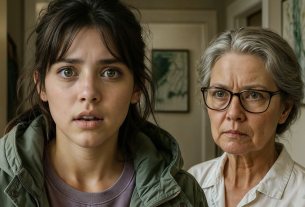
“Anton, just look at this—just look at it!” Zinaida Petrovna snapped. “Buckwheat mixed in with rice, the lid left loose, everything covered in dust. How many times have I told you? Glass jars should be rinsed with boiling water, not wiped down with some rag. All a rag does is smear the filth around, which is exactly what your darling wife is used to. And that smell—can’t you smell what’s coming from the refrigerator? It reeks like a dead mouse has been hanging there for a week.”
Her voice, sharp and creaking like an unoiled hinge, rang through the apartment, louder even than the rush of water in the pipes. She stood in the middle of the kitchen in her worn slippers, legs planted wide like she owned the place, angrily shifting jars around on the cupboard shelf. The glass knocked together with dull clinks, almost as if the jars themselves were complaining about how roughly they were being handled.
Anton sat at the table with his head bent low over a bowl of rich, greasy borscht his mother had brought in a three-liter jar. He kept lifting spoonful after spoonful with mechanical precision, doing everything he could not to look at the empty chair across from him. Fat droplets splashed back into the bowl whenever he hurried, but he didn’t notice. All that mattered was chewing—keeping his mouth busy so he wouldn’t have to answer.
“Mom, but it’s good,” he mumbled through a full mouth, hoping to steer things in another direction, but Zinaida Petrovna didn’t even glance at him.
“Of course it’s good. I made it,” she shot back. “And what does your wife feed you? Store-bought dumplings?” She slammed the sugar jar onto the counter so hard the spoon inside jumped. “And this kitchen towel—has anyone ever actually washed it, or did she use it to mop the stairwell? It’s stained all over, greasy, disgusting to touch. Is it really that hard to toss it into the washing machine? Or would her arms fall off from one extra movement?”
At that moment the lock on the front door turned with a strained metallic scrape.
In the hallway outside, Marina froze for a second, pressing her forehead against the cold metal of the door. Her shift at the hospital had been brutal: two emergency admissions, a staff shortage, and five straight hours on her feet without even a minute to sit. Her legs ached, a dull throb pounded in her temples, and all she wanted was to stand under a hot shower and wash off the smell of medicine and other people’s pain.
Instead of silence and rest, she was greeted by the familiar hated smell of fried onions and her mother-in-law’s booming voice. Marina let out a slow breath and felt a dark, sticky rage begin to boil low in her chest. She already knew Anton had broken his promise again. Once again he had let his mother in while his wife was out.
Marina stepped into the entryway, making sure not to slam the door. Quietly she slipped off her sneakers, kicked them aside, and hung her jacket on the hook. In the mirror she saw a pale face, dark circles under her eyes, and loose strands of hair falling out of her ponytail.
“And don’t you dare tell me she gets tired!” Zinaida Petrovna kept shouting in the kitchen, not realizing that the woman she was insulting was already standing in the hallway. “Tired from what? Shuffling papers around? As if I don’t know what those ‘shifts’ are. Night shifts. We know all about those night shifts—husband sitting at home alone while the wife flirts around with the doctors. Just look at her—not much to look at, but the arrogance? Enough for ten people.”
Anton finally looked up from his bowl when he heard footsteps in the hall, and his shoulders instantly hunched in fear. He wiped his mouth with the back of his hand, leaving an orange streak of borscht across his cheek.
Marina walked into the kitchen. The sight waiting for her was painfully familiar, which made it even more disgusting. Zinaida Petrovna, wearing Marina’s favorite apron—the one she saved for weekend cooking—stood in front of the open cabinet where the grains were kept. Dirty pots, plastic bags, and jars dragged out in the name of “putting things in order” were piled all over the table. The comfort Marina had spent months creating had been wrecked in just a couple of hours.
“Well, look who finally showed up,” Zinaida Petrovna said, turning and slowly raking her daughter-in-law with a contemptuous glance from head to toe. “Hello there, hard worker. Why so quiet? Your mother-in-law came over and cleaned up your mess—at least you could say thank you. You live like a pig and starve your husband. Just look at Anton. At this rate he’ll end up with an ulcer from your dry scraps.”
Marina slowly shifted her gaze to her husband. Anton sat there hunched over, staring into his bowl as though it contained the answer to every problem in the world. He didn’t even try to stand. He didn’t greet her properly. He didn’t make the slightest move to stop the stream of insults pouring from his mother’s mouth.
“Hey, Marina,” he muttered without lifting his eyes. “Mom brought borscht. Want some?”
“Borscht?” Marina repeated. Her voice was low and rough with exhaustion, but it had steel in it. “Are you serious, Anton? Borscht?”
“And what exactly is wrong with that?” Zinaida Petrovna flared up at once, planting her hands on her hips. “It’s real food, made on the bone. Not like that slop of yours from packets. Instead of turning your nose up, you should learn while I’m still alive. And where did you keep the salt? In the bottom drawer! Who keeps salt down there? Salt should be within reach. I moved everything around—at least now it looks like a proper kitchen.”
Marina slowly looked around. Her favorite jar of expensive coffee had been shoved into the farthest corner, while a cheap package of tea—the kind her mother-in-law loved—had been placed front and center. The sugar bowl had been swapped. The towels hung on different hooks. This was no longer her kitchen. It was occupied territory.
“I didn’t ask you to clean,” Marina said, looking straight into her mother-in-law’s eyes. “I didn’t ask you to come. And I didn’t ask you to cook.”
“Oh, she didn’t ask,” Zinaida Petrovna snorted, theatrically turning toward the sink and cranking the water on full blast. “If I waited for you to ask, my son would have grown moss in this filth by now. Just look at the stove! Centuries of grease! I scrubbed it for half an hour and nearly broke all my nails. It’s disgraceful. A woman in her thirties and she can’t even clean a stove. Shameful.”
She hurled a dirty spoon into the sink with a crash. Water splashed everywhere, spotting Marina’s jeans. Anton flinched, but stayed silent, absentmindedly tearing bread and pushing the crumbs through what remained in his bowl.
Marina felt her exhaustion drain away, replaced by a cold, clear fury. She had put up with too much for too long. She had spent too long trying to be polite, trying to keep the peace for the sake of this spineless man who now sat there stuffing himself and pretending not to exist.
“Anton,” she said evenly. “Look at me.”
He reluctantly raised his eyes. Fear stared back at her. The raw, animal fear of a guilty puppy that knows it is about to be hit with a slipper but still hopes to escape punishment.
“Marina, come on, let’s not do this,” he whined. “Mom just wanted to help. She meant well… You had a hard shift, I get it, you’re upset. Sit down, eat something, cool off.”
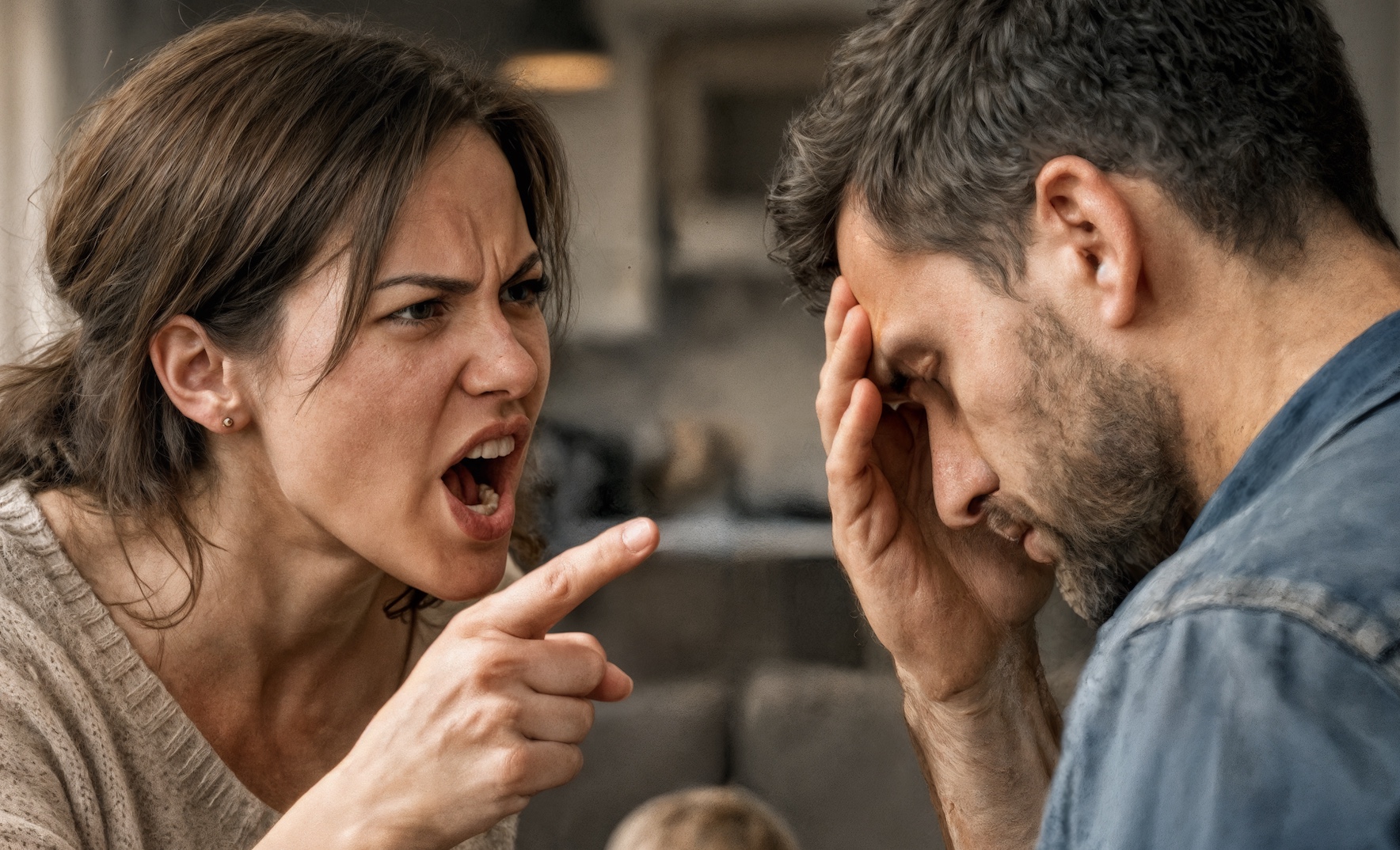
“Meant well?” Marina took a step toward the table. “This is what you call help? She comes into my house, calls me filthy, rearranges my things, insults me right in front of me, and you sit there shoveling down her borscht and nodding along?”
“How dare you talk to your husband like that?!” Zinaida Petrovna shrieked, spinning away from the sink. In her hand she clutched a wet rag dripping dirty water. “‘Shoveling it down,’ she says! You phony intellectual! He’s in his own house! You’re the freeloader here, living on his square meters!”
Marina didn’t even look at her. Her eyes stayed fixed on her husband.
“I asked you a question, Anton. Do you think this is normal?”
Anton shifted in his chair and seemed to shrink into himself, like an old ball gone flat.
“Marina, Mom’s an elderly woman… her blood pressure… So she moved things around, so what? Are you really that bothered?” He tried to smile, but it came out as a miserable twitch. “Just say thank you and let it go. Why blow this into some huge scandal over nothing?”
That was the moment something clicked in Marina’s head. The final fuse burned out. She realized the man sitting in front of her was not a husband, not a partner, not someone she could lean on. He was a stranger—cowardly, pathetic, and incapable of ever choosing her.
“Over nothing, you say?” she repeated quietly.
Zinaida Petrovna, sensing her son’s support, broke into a smug smile.
“Exactly! A hysterical woman! You need treatment, girl. You need your nerves checked. Or better yet, find yourself a real man who’ll keep you under control, since my Antosha is too soft with you. You’ve gotten far too bold.”
Marina slowly turned her eyes toward her mother-in-law. There was no fear in them, no embarrassment. Only emptiness—and the resolve of a surgeon lifting a scalpel to cut away a gangrenous limb.
She drew in a deep breath and held it, like someone about to plunge into icy water. The ringing in her ears, brought on by exhaustion and the rush of blood, briefly drowned out the shrillness of her mother-in-law’s voice. She looked at Anton—his darting eyes, the bead of sweat sliding down his temple—and understood that pity was gone. Only disgust remained.
She stepped right up to the table. Anton instinctively hunched down, expecting her to scream, but when she spoke, her voice was low, almost a whisper, which made it even more frightening in the hot, stuffy kitchen.
“Anton, put the spoon down.”
“Marina, let me at least finish…” he whined, but when he met her eyes, he lowered the spoon into the bowl. Greasy broth splashed onto the tablecloth.
“Look at me,” Marina said. “Do you remember our conversation a month ago? When she threw my skin creams in the trash because they ‘smelled like chemicals’? Do you remember what I told you then?”
Anton cast a hunted glance at his mother. Zinaida Petrovna stood by the stove, hands on hips, wearing the expression of someone ready for battle. She was clearly enjoying the spectacle, feeling like the director of the whole drama.
“We talked…” Anton muttered. “Marina, don’t start. Mom only came to help. She didn’t mean anything by it. Why are you clinging to words?”
“I’m not clinging to anything,” Marina said, standing straighter as icy determination locked through her body. “I’m reminding you of the terms.”
She paused, making sure every word reached him through the food-heavy fog in his head.
“I already told you: if your mother ever crosses the threshold of this house again, you will not be living here anymore, and you’ll only see the children on weekends. I am not going to explain it again. Do you understand me?”
Silence filled the kitchen. Even the refrigerator seemed to stop humming. Anton turned pale. His lips trembled. He had not expected this. He was used to Marina crying, yelling, locking herself in the bathroom, and then eventually everything sliding back into place. He would apologize, buy flowers, his mother would back off for a little while, and life would go on. But now there was steel in his wife’s voice.
“What… what nonsense are you talking?” Zinaida Petrovna was the first to recover. Red blotches spread across her face. “Who exactly are you throwing out of the house? My son? Out of his own apartment? And who do you think you are? A nobody we picked up, cleaned up, and took in—and now you dare open your mouth?”
She stormed toward Marina, swinging the wet rag like a flag.
“Anton!” she shouted. “Do you hear what this rude little witch is saying? She’s blackmailing you! Threatening you with the children! What children? You barren thing! You can’t even take care of yourself!”
“Mom, wait…” Anton squeaked weakly, but no one listened.
Marina never even turned toward her mother-in-law. She kept drilling her husband with that unblinking stare.
“You made your choice, Anton. You opened the door for her. You gave her keys even though I told you to take the spare back. You sat there in silence while she smeared me with filth. Time’s up.”
“Marina, where am I supposed to go?” his voice rose into panic. “It’s evening already! Let’s talk tomorrow, okay? Mom went too far, sure, it happens… Mom, just apologize to her, can’t you see she’s not herself?”
“I should apologize?” Zinaida Petrovna roared so loudly the windows rattled. “To her? Never! She should be kissing my feet for putting up with her nonsense! I’m your mother! I gave birth to you! And she’s nobody! Today it’s her, tomorrow it’ll be another one!”
Marina glanced at the table. There, beside the bread box, sat Zinaida Petrovna’s bulky, worn imitation-leather handbag. It was dirty, its handles greasy with use, and it was sitting right on the clean placemat Marina had laid out only the day before. A wrinkled plastic bag and an old knitted scarf stuck out through the half-open zipper.
That bag—filthy, чужое, out of place on her dining table—became the final straw. It was the perfect symbol of all the chaos and disrespect this woman had dragged into her life.
Without a word Marina reached out and grabbed it by the handles.
“Hey! What do you think you’re doing?!” Zinaida Petrovna screamed, lunging toward the table, but she was too late.
With one hard yank, Marina ripped the bag off the table. The bread box went with it, crashing to the floor and scattering crumbs and chunks of bread across the linoleum. Marina didn’t even look down. She turned and strode toward the hallway.
“Put it down!” her mother-in-law shrieked, hurrying after her and trying to grab her shoulder. “Thief! I’ll call the police! Anton, are you just going to sit there? They’re stealing your mother’s bag!”
Marina stepped into the hall. Her heart was hammering somewhere in her throat, but her hands moved with calm precision. She swung the heavy bag back and hurled it at the front door. It hit the metal with a dull thud, dropped onto the doormat, and a glasses case and a jar of ointment tumbled out.
“Out,” Marina said shortly, turning toward her mother-in-law.
“You… you’re sick!” Zinaida Petrovna gasped, clutching at her chest and theatrically rolling her eyes. “Antosha! I’m not well! She’s trying to kill me!”
Anton finally appeared in the kitchen doorway. He looked lost and pathetic, still holding a piece of bread he had never managed to eat.
“Marina, what are you doing… why throw people’s things around?” he whined, without taking a single step closer. “Mom, pick up your bag…”
“Me?” Zinaida Petrovna shrieked, instantly forgetting the supposed heart attack. “I’m supposed to pick it up? I’ll throw her out myself in a second!”
She lunged at Marina, hands extended, broken dirty nails forward. There was real hatred in her eyes now. This was no longer just a family quarrel—it was a war for territory, for power over her son, for the right to humiliate without consequence.
Marina did not step back. She stood by the door, straight as a blade, and watched the furious woman coming at her with icy calm. Everything that had once tied her to these people had already died inside her. All that remained was the urge to clear her house of them. Whatever it took.
“I’m going to count to three,” she said, her voice cutting cleanly through the shrieking. “One.”
She reached for the lock and turned it with a sharp metallic snap, then pulled the front door wide open. Cool air from the stairwell poured into the apartment, carrying the damp smell of concrete and tobacco.
“Two,” Marina said, pointing toward the dark opening of the landing. “And this applies to you too, Anton.”
Zinaida Petrovna froze, stunned by such brazen defiance. Her eyes darted from the open door to her daughter-in-law and then to her son, waiting for him to finally show some backbone and put this insolent woman in her place. But Anton only shifted from foot to foot, unable even to lift his eyes.
“Well?” Marina asked quietly. “Are you just going to stand there? Or do I need to help?”
Zinaida Petrovna didn’t move. She stood planted on the linoleum as if she had grown roots there, her face cycling from genuine shock to hateful triumph. She was sure this was a bluff. Surely this quiet, always exhausted girl who had swallowed her insults for years could not suddenly throw her husband’s mother out of the house. It went against every rule, every tradition, every law of Zinaida Petrovna’s universe.
“Three,” Marina said.
Her voice did not shake. There was no hysteria in it—only a dense, leaden weariness that had hardened into action. She stepped forward, closing the distance.
“Don’t try to scare me!” her mother-in-law shrieked, thrusting her elbows out. “Look at you, acting like some commander! I’ll throw you out myself, then you’ll learn what it means to talk back to a mother! Anton! Look at her—she’s attacking me!”
But Marina had stopped listening. She grabbed her mother-in-law sharply by the sleeve of her knitted sweater. The fabric stretched tight. Threads snapped.
“Hands off!” Zinaida Petrovna screamed in a pitch that seemed almost ultrasonic. “Get your claws off me! Police! Murder!”
Ignoring the screams, Marina yanked her hard toward herself and then redirected her momentum straight toward the open door. For all her size, Zinaida Petrovna proved surprisingly nimble. She twisted, grabbed the coat rack with one hand and the doorframe with the other, fingers spread like claws. The coat rack tilted dangerously, jackets tumbling down over the shoes below.
“Anton! Do something! She’s going to break my arm!” Zinaida Petrovna shrieked, bracing her feet so hard against the doormat that it bunched up beneath her.
At last Anton came out of his stupor. The sight of his mother being dragged toward the door like a naughty cat was enough to jolt him into motion. He rushed toward them—but instead of calming his raging mother, he grabbed Marina by the shoulders.
“Marina, what are you doing?! Stop right now!” he shouted directly in her ear, trying to wrench her hands away from his mother’s sweater. “Have you lost your mind? That’s my mother! Let her go! You’re hurting her!”
Marina felt her husband’s fingers bite painfully into her collarbones. He was pulling her back, protecting the woman who had just humiliated his wife. He was defending the source of chaos, not his own home. That touch became the final blow, destroying whatever scraps of feeling still remained.
She spun around sharply, shaking his hands off, and shoved Zinaida Petrovna hard in the shoulder. Without the support of the coat rack, her mother-in-law lost her balance. Her fingers slipped from the doorframe, and with a ridiculous flailing of arms she stumbled backward out onto the landing.
A heavy thud, the rustle of clothes, and an outraged cry echoed through the stairwell. Zinaida Petrovna barely managed to stay upright as her back slammed against the grimy green-painted wall.
“You bitch!” she roared from the landing, yanking her sweater back into place. “I’ll curse you! May your legs rot off! Anton, did you see that? She hit me!”
Anton stood in the doorway, pale, lips trembling. He looked from his mother on the landing to his wife. Horror and rage fought in his eyes.
“You… you crossed the line,” he hissed, stepping toward Marina. “You hit my mother. You’re not a woman, you’re an animal. Apologize right now and call her back inside.”
Marina looked at him and did not recognize him anymore. This was not the man she had once fallen asleep beside. This was an enemy. A weak, bitter, alien enemy.
“No, Anton,” she said quietly but clearly. “You crossed the line. And there is no going back.”
“I said call her back!” He reached for Marina’s arm, trying to drag her toward the landing by force so she could apologize. His fingers closed hard around her wrist, twisting painfully. “Now!”
Something primal woke up inside Marina in that moment. Survival instinct fused with the wild fury of a cornered animal. She didn’t pull away. Instead she gathered herself, channeling every ounce of hatred, every sting of betrayal, every sleepless night shift and every cutting remark into one single motion.
She stepped forward and shoved her husband hard in the chest with both palms.
Anton never saw it coming. He was standing on smooth laminate in soft house slippers. The force of the push lifted his feet off the floor. He flung his arms out, trying to grab at the air, but momentum had already taken over.
He flew backward out of the apartment, over the threshold like a champagne cork shot from a bottle. His heels scraped across the metal strip at the doorway. One slipper flew off and landed in the hall behind Marina like a pitiful relic of the old domestic comfort he had clung to.
Anton crashed straight into his mother, who had been gathering herself to charge back in. Tangled together, they went down in a heap on the concrete stairwell floor beside the bag Marina had thrown out earlier.
It was a miserable, almost grotesque sight: a grown man in one slipper and sweatpants flailing on the filthy landing in a tangle with a shrieking older woman.
Marina stood in the doorway of her apartment, breathing hard. Her chest rose and fell, sweat dampened her forehead, strands of hair stuck to her skin. She looked down at them without a trace of sympathy. Only cold, disgusted distance remained in her eyes. As if she had just swept a pile of long-accumulated trash out of her home.
“You’ll regret this!” Anton shouted, trying to get up and tripping over his mother’s legs. “Do you hear me? You’ll die alone! I’ll sue you for everything!”
“Try,” Marina said.
She took hold of the heavy metal door. Realizing what was happening, Zinaida Petrovna sprang up on all fours and lunged toward the opening, trying to jam her foot into the gap to stop the door from closing.
“Don’t you dare!” she shrieked, spraying spit. “This is my son’s apartment! You have no right!”
But Marina was quicker. She yanked the door toward herself with all her strength. The heavy slab sliced through the air with a deep whoosh. Zinaida Petrovna barely managed to snatch her hand away in time.
The door slammed shut with a heavy, final clang, cutting off the screaming, the curses, and the smell of the stairwell. The sound was like a gunshot putting an end to a long, miserable illness called their marriage.
Without losing a second, Marina turned the massive night bolt. The metal bar slid into place with a dry click. That was it. No key from the outside would open this door now.
Hell broke loose immediately on the other side. Fists, feet, maybe even that same handbag—everything rained against the metal.
“Open up, you bitch! I’m half dressed out here!” Anton shouted, kicking the door. “I don’t have my keys!”
“Whore! Junkie!” Zinaida Petrovna screamed along with him. “How are you going to look people in the eye after this?!”
Marina leaned her forehead against the cool surface of the door. She listened to the pounding, and with every blow she felt lighter. It was as if each kick from the other side was knocking the last scraps of attachment, doubt, and fear out of her.
She slowly slid down the door, not because she was crying—there were no tears left—but because she was simply exhausted. Her eyes fell on Anton’s lone slipper lying in the middle of the hallway.
“So that’s it,” she whispered into the empty corridor.
They kept raging outside, but to Marina those noises were already fading into background sound—distant, irrelevant, part of another life that no longer belonged to her. She rose to her feet, stepped over the slipper, and went into the kitchen without looking back. The smell of that borscht was still there, and it needed to be erased immediately.
The pounding on the door went on, dissolving into a dull, monotonous drumming that made the hallway walls tremble. Out on the cold landing, the storm of two voices still raged, blending into one ugly chorus of hatred and desperation. But for Marina, standing in the middle of the corridor, those sounds already seemed to come from another world, like a bad dream she had finally woken up from.
Her gaze drifted to the floor. Near the baseboard lay Anton’s lonely checkered slipper, worn down and misshapen, the heel bent inward—a perfect symbol of his spinelessness and his endless devotion to domestic comfort above dignity. Marina nudged it with the toe of her sneaker and kicked it toward the bathroom. She didn’t even want to touch this man’s things with her eyes anymore.
“Marina! Are you insane?!” Anton’s voice cracked into a falsetto. He was no longer demanding anything—he was whining, beginning to grasp the full horror of his situation. “Open the door, I said! I’m standing here in socks! There’s a draft! Do you want me to get sick?”
“Let him drop dead, the Judas!” Zinaida Petrovna screeched between kicks at the metal. “We’ll call emergency services! We’ll cut your door open with a grinder! You’ll pay for everything, you trash! Every single scratch!”
Marina did not answer. She turned and walked into the kitchen. There, in the space that had almost been taken from her an hour earlier, the air still hung heavy with the greasy smell of someone else’s cooking. Boiled onions, cheap spices—everything soaked into the curtains and the air itself. It was the smell of her old life, the life in which she had been expected to endure, keep quiet, and adapt.
She walked to the table, where the cursed three-liter jar of borscht still stood. The dark burgundy liquid with orange circles of fat hardening on top looked almost like biological weaponry.
“Well then, Zinaida Petrovna,” Marina said quietly, lifting the jar into her hands. “Looks like dinner’s over.”
She carried it into the bathroom. Lifting the toilet lid, she turned the jar upside down without hesitation. The thick soup splashed and gurgled into the bowl—cabbage, chunks of meat, beets—every last thing she had been mocked with and told to admire disappeared into the porcelain throat. Marina pressed the flush and watched the last traces of “motherly care” spin away.
Back in the kitchen, she continued the purge. With the methodical precision of a machine, she opened cabinets and removed everything her mother-in-law’s hands had touched. The cheap tea went straight into the trash. Then the gingerbread Zinaida Petrovna had brought “for tea.” Marina stripped the stained tablecloth from the table—the one splattered with borscht—and shoved it into a garbage bag without a second thought. She was not going to wash it. That thing had been defiled.
Outside, the strategy changed. The aggression gave way to pathetic bargaining.
“Marish… come on, Marish, open up, please,” Anton pleaded, probably pressing his lips against the keyhole, his voice muffled and hoarse. “We argued, fine, enough already. You got angry, I understand. Let me send Mom home in a taxi and then I’ll come in, okay? It’s cold out here, really. I left my keys on the dresser, and my phone too. Come on, be human.”
Marina froze with the rag still in her hand.
Be human.
The irony almost made her laugh. It was exactly by becoming human that she had stopped being their servant.
She walked to the window and flung it wide open. The cold evening air rushed into the overheated room, pushing out the smell of onions and scandal. Marina breathed in deeply, feeling the chill clear her thoughts.
“Marina!” Zinaida Petrovna shouted again, though weaker now, as if she were finally running out of strength. “You’ll regret this! You’ll come crawling back to us! Who’s going to want a divorced woman at your age? Anton will leave you, do you hear?”
Marina smirked.
Leave her?
She was the one who had thrown him out—like a piece of old junk too useless to keep but too pitiful to throw away until now.
She reached into the back of the cupboard and pulled out her jar of expensive coffee, the one her mother-in-law had shoved aside. She poured beans into the machine. The sound of them grinding drowned out the voices beyond the door for a moment. Fresh coffee aroma slowly spread through the kitchen, restoring the feeling of home. Her home.
Marina poured boiling water into her favorite mug, took the sandwich she had not managed to eat that morning, and sat down at the now clean, empty table.
The banging had stopped. Maybe the neighbors had threatened to call the police. Maybe Anton and his mother had finally understood that this fortress would not fall and had gone off to find shelter or a locksmith. It no longer mattered. No locksmith would come without papers for the apartment, and those papers were in the dresser drawer, the key sitting safely in Marina’s pocket. They would have to go all the way across the city to Zinaida Petrovna’s place—in slippers, without money.
Marina took a sip of hot coffee. The bitterness burned her tongue, but it felt good. It felt real.
From the kitchen she looked toward the front door. Behind that slab of metal, her old life had been sealed away: endless excuses, constant guilt, rules forced on her, and a husband who had never once become a man.
Now there was silence. Not tense silence, not ringing silence—just a calm, solid quiet that belonged to an empty house. The family was over. And thank God for that.
Marina bit into her sandwich and for the first time in that endless day actually tasted the food. She was alone. Exhausted, still in her dirty work clothes, hair a mess. But she was the one in charge. Of her kitchen. Of her apartment. And finally, of her own life.
She took out her phone, found the contact labeled “Anton,” and without a second of hesitation tapped Block. Then she did the same with “Zinaida Petrovna.”
“Enjoy your meal, Marina,” she said aloud to herself.
Her voice sounded steady and calm. Tomorrow would be a new day. There would be divorce, division of property, plenty of mud and ugliness. But that was tomorrow. Tonight she would drink her coffee and enjoy the fact that no one in her house would ever dare rearrange her jars again.