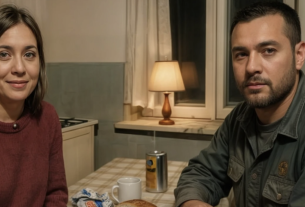
“My mother and I talked it over with Kirill, and we decided Denis will stay in your new one-bedroom apartment on the avenue. He needs somewhere to get started in the city, and you are not renting the place out yet anyway. We already promised him the keys.”
Galina Ivanovna set a printed temporary registration form down on the kitchen table in front of me. In the line marked Owner, she had already penciled in my surname. There was something unmistakably commanding in that gesture—the kind of authority shaped by years as a former head librarian, someone used to issuing forms and expecting absolute obedience to her rules.
Denis, my mother-in-law’s twenty-seven-year-old nephew, confidently shoved aside my work folder filled with ultrasound reports to clear space for his oversized gym bag. He treated his occasional taxi shifts as a temporary inconvenience, making no secret of the fact that he expected life to hand him an easy beginning at someone else’s expense. At that moment, he behaved as though he had already been officially approved to move in.
My legal husband, Kirill, pulled a set of keys to my new apartment from his pocket and dropped them onto the table in front of Denis with deliberate flair. As the owner of a small car repair shop, Kirill was used to being the unquestioned authority in his garage, and he carried that same patronizing sense of control straight into our marriage.
“And who exactly is this ‘we’?” I asked calmly, picking up the keys from the table and slipping them into my pocket. At the clinic, I spent every day making diagnoses based only on hard evidence and cold facts. I preferred to live the same way.
Galina Ivanovna straightened her back, assuming the posture of a judge about to deliver a sentence.
“The family decided, Marina. Relatives are supposed to help each other. Denis is a good boy, he is just still finding his way. He will stay there for a while, get settled, look around. He will cover the utilities according to the meter readings. Just sign the form. Without registration, he will never find a decent job.”
“The apartment is not standing empty because on Wednesday I am signing a lease with tenants. The rent is forty-five thousand rubles a month, plus a one-month security deposit. I do not provide registration even for paying renters. Is Denis ready to hand over ninety thousand rubles right now?”
Denis jerked the zipper on his bag, radiating outrage from every movement. For a taxi driver surviving on irregular fares, that amount sounded less like a figure and more like a personal insult.
“Uncle Kir, you said you had a free place for family. You said you were the owner. I already told my friends we were having a housewarming on Saturday.”
Kirill pushed his empty plate away with irritation, signaling he was ready for a harder conversation.
“Marina, stop turning this into bargaining. The other people can wait. This is our apartment, and we are supposed to help family. Denis will stay there for free until he gets on his feet. I already even paid for a moving van to bring the rest of his things tomorrow morning.”
“You paid for a van?” I looked him straight in the eye. “Using our joint bank card, the one with the money we had set aside for vacation?”
“I will put it back next month. This is not about money. He is my nephew. Not some stranger. We are not going to become poor because he stays there for six months.”
“We are not going to become poor,” I repeated as I stood up, bracing my hands against the edge of the table.
“That is because those forty-five thousand rubles of monthly income are mine. And so is the apartment. Denis will not be living there, and you can throw that registration form straight into the trash.”
My mother-in-law slammed her palm against the tabletop.
“Your apartment? You are forgetting yourself, Marina. You and Kirill have been legally married for six years. You bought that one-bedroom place a month ago. Under the Family Code, everything acquired during marriage is marital property.”
“So by law, half of it belongs to my son. And he has every right to let his own blood relative stay there without your consent.”
She recited those memorized legal phrases with such triumph it was as if she had written the Family Code herself. Kirill gave an approving nod, backing her up. They truly believed they had found the perfect legal lever to force me into serving the interests of their clan.
I turned, walked into the bedroom, opened the safe, and took out a blue plastic file folder filled with documents. No excuses. No emotional speeches. Just facts and stamped papers.
When I returned to the kitchen, I placed an extract from the Unified State Register of Real Estate in front of my mother-in-law.
“You mentioned the Family Code, Galina Ivanovna. Wonderful. Then read the section titled Grounds for State Registration of Ownership.”
She pulled the document closer, eyeing it with suspicion, as if it were a report about missing books from a library inventory. Her eyes darted across the lines.
“Gift agreement… What does that mean? You said you bought it! Kirill!”
My husband leaned forward sharply, trying to look over his mother’s shoulder.
“Marina… what gift agreement? You said we were buying it. We went together to look at apartments.”
“You looked,” I said, my voice cool and measured, cutting off any room for manipulation. “But my father paid for it. And he transferred it to me through a deed of gift. Under Article 36 of the Family Code of the Russian Federation, property received by one spouse as a gift during marriage is that spouse’s personal property. Not shared. Personal. Mine.”
Galina Ivanovna pressed her lips together. The certainty in her legal argument had cracked, but she was not ready to surrender.
“But Kirill did repairs there! He improved the apartment!” she fired back in one last desperate attempt.
“He put his heart into that place, spent his own time after work at the garage! By law, if a spouse invests in renovations, the apartment becomes shared property. We will take you to court and divide it!”
Kirill latched onto that idea immediately, encouraged by her support. He approached real estate the same way he approached a car: change the oil, replace the brake pads, and somehow the whole thing starts feeling partly yours.
“Yes, Marina! I laid the laminate in the room myself and changed the outlets. I put my labor into that apartment. So Mom is right—we both have the right to decide what happens to it. We will prove my contribution in court.”
I opened the next section of the folder and pulled out a stack of receipts clipped together, followed by a thick contract with the construction company.
“You are confusing legal concepts again, Galina Ivanovna. Article 37 of the Family Code, the one you are trying to rely on, applies only if one spouse’s investment significantly increases the value of the property. For example, major reconstruction or an extension adding new square meters.”
I laid the receipts down in front of my husband.
“Here are your financial contributions, Kirill. Building materials for thirty-two thousand four hundred rubles. And here is the completion certificate from the construction company for six hundred thousand rubles for the rough finishing, electrical work, wall leveling, and plumbing.”
“And here is the payment receipt from my personal bank account, the one I opened five years before I ever met you.”
I let the silence hang, watching my husband’s face go pale. My habit as a doctor—seeing the real picture hidden beneath appearances—never failed me. Kirill’s illusion that he had made some decisive contribution needed to be cut open and exposed immediately.
“Your laminate installation would be classified by a court as minor cosmetic work. It does not entitle you to ownership of real estate worth eight million rubles. If you believe I owe you for the work, I can transfer thirty-two thousand rubles to your card right now based on the receipts, plus another fifteen thousand for your labor. That settles every claim you think you have.”
Kirill stared at the receipts in silence. The fantasy of absolute control over my property had collapsed under the weight of a stack of documents.
Denis grabbed the handle of his bag and dragged it off the table. Without the prospect of free housing in the city center, his conquer-the-capital ambitions faded fast. The thought of returning to night shifts behind the wheel of someone else’s car clearly held little appeal.
“So you are throwing your own nephew out into the street?” my mother-in-law said quietly, her voice laced with carefully measured resentment as she crushed the unused registration form in her hand. “Haggling over pennies, waving paperwork in people’s faces. We will see how you like it when you grow old and are left alone with nothing but your documents.”
“Denis came to the city to work. Let him rent a room in a dormitory or a bed in a hostel. That is an excellent incentive to get started quickly. He will not be moving into my apartment tomorrow, next year, or ever.”
I turned to Denis.
“I am the only one with the keys. If any of you tries to force the locks, change the door, or enter without my knowledge, I will not start a family drama. I will simply call the police. Article 139 of the Criminal Code—unlawful entry into a dwelling. I will file a report the same hour.”
Galina Ivanovna rose from her chair abruptly.
“Get your things, Denis. There is nothing for us here. In this house, laws matter more than family.”
They walked out into the hallway. Kirill did not even move to see them off. He remained seated in the kitchen, staring at the plastic folder that had stripped him of his sense of control.
When the front door slammed shut behind my mother-in-law and her nephew, I calmly slid the papers back into their files. I felt neither guilt nor anger. Only absolute, crystal-clear certainty about what had just happened.
“Marina, you were hard on them,” my husband said at last, trying to salvage at least a shred of authority.
“You could have said it more gently. She is still my mother. Now she is offended. And Denis ended up humiliated. I had already promised him.”
I stopped in the kitchen doorway and looked at the man I had lived with for six years.
“If you do not like the way I defend my boundaries and my property from your relatives’ arrogance,” I said evenly, without a trace of hysteria in my voice, “you are always free to pack your things and go comfort your mother.”
Kirill dropped his eyes. He knew perfectly well that this apartment also belonged to me, since I had bought it before our marriage. And in truth, he had nowhere to go.
“And one more thing, Kirill. The money for the moving van that you took from our joint credit card without telling me—you will return it by the end of the week. Otherwise, our next conversation will be with a divorce lawyer.”
“And then we will be dividing your auto repair business, because the equipment for it was purchased during the marriage. I hope you kept the receipts for the lifts, because I keep my bank statements very carefully.”
I switched off the hallway light and walked into the bedroom. The next day I had a fully booked schedule of patients at the clinic, and in the evening I was signing a profitable lease agreement. My life was moving according to my plan, and no one had the right anymore to manage it behind my back.
Other people’s audacity ends exactly where your knowledge of your own rights begins—and where your willingness to defend them calmly, firmly, and without unnecessary emotion starts.