Part 1. The Illusion of Stability
Natasha kneaded her temples, feeling the throbbing pain pulse under her skin like it was carving out new pathways through her skull. The day had been brutal: three counseling sessions with teenagers who seemed incapable of empathy, and one with parents who were firmly convinced their child was the center of the known universe. Working as a school psychologist took everything out of her. It was like being emptied one teaspoon at a time until there was nothing left at the bottom.
And yet she loved that kind of exhaustion, because it was honest. You worked hard, so you were tired.
Unlike what waited for her at home.
The key turned in the lock with a harsh scrape. Lately, that sound had become a trigger, instantly summoning a cold knot of dread in her chest. The apartment—her stronghold, the one her father had given her—no longer felt safe.
The hallway smelled of fried meat and cheap, sickly sweet perfume.
Not hers.
Natasha slipped off her shoes, carefully avoiding a pair of men’s size-forty-three sneakers and a set of sharp high heels tossed carelessly beside them like fallen chess pieces.
“Tolik?” she called, although she already knew the answer.
A burst of loud laughter came from the kitchen—deep, crude, and layered with a shrill female cackle.
Natasha walked in and stopped.
There was her husband, Anatoly, sprawled across her favorite chair as if he owned the place, his legs thrown up onto the neighboring stool. The table was a wreck: gnawed chicken bones, grease stains on the tablecloth Natasha had embroidered when she was still a student, and empty soda bottles cluttering every corner. Across from him sat Larisa, his sister.
His sister.
“Well, look who finally showed up—the lady of the manor herself!” Larisa drawled, still chewing on a chicken drumstick as she waved a hand tipped with long, predatory acrylic nails. “We decided to grab a bite. Tolyan had the day off, I had nothing going on, so I thought I’d stop by my dear brother’s place.”
Anatoly turned his head lazily. His face, weathered from roadwork and greasy from food, shone under the kitchen light.
“Hey, Nat. Why the long face? Larisa dropped in, we had a little family time.”
Natasha said nothing. She only stared at the mountain of dirty dishes overflowing from the sink.
“Family time usually involves warning the person who lives here,” she said quietly. “And cleaning up after yourselves.”
“Oh, here we go,” Larisa groaned, rolling her eyes as she wiped her hands on the towel Natasha used for clean dishes. Natasha physically shuddered. “You’re a psychologist. You should understand the delicate emotional needs of others. We were bonding. Tolya’s got a hard job—he needs a way to decompress.”
Anatoly gave a smug grunt. He loved bragging about how cleverly he dodged work. Officially he was a road roller operator, which sounded respectable enough. But the way he described it, it might as well have been a paid position in professional loafing.
“I slept in the cab for five hours today while the engine kept running,” he said proudly, as if unveiling a great achievement. “Fuel gets written off, the hours still count, the money still comes in. Meanwhile the foreman’s running around screaming, the asphalt’s cooling, and what do I care? I’m following safety regulations. Maybe my blood pressure spiked. Doctors say I need rest, right? So I take it easy. That’s how you live smart, Natasha—not like you, killing yourself over those little brats.”
Natasha clenched her jaw.
Ever since her father had handed her the keys to this three-bedroom apartment and left for the country to recover his health and tend his vegetable beds, Anatoly had changed. At first it was small things: he stopped contributing to groceries. No mortgage now, we can relax, he’d said. Then came the comments about her father. The old man could’ve left the car too, not just the apartment. And now… this.
Natasha had always been someone who believed problems could be solved through conversation. Analysis. Compromise. She had loved Tolya—or maybe she had only loved the version of him she had invented for herself when she was younger. But the man now wiping grease from his mouth with the back of his hand looked less and less like the hero of any story she would have wanted.
Part 2. Occupied Territory
The situation didn’t worsen by the day. It worsened by the hour.
Larisa stopped merely “dropping by.”
She started staying over.
“Oh, the metro’s closed already, and taxis are highway robbery,” she would whine around eleven at night, yawning theatrically. “I’ll just sleep on the sofa in the living room, okay? I’m quiet as a mouse.”
The first time, Natasha said nothing.
The second time, she confronted her husband.
“What, are you seriously that stingy?” Anatoly asked in genuine disbelief, picking his teeth with a toothpick. “The apartment’s huge. Three rooms! What are we, aristocrats? Larisa just broke up with her boyfriend. She needs support.”
“She has her own apartment, Tolya. And a job. She’s a nail technician, she makes good money.”
“So what? She’s lonely there,” he snapped. “Stop being so selfish, Natasha. You used to be kind. Your money ruined you.”
My money? Natasha thought, but said nothing aloud. Yes, she earned it. And she spent it all on the house, on making life comfortable, on buying clothes for Tolya—who believed designer jeans were his birthright, but utilities were somehow “a woman’s responsibility.”
A month later, Larisa showed up with a suitcase.
“Just bringing over some winter stuff. My place is about to go under renovation,” she explained, promptly taking over half the hallway closet.
Then Galina Petrovna arrived.
Her mother-in-law was a heavyset, loud woman with a rare gift for filling every inch of a room and somehow squeezing all the oxygen out with her. She didn’t knock.
She had keys.
“Why does your mother have keys to my apartment?” Natasha asked one day after finding Galina Petrovna inspecting the contents of the refrigerator.
“I gave them to her,” Anatoly muttered without looking up from his phone, where he was playing tank games. “Mom wanted to make soup. You’re always at work, we’ve been living off scraps.”
What infuriated Natasha most wasn’t even their presence.
It was the attitude.
The arrogance.
They behaved as though Natasha were a temporary tenant and they were the rightful owners of the place.
“Natalya, you bought the wrong bread. Tolik likes rye,” Galina Petrovna lectured from Natasha’s father’s armchair. “And those curtains are awful. So dark and depressing. I found a nice lace set with daisies up in storage—tomorrow I’ll bring them over and we’ll hang them.”
“No,” Natasha said firmly. “I like these curtains.”
“Stubbornness is a sin,” her mother-in-law said, pursing her lips. “A mother knows what kind of home her son needs. You should think about children instead of your career. Time is ticking.”
“That’s our business.”
“Our business!” Larisa chimed in as she emerged from the bathroom wearing Natasha’s robe—Natasha’s actual robe. “We’re family! Or are you separating yourself from us now? Tolya, say something!”
Anatoly glanced up from his phone.
“Nat, seriously, don’t be so uptight. Mom’s right. Those curtains are ugly.”
That was the moment Natasha called her friend Lena, who worked in crisis management.
“Lena, they’re forcing me out of my own house,” she whispered into the phone after locking herself in the bedroom.
“Throw them out,” Lena said immediately. “You’re a psychologist, for God’s sake. You know what boundaries are. They didn’t just cross yours—they tap-danced all over them. Your Tolya is a parasite.”
“I can’t just do that… we’re family.”
“No,” Lena said flatly. “Family is when people respect you. This? This is parasitism. Keep waiting and one day they’ll have you sleeping on the doormat.”
Part 3. The Point of No Return
The crisis came on a Friday.
Natasha got home earlier than usual because her last appointment had been canceled. All she wanted was a hot bath and silence.
The moment she stepped inside, she heard something strange—clinking glasses, loud laughter, music.
There was a full-blown gathering in the living room.
At the table sat Anatoly, Galina Petrovna, Larisa, and some unfamiliar woman with bright red hair.
“Oh, the daughter-in-law is home!” Galina Petrovna announced, lifting a little glass of homemade liqueur. “Come on, Natasha, sit down and let’s drink to your father.”
Natasha froze. The blood drained from her face.
“What?” she whispered. “Dad… what happened to him?”
“Oh, for heaven’s sake, he’s alive,” her mother-in-law said with an irritated wave of her hand. “Don’t be dramatic. I meant symbolically. Since he left and handed the apartment over to the young couple. A saint of a man, really, even if he’s a bit odd. And this is Aunt Lyuba, an old friend of mine passing through from Syzran. She had nowhere to sleep, so we put her in your office.”
Natasha slowly turned toward the open door of her office.
That room.
The one where she kept case files, professional materials, and private journals belonging to clients.
The door stood wide open. Aunt Lyuba’s bag sat on Natasha’s desk, and the sofa had already been made up with guest linens Natasha had bought and carefully saved for actual guests.
“In my office?” Natasha asked, her voice trembling.
“So what?” Anatoly cut in, thoroughly drunk by now. “The sofa’s comfortable. Aunt Lyuba brought us smoked fish as a gift. Sit down, have a drink.”
“You let a complete stranger into my office, where I keep confidential documents?” Natasha asked quietly, and yet somehow the whole room fell silent.
“Oh please,” Larisa snorted. “What documents? Drawings from disturbed teenagers? Who cares? Stop acting like you’re some cabinet minister.”
“Watch your tone, girl,” Galina Petrovna snapped, rising to her feet and planting her hands on her hips. “We came to you with warmth, and you turn your nose up at us. You don’t appreciate your husband, you treat his family like trash. Tolya works his back off on that road roller, killing himself to provide for you—”
“Provide?” Natasha repeated. “He hasn’t contributed a single ruble to this household in three months. He’s living off my salary and whatever he steals by slacking off at work.”
“DON’T LIE!” Anatoly bellowed, slamming his fist on the table. “I’m saving up! For a new car for us!”
“For us or for you, so you can show off in front of your buddies?” Natasha asked. She already knew the answer. She had seen the bank statements.
“That’s enough!” Galina Petrovna stepped forward, putting herself in front of her son like a shield. “I came here to restore order. Natasha, you’ve completely lost your mind. The apartment may be in your name, but you’re married. Which means everything is shared. And a husband’s mother has every right to be here as long as she wants. Same goes for our guests. And if you don’t like it, go running to your daddy’s vegetable patch and get your nerves treated. You’re hysterical and need to calm down.”
Anatoly sat there smirking.
He felt strong with his little clan behind him.
He was certain Natasha would do what she always did—swallow the humiliation, cry in the bathroom, and later come out apologizing.
But he had forgotten one thing: psychologists know how to work with grief. They also know anger. Pure, unfiltered anger—the kind that burns bridges just to light the road ahead.
Part 4. Fury
Something inside Natasha snapped.
The sound was almost physical.
The fear vanished.
The self-pity vanished.
Whatever love she had still felt for the bloated, brazen man in that chair evaporated, leaving behind nothing but icy clarity.
Then she laughed.
It was a dry, terrible laugh that made Aunt Lyuba choke on a piece of fish.
“Shared?” Natasha repeated, cutting her laughter short. “All right then. Listen carefully, parasites.”
She stepped to the table and yanked the tablecloth with one sharp, merciless pull. Plates, bottles, salads, smoked fish—everything crashed to the floor in a thunder of breaking glass and splattering food.
“Are you insane?!” Larisa shrieked, jumping backward and clutching the robe around herself.
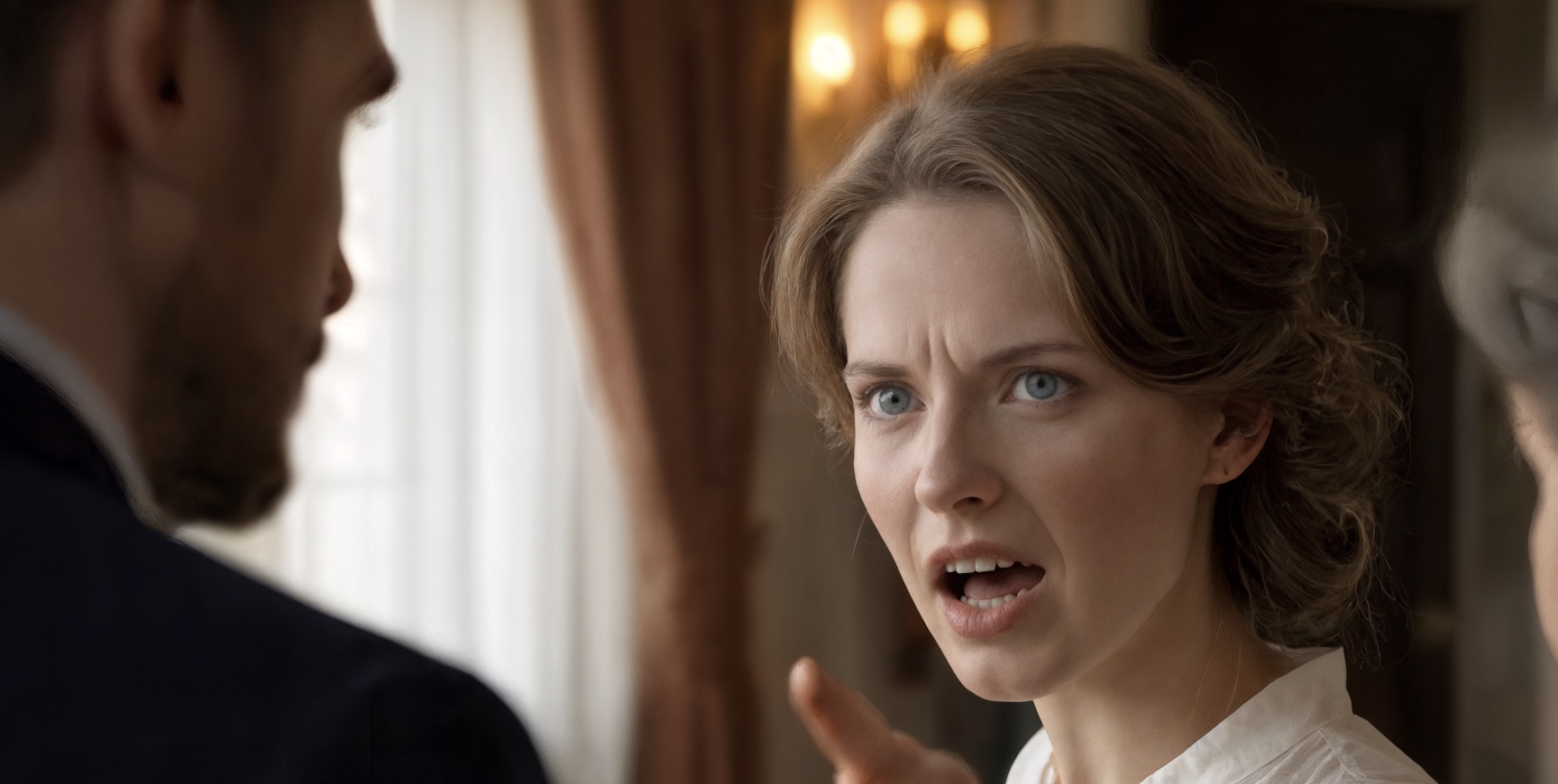
“QUIET!” Natasha roared so loudly the neighbors probably felt it in their walls. Her voice shook the room. This was not the shriek of a hysterical woman. It was the raw sound of a cornered animal that had stopped retreating and chosen to attack. “I tolerated your filth. I tolerated your laziness, Anatoly. I tolerated your greed, Galina Petrovna. I tolerated your insolence, Larisa. But the show is over. And now every last one of you is getting out.”
“How dare you—” her mother-in-law began.
“Shut up!” Natasha cut her off, stepping so close their faces were inches apart. Her eyes burned. “You are nobody here. An overgrown guest who overstayed her welcome. Get out of my apartment. Right now.”
Anatoly sprang to his feet, trying to reassert himself.
“All right, wife, calm down. You’re going too far—”
“I’m going too far?” Natasha grabbed a heavy crystal vase from the side table—a gift from coworkers—and hurled it to the floor at his feet. It exploded into glittering shards. Anatoly stumbled backward, pale with shock. He had never imagined she would turn into a force of nature.
“Now stand up and leave my apartment,” Natasha said to her husband and mother-in-law, enunciating every word with terrifying precision. “Out. And take that so-called Aunt with you.”
“Tolik, do something! She’s crazy!” Larisa squealed, backing toward the hallway.
“If you’re not gone in two minutes,” Natasha said, quieter now, though somehow even colder, “I’m calling the police. And I’ll file a report for unlawful entry and theft. Yes, Larisa, I noticed my gold earrings disappeared. Did you think I wouldn’t?”
Larisa went white and clutched her bag to her chest.
“You wouldn’t dare…” Anatoly muttered. “We’re married…”
“I’m filing for divorce tomorrow. Put the keys on the table. Now.”
He looked into her eyes and saw nothing there. No love. No attachment. Only disgust, as though she were looking at a cockroach. His confidence disintegrated on the spot. The swagger vanished.
“Fine. To hell with you,” he muttered, tossing the keys onto the floor. “Come on, Mom. She’ll fall apart on her own. Who needs her anyway? Crazy schoolteacher.”
“Get your things, girls,” Galina Petrovna ordered, trying to preserve what little dignity she had left, though her hands were shaking. “We’re never setting foot in this cursed place again.”
They spilled into the hallway—ruffled, frightened, furious. Natasha hurled Larisa’s suitcase and Anatoly’s jacket out after them.
“The door,” she said.
And then she slammed it in their faces.
One lock clicked.
Then the second.
Then the bolt.
Natasha felt adrenaline pour through her bloodstream, mixed with a dizzying sense of freedom so intense it was almost intoxicating. The apartment smelled of fish and spilled liquor, but to her it smelled like victory.
Part 5. A Life Made of Straw
Outside, it was dark. A flickering streetlamp cast weak light over the pathetic cluster of people standing near the entrance.
“Well, son,” Galina Petrovna said, fixing her disheveled hair, “come back with us. You can stay there for now. Morning is wiser than evening. That lunatic will cool off and call.”
“Of course,” Anatoly said, still trying to save face. “I’ll punish her. I won’t answer the phone for a week. Let her suffer.”
They called a taxi and went to Galina Petrovna’s cramped two-room apartment. Larisa was already living there, occupying the smaller bedroom.
Once they arrived, it turned out there was nowhere for Anatoly to sleep.
“Larisa sleeps in her room, I sleep in mine,” his mother said with a shrug. “You can take the folding cot in the kitchen. Temporarily.”
“Temporarily” stretched into a month.
Natasha never called. Not after a day, not after a week. What did arrive instead was official notice of the divorce hearing date. Anatoly tried to force his way back into the apartment, but the locks had been changed, and a broad-shouldered neighbor Natasha had asked for help met him at the door.
But the worst part began inside Anatoly’s so-called loving family.
Without his wife’s money and without a comfortable apartment to hide in, he quickly became a burden. He kept slacking off at work, brought home almost nothing, and still acted as though his mother was obligated to feed him.
“Tolya, maybe you could at least buy some sausage,” Larisa sneered one day. “You eat enough, but you never bring money.”
“I’m saving!” he snapped automatically. “And anyway, I’m recovering from stress. My wife ruined my life. She’s a snake.”
“Your wife supported your useless self, idiot,” said a new voice from the doorway.
It was Aunt Rimma, sister of Anatoly’s late father. She had come to visit Galina and walked right into the middle of the argument. Rimma had never liked Galina, especially not her greed. “And now look at you—a king with no pants.”
“That’s none of your business!” Anatoly shot back. Then he turned to his mother. “Mom, tell her. And give me some money. I know you’ve been putting aside what I sent you every month for a rainy day. I want to upgrade my car, just to spite Natasha.”
Galina Petrovna hesitated. Her eyes darted away.
“What money, son?” she asked sweetly. “We spent that ages ago. You think utilities pay themselves? What about Larisa’s boots? My medicine? There’s no money left. It all went toward supporting the family.”
Anatoly froze.
“What do you mean there’s no money? I sent you thirty thousand every month for a year and a half! That’s almost half a million! I thought I had a safety cushion!”
“What cushion?” his mother suddenly snapped, dropping the gentle-act mask altogether. “You lived like a kept man at your wife’s expense and tossed your mother scraps. That was your duty as a son. I raised you! Don’t you dare demand anything from me!”
“You… you rat,” Anatoly whispered.
“You ungrateful pig!” Larisa screeched. “Insulting your own mother? Get out!”
“I’m registered here!”
“You may have registration, but you don’t have space,” Larisa shot back with a smirk. “Go rent something if you’re so clever. Or go live in your road roller.”
“I’m not going anywhere!” Anatoly yelled.
And then something happened that he absolutely had not expected.
Aunt Rimma, who had been watching the scene with cold amusement, slowly clapped her hands.
“Bravo. What a snake pit,” she said. “Tolik, you’re an idiot. But here’s some news for you. This apartment you’re all tearing each other apart in? Half of it belongs to me. I inherited it from our parents. I let Galya live here while the rest of you fools stayed out of my way. But since you’ve turned it into a circus…” She smiled thinly. “Galya, I’m selling my share. To shady realtors. Or maybe to a traveling gypsy family.”
Galina Petrovna genuinely grabbed her chest.
“Rimma, you wouldn’t dare!”
“Oh, I absolutely would. I need money for a cruise. And you, Galya, can go look for corners to crawl into with your beloved children.”
That very evening, Anatoly found himself standing outside with a bag of clothes. His mother threw him out, accusing him of provoking Aunt Rimma and endangering their housing situation. His sister cursed him for being a freeloader.
He stood at the bus stop while fine snow drifted down. There was barely enough money left on his card for two cheap pastries. He pulled out his phone, found Natasha’s contact, and pressed call.
The subscriber is temporarily unavailable or has blocked your number.
That was when Anatoly finally understood.
All his life he had thought the women around him were resources. A wife was for comfort. A mother was for unconditional love. But without one, he had lost everything—and the other’s love lasted exactly as long as he remained useful.
He sat down on the freezing bench and began to cry.
For the first time in his life, it wasn’t fake. It wasn’t manipulation.
He had spent years thinking he was the one rolling the asphalt flat beneath everyone else. In truth, he had only buried himself under it.
Meanwhile, Natasha sat in her clean, quiet kitchen, drinking jasmine tea.
Her phone was switched off.
A new life lay ahead of her now.
And in that life, there was no room left for dirt.