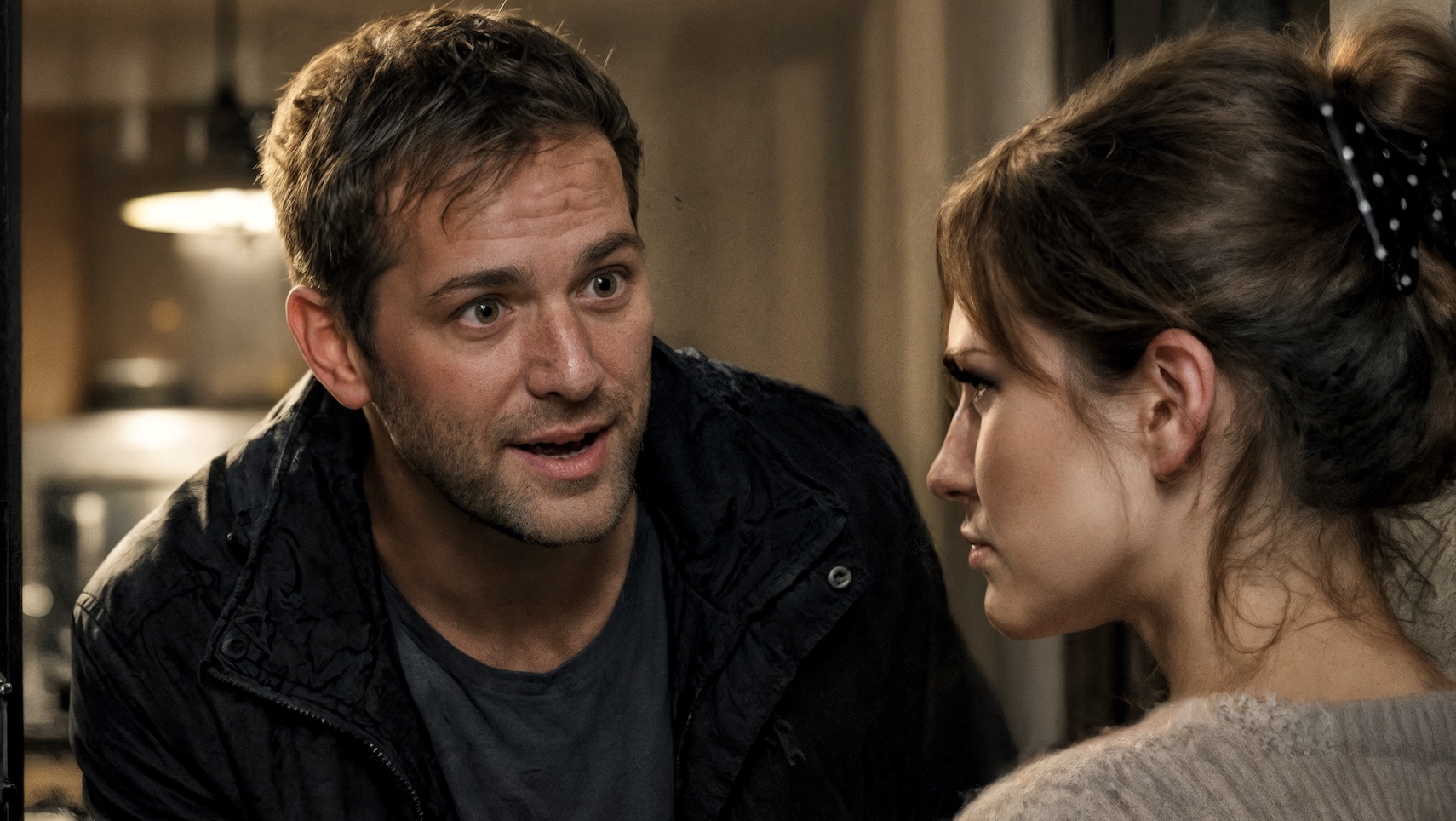
Alina looked up from her monitor when a wave of whispering rolled through the office. It was just after eight on a Monday morning, the hour when everyone was usually busy sorting through emails and mapping out the week ahead. But that morning, the atmosphere had shifted, as though someone had thrown a stone into still water.
Through the glass partition, she saw him.
Maxim was standing at the reception desk with a huge bouquet of deep red roses—far too bright, far too extravagant for an office lobby. His tall figure in an expensive navy suit stood out against the morning rush. He carried himself as if he owned the place: shoulders back, chin raised, wearing that same self-assured posture Alina remembered all too well.
Katya, the receptionist, was trying to explain something to him, motioning toward the elevators, but Maxim only shook his head and stayed where he was, glancing at his watch now and then. An expensive Swiss watch—his mother’s gift for his thirtieth birthday.
Alina felt the color leave her face. The folder with the quarterly report slipped from her hands, and papers scattered across the desk like a fan. A year and a half. A year and a half of silence, a year and a half of life without him, without both of them. Why was he here? Why now, when she had only just started breathing freely again?
Her colleague Marina leaned over the divider between their desks.
“Alina, is he here for you? What an impressive-looking man…”
Alina stood up abruptly, gathered the papers with trembling hands, and, without answering, headed toward her boss’s office. She needed to hide, to wait until he gave up and left. But deep inside, she knew Maxim was not the kind of man who backed down easily.
Especially not when his mother was behind him.
They had met four years earlier through mutual friends at someone’s wedding. Maxim had made an immediate impression—tall, broad-shouldered, confident, with a dazzling smile that was hard to resist. He worked for a large construction company, drove a brand-new SUV, and knew how to court a woman beautifully. Alina was twenty-seven at the time, and her friends had already started hinting more and more often about her biological clock.
Galina Ivanovna entered Alina’s life a month after the relationship began. Their first meeting took place in an expensive restaurant—Maxim had insisted. His mother was an elegant woman in her mid-fifties, with perfectly styled ash-blond hair and sharp gray eyes. She was impeccably polite, called Alina “dear,” and asked about her job, her family, and her plans for the future. Back then, it seemed like nothing more than normal maternal interest.
“Alinochka is so delicate,” Galina Ivanovna would say to Maxim, as though Alina were not even sitting beside them. “I hope you’re taking proper care of her.”
After the wedding, which took place a year after they met, that polite mask slowly began to slip. The first warning signs were almost subtle. Galina Ivanovna started dropping by unannounced—conveniently, she lived in the next neighborhood.
“My dear,” she would say, running a finger along the shelf in the entryway, “a good housewife doesn’t have dust in her home. At your age, I did wet cleaning every single day.”
Then the criticism of Alina’s cooking began. Alina tried—she bought cookbooks, watched recipe videos, got up an hour earlier to make breakfast. But the borscht was “too watery,” the cutlets were “dry,” and the pies were “too heavy for the stomach.”
“Maximushka is used to homemade food,” his mother would sigh. “Of course I spoiled him. What could I do? He’s my only son.”
Maxim either stayed silent or changed the subject. Whenever Alina tried to talk to him in private, he would shrug.
“Mom is just worried about us. She’s lived her whole life for me. Since Dad died, I’m all she has. Be patient. She’ll get used to you.”
One Sunday morning was bitterly cold. Alina woke with a heavy head—work had been chaos all week because they were finalizing the annual report. But there was no time to rest. Galina Ivanovna was expecting them for lunch, and before that they had to stop at the market for groceries from a list her mother-in-law had sent the night before.
Her mother-in-law’s apartment greeted them with the smell of valerian drops and the disapproving stare of its owner.
“You’re late,” Galina Ivanovna announced instead of saying hello. “I was beginning to think you’d forgotten all about your mother.”
While Maxim settled in front of the television with a bottle of beer, Alina went to the kitchen. Lunch had to be prepared under her mother-in-law’s close supervision, while Galina Ivanovna sat near the window with her knitting like a queen overseeing her domain.
“You’re cutting the carrots wrong. I showed you—into strips, not cubes. And the onions need to be finer. Maxim has hated big pieces of onion since childhood.”
Alina silently corrected her “mistakes.” After a year and a half of marriage, she had learned not to argue. There was no point.
After lunch, the neighbor Valentina Petrovna arrived—a friend of Galina Ivanovna’s since university. The two women settled into the living room with tea, while Alina began washing dishes.
“So, how’s your daughter-in-law?” the guest asked, lowering her voice, though not nearly enough.
“What can I say, Valya,” Galina Ivanovna sighed. “The girl tries, but… she isn’t at the right level. I told Maxim to choose more carefully. But young people never listen. And now my poor boy suffers. He comes home hungry, neglected. His shirts are wrinkled, his socks have holes.”
Alina froze with a plate in her hand. Heat rushed to her cheeks. She ironed Maxim’s shirts every evening, bought his socks in packs, and cooked lunches for the whole week ahead.
“And she doesn’t seem especially suited for family life either,” Galina Ivanovna went on. “It’s always work, work, work. A woman should think of her husband first, make a home. But what can you expect from modern women? They’re all career-obsessed.”
The decisive conversation happened in April, three months after that Sunday visit. Galina Ivanovna came to their apartment on a weekday, when Alina had taken the day off for a doctor’s appointment. She found her at home in casual clothes, with a cup of tea and a book.
“You’re not working?” disapproval was obvious in her voice.
“I took a day off, Galina Ivanovna. I had to see a doctor.”
“You’re not ill, are you?” There was no concern in the question—only suspicion.
“No, just a routine checkup.”
Her mother-in-law walked into the living room, swept the room with her eyes, and lowered herself heavily into an armchair.
“Alina, we need to talk. Seriously.”
A sense of dread stabbed beneath Alina’s ribs.
“I’ve thought about this for a long time. I’ve talked to friends, even to a priest. You are not right for my son. Not at all. Maxim deserves better—a woman who will be a real homemaker, the mother of his children, not…” She paused, choosing her words. “…not a career woman who thinks more about herself than her family.”
“Galina Ivanovna, but—”
“Let me finish. I’ve already decided. Divorce is the only correct solution. Maxim is still young, he’ll find a more suitable wife. And you… you’ll manage somehow. Perhaps you’ll find a man who doesn’t need a homemaker.”
That evening, when Maxim came home, his mother presented her decision as if it were already final. Alina looked at her husband, waiting for at least one word in her defense. But Maxim stayed silent, staring at the floor.
“Mom, maybe you shouldn’t be so harsh…” he began weakly.
“Maxim!” Galina Ivanovna’s voice turned hard as steel. “I would never advise you badly. Face the truth—you are not right for each other.”
A week later, Alina was packing her things. Her mother-in-law stood in the bedroom doorway, commenting on the process.
“Leave the bed linen. That was part of my dowry. And the dinner set—that was a wedding gift from my friends. And don’t forget to leave the keys.”
Maxim sat in the kitchen. When Alina passed by with her suitcase, he never once lifted his head.
The letter from the notary arrived on a rainy October morning. Alina read the official lines three times before she fully grasped their meaning. Alexey Pavlovich Krylov—her father’s uncle, whom she had seen perhaps five times in her life—had left all his property to her. An eccentric old recluse, as her mother used to call him, who had lived alone in a village outside the city. It turned out Alina was his only relative.
The house stood on the edge of a small settlement, about an hour from town. It was a two-story place with peeling blue paint on the shutters and a sagging porch. The garden was overgrown, and the apple trees bent under the weight of fruit no one had picked. In the old shed she found rust-covered gardening tools and, unexpectedly, a perfectly decent ten-year-old Toyota.
But the biggest surprise was the animals. Two enormous Central Asian shepherd dogs—Graf and Baron—greeted her with wary barking that quickly turned into cheerful whining once the neighbor, Antonina Vasilievna, explained that this was their new owner. And on the veranda, curled up in an old rocking chair, slept an enormous ginger cat.
“His name is Vaska,” the neighbor explained. “Alexey Pavlovich raised him from a kitten. The cat must be fifteen by now. The dogs are younger—about seven. He loved them more than people, may he rest in peace.”
That first night in the new house, Alina barely slept. The floorboards creaked, the wind roamed through the attic, and the dogs barked from time to time in the yard. But it was a different kind of fear—not that sticky dread of another visit from her mother-in-law, but the anxious thrill of facing the unknown.
Her own unknown.
The next morning, while making tea on the old gas stove, she smiled for no reason for the first time in a long while. Simply because she could. Because no one was there to say that she had boiled the kettle the wrong way.
She took leave from work and spent two weeks getting the house into shape. In the evenings, she drove the Toyota along the empty village roads, slowly overcoming her fear behind the wheel. The neighbors greeted her warmly, offered help, and shared practical advice.
She posted a photo with Graf and Baron on social media without much thought. In the picture, she was sitting on the porch with her arms around the massive dogs, while Vaska lounged in her lap. The caption was simple: “My new housemates.”
Three days later, Maxim was standing in her office.
“Alina, we need to talk,” he said after she finally came out of her boss’s office.
They went downstairs to the café on the first floor. Maxim looked older now—there were lines around his eyes and gray at his temples.
“I made a mistake,” he began without preamble. “A huge mistake. Mom… I never should have listened to her. These past eighteen months, I’ve realized what I lost.”
Alina stirred sugar into her coffee in silence.
“I saw your photos. The house, the dogs… You’ve changed. You seem… freer somehow. More beautiful. I want you back. I want us back.”
“There is no ‘us’ anymore, Maxim,” Alina replied calmly, lifting her eyes to his. “Actually, there never really was. There was you, your mother, and me trying to squeeze myself into your life.”
“But I love you!”
“No. You love the idea of me. The idea of a wife you can reclaim like an item still under warranty.”
That same evening, the phone rang. Alina was making dinner, chopping vegetables for a salad. The number was unfamiliar, but something told her to answer.
“Alina?” her mother-in-law’s voice sounded unusually soft, almost silky. “Good evening. This is Galina Ivanovna.”
Alina waited in silence.
“Maxim told me about your meeting. Alina, I understand that there have been… misunderstandings between us. But there’s no need to be so hasty. Maxim is sincerely sorry. He realizes his mistakes. And I… I, too, am willing to admit that I may have been overly harsh.”
“Galina Ivanovna,” Alina said, surprised by how steady her own voice sounded, “there were no misunderstandings between us. You made it perfectly clear that I was not worthy of your son. And you know what? You were right. I truly was not suited for the role you had chosen for me.”
“Alinochka, now really—”
“Alina,” she corrected. “And let’s end this conversation here. I already said everything to Maxim. The past cannot be brought back, and there is no reason to try. Goodbye.”
She ended the call, feeling a strange lightness. There was no anger, no resentment—only calm certainty. She was no longer that girl who was terrified of failing to please.
December came heavy with snow. Alina took a month off. In the mornings, she walked the dogs through the snowy woods. Graf and Baron raced between the trees, kicking up clouds of powder. Vaska preferred to watch their outings from the kitchen window, stretched out on the sill.
The neighbors had accepted her as one of their own. Antonina Vasilievna taught her how to ferment cabbage and bake bread in a traditional Russian stove. The local carpenter, Uncle Misha, helped fix the roof and refused payment—he only asked for lunch and conversation. A young family from next door invited her to celebrate New Year’s Eve with them.
In the evenings, Alina sat on the repaired veranda wrapped in a blanket. Graf would rest his heavy head in her lap, Baron would curl up at her feet, and Vaska would climb into her arms, purring like a tiny tractor. She drank tea with jam made from apples in her own garden and thought about how strangely life worked.
The divorce that had once seemed like the end of the world had turned out to be the beginning. The beginning of a life where she decided for herself what counted as a proper pot of borscht. Where dust on a shelf was not a crime. Where she could simply be herself—imperfect, sometimes lazy, sometimes sad, but real.
A reminder flashed on her phone: in one week, she was due back at work. Alina looked out at the snow-covered garden, at the dogs dozing peacefully by the stove, at the cat sprawled across her favorite chair. Then she opened her laptop and started writing her resignation letter. Uncle Alexey had left modest savings, the house did not require much money, and the local library was looking for a part-time employee.
This was her life now. A life without measuring herself against other people’s expectations, without the fear of falling short. Just the life of a woman who had finally learned to listen to herself.
Snow fell beyond the window, firewood crackled in the stove, and Alina smiled as she planned which flowers she would plant in the spring. Dahlias, perhaps. Bright, lush, and a little bold.
Just like her new life.