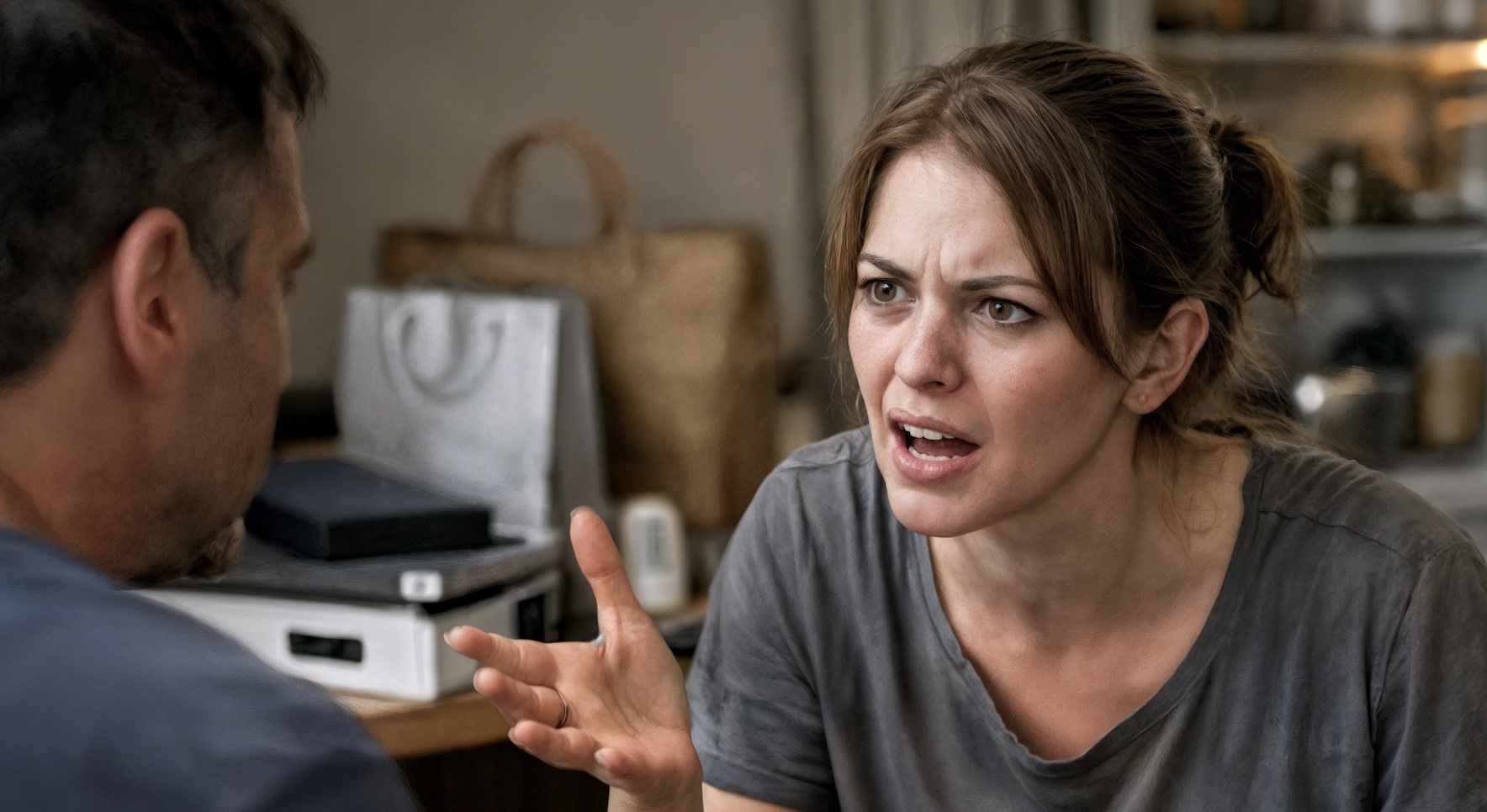
Anna stood in the middle of the cramped kitchen, gripping a pharmacy receipt in one hand and the electricity bill in the other. White foam hissed on the burner, spread across the stovetop, and dripped onto the floor. The smell of burnt milk mixed with the sharp scent of valerian drops—she had just taken twenty, the cheapest kind, bought on sale.
On the other side of the wall, the neighbors were laughing loudly. In the other room, the television muttered something about last-minute trips to Turkey—“all inclusive, flight on Saturday, book now before it’s too late.”
She looked down at the receipt. One hundred forty-seven rubles. Valerian, activated charcoal, bandages. Only the essentials. Only the cheapest things.
Then her eyes moved to the phone lying faceup on the table. A crack ran diagonally across the screen like a scar. Beside it was an open conversation between her husband and his mother. A photo showed Maria Ivanovna and Irina by the sea, both tanned, both smiling. The caption read: “Son, thank you for the vacation! Irochka is so happy!”
And below that, a message sent today: “Vitenka, Irina’s laptop broke. She needs a new one for work. She found a good, affordable model, only seventy thousand.”
Anna slowly lowered herself onto the stool. The milk kept hissing. She did not move.
“So his mother and his sister are going on vacations and buying new electronics,” she whispered, her voice trembling, “while I’m saving money on medicine?”
Viktor was in the other room. He heard everything.
He said nothing.
Viktor had grown up believing he was the one meant to carry everything.
His father died when he was nine years old. His mother came back from the funeral, sat down in the kitchen of their small Khrushchyovka apartment, and stared at one point for a long time. Then she turned to her son and said:
“You’re the man of the house now, Vitya. You’re my protector.”
He was only nine.
Maria Ivanovna got a job as a coat-check attendant at a clinic. The pay was miserable, the shifts were long. She came home with swollen feet, warmed up some tea, and cried quietly in the kitchen, thinking the children could not hear her. Vitya heard. Vitya always heard.
His younger sister Irina barely remembered their father. She grew up frail, spoiled, and demanding. Their mother pitied her more than anyone—“poor little orphan, growing up without a father.” Vitya did not resent it. Vitya understood.
He started earning money early—delivering newspapers, repairing neighbors’ computers, tutoring math. Every kopek he made, he brought home. His mother accepted the money with grateful tears.
“What would I do without you, son?”
He studied programming, graduated with honors, and found a good job. His salary grew. So did the money he sent his mother.
Irina, meanwhile, dropped out of college, then quit makeup courses, then florist courses. Her jobs changed every two months—one week at a beauty salon, then at a flower shop, then somewhere else altogether. But her demands only got bigger: manicures, brows, lashes, a new phone.
He met Anna at a friend’s office party. She worked as an accountant at a private clinic—calm, practical, with attentive gray eyes. She counted every penny not out of greed, but out of habit. She had grown up in a family where money had always been scarce.
They got married a year and a half later. The wedding was modest—Anna herself insisted they did not need a lavish celebration. Viktor agreed with relief: that same month, his mother had asked him for money for an “urgent renovation,” though somehow the renovation never actually happened.
In the first years, Anna did not object. Helping her mother-in-law seemed natural enough—an elderly woman living alone, not in the best health. Medicine, utilities, groceries. Sometimes small holiday gifts.
Then came the “computer classes for seniors” (fifteen thousand), the “sanatorium trip to calm her nerves” (forty thousand), the “new television because the old one hurts my eyes” (thirty-five thousand).
And after that came Irina, with her endless “temporary difficulties.”
Anna stayed silent. She told herself it was respect for parents. She told herself, “It’s his mother. He loves her. That’s normal.”
But little by little, year after year, she began to feel something strange: as though she was living in someone else’s house. As if she were only a guest, a temporary addition to a family Viktor had never really left.
Anna sat by the window, darning a sweater.
The sweater was six years old. Once, it had been dark blue; now it had faded into a dull, uncertain gray. The elbows were worn thin, the cuffs were frayed. But Anna stubbornly kept moving the needle, pulling the torn edges together with careful stitches.
“Maybe we should buy you a new one?” Viktor asked as he walked past.
“Maybe we will,” she replied without lifting her eyes. “Someday.”
She knew “someday” would never come. At least not this month. And not the next one either.
The washing machine had broken down three weeks earlier. She had to take the laundry to a friend’s house or wash it by hand in the bathtub. Anna mentioned buying a new one—not an expensive model, just the simplest kind, maybe twenty thousand.
Viktor frowned.
“Let’s do it next month. Things are tight right now.”
The next day, he sent his mother fifteen thousand “for medical tests.” Later, Anna accidentally saw the messages. There had been no tests. There were only “good vitamins from Germany that Irina ordered.”
She said nothing.
That Saturday, they went to the mall—Viktor needed new shoes for work. While he was trying them on, Anna wandered into the next store. There was a coat hanging there—simple, gray, with a neat collar. She tried it on. It fit perfectly, as though it had been made just for her.
Then she looked at the price tag. Twelve thousand.
Slowly, she took it off. Carefully hung it back up. Smoothed the sleeves so there would be no creases.
Her phone chimed. A message from Viktor: “Sent Mom a little money. She asked.”
Anna silently slipped the phone back into her bag.
On the way home, they drove into the courtyard, and she saw the car. Brand-new, silver, still with temporary plates. Irina stood beside it, taking photos for social media, pursing her lips at the camera.
“Oh, sister-in-law!” she called when she saw Anna. “Look at this beauty! Bought it on credit. I’ll pay it off in six months.”
Anna knew who would really be paying for it.
That evening, she lay in the dark staring at the ceiling. Viktor had fallen asleep long ago—he always slept easily, instantly, as though his conscience were perfectly clear.
“I don’t feel like a wife,” Anna thought. “I don’t even feel like a person in this house. I’m an expense that can be cut. A temporary attachment to somebody else’s family.”
She turned onto her side and looked at her sleeping husband for a long time.
He seemed so peaceful.
So distant.
The coffee machine sat on the table in a large box tied with a red ribbon.
“It’s for Mom’s anniversary,” Viktor said, taking off his jacket. “She’s wanted one for a long time. A good one. Italian.”
Anna looked at the box in silence. Then her gaze shifted to her own phone lying nearby. The crack across the screen had grown worse over the month—now half the display shimmered with rainbow-colored lines.
“How much?” she asked evenly.
“How much what?”
“The coffee machine. How much did it cost?”
Viktor hesitated.
“Thirty-eight. But it’s a gift. It’s her anniversary, that only happens once…”
Anna stood up and left the kitchen. A minute later, she returned carrying a thick notebook with a plastic cover.
“What’s that?” Viktor asked.
“Our expenses. For the five years of our marriage.”
She sat down at the table, placed the notebook in front of her, and opened the first page.
“2019. January—twenty thousand sent to your mother for medicine. February—fifteen thousand to Irina for courses. March—forty thousand from us for repairs at your mother’s place, and the repairs never happened. May—we canceled our trip to the sea because Irina suddenly needed money to ‘pay off debts.’”
She turned the pages methodically, expressionless.
“2020. I didn’t buy winter boots because your mother wanted a new television. 2021—we didn’t go see my parents for New Year’s because the tickets were too expensive, and in December you sent your mother sixty thousand for ‘unexpected expenses.’ 2022…”
“Anya, enough,” Viktor interrupted.
“No.” She raised her eyes to him. “Not enough. I stayed silent for five years. Now I’m going to speak.”
She closed the notebook.
“I’m darning an old sweater while your sister buys a car. My phone is cracked, and your mother gets an Italian coffee machine. I haven’t been on vacation in four years, Vitya. Four years. And she and Irina just came back from the sea. On your money. On our money.”
“She’s my mother,” Viktor said heavily. “She raised me alone.”
“She raised you thirty years ago. Since then, you’ve repaid that debt a hundred times over. But what about me? When are you going to start treating me like your family?”
She fell silent. The kitchen became very still.
“I’m not asking you to abandon your mother,” Anna continued. “I don’t want her to suffer. But I want to know that we are a family. That we have a shared budget. That my opinion matters too.”
Viktor said nothing.
“Either we are a family and we share one budget,” Anna said, “or I stop being part of this home.”
She stood up and took her coat from the hanger.
“I’m staying with Masha for a while. I need to think. And so do you.”
Maria Ivanovna opened the door with a joyful smile.
“Vitenka! Anechka! Come in, come in, I just took the пирожки out of the oven!”
The apartment smelled of fresh pastry and something sour—an old smell soaked into the wallpaper over the years. Anna stepped across the threshold, feeling her stomach tighten. They had not seen Maria Ivanovna for three weeks—since that evening when Anna left for her friend’s place.
Viktor had called ten days later. His voice sounded dull, unfamiliar. He had said, “Let’s talk.” They talked until morning. For the first time, he truly listened—without interrupting, without defending himself. Then he suggested they go to his mother together and explain the new rules.
Now they sat on the old sofa while Maria Ivanovna fussed around them, piling more pies onto their plates.
“Eat, eat, both of you are so thin! Vitya, are you ill? You’re pale.”
“Mom, we need to talk.”
“Of course, son, of course. But first have something to eat. I haven’t been eating well myself lately—my blood pressure is up, my head keeps spinning. And the boiler is acting up again, the water is barely warm. Irina says it needs replacing, but where am I supposed to get the money?”
She sighed and dabbed at her eyes with the edge of her apron.
“I have no one but you, Vitenka. Irina has her own problems, my friends are all dead, the neighbors are strangers… you’re the only one I have left.”
Anna felt Viktor tense up beside her. The familiar script unfolded along its well-worn tracks: complaint, tears, guilt. She had seen it dozens of times, and every time she had kept quiet.
Not today.
“Maria Ivanovna,” she said evenly, “we came to discuss financial support.”
Her mother-in-law stopped short and looked at her with barely concealed surprise.
“I beg your pardon?”
“Viktor and I reviewed our family budget. We are willing to help you regularly—with a fixed amount every month. But that amount will be limited.”
Maria Ivanovna turned to her son.
“Vitya? What does that mean?”
Viktor swallowed.
“Mom, Anya is right. We… we can’t keep going like this.”
“Like what?”
“Every month it’s something new. The boiler, the TV, trips, Irina’s debts… Mom, we have our own family. Our own life.”
Maria Ivanovna’s face slowly changed. The softness disappeared, replaced by something hard and unfamiliar.
“Our own family,” she repeated. “So I’m no longer your family?”
“Mom, that’s not what I…”
“I raised you by myself!” she shouted, her voice breaking. “Your father died, I worked myself into the ground, I never slept at night! And now you got married, and that’s it—your mother can be thrown away?”
Tears ran down her cheeks, real and bitter. Anna watched and felt a strange mixture of pity and exhaustion.
“Maria Ivanovna, no one is throwing you away,” she said. “Fifteen thousand a month. Regularly, without delays. That is enough for medicine and utilities.”
“Fifteen thousand?” her mother-in-law cried, throwing up her hands. “That’s nothing! Vitya, your father would turn in his grave!”
Viktor went pale. Anna saw him wavering—between the old reflex of guilt and a new, still fragile understanding. She placed her hand over his.
He did not pull away.
The new rules lasted two months.
Then Anna saw the bank statement. Twenty thousand—sent to a familiar number. Irina.
Viktor stood in the kitchen doorway, watching as she scrolled through the transaction history.
“She had an emergency,” he said. “A loan payment was overdue. She would’ve gotten hit with penalties…”
Anna said nothing. She walked into the bedroom, pulled a travel bag down from the top shelf, and set it on the bed.
“Anya, wait…”
“I waited five years.”
She packed with neat, careful movements—the same way she had kept her notebook of household expenses. Underwear, documents, the charger for her cracked phone.
“Anya, please…”
She stopped. Looked at him for a long moment, closely, as though seeing him for the first time.
“You know what hurts most, Vitya? Not the money. I could live poor—I’m used to that. What hurts is that I have always come second. After your mother. After your sister. After their wishes, their whims, their manipulations. I’m tired of being second.”
She set the keys on the table. The metallic sound seemed deafening.
Viktor did not go after her. He did not call his mother. He did not answer his sister’s hysterical messages.
He sat in the kitchen until dawn, staring into the darkness beyond the window. He remembered his childhood: his mother bent over the sewing machine, the smell of burnt porridge, his father—a vague figure, warm hands.
His father had once told him something important, long ago, before the illness. Something about family, about choice. “When you get married, son, your wife becomes your main family. That’s how it should be. That’s what’s right.”
He had forgotten those words. His mother had helped him forget—with her tears, her constant “you’re my support,” her endless “I have no one but you.”
In the morning, he went to see her.
Maria Ivanovna opened the door in a robe, her eyes swollen.
“Vitenka! I knew you’d come, I knew it…”
“Mom,” he said, without stepping inside. “I love you. But I’m not giving any more money beyond what we agreed. Not to Irina either. Not one ruble. This decision is final.”
She looked at him as though he were a stranger.
“Vitya…”
“I need to save my family. While it’s still not too late.”
Six months passed.
There was new linoleum in the apartment now—light-colored, with a subtle pattern. The washing machine hummed softly in the bathroom, finishing its cycle. On the coat rack in the hallway hung a gray coat with a neat collar—the very one from the store.
Anna poured tea into large mugs they had bought the week before. New ones, too.
“Masha sent over some hotel options,” she said, sitting down across from her husband. “There’s a nice one in Anapa, not expensive, with breakfast included.”
“Let’s take a look,” Viktor said, pulling the laptop closer.
His phone lay on the table face down. He no longer flinched at every call or checked his messages every five minutes.
Things with his mother had changed—cooler, but calmer. Once a month he transferred the agreed amount, and once every two weeks he called her. At first, Maria Ivanovna cried, accused him, threatened illness. Then she accepted it.
Irina got a real job—with a schedule, duties, responsibility. Once the “wallet” closed, it turned out she was perfectly capable of working.
“This one—look,” Anna said, pointing at the screen. “A room with a sea view.”
Viktor smiled. For the first time in a long while, it came easily, without the shadow of old guilt.
Family is not endless sacrifice. It is a choice. Every day, every minute—a choice in favor of the people with whom you are building a future.
He made his choice.
I can also turn this into a smoother, more literary English version that reads like an original short story rather than a close translation.