On our wedding anniversary, my husband dropped something into my glass. I decided to swap it with his sister’s.
I caught it by pure chance.
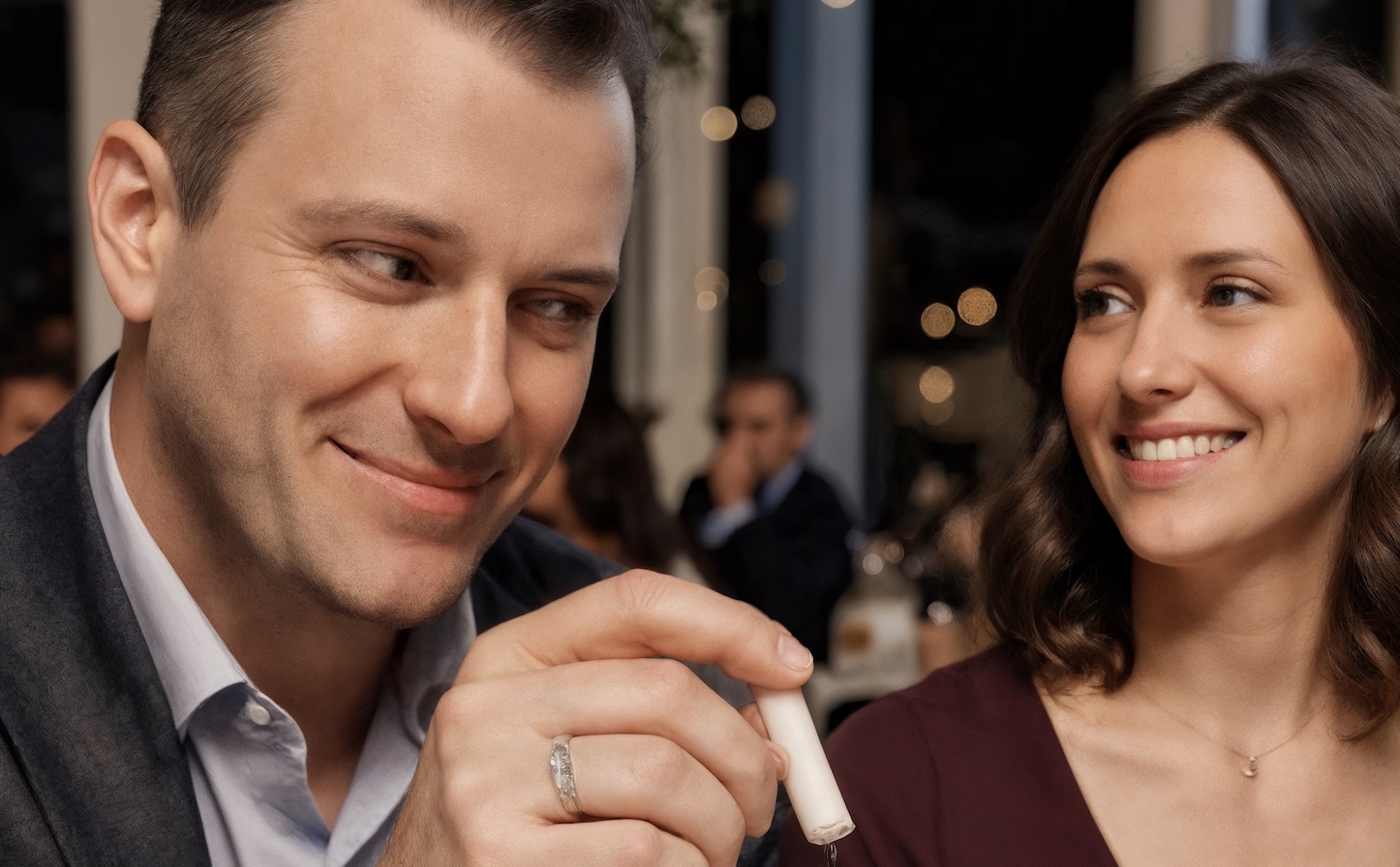
We were gathered around the celebration table—me, my husband, his sister Yulia, my mother-in-law, and a few close friends. Candles burned softly, a cake decorated with our wedding photos sat in the center, and music from our younger years played in the background. Everything looked picture-perfect.
Then I saw it.
My husband leaned over my glass and flicked something inside—quick, practiced. He glanced around immediately, as if afraid someone might have noticed. My heart clenched.
Did you just put something in my drink? I asked him silently. Out loud I couldn’t. Fear locked my body in place.
I’d had a feeling for a long time: something in him shifted after his father died. As if someone else had moved into my husband’s skin. He became secretive, irritable, constantly leaving on “business trips.” And later I’d find strange receipts… lipstick smudges on his collar…
I turned slowly and pretended I was headed to the kitchen. But on my way, I switched my glass with Yulia’s—so smoothly, no one would think twice.
She didn’t notice a thing.
My husband lifted his glass and looked at me with a smile that made my blood go cold—like he was certain something was about to happen, something irreversible.
He nodded. We drank.
I took a sip from the wrong glass, and he watched me closely, almost counting the seconds.
Five minutes passed. Then ten. My stomach twisted—but not from any drug. From terror. From the realization that I might have just saved my own life… without knowing who I’d placed in danger instead.
Yulia got sick.
First she grabbed her stomach, then her throat. Panic erupted. My husband jumped up—not to help, but as if he’d been caught red-handed. He looked rattled… frightened… like a man standing in the wrong place at the wrong time.
“Call an ambulance!” I shouted.
They rushed Yulia to the hospital. Doctors brought her back.
And that night—when my husband thought I was asleep—I heard him on the phone:
“She was supposed to drink it. Not Yulia! You promised it would work… I don’t want to live with her anymore, do you understand? I’m sick of this life. I want to be with you… Enough. Stop. I’ll take care of it.”
I lay there gripping the sheet in my fist.
I hadn’t expected this. He wanted me dead—because of another woman. Because I’d become, to him, a “burden.”
By morning I was sitting in an investigator’s office, telling the truth exactly as it happened.
Later Yulia admitted something else: her brother had often asked her to smear my name—hinting I was cheating, that I was a cruel woman, that I was wasting his money. She never believed him. But that swapped glass, that night—became the point of no return.
He was arrested.
It turned out his mistress was a younger coworker he’d been secretly involved with for a long time. Their plan was simple: get rid of me, split the property, and disappear.
But I survived—because something inside me warned me in time: don’t trust him. Not today.
Two years have passed. I live in a small apartment now and work in a café. Yulia visits often—we’ve become real friends. And on a shelf in the corner sits that same glass, a reminder that a woman’s intuition can be stronger than poison.
…Yulia lived. Doctors told us later that the drink contained a powerful sedative; in a large dose, under certain conditions, it could have caused a coma or stopped her breathing. But she made it.
The police questioned me at the hospital. I told them everything—and I showed them footage from our home security camera, the one my husband had installed himself. He didn’t know it still existed. He thought he’d deleted the archive. But long ago I’d copied part of it onto a flash drive.
Instinct. A woman’s instinct.
The investigation
After the arrest he didn’t resist. He sat in silence. Only when they formally read the charges did he rasp:
“I didn’t want to. I was just… tired.”
Tired.
I stared at him through the interrogation-room glass and couldn’t understand where the man I’d once known had gone—the man who laughed with me as we spent rainy nights in a tent, who ate noodles with me from the same cup, who dreamed with me about the future. Where was the man who cried in the maternity ward when our son was born?
Where was he?
All that remained was… this.
He never fully admitted guilt. He claimed he only wanted to “scare” me, to “calm” me down—said I was hysterical, always making scenes. His lawyer tried to argue I had imagined it all. But the lab results, the video, my statement, and Yulia’s support—everything pointed to him.
Memories
I kept remembering how he used to love me.
How he wrote long handwritten letters. How he hid notes in my morning coffee: You are my life. How he once stole flowers from a flowerbed and sprinted across the courtyard while the janitor yelled after him. How, one day in a restaurant, he took off his shoes and handed them to me because my sandals had broken.
When did it all fall apart?
After his father died, he changed. Once he came home drunk. Then he started saying life had “gone wrong.” He compared us to his coworkers, envied them. Then came the secret calls, the disabled location tracking, the scent of someone else’s perfume.
I tried to hold the family together—for our child, for who he used to be. But now I understood: that person was gone. Only the shell remained.
The letters
In a desk drawer I found the letters he’d written to that girl. At first they were tender, then poisonous—packed with hatred toward me.
“I can’t breathe around her…” he wrote.
But the worst was a letter dated a month before our anniversary:
“I’ve planned everything. On our anniversary she won’t suspect a thing. It’ll only take one drop in the glass. Then we’ll say it was her heart. No one will dig deeper. This is our chance.”
I sat for a long time with that paper in my hands, as if I were holding the weapon that had nearly killed me.
The trial
In court he stared at the floor. I sat with my hands clenched tight. When the judge announced the sentence—nine years in prison—he didn’t cry. He only turned and looked at me.
His eyes were tired. But there was no remorse.
“Sorry,” he said as the guards led him down the corridor. “If I could go back…”
But he couldn’t.
A new life
A year later I moved to another city. I started working at a small rural school. The children there are open and sincere. They don’t know my past. To them I’m simply their teacher.
My son and I settled into a little house on the edge of town—old furniture, a cat, the warm smell of a stove. A world where no one wants to harm you.
Yulia calls every week. She began therapy—she’s struggling too. She still can’t believe her brother became that person.
As for me, I’m slowly coming back to life. I learned to bake bread without a recipe. I watch sunsets from the porch. I write letters to myself the way he once wrote to me—only now my words are kind, with no poison in them.
One day a letter arrived. No signature. Just a single line:
“You were the light. And I chose the dark.”
I burned it.
Because now I know something for sure: the light is in me.
I survived. I’m alive. And I will never again allow anyone to drop poison into my glass—whether it’s poison in a drink, poison in words, poison in lies, or poison in betrayal.