I had never liked loud, crowded feasts. Ever since childhood, I’d felt more at home in kitchens after midnight: the steady knock of a knife on a cutting board, the kettle’s soft hiss, a quiet lamp glowing above the table—and people speaking plainly, without putting on a show. But that night I was standing in the very heart of a heated banquet hall. I wore an emerald dress, and a warm, sticky stream of red wine seeped down my shoulder. Its scent was sharp and biting, like raw iron.
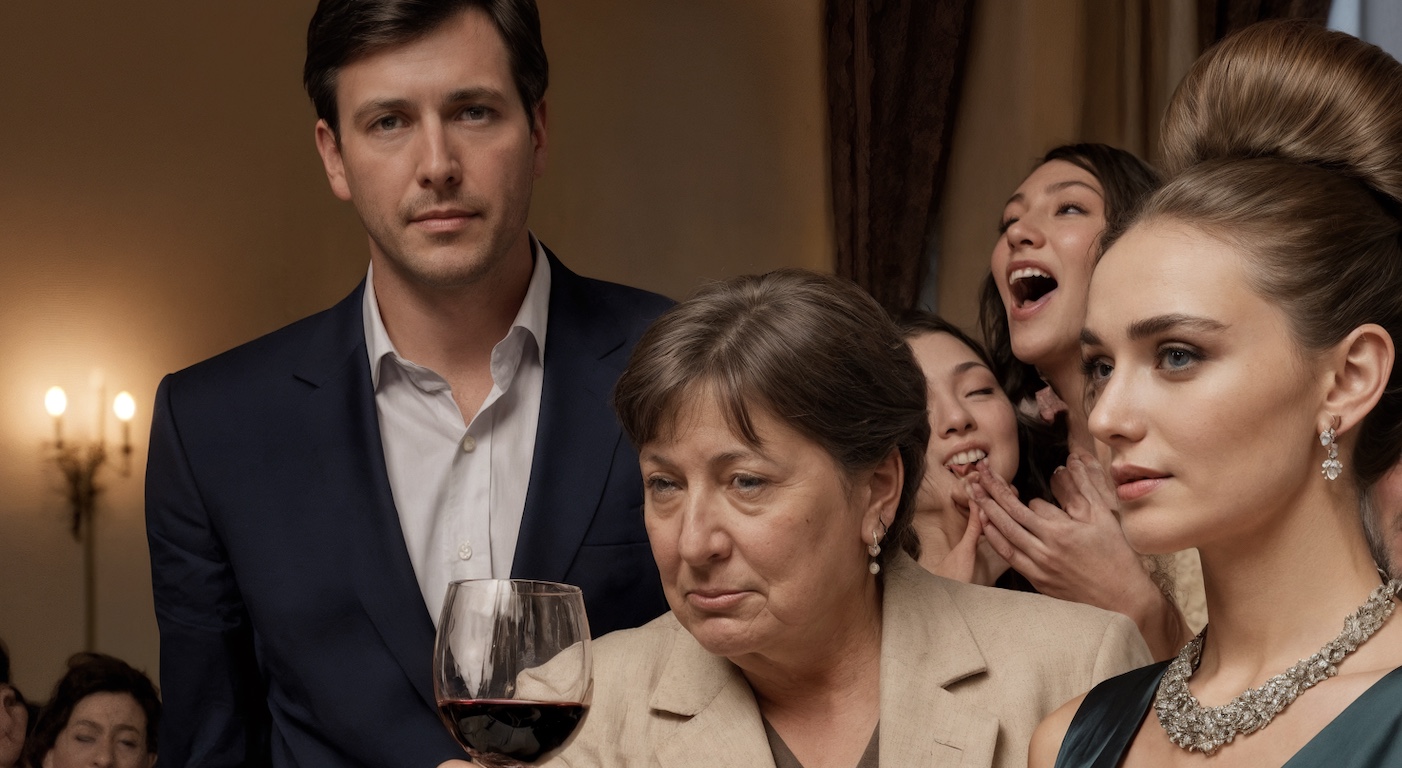
My mother-in-law held the empty glass as if it were a trophy. My husband’s sisters were already doubled over with laughter—loud, vicious laughter, the kind where a person isn’t really laughing so much as tearing a piece out of you while you’re still alive. My husband stayed silent, pretending to examine the chandelier. His face might as well have said, Your fault. Why did you come in a dress like that?
I didn’t wipe myself off. I took a thin handkerchief from my clutch—a gift from my late grandmother—and covered the crimson stain so it wouldn’t drip onto the floor. Then I smiled at the waitress who had frozen beside my elbow and whispered,
“It’s okay, Sonya. Don’t worry.”
Sonya nodded and ran to the kitchen. And a minute later our manager stepped onto the small stage, tapped a spoon against the microphone, and said:
“Ladies and gentlemen, may I have your attention for a moment! Tonight is a special night. We’re raising our glasses not only to the birthday guest. We have an announcement: as of today, Calico Tablecloth has a new owner. Or rather—a new owner she. Let’s give a round of applause to the new mistress of our restaurant!”
The light swung toward me instantly, like a spotlight.
The laughter at my mother-in-law’s table choked off and vanished. My husband lifted his head as if someone had called him by his last name. I walked calmly toward the stage—the cold, tacky wine had already cooled—and heard someone whistle at the back of the hall, then clap. People turned, whispered, smiled: “So it’s her… that dark-skinned girl with kind eyes.”
I stepped up. When the microphone was handed to me, I said:
“Thank you. But the applause shouldn’t be for me. The people working here tonight deserve it: our chefs, pastry team, the staff on the floor, my deputy Alexey, and our accountant, Lydia Petrovna. If you love this place, then it means we’ve done everything right.”
The room applauded again—this time truly warm, real. I watched my mother-in-law trying to regain her balance—fastening a bracelet that hadn’t even come undone, adjusting her hair. The sisters leaned toward each other and whispered, curling their lips in the exact same practiced way, as if they’d rehearsed it in front of a mirror. My husband finally caught my gaze. There was no remorse in his expression, no joy—only the stunned fear of someone who missed the train because he’d convinced himself the train wasn’t going anywhere.
But before I tell you what happened next, I need to take you back a few years—to where this evening began, thread by thread, like a pattern appearing on an old shawl.
—
My name is Vera. I grew up in a small town on the bank of a quiet river. My mother died early, and my father—silent and closed off—couldn’t figure out what to do with me for a long time, so he left for shift work far away. I was raised by my grandmother. She didn’t like long talks and never complained. She taught me one thing above all:
“Don’t be afraid to start over. And do your work well. Even if it’s someone else’s kitchen—clean up after yourself as if it were your own home.”
Because of her, I knew how to cook and how to count money. After vocational school I got a job in a pastry workshop—not a trendy one, but an honest one: cookies for schools, wedding cakes, pastries for the local hospital. The pay barely covered life, but I felt warm inside from the simple, clear usefulness of what I did.
I met Igor by accident. An old elevator in our building broke down, and I got stuck on the stairs with boxes of cakes. He helped me carry them, cracked jokes, then brought me coffee. Igor was cheerful, confident, with the light step of a man who always seems to land on his feet. His mother, Galina Petrovna, carried herself rigidly, spoke slowly, and smiled now and then—but in a way that made you want to wrap a scarf around your throat. Igor had two sisters, Lena and Olya—beautiful, with enormous lashes and neat, advertisement-perfect noses.
At first I fascinated them—like something exotic. “She’s from a regular family,” they’d whisper with interest. “Can you imagine—she bakes cakes herself! Not a real chef, of course, but still… funny.” Then their interest faded into polite boredom. I watched and learned from them: how to hold cutlery, how to walk in heels, how to smile at people who are openly rude to you. But I still stayed “wrong” to them. Not from their world. Not with their vocabulary.
We got married quietly, without big dancing. I hoped for a simple life: work, save, one day have a baby. Igor promised he’d “pull me into” his firm—but it went differently. The business collapsed, and Igor started spending long evenings with his “businessman” friends who were, in truth, unemployed men with expensive phones. I took side jobs: night shifts at a bakery, sometimes serving in the dining room of a nearby restaurant called Calico Tablecloth.
The owner was Armen Arkadyevich, grey-haired and narrow-shouldered, with long, pianist’s fingers. He was fair and fearless, like a surgeon. “A kitchen heals people, Vera,” he loved to say. “You just have to learn to listen—what medicine they need today: cabbage soup, cutlets, a slice of lemon cake, or simply tea and a kind look.” I fell in love with that place: fogged-up cups, broth in the air, notes on magnets where the cooks left each other silly messages.
Sometimes, when I came home near dawn, I’d find Igor sitting in the dim kitchen, scrolling through his phone. “Why are you destroying yourself?” he’d ask. “How long can you keep doing this?” I’d answer, “We need it right now. Later it’ll get easier.” He’d nod, promise he was “about to launch a new project,” and that would be the end of our conversation.
For the first anniversary of our marriage, I cooked a whole spread for his family: roasted beet salad, warm bread, little honey cakes. Galina Petrovna tasted it politely, said, “Original,” and nothing more. Igor’s sisters invited me out “into society,” promised to “polish my manners,” but by the third time I realized it wasn’t care—it was exercise: how far you can push a person before they finally fall.
One evening at Calico Tablecloth, a woman in an old blue coat walked in. She sat by the window, stared at the snow for a long time, then asked for tea and a pastry. I brought them—and couldn’t help myself: I added a second pastry, even though I knew it would count as a “loss.” The woman looked at me calmly, the way someone looks at the morning sky, and said:
“My girl, you should be the one running this place. You can feel people—can’t you?”
“At best I’m an administrator,” I smiled. “Seeing is one thing. Managing is another.”
“If you see honestly, you’ll learn to manage,” she replied. “My name is Lydia Petrovna. I’m a retired accountant. If you ever need advice—find me.”
I took it as random kindness and quickly forgot. But her words stayed stuck in my memory like a quiet pin: they didn’t hurt, they just held shape.
—
Everything changed when Armen Arkadyevich had a heart attack. He survived by a miracle, but doctors forbade him to keep working at the old pace. “Either I sell,” he told me with a frown, “or I close it. And it’s like a knife in my chest. But I can’t hold it anymore.”
I walked back and forth between home and work as if traveling between two different countries. At home, Igor still promised he was “about to start,” and in my hands a thought ripened: what if I take the risk? Get a loan, use my savings, negotiate… I knew almost every supplier, I’d seen the weak points—unnecessary purchases, dead hours when the dining room sat empty, mornings without breakfast service.
I met Armen Arkadyevich in his small office that smelled of mint and old paper and said:
“If you’re willing to sell in parts, I’ll pull together a team and take it on. I won’t promise miracles. I’ll promise work.”
He was silent for a long time, then asked:
“And what does your husband say?”
“My husband isn’t saying anything yet,” I admitted. “First I need to understand if I can make it work—at least on paper.”
He smiled. And months of negotiations and numbers began. I discovered that every evening I was calling that very Lydia Petrovna—the retired accountant in the blue coat. She didn’t just advise me. She became my thick, healthy air.
“Vera,” she’d repeat, “accounting isn’t only money. It’s breathing. Watch where you get short of breath. Don’t chase fashion. Make it tasty and honest—so people can come in with a pension in their pocket and tiredness on their shoulders.”
I sold my grandmother’s old little summer cottage, took out a loan, and Armen Arkadyevich kept a small share so he could still sit in the corner sometimes and argue with everyone out of habit. We rewrote the menu, stopped buying extra, opened early breakfasts—for nurses from the nearby clinic and teachers from the school. On Saturdays we created a “quiet hour” for older couples: live soft music, a teapot on the table, pie served in slices.
I stopped feeling small and invisible. Now I had duties, responsibility, and a team—people of all kinds: quiet Pasha the chef, bubbly Sonya the waitress, strict Marina in inventory who knew exactly where people stole and where things were simply dropped. I spoke to them honestly and asked the same from them. We worked hard, sometimes to exhaustion, but every night I’d lock up, breathe in the empty air of Calico Tablecloth, and feel light inside.
At first Igor nodded: “Well done, keep growing.” Then he started trying to interfere—bringing “advice” from his friends who suggested “elite tastings for four thousand a set” and “get rid of soups, soups are for poor people.” I answered calmly, “Our soups are for people. We won’t be ashamed of what we know how to do.” Igor got offended, went onto the balcony with his phone, and talked for a long time about “provincial thinking.” My mother-in-law would politely ask how “the café” was going and act surprised that I looked so tired. “But you manage now, Vera, you’re not a cook—why do you have circles under your eyes?”
At first I tried to explain. Then I stopped. At night I slept, in the morning I got up, and I worked again. When you’re holding something living in your hands, why prove it to those who only love plastic?
—
For many guests, the restaurant became an island. People proposed there, made up after fights, celebrated leaving the hospital, said goodbye to loved ones quietly—over tea and “mom-style” pie. In the kitchen we placed a box for wishes, and in the evenings we’d pull out notes. Most often they wrote: “Thank you for the calm.” That word became the most important one to me.
And then one day Galina Petrovna called:
“Vera, Igor’s birthday is coming up. We’ve decided to celebrate in a decent place. Help us with a restaurant—you’re ‘in the field,’ aren’t you?”
“All right,” I said. “How many guests?”
“About forty. We’d like Calico Tablecloth. We like it there. Only, Vera, don’t interfere too much—you’re just an ‘administrator,’ like you said. Talk to management so they lower the prices.”
I heard the smile in her voice. I knew she wasn’t following my life at all: to her, I would always be “the girl who bakes little cakes.” I agreed because I knew every guest mattered to us. And because I didn’t want to turn my life into theater. Truth finds its own stage.
We prepared the hall—linen tablecloths, pale plates, generous platters meant for sharing. I asked the staff to be gentle and attentive: my family would be sitting at that table, and I didn’t want them to feel bad, even if they once made me feel bad.
Everything went smoothly—until my mother-in-law decided to “accidentally” bump my wineglass. I saw her aiming, saw her slowly moving her hand, saw the shadow of satisfaction cross her face—and saw Igor’s sisters watching not the food, but my chest, right where the stain would bloom. I had time to think only one thing: Let it. Let this drop be the period at the end of our old conversation.
The drop didn’t become a period. It became an exclamation point. And right after it came the announcement.
—
After the applause, I returned to the table, took a clean napkin, and dabbed my dress. Then—believe it or not—I placed a plate in front of my mother-in-law: her favorite pears in wine. She looked at me as if she were seeing my face for the first time.
“This…” she murmured.
“Yes,” I answered. “The one you love. Pasha made it.”
“You’re the owner?”
“Yes. Together with my team—and with our guests.”
She suddenly looked small and tired. Not angry—tired, like someone who spent her whole life climbing the hill of “being proper” and then realized there was nobody waiting at the top.
“We’re not your enemies, Vera,” she said quietly.
“I never thought of you as enemies, Galina Petrovna. But you were unfair. And Igor was, too.”
I turned to my husband. He looked away, then finally forced out the question:
“Why didn’t you tell me?”
“Because I was waiting for us to have a conversation that wasn’t about who’s ‘more important,’ but about how we live. I was waiting for honesty. Without it, we couldn’t build anything anyway.”
“So what now?”
“Now I suggest we finish tonight calmly. The bill is on me. But tomorrow I want us to talk. If we’re family—then respectfully. If not—then we part honestly.”
Lena and Olya exchanged a look. Their lashes seemed to melt, like dolls held too close to a candle flame. They wanted to sting me again, but they couldn’t find the words. The truth had sounded too loudly for laughter to survive.
The evening ended quietly. People danced. I moved between tables and caught different looks: sympathetic, admiring, curious. I smiled the same way at everyone—the ones who liked me and the ones who doubted. Near the doors, when the guests were already leaving, Lydia Petrovna approached me.
“Well then, mistress of the house?”
“I don’t like that word,” I smiled. “I serve here.”
“And that, Vera, is the point. Tonight you chose dignity instead of revenge. Remember—walls stand because of that.”
—
The next day, the conversation with Igor was heavy. He arrived with slumped shoulders, sat on the edge of the chair like a schoolboy.
“I’m guilty,” he said right away. “I didn’t protect you.”
“It mattered more to you to be the ‘right’ son,” I replied. “I understand. But I needed a husband.”
“I can change.”
“We both can,” I exhaled. “Only I already have. I don’t want to live in a place where I’m ashamed of and hidden away. If you’re ready to walk beside me—then let’s go. If not—let me go.”
We tried. For six months he worked with us in delivery, learned to respect other people’s labor, stopped wandering from one endless “promising meeting” to another. He truly made an effort. But there was always that hunger inside him—to be approved of by the people looking down from above. He wasn’t cruel. He was gentle, but exhausted by his own dependence. In the end we separated peacefully. I didn’t scream. He didn’t slam doors. One day we simply understood we were held by different shores.
For a while my mother-in-law pretended I didn’t exist. Then she got sick—just an ordinary cold that becomes an ordeal when you’re alone. I brought her soup, medicine, left a note: “Get well soon.” A week later she called.
“Thank you, Vera.”
“You’re welcome.”
“I was wrong.”
“I wasn’t always right either, Galina Petrovna. But let’s be honest now: you’re my family, whether we like it or not. If you want, we can help each other—without barbs.”
A month later she came to the restaurant in a pale blouse with a small brooch. She sat in the corner and ordered tea. I walked over myself—without sending a waitress. We were silent for a long time. Then she said:
“It’s good here. Calm. I was always afraid of calm—I thought it was weakness. But it’s strength, isn’t it?”
We didn’t become best friends, no. But we learned to speak without poison. She started coming to the “quiet Saturdays,” smiling at the couples at neighboring tables, sometimes even praising the pies. Igor’s sisters avoided me for a year. Then one of them asked for a job—temporary. I agreed. She worked honestly, and we parted without bitterness.
I didn’t build myths about perfect reconciliation. Life rarely gives ideal endings. But it’s generous with simple human meaning: do your work well, and the world around you stops buzzing.
—
The restaurant grew. We opened a small bakery by the entrance—the smell of fresh bread became our bell. Lydia Petrovna kept the books down to the smallest bead, and on Saturdays she organized a “memory club”: women in their sixties and seventies gathered for tea and told stories—how they dried apples on balconies when they were young, how they rewound their whole lives without noticing their grandchildren had grown up. I loved listening: in their voices there wasn’t weariness, but the music of maturity.
One day a short woman with gray eyes came up to me and said:
“Vera, you’ve made a home here. Not a restaurant—a home. I come when I need to feel alive.”
I answered:
“Then let’s agree we’ll protect it together. You—as a guest. Me—as the one who must not ruin it.”
That day I felt it clearly: my grandmother’s words, spoken in a tiny kitchen twenty years ago, had grown into walls, chairs, tables, light. “Clean up after yourself as if it were your own home.” I do. And every night, when I’m the last to leave, I run my hand along the front counter by the entrance. It’s my home ritual—like someone else’s evening prayer.
—
Sometimes young girls who work shifts in the dining room ask me:
“Vera Nikolaevna, how did you hold it together back then, when your mother-in-law… you know, poured wine on you?”
I smile and tell the truth:
“I didn’t ‘hold it together.’ I just chose who I wanted to be. The one who throws it back—or the one who stays herself. And I had my team and my work. When you have labor in your hands and calm in your heart, other people’s malice flies past you like dust.”
They nod—some with understanding, some with doubt. But later I see one of them patiently explaining to a difficult guest that the bread is fresh from the oven and needs just a minute. I see another gently drape a shawl over an elderly woman’s shoulders because the window pulls cold. And I know: none of it was for nothing.
—
I rarely hear about Igor now. He remarried. We crossed paths once by accident, right outside our restaurant. He held a small boy’s hand. The child reached for a bun. Igor looked embarrassed, but he didn’t run away.
“How are you?” he asked.
“Fine. Working.”
“That’s good.”
He nodded toward the display case.
“The buns smell like childhood.”
“And you—everything okay?”
“Everything.”
We stood there in silence, and it didn’t hurt. We had become different people. Sometimes that’s how it is: love brings you to the place where you learn honesty—and then lets you go.
—
That night—wine and the announcement—wasn’t a victory for me. It was a moment of growing up. People often want stories like this to end with fireworks, like a movie: villains punished, the heroine dancing on a table to triumphant music. Life is wiser. It doesn’t demand dancing. It only asks that we stop by a window, open it, and let fresh air in.
I often remember my grandmother’s kitchen and her hands smelling of rye dough. She knew how to be grateful for salt when there was salt, and how to live without sugar when there was no sugar. She taught me the same: don’t beg the world for extra—but don’t hand it your self-respect.
And when the waitstaff turn off the lights at night and silence enters the dining room, I sometimes say out loud:
“Thank you to everyone who was here today. To those who smiled, and to those who couldn’t. We’ll brew tea, wash the floors, lay clean tablecloths. Tomorrow will be a new day—and someone will whisper again, ‘Thank you for the calm.’”
And it feels like I hear a familiar voice answer:
“Good, my girl. Do your work well. That is always—about love.”
That’s how we live. On Saturdays at Calico Tablecloth soft melodies play. Elderly couples come, and women with deep, wise eyes—women like you—sit slowly over pie, hold hands, and laugh not loudly, but as if they’ve poured their whole lived life into that laughter. And I understand again: the most important applause isn’t the kind announced into a microphone. The most important applause is when someone, leaving, looks back and nods to you like to the keeper of the house:
“Thank you. It’s good here.”
That alone was worth surviving the laughter, the wine, and the little barbs. Because in the end, it isn’t they who define us—it’s what we do when we’re alone with ourselves and our work.