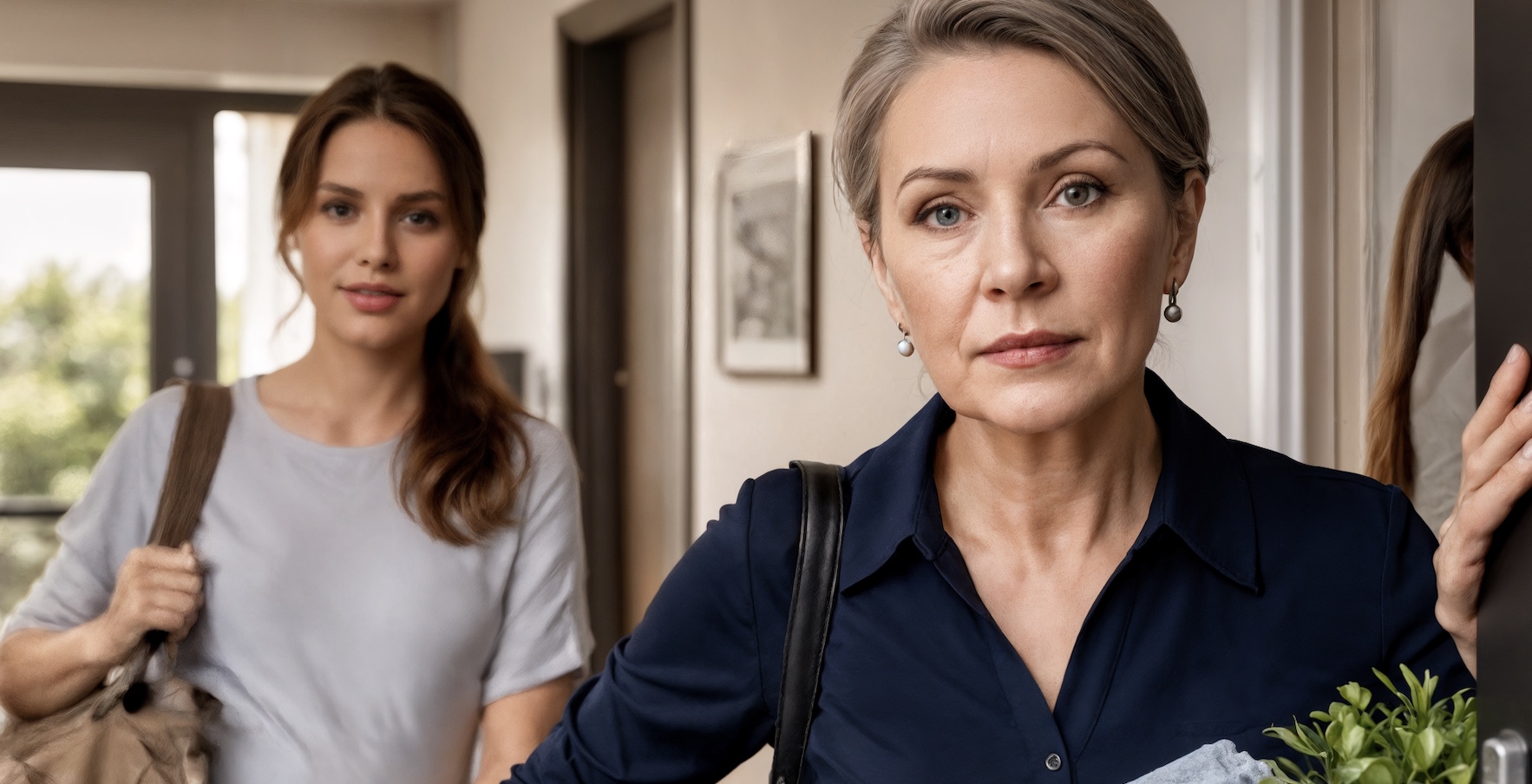
Polina was laying out plates on the large dining table when she heard her mother-in-law’s excited voice ring out from the living room.
“Inga, just look at this chandelier! It must have cost a fortune—one hundred thousand at least, maybe even two! We’ve never had anything this beautiful in our house.”
Anton, who had been slicing bread in the kitchen, tightened his grip on the knife as if he wanted to snap it in half. Polina walked over, touched his shoulder lightly, and gave a small shake of her head, silently asking him not to start. He took a deep breath and nodded, though the tension in his body remained.
“Galina Petrovna, Inga, dinner is ready!” Polina called out politely.
Her mother-in-law drifted into the dining room, carefully holding her eighteen-year-old daughter by the arm.
Inga, whose waist was only just beginning to show the faintest curve, moved with such exaggerated care that she looked less like a woman four months pregnant and more like someone carrying a fragile crystal vase.
“Careful, sweetheart, don’t trip,” Galina Petrovna fussed, helping her daughter sit down. “Are you comfortable? Should I bring you a cushion?”
“Mom, I’m not disabled,” Inga said lazily, though there was obvious pleasure in her voice.
Anton sat down opposite his sister without saying a word. Polina took the seat between her husband and her mother-in-law, already preparing herself to play the peacemaker.
“Polina dear, these cutlets are absolutely wonderful!” Galina Petrovna exclaimed, almost drowning in her own praise. “Isn’t that right, Inga? See, this is how a wife should cook for her husband. And what lovely tableware! We don’t have dishes like this at home.”
“There’s nothing special here. Stop exaggerating,” Anton said sharply.
“Oh, come now, son, don’t be modest,” his mother replied in a rush, then added, “You two live like people from some glossy magazine. This cottage is a dream. Two bathrooms! Can you imagine, Inga? And the kitchen is so spacious…”
Polina noticed Anton gripping his fork harder and harder. In five years of marriage, she had come to know him well. They had built this life together, worked like mad to buy this house and make it their own. Anton couldn’t stand it when their achievements were treated like some kind of lucky accident.
“So what did the doctor say?” Polina asked quickly, turning to Inga to change the subject. “Is everything all right with the baby?”
Her sister-in-law shrugged, eyes still glued to her phone.
“Seems fine. We’ve got another ultrasound tomorrow. Mom booked me into some elite clinic. Says they’ve got the best equipment in the region.”
“Of course they do,” Galina Petrovna cut in. “At those prices, they had better. It’s a blessing you children can afford to help the family.”
Anton’s fork twitched in his hand.
“We can afford it,” he said through clenched teeth, “because we work twelve hours a day, not because we—”
“Anton,” Polina warned softly.
“Not because you what?” Inga lifted her head, challenging him.
“Not because we spend our nights partying in clubs,” he shot back. “Or drop out of university in our first year. Or get pregnant by the first guy who comes along.”
“Anton!” Polina pleaded.
“How dare you say something like that!” Galina Petrovna cried out. “Whatever happened, she is still your sister!”
Inga went pale, but answered proudly:
“For your information, it wasn’t just some random guy! Dima and I were in a serious relationship!”
“A serious relationship?” Anton scoffed. “So serious that he vanished the moment he heard about the baby?”
“He didn’t vanish! He just… he needs time to think.”
“He’s been thinking for three months. Keep waiting for a miracle, you idiot.”
That was too much for Polina. She stood up and began gathering the empty plates, setting them down louder than necessary.
“That’s enough,” she said firmly. “Inga, don’t pay attention to your brother. He’s tired from work. And you,” she added, turning to her husband with a look of reproach, “come help me with the dishes.”
In the kitchen, Anton silently rinsed plates under the running water. Polina watched the muscles jump in his jaw.
“Couldn’t you have kept quiet?” she asked in a low voice.
“Polina, do you even see what’s going on? Mom is fussing over Inga like she’s some sacred treasure. She’s eighteen, pregnant by an irresponsible idiot who dumped her, and Mom is encouraging all of it.”
“What’s done is done. The baby is innocent.”
“I’m not blaming the baby. I’m asking something else. Why are we supposed to pay for Inga’s stupidity?” Anton turned to his wife. “The clinic, the medicine, the delivery… and then what? Are all three of them going to live here? Mom, Inga, and the baby?”
Polina said nothing, because exactly the same question had been circling through her own mind.
From the living room came her mother-in-law’s voice, murmuring something soothing to her daughter.
The next morning, Polina walked her mother-in-law and sister-in-law to the minibus stop. Galina Petrovna spent the whole way talking anxiously about how important proper examinations were, while Inga stayed silent, staring at her phone. At the stop, Galina Petrovna hugged Polina tightly.
“Thank you, dear, for taking us in. I don’t know what we would have done without you.”
Polina smiled and waved as the minibus drove away.
The day promised peace and quiet. She could focus on her own work and spend a few calm hours on her dissertation.
But by half past three, she heard the gate opening. Looking out the window, Polina saw the two women coming back. Something about the way they walked felt strange.
“You’re back already?” she asked in surprise as she opened the door. “How did it go? Is everything okay?”
Galina Petrovna walked past her without a word and took off her coat. Inga slipped inside after her, eyes lowered.
“Yes, everything is fine,” her mother-in-law muttered. “Just fine.”
“What did the doctor say? Did they do the ultrasound?”
“They did, they did,” Galina Petrovna answered hurriedly as she untied her scarf. “Polina, could you give us some bags? We need to pack.”
“Pack? Why?”
“We’re going home. We can still catch the last train tonight.”
Polina watched Inga silently climb the stairs to the guest room where they had been staying.
“Galina Petrovna, what happened? You were going to stay for a few more days, do more tests…”
“Plans changed. That’s all.”
“But you said yourself the medical care in your district wasn’t very good…”
“I said that! So what?” Galina Petrovna snapped. “And now I’m saying something else! Maybe a person knows better where she ought to be treated!”
Polina stepped back. She had never seen her mother-in-law like this before.
“I’m sorry, I didn’t mean—” she began, but Galina Petrovna was already heading upstairs.
“Inga! Inga, where’s my bag? We need to hurry!”
Polina remained standing downstairs. From above came muffled voices, the rustling of bags, quick footsteps. Half an hour later, both women came down carrying their things.
“Well then,” Galina Petrovna said with a strained smile. “Thank you so much. Tell Anton…”
“Maybe you should wait for him to come home from work? He’ll be upset that he didn’t get to say goodbye.”
“No, no, we don’t have time. We’ll miss the train.”
Inga said nothing the entire time, only watched everything in silence.
“Inga, are you okay?”
The girl nodded without lifting her head.
“She’s just tired,” Galina Petrovna answered for her daughter. “All these appointments are stressful. And now there’s the trip home.”
Polina walked them to the gate, still trying to understand what had happened. Something had clearly gone wrong at the clinic, but what exactly remained a mystery.
As soon as she came back inside, she called Anton.
“They left?” he asked in surprise. “What happened?”
“I don’t know. They came back from the appointment acting strange. Galina Petrovna said plans changed and that it would be better to continue treatment at home.”
“Well, that’s great,” Anton said, with obvious relief in his voice. “Looks like they finally came to their senses. Maybe they realized it’s time to stop wasting our money on expensive clinics.”
“Anton, I don’t think it’s about money…”
“Then what is it? Polina, if they don’t want to talk, that’s their problem. The main thing is the burden is off our shoulders. No feeding them, no putting them up, no paying for tests. Good decision. Good riddance.”
Polina wanted to argue, wanted to say that something felt wrong, that Inga had looked like more than just a tired girl. But Anton sounded so relieved that she stayed quiet.
“Maybe you’re right,” she said.
After hanging up, she opened her laptop, pulled up her dissertation, and breathed out happily. Silence. Peace. No family drama. Everything was back to normal.
A week later, Polina was pouring boiling water over oatmeal when she heard the neighbor’s dog barking loudly. Then came the click of the gate. Voices followed, along with the scraping sound of heavy bags being dragged across the gravel.
She looked out the window—and froze.
A whole procession was making its way toward the house: Galina Petrovna in front carrying an enormous travel bag, Inga behind her dragging a wheeled suitcase, and bringing up the rear was a strange man in his forties carrying two bulging duffel bags.
“Polina! Dear Polina!” her mother-in-law shouted joyfully the moment she spotted her in the window. “Open up, quickly, we’re here!”
Polina moved toward the door almost automatically, still unable to believe what she was seeing. On the threshold stood a glowing, flushed Galina Petrovna, pink from the cold and excitement.
“Surprise!” she announced, throwing her arms around her stunned daughter-in-law. “We’re back! And this time, we’re staying for good!”
The stranger carried the bags into the hallway and nodded politely.
“I’m the taxi driver. Could I get paid?”
While Galina Petrovna settled the fare, Polina struggled to collect herself. Inga ignored everyone, took off her shoes, and went straight into the living room.
“Galina Petrovna,” Polina began once the door had closed behind the driver, “what is going on? You went back to the village…”
“We did, we did!” her mother-in-law laughed as she pulled off her coat. “And now we’ve come back! We thought it all through, made our decision. We’re going to live here!”
“Live… here?” Polina felt the back of her neck turn cold.
“Well yes, live here. Do you know what the doctor told us at that appointment? That Inga and the baby are both doing well, but it would be better for her to stay in the city for monitoring and to give birth here. The standard of care is much higher, and there will be more support.”
Polina looked toward Inga, who had already made herself comfortable on the sofa with her phone.
“We spent a whole week thinking,” Galina Petrovna went on. “We weighed everything carefully. And we decided we should move! Your house is big, there’s room for everyone. And after the baby comes… well, we’ll see. Maybe we’ll just stay permanently.”
“Wait. Are you saying you plan to live with us? Permanently?”
“What’s so strange about that?” Galina Petrovna said in surprise. “Family should stick together! Especially when a grandchild is on the way.”
“But why didn’t you talk to us first? This is our house! You can’t just move into somebody else’s home without asking!”
“You talk as if we were strangers!” her mother-in-law protested. “Anton is my son! That means we have every right to live in this house!”
“And what about work?” Polina felt panic rising inside her.
“What work? I quit!” Galina Petrovna announced proudly. “My job at the district administration. I told my boss, ‘I’m sorry, but my grandchild matters more!’ We rented out our house in the village to a young accountant who just came to work in our district. Nice boy, tidy, decent. He’ll rent it for a year, maybe longer. So the money side is settled. Well… enough for small expenses.”
“Mom, can you put the kettle on?” Inga called from the living room.
“Right away, sweetheart!” Galina Petrovna hurried into the kitchen. “Polina, where do you keep the honey? The doctor said Inga should cut back on sugar.”
Polina stood in the middle of the hallway, now crowded with чужие suitcases and bags, unable to process what was happening. Just an hour ago she had been eating breakfast peacefully, planning her day, enjoying the quiet. And now…
“This is insane,” she murmured. “Completely insane.”
“What was that, dear?” Galina Petrovna called from the kitchen.
“I said you could have warned us!”
“But we wanted it to be a surprise!” her mother-in-law laughed. “We thought you’d be happy!”
At that very moment, the doorbell rang. Polina flinched, then looked at the mountain of luggage in the hallway, at Galina Petrovna taking over her kitchen, at Inga already watching television in the living room.
And suddenly she burst out laughing. Loudly, almost hysterically.
“Polina, what’s wrong with you?” her mother-in-law asked, alarmed.
The bell rang again. Polina kept laughing, imagining Anton’s face when he came home and discovered his new permanent houseguests. Just a week ago he had been celebrating because “the burden was gone.”
She wiped tears from her eyes and walked toward the door, still giggling.
I wonder who that could be. Maybe some more relatives have arrived with bags of their own.
The bell rang a third time, longer now, sharp and insistent.
Polina was still laughing when she opened the door and saw Anton standing there with his keys in his hand.
“Hi,” her husband said, confused. “Why are you in such a good mood? And why didn’t you open the door? I thought you weren’t home.”
“What are you doing here so early?” she asked, trying to steady herself. “It’s not even lunchtime.”
“The whole system crashed,” Anton said, waving a hand. “The office database completely went down. They told us to go home while IT sorts it out. I thought I’d get some rest for once…” He stopped dead as he noticed the bags in the hallway. “What on earth is all this?”
The smile vanished from his face as if someone had erased it.
“Antosha!” came Galina Petrovna’s joyful cry from the kitchen. “My dear boy is home!”
She floated out with a cup in her hand, her face shining with happiness.
“We’re back! And now we’re all going to live together, one big happy family!”
Anton looked at his mother, then at the bags, then at Polina, who was still half choking on laughter.
“What do you mean… live together?” he asked slowly.
“Well, what else?” Galina Petrovna rushed forward to hug him. “We’ve moved in with you! We rented out our house, I quit my job. We’ll all help with the baby together.”
“What baby?”
“What do you mean, what baby? The one Inga is having! The doctor said it would be better for her to stay in the city for checkups and the birth. So we decided—”
“Who decided? Who, Mother, made that decision?”
“Well, Inga and I, of course. Who else?”
“And did it never occur to you to ask us?”
Galina Petrovna blinked in confusion.
“Antosha, what are you saying? I’m your mother. Does a mother need permission from her son?”
“Yes!” Anton roared so fiercely that Polina stopped laughing at once. “Yes, she does! This is our house. Ours. Do you understand that word?”
“Son, calm down…”
“No, I will not calm down! Have you completely lost your minds? Who just packs up and moves into someone else’s home without asking?”
“We’re not strangers,” Galina Petrovna said tearfully. “Anton, I’m your mother!”
“And this is my house! And my life! And I’m not going to support all of you!”
Inga appeared from the living room.
“Stop shouting, brother. You’ll make Mom sick. What will you do then?”
“Are you seriously going to tell me how to talk in my own house?” Anton snapped. “You got pregnant by the first loser who crossed your path, and now you’re dragging everyone else into your mess.”
“It was not the first loser!” Inga flared up. “And anyway, that’s none of your business. You’re my brother, which means you’re supposed to help me.”
“Helping is one thing. Letting you sit on our necks is another.”
“Anton, stop,” Polina tried to intervene, but by then he was impossible to contain.
“No, I won’t stop!” He pointed at the bags. “How long are you planning to stay here? A month? Half a year? A full year?”
“Well… at least until the baby is born,” Galina Petrovna said uncertainly. “And after that, we’ll see…”
“We’ll see? And if you get comfortable here? Are you planning to turn our home into a boarding house?”
“Antosha, why are you speaking so cruelly?” his mother sobbed.
“Because I’ve had enough!” Anton paced the hallway, kicking at the duffel bags. “I’m sick of the fact that every single time one of you has a problem, you run straight to us. Give us money, let us stay, feed us! And no one ever stops to think that maybe we have our own life, our own plans!”
“You have a big house, you have money,” Galina Petrovna cried. “We can’t manage without your help.”
“You can! You managed in the village before, didn’t you? Or have all the hospitals there suddenly closed?”
“Anton, don’t say something you’ll regret,” Polina tried again.
“Oh, I’ll say it!” he shot back, turning to her. “Do you realize what’s happening? They are planning to live here. Permanently. Mom quit her job! They rented out the house! They burned every bridge behind them and now they’re dumping everything on us!”
Galina Petrovna was crying, Inga was sniffling, and Anton was circling the hallway like a trapped animal.
“Pick up your bags and leave,” he said at last, stopping dead. “Right now.”
“Son!” his mother gasped.
“Don’t start with the tears. It’s not going to work.”
The silence that followed was broken only by the television murmuring in the living room and Galina Petrovna’s quiet sobs.
Polina looked at the scene before her and understood that she could not stay silent any longer.
“That’s enough,” she said quietly, but with such firmness that everyone turned toward her. “Enough.”
She walked over to her husband and placed a hand on his shoulder.
“Anton, go to the study. Cool off.”
“Polina, you understand what—”
“I understand. Go.”
Anton looked at her, nodded, and went upstairs.
Polina turned to her mother-in-law and sister-in-law.
“Sit down. We need to talk.”
“My dear girl,” Galina Petrovna began, “I never thought Anton would react like this…”
“Sit down,” Polina repeated calmly.
They moved into the living room. Polina switched off the television and sat opposite them. Inga curled up on the sofa, tucking her legs underneath her, while Galina Petrovna perched nervously on the edge of an armchair.
“Galina Petrovna, do you truly not understand that what you did was wrong?”
“Well… perhaps we should have warned you…”
“Not perhaps. You absolutely should have. You quit your job, rented out your home, packed your things, and arrived here expecting to live with us, all without even informing us. That is not help. That is taking over.”
“But we’re family!” Inga protested.
“Yes, we are. But that does not give you the right to trample over our boundaries,” Polina answered sharply. “Inga, you’re eighteen. You’re an adult. You’re going to have a child. It’s time for you to start taking responsibility for your choices instead of shifting that responsibility onto other people.”
“But the doctor said—”
“The doctor said it would be better to be monitored in the city. He did not say you should invade your relatives’ home. There is rental housing in the city. You simply chose the easiest option—dropping onto our heads without warning.”
“We don’t have money for a rental,” Galina Petrovna sobbed.
“Of course you don’t,” Polina said, leaning back in her chair. “You quit your job. What exactly were you planning to live on? Our money?”
“We rented out the house…”
“For a tiny amount that might cover a few days in the city,” Polina cut in. “And after that? Who was supposed to pay for the rest? Us?”
No one answered.
“You know what hurts the most? If you had come to us honestly and said, ‘Please help us, we’re in a difficult situation,’ we would have helped. Of course we would have. But you didn’t ask. You simply moved in as though it were your right.”
“We didn’t think…”
“Exactly. You didn’t think. Not about our opinion, not about our plans, not about the fact that we have our own life.”
She looked at them steadily.
“Galina Petrovna, call that accountant and arrange for him to vacate your house. Inga, pack your things. You’re going home.”
“But what about—”
“I will transfer you money for checkups at the district hospital. It will be enough to get you through until the birth. Everything else, you will have to sort out yourselves.”
“Polina dear,” her mother-in-law protested, “but I already quit my job…”
“Then go back or find another one,” Polina said firmly. “And Inga, either go back to the child’s father and make him take responsibility, or start acting like an adult yourself.”
“But Dima—”
“Dima left you. Accept it,” Polina said bluntly. “You cannot spend the rest of your life hiding behind your mother. You are going to have a baby. You need to learn to stand on your own feet.”
Galina Petrovna broke into fresh tears.
“And what if something goes wrong? What if the birth is difficult?”
“Then you come here for the delivery. We will arrange a doctor, we will help pay for it. But you will not live here. That is final.”
Polina stood, walked over to the bags, and began moving them toward the door.
“Call a taxi. You’re leaving today.”
“I heard everything,” Anton said, appearing in the hallway. “And I agree with every word my wife just said.”
He stepped up to his mother.
“Mom, I’m not refusing to help you. But not like this. Not at the cost of our home and our peace.”
“Antosha…”
“Mom, enough. Whether you like it or not, you are going to respect our boundaries.”
An hour later, the taxi carrying the relatives pulled away from the house. Polina and Anton stood together by the gate, arms wrapped around each other.
“You know,” Anton said with satisfaction, “we handled that pretty well.”
“We did,” Polina replied. “Though now they’ll probably think we’re heartless selfish monsters.”
“Let them. At least we’ll be living our own life.”
The couple went back inside. In that moment, peace felt like something priceless. Polina put the kettle on and took out some cookies. Outside, snow had started to fall.
“Do you regret it?” Anton asked suddenly.
“No,” Polina answered without hesitation. “Pity and help are not the same thing. We will help. But we are not going to let anyone use us.”
She looked at her husband and smiled. Peace settled over the house at last—a fair, hard-earned, honest peace.