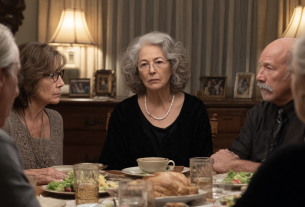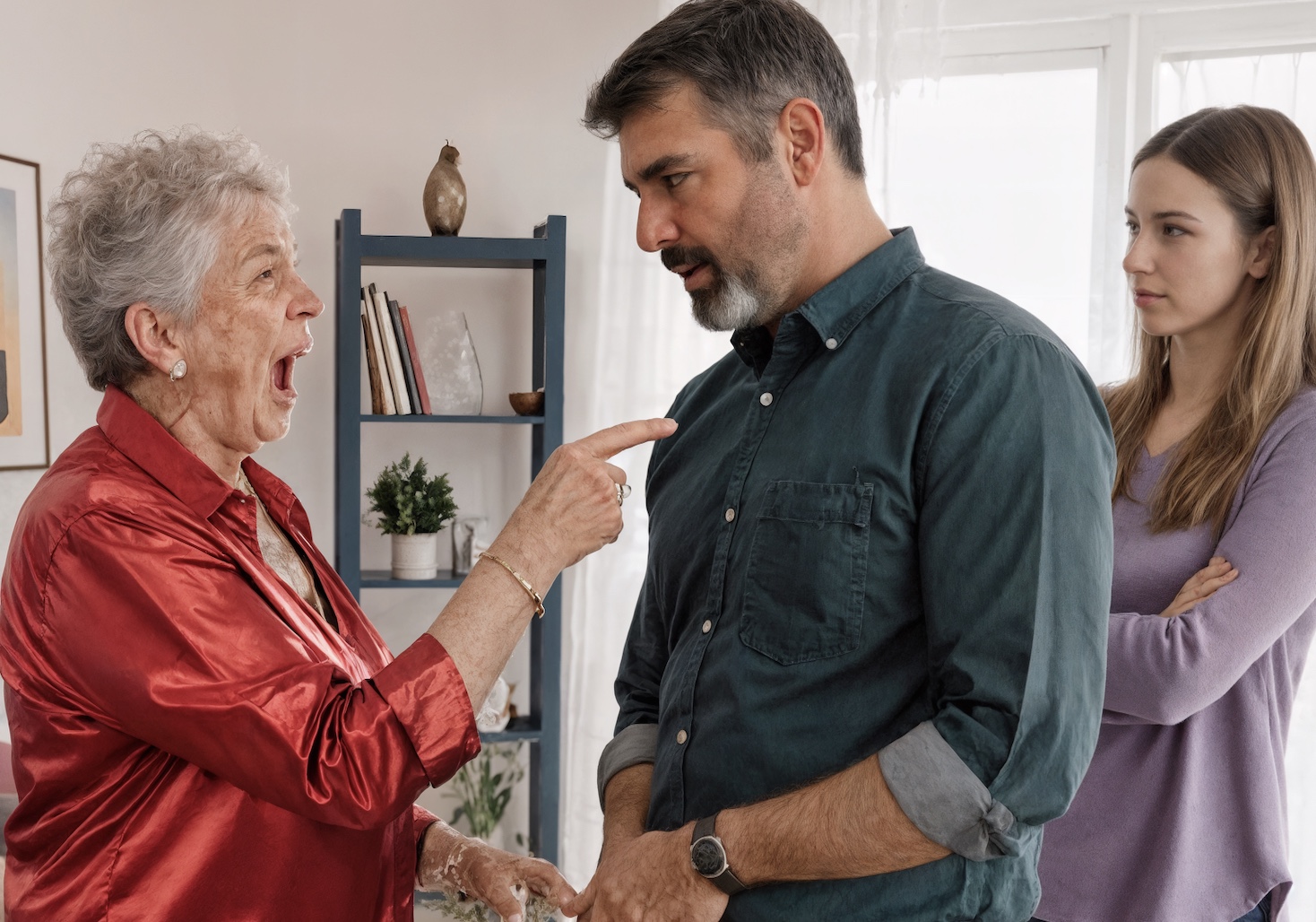
“Have you completely lost it?” Taisiya Petrovna slammed her palm on the table so hard the cups trembled on their saucers. “What divorce? What are you even talking about?”
Her son Viktor sat across from her, crushing a cigarette pack in his hands and staring anywhere but at his mother—at the faded rose wallpaper, the dulled chandelier, anything to avoid her eyes. He was thirty-eight, yet in this apartment, in that chair with the sagging back, he still felt like a teenager hauled in for a lecture.
“Mom… I’ve made up my mind,” he muttered at last. “Dasha and I… we didn’t work out. We’re just too different.”
“Too different!” Taisiya Petrovna threw her hands up; her heavy gold bracelets clinked. “Five years together and now you’re ‘too different’—were you hiding your personalities before? I told you from day one: you should’ve married Katyusha. A decent girl from a proper family, her father’s a department head. But no—you had to fall for that… music teacher!”
Viktor flinched. He’d heard this refrain ever since he first brought Darya home. His mother had greeted her with a strained smile, scanned her simple dress and cheap shoes, and immediately filed her under “unsuitable.” Dasha was quiet and educated, loved Chopin and old French films. Taisiya Petrovna called it pretentious.
“Mom, stop,” Viktor said, rubbing his face tiredly. “I just came to tell you. The papers have already been filed.”
His mother went still. The face that had been crimson with rage turned abruptly pale, and she lowered herself back onto the chair as if her legs had failed her.
“The papers were filed,” she repeated softly, tasting the words. “So it’s serious. And she agreed?”
“She didn’t argue.”
Taisiya Petrovna narrowed her eyes. A calculating engine started up in her head—quick, methodical, running scenarios. The apartment was in Viktor’s name, though they’d lived there together. The car was his too. The dacha… the dacha was old, inherited from her own parents. What was there to split?
“And the assets?” she asked, forcing her voice into practiced indifference.
“What assets, Mom?” Viktor gave a dry little smirk. “There’s nothing to divide. The apartment was mine before we married; I bought the car. Dasha’s got her piano and her books.”
Taisiya Petrovna exhaled in relief, careful not to show it. Inside, she was almost giddy—so, no real losses. That upstart with her dainty manners would be gone, and Viktor could finally find a normal wife. Someone from their world.
Three weeks passed.
Three weeks of relative calm, during which Taisiya Petrovna was already mentally selecting a bride—Irочка, her friend’s daughter who worked at a bank… or Lenka… no, wait, not Lenka. Zhenya! Zhenya Soboleva: pretty, practical, the domestic type.
And then the phone rang.
“Have you heard?” Lyudka’s voice buzzed with excitement. “Did you hear the news?”
“What news?” Taisiya Petrovna adjusted her robe and headed to the kitchen, trapping the phone between her ear and shoulder.
“About your daughter-in-law! That… what’s her name… Dashka!”
“And what about her?” Taisiya Petrovna’s chest tightened. There was something ugly and triumphant in Lyudka’s tone.
“You don’t know? Oh, I can’t—this is incredible! Her aunt died—she lived in Germany. No children. And she left everything to her! An apartment in Berlin, a bank account… People say it’s a million euros, at least!”
A high ringing filled Taisiya Petrovna’s ears. She sank onto a stool, her legs suddenly weak.
“W-what… what did you say?”
“A million!” Lyudka practically purred, savoring the drama. “Can you imagine? And your Vitya divorced her right before that! What a mess he’s in!”
Taisiya Petrovna hung up without a goodbye. Her fingers shook. Her mind flashed in jagged fragments—one million euros, an apartment in Germany, and Viktor had filed for divorce. Dear God, what had she done? Why had she pushed him? She should’ve been telling him to keep the peace, to hold the marriage together!
She grabbed her phone and called her son. One ring. Two. Three.
“Yeah, Mom?” Viktor answered, sounding exhausted.
“Sweetheart,” Taisiya Petrovna forced her voice into something gentle, though inside she was boiling. “How are you?”
“Fine. Why?”
“Listen…” She paused, choosing her words. “Maybe you were too hasty with the divorce? Maybe it’s not too late to fix things?”
“Mom, what are you talking about?” Viktor sounded genuinely confused. “You were the one who—”
“I just… thought about it,” she cut in quickly. “Five years together—you get used to each other. Maybe you should try again? Talk to her?”
“I don’t have time. We’ll talk later.”
He hung up. Taisiya Petrovna stared at the phone and slowly set it down.
She had to think. She had to come up with something—fast.
That evening she went to Viktor’s place. He lived alone in the same apartment now—Dasha had moved in with a friend. He opened the door in a wrinkled T-shirt; he smelled of cigarettes and sleepless nights.
“Mom? What’s going on?” he asked, startled.
“Brought you some pies,” Taisiya Petrovna lied, squeezing past him with a plastic bag. The bag was empty—she’d grabbed it for show. “You’re all alone here, probably starving.”
They walked into the room. Viktor dropped onto the couch and turned on the TV. Taisiya Petrovna looked around: overflowing ashtrays, dirty plates on the table, laundry scattered on a chair. No woman in the house—and it showed.
“Vitya,” she began carefully, “I’ve been thinking… do you and Dasha talk at all? Sometimes?”
“Why would we?” he shrugged. “It’s done.”
“But still…” Taisiya Petrovna sat beside him and placed a hand on his shoulder. “She’s not a stranger. Five years together. Maybe you could call her, meet up? You should at least part on civil terms.”
Viktor eyed her suspiciously.
“What’s gotten into you? You couldn’t stand her before.”
“I just…” Taisiya Petrovna looked away. “Adults should act humanely. What if she’s upset, alone?”
Viktor snorted but didn’t answer. Taisiya Petrovna realized she needed to be bolder.
“Son, you need to go back to your wife immediately,” she lowered her voice to a whisper, though no one else was in the apartment. “She’s received an inheritance! And then we’ll teach her a lesson and make sure she ends up with nothing!”
Viktor stared at her as if he’d never seen her before.
“What… what are you saying?”
Taisiya Petrovna realized she’d blurted it out. The words escaped before she could swallow them. She was used to commanding, directing, deciding—and now she sat facing a son who looked at her like she was a stranger.
“I meant…” she tried to patch it up, but Viktor was already on his feet.
“So you know about the inheritance,” he said—not a question, a fact. “Lyudka’s been calling you, hasn’t she?”
Taisiya Petrovna said nothing. Viktor paced the room, stopped at the window, lit a cigarette. The silence thickened, heavy and unbearable.
“Mom, do you even hear yourself?” He turned; there was something new in his eyes. Not anger—something more bitter: disappointment. “ ‘Teach her a lesson and leave her with nothing’? That’s about a person I lived with for five years.”
“You don’t understand, Vitenka,” Taisiya Petrovna rose, speaking faster, more confidently—she was a master at grabbing control back. “That girl sat on your neck all these years! Teaching her little music for pennies while you supported her! And now she—”
“She worked,” Viktor cut in sharply. “She taught at a music school and gave private lessons. And, by the way, when I got stuck with that loan last year, it was Dasha who helped. She saved money from her lessons.”
“What money?” Taisiya Petrovna waved it off. “Spare change! And now, suddenly, a million euros! You really think she’ll remember you?”
Viktor slowly stubbed his cigarette out in the overflowing ashtray. His face was unreadable.
“And why should she remember me?” he asked quietly. “I filed for divorce, Mom. I did. And do you know why?”
Taisiya Petrovna went still. Something in his tone made her fall silent.
“Because I was tired,” Viktor continued, words spilling out like a split bag. “Tired of every visit from you ending in a fight. You picked apart her cooking, her cleaning, her clothes. Remember my birthday, when you said in front of everyone that ‘a real wife should know how to host guests’? Dasha spent the entire evening in the kitchen so she wouldn’t cry in front of people.”
“I just wanted—”
“You wanted me to marry someone else,” Viktor said calmly, but every word hit like a slap. “Katyusha from a ‘decent family’… or Zhenya Soboleva. You wanted to run my life like you always do. And I let you. Because I’m weak, right, Mom?”
Taisiya Petrovna backed toward the door. For the first time in years, she didn’t know what to say.
“Viktor, I’m your mother…”
“And that’s why I’m ashamed,” he looked her in the eyes. “Ashamed that I let you poison our marriage. Ashamed that I didn’t protect Dasha. She never complained, you know. She swallowed every jab, tried to please you. And I… I got tired of being stuck between you. So I chose the easy way out—I left.”
Taisiya Petrovna grabbed the doorframe. Everything inside her twisted—hurt, confusion, and the terror of losing control.
“So it’s all my fault?” Her voice shook. “I’m the reason you divorced?”
“No, Mom.” Viktor shook his head. “I made that decision myself. A cowardly decision. And now I have to live with it.”
He grabbed his jacket from the chair and dug in his pocket for his keys.
“Where are you going?” Taisiya Petrovna blurted.
“To Dasha. To talk.”
“About the inheritance?” it slipped out, and she immediately regretted it.
Viktor stopped in the doorway, turned back, and gave a tired, sad half-smile.
“You know what’s the worst part, Mom?” he said quietly. “You can’t even imagine that someone might simply want to apologize. With no hidden motive. No calculation.”
The door shut behind him. Taisiya Petrovna was left alone in the messy apartment, among dirty plates and ashtrays. She sat on the couch that still held her son’s warmth, and suddenly felt her hands trembling.
Dasha was staying with her friend Anna in a two-room apartment on the outskirts of town. Viktor found the address in an old chat thread and took the metro. Climbing the stairs, his heart pounded like he was walking into an exam.
He rang the bell. A pause. Footsteps behind the door.
“Who is it?” Anna’s voice—sharp, wary.
“It’s me. Viktor.”
Silence. Then the lock clicked. Anna opened the door and stood in the doorway—small, but fierce, like a guard dog.
“What do you want?” she asked, no greeting.
“Anna, can I talk to Dasha?”
“And does she want to talk to you?” Anna crossed her arms. “You’ve said enough to her over the years. Or rather—you didn’t. You stayed silent when you should’ve stood up for her.”
Viktor clenched his fists. Fair. All of it was fair.
“I know. Please. Five minutes.”
Anna studied him, then called over her shoulder, “Dashka! Someone’s here… for you.”
Dasha came out of the room. She’d lost weight these past weeks, shadows lay under her eyes, yet she looked… calm. As if something inside her had shifted into a new shape.
“Hi,” she said simply.
“Hi,” Viktor shifted awkwardly. “Can we talk?”
Dasha nodded to Anna, and Anna—after shooting Viktor one last warning look—disappeared into her room.
They sat in the kitchen. Dasha put the kettle on, took out two mugs—mechanically, out of habit. Viktor watched her hands, the familiar movements, and suddenly understood with painful clarity just how much he’d lost.
“I heard about the inheritance,” he began. Dasha froze. The kettle clicked off. “And I’ll say right away—I’m not here for that. I came to apologize.”
Dasha slowly poured the water and set one mug in front of him.
“For what, exactly?” she asked. Her voice held no bitterness, no sarcasm—just a question.
“For everything.” Viktor wrapped his hands around the hot mug. “For not protecting you from my mother. For pretending I didn’t see how hard it was for you. For walking away when it got unbearable instead of talking, trying to fix it.”
Dasha sat down across from him and looked into his eyes—long, searching.
“Your mother called today,” she said at last. “Three times. I didn’t pick up.”
Viktor closed his eyes.
“I know. She—”
“She wants you to come back,” Dasha finished. “And then, quote, ‘teach me a lesson and leave me with nothing.’ Right?”
Viktor went pale. His mouth opened, but no words came. Dasha took a calm sip of tea.
“She left a voice message,” Dasha continued. “By accident. I guess she didn’t hang up properly, and it recorded. She was talking with Lyudka about how best to do it. Want to hear it?”
“No,” Viktor breathed. “God… Dasha, I’m so ashamed.”
“I was ashamed too,” she said softly. “All those years. Ashamed that I couldn’t be good enough for your mother. Ashamed that I let her grind me into the dirt. Ashamed that I clung to a marriage where I wasn’t valued.”
“I did value you,” Viktor protested. “I just—”
“You were silent,” Dasha finished. “And that was the worst part. You know, when you filed for divorce, I cried at first. For a week. Then one day I realized—I could breathe. Like a stone slid off my chest.”
Viktor nodded. He understood. He had felt that relief too—and then the emptiness.
“And the inheritance?” he asked. “Is it true?”
Dasha gave a small smile.
“It’s true. Aunt Marta—my mother’s sister. She moved to Germany before I was even born. I saw her only a couple of times. The last time was at my mom’s funeral. She was alone, no children. And she left everything to me.”
“That’s…” Viktor didn’t know what to say. “That’s amazing. Honestly.”
“Yes,” Dasha said. “You know what’s funny? I found out about the inheritance a week before you filed for divorce. I wanted to tell you, but you came home and said we didn’t fit, that it was over.”
Viktor froze mid-breath.
“You… knew?”
“I did,” Dasha nodded. “And I understood that if I told you then, you’d think I’d kept it secret on purpose. Or your mother would claim I bought you with money. So I stayed quiet. Signed the divorce papers and left.”
Viktor rubbed his face with both hands.
“What an idiot I am.”
“You’re not an idiot,” Dasha shook her head. “You’re just weak. And that’s your choice, Vitya: spend your whole life doing what your mother wants, or finally learn to live with your own mind.”
She stood and went to the window. Rain misted the glass; the city blurred into gray twilight.
“I’m leaving for Berlin in a month,” she said without turning. “There’s an apartment. I’ll find work. A new life. And I don’t want you coming back to me because of money or pity.”
“And if it’s not because of that?” Viktor asked hoarsely.
Dasha turned. Looked at him for a long moment.
“Then deal with your mother first,” she said quietly. “Set boundaries. Learn to tell her ‘no.’ And then come back. If you still want to.”
Taisiya Petrovna didn’t sleep all night. She paced the apartment, brewed tea and didn’t drink it, turned the TV on and off. She called Vitenka—he didn’t answer. She called Dasha—silence.
By morning she’d decided: she had to act. Fix the situation. She got dressed, put on makeup, and went to Anna’s place—she’d squeezed the address out of Lyudka.
She rang the bell. Dasha herself opened the door. Seeing her mother-in-law, she didn’t look surprised.
“Good afternoon, Taisiya Petrovna.”
“Dashenka!” the older woman put on a bright, sugary smile. “My girl, may I come in? Have a heart-to-heart?”
Dasha stepped aside. Taisiya Petrovna walked into the kitchen, glanced around—clean, modest, poor. She sat at the table and folded her hands.
“Dashenka, I came to make peace,” she began in honeyed tones. “I know there were misunderstandings, but we’re family! Viktor is falling apart without you. Maybe we forget the grievances? You come back, and I promise—I won’t say a word against you ever again!”
Dasha set a mug of tea in front of her, sat opposite, and smiled.
“Taisiya Petrovna, I heard your voice message.”
The older woman froze. Her face slowly changed color—pale to red.
“What message? I didn’t—”
“ ‘Teach her a lesson and leave her with nothing,’ ” Dasha quoted calmly. “Do you remember?”
Silence dropped between them. Under the table, Taisiya Petrovna curled her hands into fists. Then she exhaled and leaned back. The pleasant mask slipped off her face.
“So what?” she snapped. “You think you have a right to that money? You sat on my son’s neck for five years! He supported you, dressed you, fed you! And what did you give him? No children, the home’s a wreck, you can’t even cook properly!”
“I gave love,” Dasha answered simply. “But you will never understand that.”
“Love!” Taisiya Petrovna scoffed. “Love won’t buy you an apartment! You think Vitya won’t come back? He will—where else will he go? I gave birth to him, raised him, taught him! He listens to me!”
“You broke him,” Dasha corrected. “His whole life. And you’re still trying. But here’s the thing: I’m done playing a role in your little performance.”
Dasha stood, walked to the door, and opened it.
“Leave, Taisiya Petrovna. And stop calling me. And stop calling Viktor. If he ever comes back, it’ll be his choice. Without you.”
Taisiya Petrovna sprang up, grabbed her purse.
“You’ll regret this!” she hissed. “I’ll find a way! I—”
“You won’t find anything,” Dasha said evenly, without anger. “Because I’m leaving. And you’ll be left with your manipulations and your loneliness.”
Taisiya Petrovna stormed out and slammed the door. She went down the stairs with a boiling, helpless rage. That upstart—that nobody—daring to speak to her like that!
She pulled out her phone and called Viktor. This time he answered.
“Mom, I don’t want to talk to you.”
“Vitya, son, do you understand that she—”
“I understand,” he cut in, tired. “I understand more than you think. And you know what, Mom? I’m done. Done being your puppet. I’m thirty-eight years old, and it’s time I started living my own life.”
“But I’m your mother!”
“Yes,” Viktor said quietly. “And that’s exactly why it hurts most. Goodbye, Mom.”
He hung up. Taisiya Petrovna stood in the middle of the courtyard gripping her phone, and suddenly realized she had lost. Lost completely. And there was no one to blame but herself.
But admitting that?
She never would. Not ever.