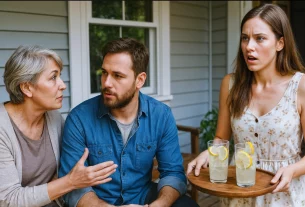
Zinaida Petrovna was dying. Slowly, but relentlessly. Pancreatic cancer—a sentence that could only be challenged one way: an outrageously expensive operation at a private clinic.
Three hundred thousand rubles. That was the sum Vitaly had to find within two weeks.
He sat in the kitchen, staring at his phone where the doctor’s message flashed: “Decide fast. We’re down to days.” The door creaked behind him—Irina, his wife, walked in. Her face was unreadable, as it had been for weeks. She poured herself some water, took a small sip, and said softly, almost matter-of-factly:
“Don’t even ask.”
Vitaly looked up. Something clenched in his chest—he hadn’t said a word, yet she already knew. Of course she did. Thirty years of marriage had taught her to read him without hearing anything aloud.
“Ira… she’s dying…”
“I’m not giving your mother money for that surgery!” Irina’s voice broke into a shout, even though she was clearly trying to keep herself together. “Let her finally pay for every humiliation and every dirty thing she’s ever done to me!”
Vitaly sprang up; the chair toppled over with a crash. He hadn’t expected that. Yes, he knew his wife and his mother had never been close—but to say it like this, straight to his face… to refuse help to a dying person…
“Do you realize what you’re saying?!”
“I realize it perfectly!” Irina put the glass down; water sloshed over the edge. “Twenty-eight years, Vitalik. Twenty-eight years I endured her. How did she greet me in your house when we were just dating—remember? ‘That silly hen isn’t a match for you. Find a girl from a respectable family.’ And at our wedding, in front of all your relatives, remember how she said I married you only for your Moscow registration?”
The memories poured in, and Vitaly felt the floor give way beneath him. Yes, it had all happened. His mother truly hadn’t accepted Irina at first. But later… later things got better, didn’t they? Or had they never really changed?
“When I had the miscarriage,” Irina went on, and her voice grew quieter—sharper, more dangerous—“your precious mother told me: ‘So God sees you’re unworthy of being a mother.’ Do you remember that, Vitaly? Because I do. I still remember lying in that hospital bed, crying into my pillow, because no one had ever hurt me with words the way she did.”
Vitaly sank back into the chair. Yes, he knew that episode—but his mother had apologized later, said she wasn’t herself, said she’d been upset…
“She apologized,” he tried.
“Apologized?” Irina let out a bitter, angry laugh. “She walked into my room, shoved a bag of apples at me, and muttered, ‘Fine, sorry, I got worked up.’ That’s not an apology, Vitaly. That’s a formality so you’ll stop bothering her.”
He said nothing. What was there to say? His mother was a difficult woman—controlling, blunt, always convinced she was right. She had raised him alone after his father died, worked two jobs, went hungry at times, but got him educated and on his feet. He owed her a lot. But Irina… Irina had suffered plenty too.
“When Zhenya was born,” Irina stepped closer, and Vitaly saw her eyes shining with tears she refused to let fall, “she didn’t visit us for two months. Two months! Because, apparently, I ‘only’ gave birth to a son, and she wanted a granddaughter. Remember how you begged her to come? How you asked her to at least look at the baby? And she kept saying, ‘I’m busy. I don’t have time for your children.’”
“But later she loved Zhenya…”
“Yes!” Irina shouted. “She ‘loved’ him when he was five and started winning those chess tournaments—when she could brag to her friends: ‘My grandson is a genius!’ And before that? Before that she looked at him like he was a nuisance.”
Vitaly rubbed his face with both hands. Exhaustion pressed down like a slab of lead. On one side was his dying mother who, for all her faults, had raised him and given him everything she could. On the other side was his wife, who had swallowed humiliation for his sake, for their family’s sake. And now the reckoning had arrived—old bills, accumulated for years, that he’d chosen not to notice.
“I’ll sell the car,” he said quietly. “I’ll take a loan. I’ll ask Sergey to lend me—”
“Do whatever you want,” Irina cut him off. “But not a kopek from my money, and not a kopek from our shared budget. I don’t want to be part of saving someone who ruined half my life.”
She left the kitchen, and Vitaly was alone again. The wall clock ticked steadily, counting down time—time his mother hardly had left. He grabbed his phone and started scrolling through contacts with shaking fingers. Sergey, his childhood friend… but Sergey had two kids and a mortgage. Anton, an old coworker… but they hadn’t spoken in five years.
One thought kept circling in his head: How did I let it come to this? How did I miss the point where something could still be fixed—where he could have reconciled them, found a compromise? He’d always played peacemaker, always smoothed things over, always told himself time would heal. But time, it turned out, hadn’t healed anything—it had piled grudges up like snow until the whole mass collapsed in an avalanche.
His phone buzzed. A message from Zhenya, their son: “Dad, I heard everything. Mom’s right. Sorry.”
That was the last straw.
Vitaly turned the phone off and hurled it onto the table. His son was on his wife’s side—of course. What had he expected? Zhenya had grown up under his grandmother’s constant grumbling, her digs and barbs.
“Another bad grade? Who did you get so useless from?” she’d snap when he was only eight. And then, when he started winning tournaments, she would bloom with pride: “My grandson, my blood—he takes after me. I was top of my class too.”
Vitaly got up and went to the window. Outside, an unpleasant autumn drizzle smeared the glass; dull streams ran down the sill. He remembered how, ten years earlier, his mother had come to their dacha. Irina had cooked all day—baking pies, stirring jam, setting the table. And Zinaida Petrovna walked in, looked over the spread, and said: “Your pies are always raw. You never bake the dough properly.” Irina had gone pale, pressed her lips tight, and silently carried the plates to the kitchen. Vitaly tried to lighten the mood with a joke, but it came out stiff and stupid. That evening, his wife cried in the bathroom while he stood outside the door, not knowing what to say.
How many evenings like that had there been? Dozens. Hundreds, perhaps.
He went back to the table, opened his laptop, and started searching loan options. Interest rates danced before his eyes—eighteen percent, twenty-two, twenty-five… Sell the car—he’d get two hundred thousand at most; it was old, high mileage. Not enough. Borrow from Sergey… Sergey was drowning in debt after his divorce.
The door creaked again. Vitaly turned—Irina stood in the doorway. She looked tired, worn out. She’s aged over these years, he thought suddenly. When they met, she’d been twenty-three—bright, laughing, wearing ridiculous floral dresses, dancing to old records. And now… now a woman stood before him with dimmed eyes and bitterness at the corners of her mouth.
“You think this is easy for me?” she asked quietly. “You think I’m some kind of monster for refusing help to a sick person?”
Vitaly stayed silent.
“I’m not a monster,” Irina went on, sitting across from him. “I just can’t anymore. Do you understand? I can’t. For twenty-eight years I swallowed her poison. Every time she came, I knew I’d get a fresh dose of humiliation. And you… you always stayed quiet. You always pretended nothing was happening. ‘That’s just how she is, ignore it,’ you’d say. How do you ignore it when she calls you a barren cow in front of the whole family at an anniversary dinner?”
“That was twenty years ago…”
“And?” Irina slapped her palm on the table. “Does that erase it? Words don’t disappear, Vitaly. They burn into your memory like acid. They sit inside you and eat everything from the inside out. You never protected me. Not once.”
He wanted to argue, but stopped. Because she was right. He really had never taken his wife’s side against his mother. He’d hidden behind lines like “you’re both important to me” and “let’s all get along.” He’d been a coward—there was no other word for it.
“When your father died…” Irina started, then paused. Finally, she continued. “I was nineteen then. Still in college. Your mother summoned me to her kitchen and said: ‘If you think you’ll get my son now, you’re mistaken. I need him here, near me—not with some empty-headed nothing like you.’ You were at the military office at the time, doing your medical check. I came home and cried for three hours. Then I pulled myself together and decided: I’ll prove it. I’ll prove to that woman I’m worthy of being with you.”
Vitaly listened, his insides tightening. He hadn’t known that story. He hadn’t known his mother had said those things to Irina.
“And I proved it,” Irina gave a crooked smile. “For twenty-eight years I proved it. I gave birth to our son even though doctors said I shouldn’t after that miscarriage. I worked two jobs when you went unpaid in the nineties. I endured her visits, her comments, her endless disapproval. And you know what I realized? She never cared. No matter what I did, she still believed I was unworthy. Because in her eyes, no one was good enough for her precious boy.”
Vitaly shut his eyes. The picture forming was ugly and cruel. His whole life he’d tried to balance between two women, to satisfy both, and in the end he’d simply allowed one to slowly destroy the other.
“Three years ago,” Irina’s voice dropped even lower, “when they found my fibroid and I needed surgery, I asked your mother to stay with Zhenya for a bit. He was sixteen—practically grown—but I was scared. It was the first time I’d be away for two weeks. Do you remember what she said?”
Vitaly shook his head.
“She said: ‘What am I, your nanny? You gave birth—so deal with it yourself.’ She was sixty-eight then, retired, sitting at home with nothing to do. But she refused. And I went into surgery knowing my son would be completely alone. And your mother went to her friend’s dacha to grill шашлыки.”
A heavy silence hung between them. Somewhere in the bathroom a faucet dripped—steady, irritating. Vitaly stared at the floor, realizing he was looking at his entire life laid out in neat pieces. And it didn’t look good.
“I’m not saying she’s a bad person,” Irina finally said. “She was a good mother to you. She loved you—that’s true. But she was a horrible mother-in-law. And an even worse grandmother. And I’m tired, Vitaly. Tired of excusing her by saying she had it hard, she raised you alone, that she just has that kind of character. Everyone has a character, but that doesn’t give them the right to humiliate people.”
Vitaly stood up, went to the sideboard, pulled out a bottle of cognac, poured a glass, and drank it in one swallow. His throat burned, but the burn felt almost comforting—at least it was something besides the hollow emptiness inside him.
“What am I supposed to do?” he asked hoarsely.
“I don’t know,” Irina replied. “It’s your choice. But I made mine. Sorry.”
She left, and he remained alone in the kitchen. His phone buzzed again—this time a message from his mother: “Vitya, have you decided anything? The doctor said we need the deposit tomorrow.”
The next morning Vitaly went to his mother. She lay on the sofa under an old plaid blanket—the same one his father had once brought from a business trip. Her face was gaunt, her eyes sunken, but her gaze was the same as ever—sharp, demanding.
“Well?” she asked instead of greeting him. “Did you find the money?”
Vitaly sat on a chair beside her, hands on his knees. He stayed quiet for so long his mother began to fidget.
“Vitya, can you hear me? There’s no time!”
“Mom,” he said at last, “do you remember what you told Ira when she had the miscarriage?”
Zinaida Petrovna frowned.
“What miscarriage? When was that?”
“Twenty-five years ago. You told her God sees she’s unworthy of being a mother.”
His mother waved it off irritably.
“So I said something… I don’t remember anymore! Why dig up ancient history? I’m dying, and you’re coming at me with complaints!”
“She remembers,” Vitaly said softly. “Every word. All these years.”
“And so what?!” Zinaida Petrovna tried to sit up, but didn’t have the strength. “Do I have to be a saint? I raised you alone, tore myself apart, went hungry! I have the right to say what I think! And your Irinka… that spoiled little—”
“Enough,” Vitaly cut her off, startled by the firmness in his own voice. “Just… enough, Mom.”
They stared at each other, and Vitaly suddenly understood: she would never change. Even facing death, even now—she wouldn’t admit guilt. She wouldn’t say, “I’m sorry, I was wrong.” Because in her world she was always right, always the victim, always the one everyone owed.
“I sold the car,” he said. “Two hundred thousand is there. I borrowed the other hundred—at a brutal interest rate. It’s enough for the operation.”
His mother’s face brightened.
“See! I knew you wouldn’t abandon me! You’re my son, my—”
“But there’s a condition,” Vitaly interrupted. “After the surgery, when you recover, you’ll come to our home and ask Ira for forgiveness. For everything. For every word, every humiliation. And you’ll apologize to Zhenya too—for the way you treated him when he was little.”
Zinaida Petrovna stared at him as if he’d lost his mind.
“Are you insane?! I’m not crawling on my knees to anyone!”
“Then there’s no money,” Vitaly stood up. “Choose, Mom. Your pride or your life.”
He left without waiting for an answer. He walked down the stairs—the elevator, as always, wasn’t working—then stepped outside into the same drizzle. He got into a car that no longer truly felt like his. He’d sold it yesterday to an acquaintance—fast and cheap.
An hour later, the phone rang. His mother. He stared at the name lighting up the screen for a long moment, then answered.
“Fine,” he heard her strained voice. “I… I’ll apologize. Just give me a chance to survive.”
Vitaly closed his eyes. A victory? Or just another turn in the same endless game?
The operation was scheduled three days later. Vitaly paid the deposit and signed the papers. Irina learned everything by accident—she spotted the receipts on the table. She came into the kitchen and sat across from him.
“So you did find the money.”
“I sold the car. Took a loan.”
She nodded without speaking. Then, unexpectedly, she reached across the table and covered his hand with hers.
“She promised she’ll apologize to you,” Vitaly said. “After the operation. She’ll come and say it.”
Irina gave a sad little smile.
“She won’t come. I know her. She’ll recover and say she lied to you, that she agreed under pressure. Or she’ll claim you made it up.”
“Maybe,” Vitaly admitted. “But at least I tried.”
They sat holding hands while dusk thickened outside the window.
The surgery went well. Zinaida Petrovna survived. A month later, when she was stronger, Vitaly came to pick her up from the hospital. She got into a taxi—he still hadn’t bought another car—and suddenly said:
“Vitya… I’ve been thinking. Maybe I really was… wrong in many ways.”
He turned, not believing his ears.
“I won’t come to your house,” she continued. “I can’t. I won’t find the right words. But tell Ira… tell her I won’t interfere anymore. At all. I’ll live out whatever time I have left quietly, alone. That’s more honest.”
Vitaly opened his mouth, but his mother raised a hand.
“Don’t. I know it’s too late. Some things can’t be fixed. You can only stop making them worse.”
The taxi stopped at her building. Zinaida Petrovna got out, leaning on a cane—the doctors said recovery would be long. She turned back one last time.
“Thank you for saving me. Even if I didn’t deserve it.”
And suddenly Vitaly thought: maybe this was what forgiveness truly looked like—not speeches, not dramatic embraces, but the ability to let go and step aside. Not shatter what was already broken by trying to glue it together. But to admit: yes, it happened, yes, it hurt—and from now on, everyone walks their own road.
He came home. Irina was baking a pie—cherry, her signature one. She saw him and smiled tiredly.
“So… is she coming to repent?”
“No,” Vitaly said. “She said she won’t show up anymore. Ever.”
Irina froze with the knife in her hand. Then she nodded. And strangely—there was no relief on her face. Only a kind of emptiness. As if the war had ended, but there was no victory—just silence.
“Maybe that’s for the best,” she said at last.
They never spoke about it again. Life moved on—with a loan they’d be paying for five more years, without a car, with a new, unfamiliar quiet where there were no scandals and no reconciliations.
Only a year later did Vitaly learn from a neighbor that Zinaida Petrovna went to church every week and lit candles—silently, telling no one—for Irina’s and Zhenya’s health.
And maybe, in the end, that was enough for everyone.