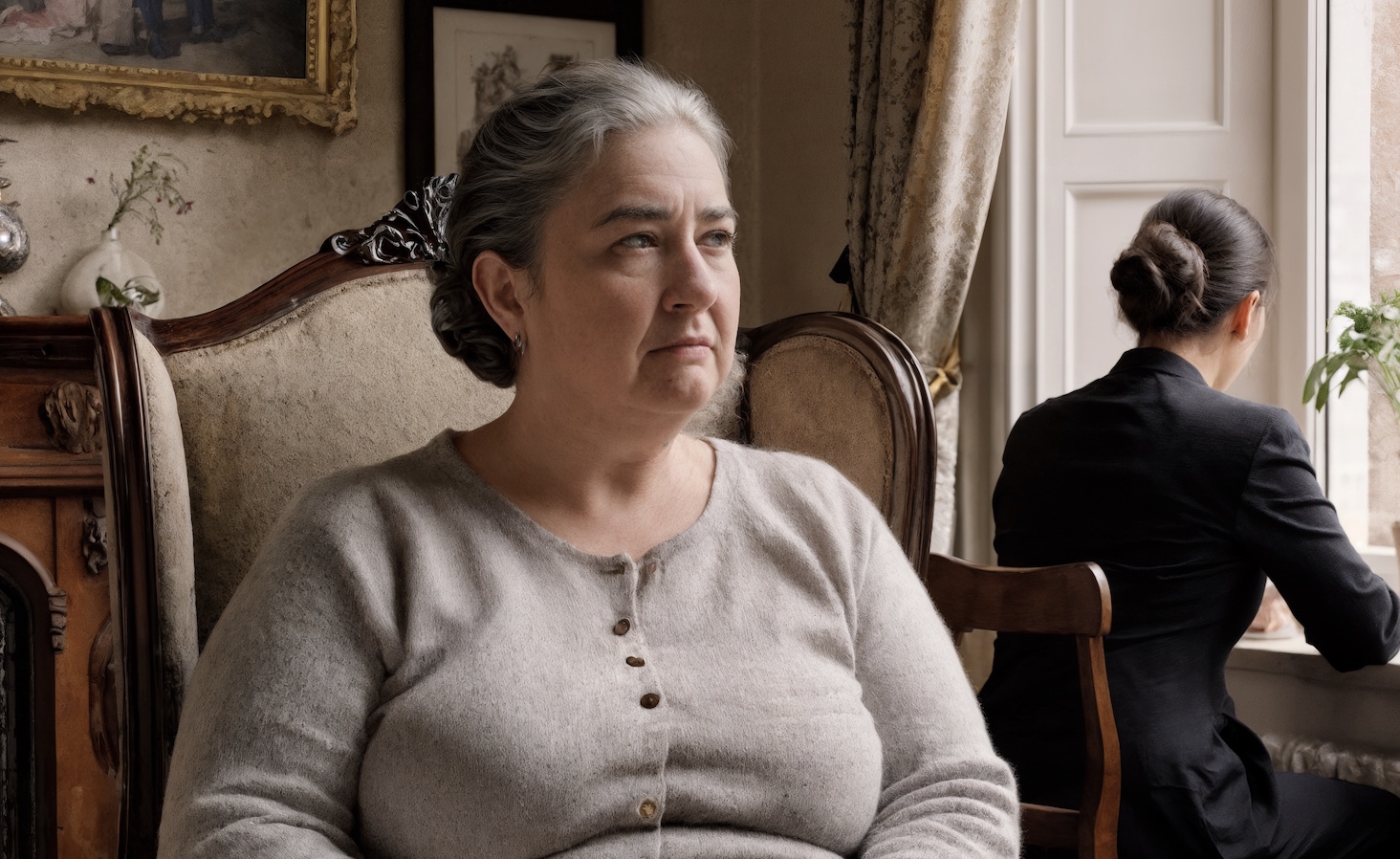
In Galina Petrovna’s living room, the air carried the scent of freshly brewed tea and pricey almond cookies she’d bought specifically for company. Everything felt thick and still—like the room itself was waiting for the first gunshot. The hostess, trim and perfectly put together, her silver hair arranged as if by a ruler, kept straightening a napkin on the glass table, aligning it with geometric precision. Her sister, Aunt Valya, sat in an armchair, studying a little bowl of jam with the concentration of an art critic. And Valya’s husband, Uncle Kostya, stared silently out the window, looking unmistakably out of place.
“Well, everyone’s here,” Galina Petrovna began without sitting down. Her voice sounded ceremonial, a touch theatrical. “I called you because major changes are coming to our family. Good changes.”
Aunt Valya jolted, catching the scent of something interesting. Uncle Kostya slowly shifted his gaze from the window to his sister-in-law.
“My Artyom has finally made up his mind,” the mother-in-law said, pausing to let it land. “He’s filing for divorce. And immediately—without that… shameful in-between—he’s marrying Lera. Igor Mikhailovich’s daughter. His CEO. You know Igor Mikhailovich, don’t you?”
“Of course—he’s been in the news,” Aunt Valya answered quickly, a spark of genuine curiosity lighting her eyes. “That’s… serious money. And connections. So our Artyom will become a director right away, yes?”
“Not right away, but the road will be open,” Galina Petrovna nodded, pleased with herself. “This isn’t just marriage. It’s a strategic alliance. At last my son will choose a woman from his own circle, not…” She wrinkled her nose, searching for the nastiest word, “…not some grey little mouse.”
Silence settled over the room. Uncle Kostya reached for a cookie, but when he caught his wife’s look, he pulled his hand back.
“And Anya?” he asked carefully. “And their son? Stepa is still so small.”
Galina Petrovna waved a hand as if swatting a fly.
“Anya was his youthful mistake. He fell in love and went blind. She’s from a simple family, she’s nothing special, no career at all. All she could do was sit at home and raise a child. And even that—between us—she didn’t do perfectly. Stepan is sickly, whiny. Lera, though—educated girl, two degrees, speaks languages. She’ll give my grandson the right upbringing, the right contacts, the right environment.”
Aunt Valya nodded vigorously, matching her sister’s tone.
“Exactly! What could Anya have given him? You, Galya, poured your whole soul into your son—raised him alone, pulled him up, helped him buy an apartment. And she came into a ready-made life. And not an ounce of gratitude. Remember what perfume she gave you for your birthday? Some cheap thing.”
“I remember,” Galina Petrovna said, her lips tightening into a thin line. “No taste. No ambition. Artyom needs a woman who’s his equal—someone who pushes him upward, not drags him down into her dull little routine.”
Uncle Kostya cleared his throat into his fist.
“But… they’ve been married seven years. Property, the apartment… She can demand half.”
“She won’t demand anything!” Galina Petrovna’s voice rang sharp as a tightened wire. “The apartment is in Artyom’s name, and the down payment was paid by me and my late husband. It’s family property. And what did they ‘save together’? An old car? Let her take it. We’re not greedy. We’re humane. We’ll give her a month to pack her rags and clear out. For Artyom’s new chapter, everything has to be clean.”
She swept her gaze across the relatives, and her face softened into something that almost resembled maternal concern.
“I only worry about Stepan. He needs to be moved gently, carefully, to a new home, a new life—no trauma. Lera is already looking at children’s room designs, English-style. And she’s searching for an elite boarding school.”
“And Anya will agree to that?” Uncle Kostya tried again.
“What does it matter?” Galina Petrovna stared at him coldly. “A man decides. The head of the family. She’ll do what the court says. And Artyom—with the support of his new father-in-law—will have the best lawyers. He’ll secure his son’s future even if he has to fight in court. But I think Anya will get it herself. She’s not confrontational. She’ll accept it.”
Aunt Valya sighed in admiration.
“Your son is a real man, Galya. Not afraid to change everything for growth.”
“I raised him that way,” Galina Petrovna said proudly. “To see opportunity and make the right decision at the right moment. There’s no one to pity. Everyone stands on their own step in life. Artyom is climbing. And Anya… she just couldn’t hold his level. It happens.”
She stood, signaling the “council” was over.
“So those are the news. Artyom is having dinner today with Lera and her parents—discussing details. And we need to settle practical matters. How to help Anya move out faster so the boy won’t be stressed by long packing. Kostya, maybe you can help with the car? And Valya—you can talk to her woman-to-woman, no hysterics. Explain that this is best for everyone. Especially for Stepa.”
Uncle Kostya nodded, eyes down. Aunt Valya was already building a “conversation plan” in her head.
Galina Petrovna walked to the window where dusk was settling, and spoke to the glass as if stating an accomplished fact—quietly, but with absolute clarity:
“The daughter-in-law is already leaving. We only need to help her close the door behind her. Carefully. So she doesn’t slam it.”
Outside, the darkness was thick and ink-black. Anya stood in the middle of the kitchen, palms pressed to the cold countertop, trying to stop her fingers from trembling. On the phone screen beside her, the last message she’d sent three hours earlier froze in place: “Artyom, is everything okay? I’m keeping dinner warm. Stepan is asking.” Beneath it sat a grey check mark—delivered. No “read,” no reply.
She closed her eyes and drew in a deep, broken breath. The apartment was unnaturally quiet, heavy. Usually around this time—close to ten—she would hear the TV from the living room where Artyom watched the news, or the tap of his laptop keys. Now there was only the soft hum of the fridge and Stepan’s faint sleep-breathing from the next room.
Anya moved to the sink where two plates and two cups lay in messy disorder. She and Stepan had eaten alone. Again. Third day in a row. The first day Artyom said he was stuck at an important project meeting. The second—dinner with potential investors. Today… today he simply hadn’t answered at all.
“Mom, when is Dad coming back?” Stepan had asked at dinner, smearing mashed potatoes across his plate with a fork.
“Soon, sweetheart. He has very important work right now.”
“But he promised the water park on Saturday.”
“He did. Maybe next Saturday we’ll go.”
She could hear the false note in her own voice, and she could see her son heard it too. He didn’t ask again—only frowned in that stubborn way that made him look just like his father when he was annoyed. That resemblance cut her, sharp and sudden.
She began washing the dishes mechanically. The hot water stung her skin, but at least it anchored her to something real. In her mind she replayed the last few weeks: the distance. The short, businesslike conversations. A new expensive cologne she didn’t recognize. The way the name “Lera” kept appearing, casually, in workplace stories: “Lera suggested a brilliant solution.” “We met with the client with Lera today.” “Lera’s opinion matters a lot to Igor Mikhailovich.” Before, she’d dismissed it as work chatter. Now each mention pulsed at her temples like a dull alarm.
She dried her hands and picked up the phone again. Her finger hovered over the call icon. Call him? And what would that be—a nagging wife distracting a busy husband? A paranoid check? She was terrified of both. Terrified of hearing his tired, irritated voice. Even more terrified of hearing laughter behind him, clinking glasses, music—proof.
Instead she opened the chat and typed: “Artyom, Stepa and I are worried. Just give us a sign you’re okay.” She sent it. The message vanished into digital silence.
Half an hour passed. Anya peeked into Stepan’s room. He was asleep clutching a toy truck—his father’s gift from last birthday. The blanket had slid onto the floor. She pulled it back up and kissed his warm temple. He sighed in his sleep and rolled onto his side.
And as she stepped out of the room, her phone finally vibrated in her robe pocket—sharp, unexpected, making her heart jump into her throat.
She yanked it out, almost dropping it. The screen showed one name: Artyom. But it wasn’t a call—only a text notification. A thin strip of words.
Her finger felt stiff, disobedient, as she tapped to open it.
“We need to talk. I’ll come tomorrow afternoon. It’s important.”
Nothing else. No “how are you,” no “kiss,” not even “don’t wait up.” Just a dry instruction. A sentence that felt like a verdict.
Anya lowered herself onto the edge of the living-room couch. Her body turned heavy, hollow. She reread the message, then again, searching for warmth between the lines, a hidden meaning, a scrap of hope. There was none—only cold steel.
We need to talk. They hadn’t “talked” in a long time. Their conversations had shrunk to “what’s for dinner,” “pay the kindergarten bill,” “can you pick up Stepa tomorrow?” A “talk” meant something big. And as she’d learned from her friends’ bitter stories, a man’s “important talk” was never good news.
Tomorrow afternoon. Not evening. Not night. Afternoon—during work hours. That meant he’d taken time off, scheduled it like a meeting.
It’s important. Those two words turned everything inside her into ice. She understood. Not with logic—with her whole body. The “wind of change” Artyom loved talking about had arrived, and it was blowing her off the place she’d called home.
She didn’t know how long she sat in the dark without turning on the lights. Her eyes adjusted, picking out silhouettes of familiar furniture: his chair, his side table, his bookshelf. Everything still held his presence—and now that presence felt oppressive, alien.
Then a muffled whimper came from the nursery—Stepa, probably dreaming. Anya jolted awake inside herself. Motherhood kicked in automatically, shutting down panic. She soothed him, whispered reassurance, waited until his breathing evened out again.
After that she went into the bathroom, locked the door, turned the faucet wide open. Water thundered into the empty tub, filling the small room with white noise that could swallow any sound.
Only then, staring at her reflection—pale face, huge eyes swollen with unshed tears—did she finally lay her head on her folded arms at the sink. Her shoulders shook. Silent sobs tore through her, hidden beneath the roar of water. She wasn’t crying only about tomorrow’s conversation. She was crying for seven years that suddenly, under the harsh light of one text, felt like an illusion—big, naïve, and cruel.
The next day dragged like a shapeless torment. Anya moved as if everything was in slow motion—heavy limbs, tangled thoughts, one obsessive question ticking in her ears like a clock: About what? What will he say?
She tried to do normal things—dropped Stepan at kindergarten, stopped at a store, began cleaning. Nothing held together. She kept staring at the clock. Artyom had written “afternoon.” That could mean two. Or four. She didn’t dare ask.
By noon her nerves snapped. She changed out of her house pants into plain jeans and a sweater, dabbed concealer under her eyes to hide the sleeplessness. A clumsy attempt to keep a shred of dignity—to meet him not as a worn-out housewife, but as an equal. Even though equality had died long before the doorbell rang.
He rang at exactly three. The bell was short and businesslike—no cheerful jingle she’d once set.
Anya’s heart dropped to her feet and pounded in her temples. She walked to the door, took a deep breath, and opened it.
Artyom stood in the hallway. Not in his usual hoodie, but in a perfectly fitted dark blue suit, a white shirt open at the collar. He smelled not like her shampoo and home coffee, but like expensive woodsy cologne and cold street air. His face was smooth, calm—almost detached. Keys dangled in his hand, but he hadn’t used them. As if this already wasn’t his home.
“Hi,” he said, nodding briefly. His gaze slid over her without stopping, then moved past her into the apartment like he was assessing the space.
“Hi,” Anya forced out, stepping aside. Her voice sounded чужой—thin, hoarse.
He walked into the living room, set his keys on the small cabinet by the mirror. His fingers paused on the broken carved handle—the same one he’d promised to fix half a year ago—then pulled away.
“Sit,” he said, indicating the couch. He stayed standing by the fireplace, like a presenter before an audience.
Anya sat on the edge of the couch, hands locked on her knees, fingers cold. She stared at him, waiting, unable to speak first.
Artyom exhaled and crossed his arms. His posture, his tone—everything screamed unpleasant but necessary procedure.
“I’ll speak plainly, Anya. No long prefaces. You and I have exhausted our marital resources. We’re not a couple anymore. We’re two different people moving in opposite directions. You one way, me another. And that’s normal. Our paths have simply diverged.”
Each word landed like a measured tap of a small hammer—precise, emotionless.
“What… what does ‘exhausted our resources’ even mean?” Anya whispered. “We have a family. Stepan. A life together.”
“That life ended around the moment you decided the role of housewife was enough,” he replied gently, and mercilessly. “We don’t have shared goals anymore, Anya. You didn’t grow with me. You stayed where you were seven years ago. I need a woman who isn’t just present, but is a partner. An ally. Someone my circle will respect.”
“My circle?” A bitter irony slipped into Anya’s voice, surprising even her. “So I embarrass you now? I’m not good enough for your new friends?”
“Don’t hystericize and simplify,” he winced, as if at an unpleasant sound. “This isn’t about being ‘good enough.’ It’s about compatibility. About level. You understand that Lera…”
He faltered for a split second—his first crack—then recovered.
“…that with Lera it’s two people meeting on the same level of development. Her father, Igor Mikhailovich, is my mentor. And her support opens completely different prospects for me—and therefore for our son.”
The name “Lera” finally sounded out loud, not as a coworker but as an accepted reality. Ice slid through Anya’s veins.
“So it’s… true,” she said, not even to him, but to herself. “You’ve been cheating. All this time.”
“I found someone I have a future with,” he corrected, refusing the word cheating. “And I made a decision. I’m filing for divorce. I want everything to happen quickly, civilly, without scenes. For Stepan.”
“For Stepan?” Anya sprang up, voice breaking with pain. “You’re destroying his family for some… career, and you say ‘for him’?”
“I’m talking about his future!” Artyom’s voice rose too, steel flashing in it. “What can you give him, Anya? An apartment in this building? A municipal kindergarten? The future of a modest clerk? I can give him everything. A new house in a gated community. The best private school. Languages, travel, connections. I’m his father, and I’m obligated to give him the maximum opportunities. You want to take that away because you’re offended?”
Anya stared at him, not believing what she was hearing. He sounded like he was negotiating an investment, not taking a child’s mother apart.
“And how do you imagine this?” she asked, each word heavy. “He’ll live with you? With her?”
“Of course.” Artyom didn’t blink. “It’s the best option. Lera has a large home; they’re already preparing a room. She’s great with children—she has a younger brother. She can give him much more than—”
He didn’t finish, but the sentence hung in the air: more than you.
“You want to take my son from me?” Anya’s voice came out as a whisper, so frightened it even made Artyom look away for a moment.
“I’m not ‘taking’ him. I’m offering him a better life. And I’m offering you decent terms. The apartment is mine, obviously. My parents invested too much to split it. But I won’t leave you on the street. You take the car. And I’m ready to pay a lump-sum compensation. A good compensation. So you can rent a place, get back on your feet. Find work.”
He spoke about money like severance for an underperforming employee.
“So I have a month to clear out your apartment, you give me cash so I disappear, and Stepan goes to live with your new wife?” Anya’s voice cracked into a shout. “Have you lost your mind? Never! I’m not going anywhere, and you won’t get my son!”
Her scream finally burst free—seven years of fear and pain spilling out.
Artyom waited a beat, letting her burn out. His face went blank again.
“Anya, please don’t make me act harshly. I want to settle this peacefully. But if you refuse reasonable conditions…” He spread his hands. “I’ll have the best lawyers. Given my financial stability and your… lack of permanent income and property, the court can very well decide in the father’s favor. You don’t want Stepan watching us fight in court, do you? Watching you try to keep him in this…” His gaze swept the room like an appraiser. “…in this environment.”
It wasn’t a request anymore. It was an ultimatum—cold, calculated, merciless.
Anya stood with her arms wrapped around herself as if she could physically hold her world together. The man in front of her wasn’t her husband, not the person she’d loved. He was a confident stranger who saw her as an obstacle on a “correct” path.
“So you decided everything already,” she said dully. “Without me. Without a conversation. You just informed me.”
“I made a considered decision. For everyone’s benefit, including yours. One day you’ll understand I was right.”
“Get out,” Anya breathed, no longer looking at him. She had no strength left. Fighting in that moment was pointless. She just needed him gone—needed the nightmare to end.
“Think about what I said. This is just business, Anya. Don’t complicate it.”
He turned, took his keys from the cabinet. At the door he glanced back.
“I’ll call in a couple of days. I hope by then you’ll be ready for constructive dialogue.”
The door clicked shut—quiet, but final.
Anya slid down to the floor in the entryway, back against the cold door. The silence that had pressed on her yesterday now roared. Her ears rang with phrases:
exhausted resources… compatibility… level… just business…
And worst of all:
Stepan will live with me.
She closed her eyes and pressed her forehead to her knees. Fear for her son—raw, animal—now outweighed even betrayal. It was the only thing strong enough to crack the ice. But she didn’t yet know how to fight it.
Two days passed—forty-eight hours Anya lived like she was sleepwalking. She took Stepan to kindergarten, cooked, cleaned. Her hands worked while her mind floated somewhere else, trying to accept a reality where her husband had become a cold man openly threatening to take her child.
Fear for Stepan was the only thing that kept her from sinking completely. It pushed her forward, forcing her to look for any support. And out of an old, naïve habit, her thoughts turned to Galina Petrovna—her mother-in-law. Stepan’s grandmother. The woman who had always loved calling herself the guardian of “family.”
She’s a mother, Anya told herself as she pulled on her jacket to go there. She’ll understand. She won’t allow a grandson to be separated from his mother. She raised Artyom alone after her husband died. She has to understand me.
That thought became a thin beam in total darkness. Anya barely remembered the trip to the familiar building in an old but tidy brick neighborhood. She didn’t call ahead—afraid Galina Petrovna would refuse to speak. She came unannounced, hoping shock might trigger a scrap of humanity.
Galina Petrovna didn’t open right away. She must have watched through the peephole for a long time. When the door finally swung open, her face showed no surprise, no warmth—only a cold, cautious politeness, like she was dealing with an unpleasant visitor.
“Anna,” she said, not moving aside. “What a surprise.”
“Galina Petrovna, may I come in? I really need to talk to you,” Anya’s voice came out weak, pleading.
“Well, since you’re here… come in.”
The mother-in-law stepped back. The apartment, as always, was sterile-clean, smelling of polish and lavender. Everything sat in the place it had been assigned forever. Order bordering on obsession.
“Take your shoes off, please. I just washed the floors,” Galina Petrovna tossed over her shoulder as she headed to the living room.
Anya obeyed and followed. She perched on the edge of the stiff couch while Galina Petrovna sat in her favorite high-backed chair, spine straight, hands folded, waiting.
“Galina Petrovna… Artyom came to me. He’s talking about divorce. And… he wants to take Stepan to live with him. With them. With that… with Lera.”
The words tangled as Anya spoke. She searched Galina Petrovna’s eyes for understanding, outrage, compassion—anything.
Galina Petrovna sighed, deep and tired, like someone forced to deal with another person’s foolishness again.
“Anna, Anna… I know. My son told me everything. And you know what? I understand him. As a mother—I understand and support him.”
Anya froze, as if she hadn’t heard.
“What… what did you say?”
“I said I understand his decision. A man must grow. And he needs a companion who fits him. Look at yourself, Anna. What are you, really? You’ve spent years at home—no career, no ambition. You couldn’t even keep yourself up—always exhausted, always in those stretched sweaters. And my Artyom—he’s a star. He deserves more.”
Each sentence was a precise blow delivered in a calm, almost sympathetic voice—which made it worse.
“But… but Stepan… I’m his mother!” Anya choked, tears ringing in her voice. “How can you approve taking a child from his mother? You’re a mother too!”
Galina Petrovna leaned forward. Her gaze sharpened, cutting.
“Exactly because I’m a mother, I think about my grandson’s future. With you, Anna, what future does he have? A tiny rented place? A mediocre school? You’ll work from morning till night just to survive, and he’ll be left to himself. You call that maternal love? That’s selfishness.”
“It’s not selfishness!” Anya jumped up, unable to sit. “I love him! I raised him! I’ve always been with him!”
“And you raised a softie who’s always sniffling,” Galina Petrovna snapped. “Because you bundled him up, stuffed him with pills for every sneeze, indulged every whim. No—those approaches won’t take him far. But with Lera…”
At the name “Lera,” Galina Petrovna’s expression oddly softened, approval gleaming in her eyes.
“Lera has ideas. Character. She’s already choosing a wonderful boarding school for Stepan—languages and etiquette. She can make a true gentleman out of him, a man of high society. She has the resources. And—importantly—she understands discipline.”
Anya stood with clenched fists, trembling with powerless rage.
“So you… you’re already talking to her? Discussing my son?”
“My grandson,” Galina Petrovna corrected icily. “And yes, of course. Lera and I found common ground quickly. Smart, well-bred girl. You can tell—good family. Not like…”
She didn’t finish, but the contemptuous scan from head to toe finished the thought.
“She invited me over already. Showed me the house. Imagine—they have a separate playroom with a real billiard table and a projector. And a huge garden. What can you offer? A sandbox in a yard full of questionable people?”
Anya finally understood: no ally lived here. In this sterile apartment sat the enemy’s headquarters. Galina Petrovna wasn’t just taking her son’s side—she had already joined his new world, a world where Anya’s motherhood didn’t matter.
“You’re… you’re selling him,” Anya whispered. “Your own grandson. For connections and a billiard table. You’re trading him for your convenient life.”
“Don’t you dare speak to me like that in my house!” Galina Petrovna rose, regal in her anger. “I’m thinking of his welfare, and you’re thinking of your wounded pride! You’re just bitter they replaced you with a better model—admit it!”
That was beyond anything. Anya felt the last threads connecting her to that family, that past, snap with a loud inner tear.
“I’m leaving,” she said hoarsely, turning toward the door. No strength for words remained.
“And good. Think carefully about what I said. If you really love your son—let him go. Give him a chance at a brilliant future. And you… you should finally arrange your personal life. Maybe you’ll find someone who’s interested in your suffering.”
Anya walked out without looking back. The door shut with a quiet, pointed click. She went down the stairs, stepped into the cold air—and only there, under the sharp autumn wind, let tears finally spill. Tears not only of pain, but of total collapse of every illusion.
Back in her apartment, Galina Petrovna adjusted the napkin on the table with satisfaction, then picked up her phone and dialed.
“Artyomushka, it’s Mom.”
“Hi, Mom. What happened?”
“Your wife was here. Or rather, almost your ex. Came trying to press for pity, play the mother card.”
“And?” tension flickered in Artyom’s voice.
“Calm down, son. I handled her properly. Explained everything from the child’s future standpoint. Put her in her place. I think she understands now that resisting is pointless. Just give her time to accept.”
“Thanks, Mom. I knew I could rely on you.”
“Anything for you, son. And for my grandson. The main thing is: stay firm. Don’t fall for her manipulation. Remember—this is for Stepa’s good.”
“I remember, Mom. Thanks again.”
Galina Petrovna hung up and went to the window. Down by the entrance she spotted Anya’s small bent figure moving slowly along the street, arms wrapped around herself. The mother-in-law shook her head with the pitying look people reserve for children who refuse to see “the obvious.”
You’ll manage, she mouthed soundlessly, stepping away from the window. You’ll manage. You’ll get used to it.
There was no real compassion in it—only the cold satisfaction of a job done. A road cleared for her precious boy and his “brilliant future.”
Three days after the visit, Anya sat in a small but cozy office at a legal clinic called “Legal Shield.” She’d found it online, choosing it because reviews described a calm, competent family-law specialist—Sergey Mikhailovich—and because people wrote: “He doesn’t feed you fairy tales, but he fights to the end.” She didn’t need pity now. She needed clear thinking.
While she waited, her fingers worried the edge of a folder where she’d stuffed every document she could find that morning: her passport, marriage certificate, Stepan’s birth certificate, a few utility receipts. She felt unprepared, exposed—like a schoolgirl before a harsh exam.
The door opened. A middle-aged man in glasses entered, tired but attentive. He didn’t smile, only nodded and motioned her in.
“Anna? Come in, sit down. I’m Sergey Mikhailovich. How can I help?”
His voice was even, professional—no fake sympathy, no irritation. It steadied her. She sat, set the folder on the desk, and began talking. At first she stumbled, confusing details; then words poured faster—fear, hurt, anger all spilling out. Artyom. Lera. Threats to take Stepan. The demand to vacate the apartment. The mother-in-law who turned into an enemy.
Sergey Mikhailovich listened without interrupting, making occasional notes. When she finally ran out of breath and looked at him helplessly, he set his pen down.
“Let’s do this in order, and honestly, Anna. Leave emotions outside. We’ll talk facts and the law. First and most important: no matter what he says, you are the child’s mother. Under Russian family law you and the father have equal rights. A child cannot simply be ‘taken’ because the father has more money.”
Anya froze, absorbing every word.
“But… he said the court will side with him. Because of housing, stability…”
“It’s a factor, not a verdict,” the lawyer replied. “The court prioritizes the child’s interests. And the child’s interests, especially at his age, are usually: stability, routine, and—most importantly—the mother’s presence. Seven-year-old boy? In most cases the court leaves him with the mother. Unless there are extreme reasons: alcoholism, drug abuse, no job, no place to live. Does any of that apply to you?”
“No! Of course not!” Anya exhaled.
“Good. Then that threat is mostly pressure. Now about the apartment. You said it was purchased during the marriage?”
“Yes. But… his parents paid the down payment. He keeps repeating it.”
“That matters, but it doesn’t automatically remove it from marital property. If there’s no prenuptial agreement stating otherwise, the apartment is normally split in half—regardless of who contributed initially. He can try to argue his parents’ contribution should be considered, but he can’t erase your share. If he wants to keep the apartment, he must pay you compensation equal to half the market value. Not a ‘one-time help’—half the value. Property division is a separate proceeding.”
For the first time in days, something lit in Anya’s chest—not hope exactly, but structure. A hard, cold support: the law. A wall she could stand behind.
“And if… if he drags it out, pressures me? He has money for lawyers.”
“He has money. You have rights. And we’ll have evidence,” Sergey Mikhailovich said. “We’ll act by the rules, but firmly. We start with a formal letter stating your position: you do not accept his conditions, you insist on property division and on determining the child’s residence with you. That puts him in a framework. Then—either a settlement or court. But you stop being passive.”
He looked at her over the rim of his glasses.
“Most important, Anna: stop being a victim. He behaves like an aggressor because he thinks you’re weak. Show him you’re not. Not with emotion—by action. Collect everything: threats, messages, recordings if you can. Document all contact. And with Stepan—be as calm and confident as possible. A child’s instability can be used against you.”
“I understand,” Anya said softly, and for the first time her voice sounded steady. “I’m ready to fight.”
They discussed details and fees. When she left, she carried a checklist of concrete steps. Her folder no longer felt like proof of helplessness—it felt like a weapon. Fear didn’t disappear, but something else joined it: determination.
That same hour, in a luxurious boutique downtown, the air smelled of leather, expensive perfume, and money. Artyom stood by a glass case where dozens of wedding rings lay on velvet pads. Lera, holding his arm, pointed lightly at different designs for the salesperson.
“This one is interesting, Ar—look,” she indicated a wide band of white gold with a line of diamonds. “But maybe too flashy. And this? Classic, but with engraving…”
Her voice was playful and bright as she tried rings and extended her hand for Artyom’s approval.
“It looks good on you,” he said, smiling. Here, in this new light, he felt like a different man—successful, chosen, finally building life by the correct blueprint.
“Dad said that once all the paperwork is done, he’ll consider you for deputy head of the new branch,” Lera said quietly, as if mentioning the weather.
Artyom’s pulse jumped. That was what he’d wanted. What made the “hard decisions” worth it.
“That’s… incredible. Thank him.”
“You’ll thank him yourself,” she smiled. “Once everything is official. When there are no… loose ends.”
She looked at him—not with a question, but with calm certainty. She didn’t doubt the “loose ends” would be dealt with swiftly.
“No problems,” Artyom said quickly, catching her gaze. “I’m in control. Anya… she understands resistance is pointless. I think everything will be resolved soon.”
“Perfect,” Lera said, slipping the ring off and handing it back. “Then we’ll take these. Classic is always a safe bet. Like your choice, darling.”
She kissed his cheek. Pride surged through him. Career, woman, future—everything lined up. Only formalities remained.
While the salesperson wrote up the purchase, Lera asked, still casually, as if discussing a grocery list:
“By the way, is your ex already moving out? So we can plan Stepa’s move and his room remodel. I’ve already picked wallpaper—stars and constellations. Very educational.”
The question hung there—simple, cynical, like an invoice. Artyom hesitated for a heartbeat, remembering Anya’s cold eyes and her whispered “Never.” But he pushed it away. She would give in. She had to. He wouldn’t allow another reality.
“Soon,” he said confidently, drawing Lera closer. “Very soon everything will be clean. And we’ll start our new life with a blank page.”
He said it so firmly he almost believed it himself.
Almost.
Anya didn’t surrender.
From the moment she walked out of Sergey Mikhailovich’s office, something inside her shifted. Fear stayed—but now it worked like fuel, turning despair into cold, methodical resolve. She signed a contract with the lawyer, and an official letter went to Artyom stating her position. A week of silence followed—then a court envelope arrived.
It was a claim. Artyom, using an expensive law firm, asked the court to urgently set a visitation arrangement—specifically, permission to take Stepan for the entire New Year holiday period, from December 30 through January 8.
Sergey Mikhailovich frowned as he read it.
“Predictable. They’re trying to crush you procedurally and secure a formal decision favoring the father—show he’s active, caring, eager to spend the holidays. Judges often grant it when they see money and ‘initiative.’ We’ll object, but… odds aren’t on our side.”
And that’s how it went.
The hearing was short and horrifyingly impersonal. Sitting on a hard bench, Anya felt not like a mother, but like a mistaken attachment to her own child. Artyom’s lawyer—a smooth, convincing man in a flawless suit—painted an idyllic picture: a father who’d prepared a child’s room in a new home, a future wife who would “welcome the boy with love” (the lawyer carefully avoided the word stepmother), holiday plans—a country resort, sledding, a restaurant New Year’s party. All for the child’s benefit.
Anya spoke in a shaking voice: Stepan had never been away from her that long; it would stress him; their tradition was celebrating at home together. The judge—a tired-looking woman—listened, but her eyes kept dropping to documents: Artyom’s income statement, bank extracts, property papers. Against that polished stability, Anya’s “stress and tradition” sounded… weak.
The decision came three days later. The father’s claim was granted in full: Stepan would go to his father on December 30 at 12:00 and return to his mother on January 8 at 18:00.
When Anya read it online, she lowered her head onto the keyboard. It wasn’t just losing. It felt like an authorized seizure. They had stolen the most precious days—the days when Stepan’s laugh and bright eyes were the only light she had. Now that light would be for them: Artyom, Lera, Galina Petrovna.
The evening of December 29, her face turned to stone, she helped Stepan pack a bag. He followed her around, small and worried, sensing the pressure in the air.
“Mom, why am I going to Dad’s for so many days? What about Santa? He comes here, doesn’t he?”
“He’ll come, sweetheart. He knows exactly where you’ll be. Your present will find you.”
She spoke while turning away so he wouldn’t see her mouth trembling.
She packed his favorite pajamas, the toy he couldn’t sleep without, a book. Each item felt like a piece of her being ripped away.
On the morning of the 30th she didn’t sleep at all. At exactly noon, it wasn’t a doorbell—it was a short, commanding knock. Anya flinched. Artyom always rang. Now he knocked like an owner.
She opened—and saw not him, but Galina Petrovna. Behind her, Artyom stood a few steps back in an expensive shearling coat, talking on the phone, not even looking their way.
“Well? Ready?” the mother-in-law chirped, like they were heading for a picnic. She walked in without waiting, eyed Anya critically. “You look awful, Anna. Ruining your nerves. It’s all for the best.”
She barely acknowledged Stepan clinging to Anya’s leg. Instead she set down a huge glossy bag with a high-end toy store logo.
“Brought my grandson holiday gifts. A new set, a construction kit, a warm snowsuit. So we have everything there and don’t need anything of yours.”
Anya stared, silent. All the hatred and pain in the world pressed in her chest, but what came out was only dead quiet.
“Stepa, come to Grandma. We’re going to Dad,” Galina Petrovna said.
The boy looked at Anya—fear and question in his eyes. Anya knelt, cupped his face.
“Go, sweetheart. Everything will be okay. Dad and Grandma are waiting. Have fun. And I… I’ll wait for you. I’ll wait so much.”
She hugged him hard, breathing in his scent like a charm to survive nine days of emptiness. Then she let go.
“All right, enough with the affection,” the mother-in-law said impatiently. “The car is waiting.