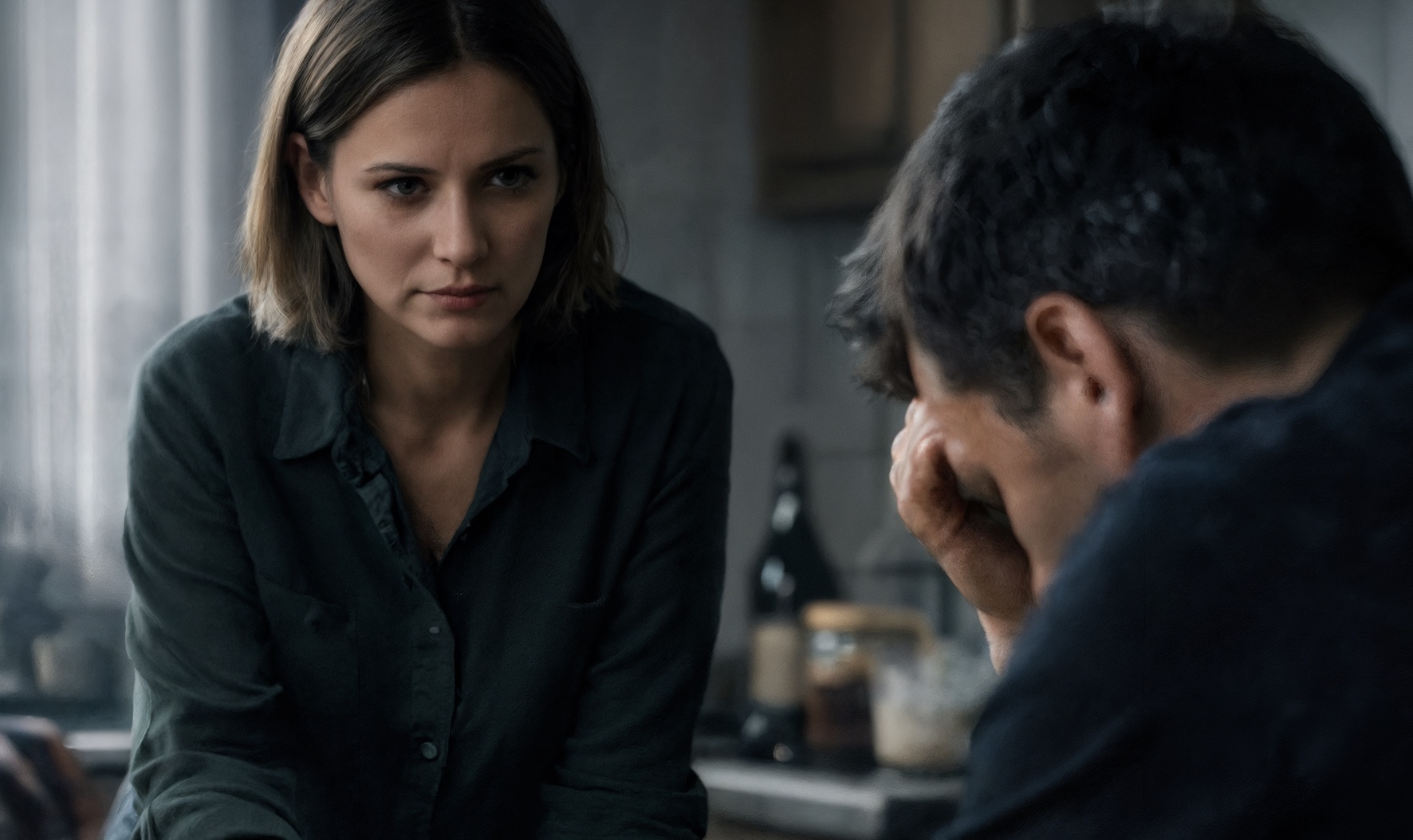
“I didn’t grind myself down working two jobs just to buy this dacha, only for your mother to haul her entire traveling circus of relatives out here and turn it into a boarding house! Keys on the table, Dima—and by tonight I don’t want a trace of them left!”
Lena wasn’t yelling. She spoke in that particular low, dense voice—the one that made people in her department go cold inside and instantly stop arguing.
She stood at the gates, thrown wide open, one hand resting on the hood of her car. The metal was hot, but it was nothing compared to the boiling heat rising in her chest. In front of her, like a bad dream, a neighborhood-scale apocalypse was unfolding. Her small, cozy house—her fortress, bought with two years of life without vacations or weekends—now looked like a train-station square on market day.
Dmitry stood in her path, shifting from foot to foot. In one hand he held a half-eaten piece of bread; with the other he tried to hide a ketchup stain on his T-shirt. He looked like a schoolboy caught smoking in the restroom—pitiful, twitchy, eyes skittering everywhere.
“Len, why do you have to come in swinging right away?” he started, slipping into his usual tune, forcing a smile that came out crooked and strained. “What do you mean, strangers? That’s Uncle Vitya with his family, Aunt Lyuba… Mom just said it would be a sin to waste weather like this. We’re family. You can’t be so… selfish.”
Lena silently looked past her husband’s shoulder. On her perfectly clipped lawn—the one she tended with obsessive persistence after work—sat someone’s dirty, rust-specked Logan. Tires planted right on the grass. From the open windows blasted some vulgar pop music, the bass thumping so hard it seemed to rattle the house.
A little farther, near the veranda, a cheap collapsible grill belched smoke. The smoke was black and biting—someone had clearly poured lighter fluid without restraint, chemicals and all. A heavy, sweaty man in a sleeveless undershirt fussed around the coals, red-faced and panting. He fanned the fire with a piece of cardboard so violently that sparks flew toward the freshly painted porch rails.
“Family?” Lena echoed, and metal rang in her voice. “Dima, I saw those people once—five years ago—when they tried to steal my shoe at our wedding and ended up fighting a waiter. That’s not family. That’s a natural disaster. You asked for the keys so you could mow the grass and tighten the fence netting. Looks like you crushed the lawn with tires—and the netting is apparently being held up by that sack of charcoal.”
She stepped onto the property without waiting to be invited. Her heels dug into the gravel path. Dmitry hustled after her, trying to block her way, but not daring to touch her.
“Lenusya, just… please, can you endure it?” he pleaded. “It’s awkward—people came, they’ve settled in. Mom tried so hard, she marinated the meat since last night. They didn’t know you’d show up. I thought we’d sit quietly, like family…”
“Like family is ten people squeezed onto six hundred square meters?” she cut him off sharply, stopping in front of her pride and joy—her alpine rock garden.
What she saw made her squeeze her eyes shut for a second. On the stones, among the sedums and dwarf conifers she’d ordered from a specialty nursery, stood a half-open five-liter water jug and a whole pile of plastic cups. Someone had decided her rockery was a perfect natural buffet table. A greasy disposable plate with a half-eaten pickle had stuck itself to the juniper.
“Get that off,” Lena said quietly, pointing. “Now.”
“Oh, we’ll get it, we’ll get it, for God’s sake, it’s not a big deal,” Dima waved it away—yet didn’t touch the jug. “You should go say hello. Look—Mom’s waving.”
On the veranda, settled like the rightful owner in Lena’s wicker chair—the very chair Lena had dreamed of using with a book and coffee—sat Zinaida Petrovna. She looked like a general inspecting troops: bright floral robe, a wineglass in hand. When she noticed her daughter-in-law, she didn’t even pretend to stand. She only lifted her glass in greeting and shouted something over the music.
Lena felt something inside her switch off. The last flicker of pity she still had for her husband evaporated. What remained was pure revulsion. She looked at Dima, and he suddenly seemed like part of the spectacle too—just as foreign and out of place on her land as the plastic trash on her juniper.
“I’m not greeting anyone, Dima. I didn’t invite guests. I came home. To my home—the one registered in my name, the one I’m paying the mortgage on. Right now you’re going to your mother and you’re going to tell her the party is over. You’ve got one hour to pack up, haul out the trash, and get that car off my lawn.”
“Are you out of your mind?” Dima hissed, and for the first time real fear flashed in his eyes. “How am I supposed to say that? They’ll be offended! Uncle Vitya drove all the way from outside the city. Mom will start a scandal—you know her. Just… change, sit with us for an hour, and they’ll leave on their own tonight. Don’t be a bitch, Len.”
“A bitch?” Lena let out a bitter laugh. “So when I worked six months straight without a day off to cover the down payment, I was wonderful. But when I don’t want my house turned into a dump, I’m the villain?”
A grimy kid about seven sprinted past them, shrieking as he kicked an inflatable ball. The ball slammed into a freshly planted thuja with a wet thump, snapping off the top. Lena flinched like the blow had landed on her. Dmitry looked away, guilty.
“One hour, Dima. Time’s running. If sixty minutes from now there’s even one living soul here besides me, I’ll call a tow truck for that junker—and I’ll throw your relatives’ things over the fence myself. And trust me, I won’t be checking whether it lands in mud or nettles.”
She turned and walked toward the house, weaving between strangers who watched her with wary, measuring looks. Some went quiet; some kept chewing, ignoring the homeowner. The air reeked of cheap charcoal, stale booze, and brazen чужие perfumes. Lena climbed the steps, feeling her husband’s stare on her back—confused, pathetic, completely useless. The war for silence was only beginning, and she wasn’t taking prisoners.
Zinaida Petrovna wasn’t just sitting on the veranda—she was ruling it. Her large figure in a bright yellow sundress covered in oversized sunflowers seemed to occupy the whole terrace. She looked like a plump merchant’s wife from a Kustodiev painting—only instead of a samovar there was a battery of bottles with colorful labels and mountains of food.
Lena climbed the steps, feeling the wooden boards vibrate from the bass thumping out of the car. She met her mother-in-law’s eyes and saw not a hint of embarrassment—only confidence. Zinaida Petrovna threw her hands up in welcome, nearly tipping a salad bowl.
“Well, look who finally showed up!” she boomed, her voice easily overpowering the party noise. “Lenka, why are you standing there like a post? Come on, we’ll pour you a penalty shot. You’re pale—city work is killing you. You need fresh air, not to rot in an office.”
Lena’s eyes slid to the table. Her favorite linen tablecloth—brought from a business trip to Italy—was smeared with greasy stains. But worse was the centerpiece: her collectible handmade Japanese bowl, thin porcelain she hardly dared touch. It was now filled to the brim with Olivier salad drowned in mayonnaise, and a dirty spoon stood in the middle like a flag planted on conquered land.
“That’s my dishware,” Lena said dully, feeling a lump rise in her throat. “Zinaida Petrovna, I asked Dima—don’t take anything from the cupboards. There was a bag of disposable plates specifically for picnics.”
Her mother-in-law rolled her eyes theatrically and clicked her tongue, turning to the permed woman beside her.
“Lyuba, would you look at her! We came with our whole hearts, we set a table, and she’s trembling over plates. Len, you don’t live in a museum. Things are meant to be used, not admired. Are we family or what? What kind of petty stinginess is it to ‘protect’ a bowl from your husband’s relatives?”
“This isn’t stinginess. It’s respect for someone else’s property,” Lena said, each word clean and sharp. She stepped closer, and the guests shifted instinctively, sensing the cold coming off her. “And since we’re talking about family—why is there a man sleeping in my hammock with shoes on?”
She pointed to the corner of the garden where her snow-white woven hammock hung between two apple trees. A man lay sprawled in it, dirty sneakers dangling, snoring with a hat over his face. The hammock sagged nearly to the ground under his weight.
“That’s Uncle Kolya—tired from the road, his blood pressure,” Zinaida Petrovna dismissed it, spearing a pickled mushroom. “Let him sleep. What, are you sorry for the hammock? Cloth is cloth—wash it. Lena, you’ve gotten nervous. That’s loneliness. That’s why we decided the house shouldn’t sit empty. A dacha should live, it should breathe! Children’s laughter should ring here, it should smell like shashlik, not like you’ve built yourself a crypt. Me and Dimочка talked it over and decided: we’ll come every weekend and help ‘beautify’ the property.”
Lena felt the ground tilt. “Talked it over with Dimочка.” She looked at her husband, hiding behind relatives at the grill, pretending he was deeply busy turning skewers.
“I’m going inside,” she tossed out, refusing to listen to another sermon on the joys of collective labor.
Inside the house didn’t smell like lavender and wood the way it usually did. It smelled like fried onions and stale alcohol. Lena walked into the kitchen and froze.
It looked like locusts had swept through. Cupboard doors hung wide open. Torn packages lay across the counter: her expensive coffee—the one she bought only for herself—was spilled everywhere; premium cheese had been hacked apart, pieces scattered beside a dirty knife. And the final punch: an empty bottle of olive oil. The special one—the pricey, “for salads only” oil she’d saved.
“They fried with it?” Lena whispered, tracing a greasy streak on the counter. “They fried meat in oil that cost three thousand rubles?”
A mountain of dirty dishes rose in the sink. Not disposable—no. They’d taken everything: her favorite mugs, plates, wine glasses. Someone had even stubbed out a cigarette in a saucer from her coffee set.
On the living-room sofa, right on the pale upholstery, lay a denim jacket and a bag with filthy green onions sticking out. Lena went to the window. Through the glass she watched Zinaida Petrovna waving a chicken leg as she lectured the group, and the group hummed their approval. Her mother-in-law already felt like the absolute owner here—rearranging furniture in her mind, digging up beds, assigning a schedule for future visits.
Lena understood: this wasn’t a visit. This was an occupation. If she swallowed it now—if she gave even a millimeter—her dream of a quiet hideaway would become a communal apartment that permanently smelled of overfried onions and drunken songs on Friday nights.
She returned to the veranda. The chatter died for a heartbeat—Lena looked like a person about to light a fuse on a stick of dynamite.
“Zinaida Petrovna,” Lena said evenly, staring straight into her eyes. “You said a dacha should benefit the family. I completely agree. Only you got the definition of ‘family’ wrong. My family is me. And this house is my property. You have forty minutes. If you don’t start packing right now, I’ll start throwing your things over the fence. And I’ll start with this salad bowl.”
She stepped to the table and placed her hand on the rim of the Japanese bowl filled with Olivier. Zinaida Petrovna froze, mouth open; the chicken in her hand stalled halfway. The air thickened—heavy and sticky, like the smoke from that cheap grill. Dmitry finally tore his eyes from the coals and looked toward the veranda, terrified, realizing the storm he’d dreaded had just begun.
Dmitry bounded up onto the veranda, nearly tripping over an empty vodka bottle. Red blotches spread across his face; his hands trembled—whether from fear of his mother or fear of his wife, it was hard to tell. He rushed to the table, trying to plant himself like a living shield between Lena and the doomed bowl.
“Lena, don’t you dare!” he squealed, his voice cracking. “What are you doing? People are sitting here! Put the bowl down!”
Lena stared at him for a long moment without blinking. There was no rage in her eyes, no hurt—only a cold, almost disgusted curiosity, the way you look at a crushed insect. Slowly, she tipped the ceramic bowl. The heavy, mayonnaise-laden mass slid out with a wet slap right onto the dirty tablecloth, splattering Zinaida Petrovna’s robe.
Silence fell on the veranda. Only the buzz of a fat fly over the meat platter broke it.
“Are you sick in the head?” the mother-in-law hissed, brushing potato chunks off the sunflower print on her chest. “Vitya, look at her! She’s a lunatic! Wasting food! We came like human beings, and she—ugh. Ungrateful pig!”
“Mom, wait—” Dima grabbed Lena by the elbow and dragged her aside, toward the corner of the house, away from the relatives’ greedy eyes.
Lena didn’t resist, but she yanked her arm free as if his touch were contagious. They stopped by the downspout. Dmitry breathed hard; he smelled of cheap beer and panic.
“Lenka, you’re going too far,” he whispered, glancing back at the veranda where an outraged rumble was already building. “You can’t do that! They’re my relatives. Uncle Vitya drank—he can’t drive. Where am I supposed to put them right now? At night? Let’s make a deal. They’ll stay the night, quietly, I’ll lay them on the floor, we won’t even take bedding. And in the morning—swear to you—they’ll be gone. Please. Don’t humiliate me in front of my family.”
Lena looked at him and didn’t see the man she’d married three years ago. She saw a spineless substance desperately trying to mold itself into whatever shape pleased everyone.
“You’re humiliating yourself, Dima,” she said softly. “By bringing this caravan into my house without asking. By letting your mother run my kitchen. By standing here whining instead of solving the problem.”
“What problem?!” he flung his hands up. “What did they do to you? So they ate, so they drank! Are you that stingy? You’re rich now—boss lady, SUV and all. Did that piece of cheese really get stuck in your throat?”
“It isn’t about the cheese, Dima. It’s about you letting invaders in. Do you hear what they’re saying?”
From the veranda came drunk, loose voices. The permed aunt was booming: “Look at that city princess! Dumped the salad! In our day I’d have slapped her so hard her ears would ring. Dima’s a doormat—that’s why she climbed onto his neck. You’ve got to keep a woman in line, not hand her the dacha keys!”
“Exactly!” a male voice barked. “They go mad from having too much. She stole that money, probably—no one earns a house like that honestly—and now she doesn’t consider normal people human. Don’t worry, Zinka, we’ll re-educate her. Tomorrow we’ll make her dig the beds—she’ll lose her arrogance quick enough.”
Lena gave a thin smile and looked at her husband. Dmitry flushed even darker and dropped his gaze.
“You heard them?” she asked. “They’re already planning my ‘re-education.’ Tomorrow they’ll rip up the lawn for potatoes, and the day after Uncle Vitya will decide he needs the bathhouse more than I need my storage room.”
“They’re just drunk,” Dmitry mumbled, pitifully. “They’ll sleep it off and be normal. Len, please. One evening. For me. If you throw them out now, Mom will never let me live. She’ll curse me.”
“And if I don’t throw them out, I won’t have a life,” Lena cut in. “I come here to rest—not to work as an entertainer for rude strangers.”
She stepped closer, closing the distance until there was nowhere left for him to dodge. Her voice turned hard and dry, like autumn leaves.
“Listen carefully, Dima. I don’t have time for this kindergarten nonsense. It’s four o’clock. You and your ‘family’ have exactly twenty minutes to get into the cars and leave. A taxi back to the city costs two thousand. If your uncle doesn’t have the money—pay it. If you don’t—borrow it from your mother.”
“And if I don’t?” Dima tried to square his shoulders, pretending at firmness, but it came out pathetic. “If I say they’re staying? This is my dacha too—I’m your husband!”
“On paper, this dacha is mine alone,” Lena said flatly. “Bought with my pre-marriage savings and registered in my name. You have no claim to it. You’re a guest here. And as a guest, you’re behaving disgracefully.”
Lena drew a deep breath, feeling the last thread tying her to this man snap cleanly inside her.
“Either they leave now, or you leave with them. You pack your things, you get into that rusty Logan with Uncle Vitya, and you go to your mother. And you don’t come back here. And you don’t come back to our apartment either. You’ll leave your keys on the table.”
Dima froze, mouth open. He’d expected a screaming match, flying plates—anything but this calm, glacial certainty.
“You… you’re kicking me out? Because of my mom? Over shashlik? Len, are you hearing yourself? We’ve been together five years!”
“Not over shashlik, Dima,” Lena said. “Over you choosing to be a convenient son instead of my husband. You let them humiliate me in my own house. The choice is yours. Time’s running.”
She turned and walked back to the veranda. The group quieted when she returned, though it didn’t last long. Zinaida Petrovna, wiping mayonnaise off her chest with a napkin, was already filling her lungs for another tirade.
“Well?” she asked with a nasty little smirk as Lena climbed the steps. “Did you two talk? Did your husband come to his senses? Or are you still giving orders? Sit down—have your penalty shot while I’m still being nice. And bring me a clean fork, because this one’s disgusting.”
Lena didn’t answer. She sat down in the wicker chair opposite, folded her arms, and waited. She watched Dmitry climb the steps behind her—slowly, like a man walking to the scaffold. His eyes darted, his lips shook; he looked ready to betray anyone at all, just to avoid open conflict. But today, hiding in a corner wouldn’t save him.
The twenty minutes passed as quietly as ice melting in a glass of warm vodka. No one moved. If anything, the feast seemed to find a second wind. Uncle Vitya, flushed and sweating, was already trying to tune a guitar missing a string, while Aunt Lyuba laughed loudly, crossing her legs and shamelessly displaying varicose veins like trophies.
Dmitry didn’t leave. He sat beside his mother, shoulders hunched, viciously poking at a piece of wilted cucumber with his fork. He’d made his choice—or rather, he’d chosen not to choose, hoping the situation would dissolve on its own like a fading bruise. Zinaida Petrovna noticed Lena still sitting there and lifted her shot glass with a triumphant grin.
“There we go!” she bellowed. “She threw her tantrum and calmed down. Women are like weather—rain in the morning, sunshine by evening. Dima, pour your wife a drink, don’t sit there like a stump! Let’s toast to reason defeating arrogance!”
Lena rose slowly. She wasn’t crying. Her lips didn’t tremble. Inside her was a ringing, lifeless emptiness—the kind that comes after an amputation, when the anesthetic still holds and there’s no pain yet, only the understanding that what’s lost is gone for good. She took her purse, checked her phone and her car keys. Her movements were smooth and exact, like a surgeon’s before an operation.
“Reason really did win, Zinaida Petrovna,” Lena said in the same everyday tone you’d use to discuss a grocery list. “Only you’re celebrating too early.”
She walked up to Dmitry. He lifted a cloudy gaze at her—hope and animal fear mixed together. He still believed she would sit down, pick up a plastic cup, and become “one of them.”
“Your keys,” Lena said, holding out her palm. “The keys to the apartment.”
“What?” Dima blinked stupidly. His fork slipped from his fingers and clinked against the plate.
“The keys to my city apartment, Dima. Put them on the table. Now.”
“Len, why are you starting again?” he whined, glancing at his mother as if she could rescue him. “We’re sitting нормально… Why the keys? Tomorrow we’ll go together—”
“We’re not going anywhere together,” Lena said. “You’re staying here—with your mother, Uncle Vitya, the salad on my tablecloth, and the filth you brought into this house. This is your natural habitat, Dima. You belong here. And you’re not walking into my apartment again.”
Zinaida Petrovna slammed her shot glass on the table, vodka splashing across the sticky surface.
“What nonsense are you spewing, you idiot?!” she shrieked, instantly dropping her fake cheer. “Throwing your husband out? Who do you think you are?! He’s registered there!”
“He isn’t registered there,” Lena replied calmly, not even bothering to look at her. “He’s registered with you—in that two-room apartment in Khimki—along with you, your sister, and your nephews. In my apartment he simply lived. He lived there while he was my husband. But I don’t need a husband who lets his relatives wipe their boots on his wife.”
Lena leaned in close to Dmitry’s face. He recoiled, feeling the icy chill coming off her.
“I gave you a choice. You chose your mother. Wonderful—an exemplary son. Now live with her. Keys. On the table. Or I change the locks tonight and dump your things in trash bags on the landing. And don’t doubt it, Dima—I will do it. You know I don’t throw words into the wind.”
With shaking hands, Dmitry pulled out his keyring from his shorts pocket. Metal rang against the glass tabletop. In the sudden hush, the sound seemed deafening. Uncle Vitya’s guitar died. Aunt Lyuba stopped chewing. Everyone stared at Lena as if she were an alien speaking the language of threats.
“And now listen carefully, dear relatives,” Lena said, scooping up the keys and straightening as she looked over the colorful crowd. “I’m not calling the police. I’m not fighting you. I’m too disgusted to touch you. Drink the vodka. Finish my cheese. Sleep in my bed if your conscience allows. But tomorrow at ten in the morning a crew will come to replace the fence and install an alarm. And with them will come a private security team—big guys. If by then even one of your socks is still here—don’t say you weren’t warned.”
“You think you can scare us?” Uncle Vitya roared, trying to stand, but he swayed and collapsed back onto the bench. “We’re family! We have rights!”
“You have exactly one right,” Lena snapped. “To get out of here while I’m still being polite. Dima—goodbye. I’ll file for divorce through Gosuslugi. You won’t even have to go anywhere. Convenient, isn’t it? You love when things are convenient.”
She turned and walked to the car without looking back. Her spine was straight as a wire.
“Lenka! Stop!” Dima suddenly shouted, jumping up. “You can’t just leave! Lenka, this is insane! Mom, tell her!”
Zinaida Petrovna grabbed her son by the arm and yanked him down hard, forcing him back onto the bench.
“Sit!” she hissed viciously. “Let her go, the hysterical fool! She’ll crawl back on her knees, she has nowhere else to go! Who needs a spiteful woman like that with a mortgage tied to her? She’ll come back, Dimочка—she’ll come. And then we’ll be the ones setting the rules!”
Lena slid into her crossover. Inside it smelled of leather and her perfume—clean, cool, the scent of freedom. She started the engine, and the deep rumble swallowed the drunken shouting from the veranda. In the rearview mirror she saw Dmitry lurch as if to run after her, but his mother clung to his arm, barking something furious into his face.
Lena pressed the gas. Gravel crunched under the tires. She drove out through her gate, leaving behind the trampled lawn, the smoking grill, and the swarm of strangers chewing through her life. Tomorrow there would be new locks. Tomorrow there would be a cleaning crew. And tonight she would go to an empty, quiet apartment where no one would dare touch her favorite cup.
Her heart beat steady. There were no tears. Only a clear, clean understanding: she had just cut loose the dead weight that had dragged her down for the past three years. And that dead weight was now sitting on her veranda, listening to his mother and drinking warm vodka—trading his marriage for a bowl of Olivier salad.