Olga stood by the window with a cup of tea gone cold in her hands, staring out at the familiar courtyard. The playground, the benches, the flowerbed with yellow marigolds—everything looked exactly the same as it had a month ago, two months ago, a year ago. But inside her, everything had shifted, as if someone had flipped her life upside down, shaken out whatever didn’t belong, and set it back in place again. Empty—yet steady.
The divorce had been finalized quickly. No children. No jointly acquired property worth fighting over. The apartment was hers—bought three years before she even met Artyom, with money she’d saved working as a cost-estimating engineer. Forty-six square meters, third floor, south-facing windows. Her ground. Her walls. Her silence.
Artyom moved out a week after the papers were signed. He packed his things into two suitcases, took his laptop, some books, his gym bag. No drama, no door slamming, no speeches, no attempts to prove anything. He simply left, leaving behind the scent of men’s cologne in the bathroom and an empty shelf in the closet. And one line he tossed over his shoulder on the way out:
— I’ll drop by later for a couple of small things. Nothing important, but still.
Olga nodded, not bothering to ask what he meant. She didn’t care. The point was: he was leaving, and she was staying. The point was: she no longer had to pretend everything was fine when it had been crumbling for a long time.
Almost two months went by. Artyom didn’t call, didn’t text, didn’t show up. Olga slowly got used to living alone—coming home from work, cooking dinner only for herself, watching series he used to hate, going to bed when she felt like it instead of adjusting to someone else’s routine. And with each day she felt lighter, like someone had finally lifted an invisible burden off her shoulders.
She didn’t change the locks. Not because she missed him, and not because she hoped he’d come back. She just didn’t want the hassle. He still had keys, but he wasn’t using them—so, in her mind, the issue had closed itself. That’s what she thought.
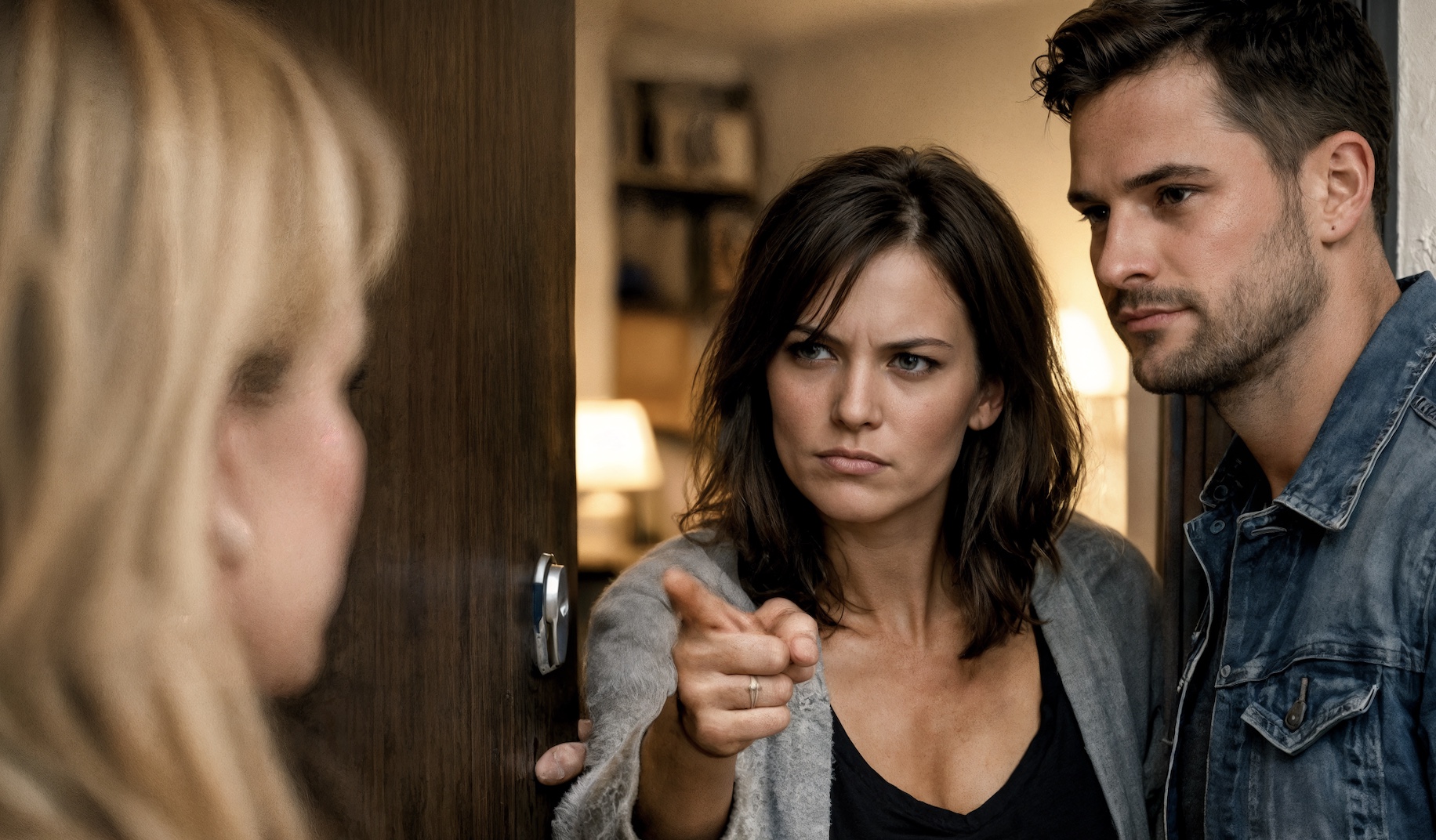
Then, on Friday evening, just as Olga returned from work and changed into her home clothes, the doorbell rang—sharp and insistent, as if the person outside was in a rush or certain they were expected. She went to the peephole, looked—and froze.
Artyom stood on the landing.
And beside him—another woman.
Young, around twenty-five, in a leather jacket with bright red lipstick. She stood close to him, nearly brushing his shoulder, and she studied the door the way someone studies a place they’re about to evaluate.
Olga opened the door slowly. Not flinging it wide, not stepping back with forced politeness—just opening it calmly, without emotion, her hand steady on the handle.
— Hi, Artyom said. His voice was uncertain, dressed up in fake cheer. — I’m here for my stuff. Remember I said I’d stop by?
Olga nodded in silence. Her gaze slid to the girl, who had already leaned forward to peer into the hallway. She looked over the walls, the floor, the coat rack with Olga’s jacket—like she was mentally deciding what she’d rearrange.
— And this is Vika, Artyom added, gesturing awkwardly toward his companion. — We… well, you know.
Vika smiled, but her smile was tight, almost defiant. She stepped closer to the threshold, like she intended to follow Artyom inside.
That was when Olga spoke. Her tone stayed even—no raised voice, no edge—but there was such final certainty in it that Vika stopped mid-step.
— There’s nothing for you to do here. This apartment was mine before the marriage.
The words hung in the air. Vika blinked a few times, as if she didn’t immediately understand they were meant for her. Then red patches appeared on her cheeks and her eyes snapped toward Artyom.
— What? she asked, confusion tangled with offense.
— You heard me perfectly, Olga repeated, calm as ever. — This is my apartment. It’s in my name and it was bought long before I got married. Artyom doesn’t live here anymore. And you—especially not.
Artyom jerked like he wanted to jump in, but the words died in his throat. He clearly hadn’t expected this. He must have assumed Olga would get embarrassed, flustered, or simply keep quiet. But she stood steady, holding the door with one hand, looking at Vika so calmly that Vika began to retreat.
— Artyom, Vika started, irritation seeping into her voice. — You told me this was your apartment. Ours. That you bought it together…
Olga let out a short laugh—dry, humorless.
— We didn’t buy anything together. I bought this apartment with my own money in 2019. Artyom moved in after the wedding in 2022. He lived here for two years. And he moved out two months ago. That’s it.
Vika stared at Artyom. Something ugly flashed in her eyes—disappointment mixed with anger.
— So you don’t even have a place of your own? she asked quietly.
Artyom went pale.
— Vik, it’s not like that… I explained… We’re renting right now…
— Renting, Vika repeated, her voice turning hard. — And I thought you were just staying here temporarily until you went back to your own place.
Olga watched the exchange and felt a strange kind of calm. No pain. No jealousy. Not even amusement. Just indifference. These two were strangers now, and their problems no longer belonged to her.
— Artyom, she said, addressing her ex, — you can come in and take what you need. Alone. Without company. You have ten minutes.
Artyom nodded, not looking at Vika.
— Okay. I’ll be quick.
He stepped inside and went to the room. Vika stayed on the landing, arms crossed, her face set like stone.
Olga didn’t close the door, but she also didn’t invite the girl in. They stood there about a meter apart, silent. Vika kept peering into the apartment from the hallway, as if trying to understand what was so special about those walls.
— It’s a nice apartment, Vika finally said. Her tone was flat, but envy slipped through.
— Thanks, Olga answered briefly.
— How many years did you save for it?
— Five. I worked, set aside every paycheck, didn’t waste money on nonsense. Then I took a mortgage and paid it off early.
Vika nodded, thoughtful.
— And Artyom… he contributed anything?
— No. It was before him.
— Right.
A pause stretched out. From inside the room came noises—Artyom rummaging through a closet, plastic bags rustling.
— So why did you divorce? Vika asked suddenly.
Olga looked at her with quiet focus.
— That’s none of your business.
— I’m just curious.
— Curious, Olga echoed. — Fine. Short version: he didn’t want to work. He sat at home playing computer games, promising he’d find a job tomorrow, the day after, next week. I paid for everything—mortgage, utilities, groceries. Sometimes he bought beer. After two years, I got tired of being his mother.
Vika went still. Her face drained of color.
— Does he work now?
— I have no idea. That’s not my problem anymore.
Artyom came out of the room with a small bag in his hand. His expression was tense; his eyes darted between Olga and Vika.
— That’s everything, he said. — I got it.
— Good, Olga nodded. — The keys.
— What?
— The keys to the apartment. Leave them.
Artyom hesitated.
— What if I still need something later?
— Then call me, we’ll set a time, and I’ll open the door, Olga said. — But leave the keys. Now.
He reached into his pocket, pulled out a keyring, slid off two keys—one for the intercom, one for the apartment—and placed them on the shelf by the door.
— Thanks, Olga said.
Artyom nodded and stepped back onto the landing. Vika turned without a word and started down the stairs. He hurried after her.
— Vik, wait, I can explain—
— Don’t explain anything, she snapped, not looking back.
Olga shut the door. Turned the lock. Listened—muffled voices, then hurried steps down the stairs, then silence.
She went into the room, picked up the keys from the table, returned to the entryway, and set Artyom’s keys beside her own. She stared at them for a moment. Then she took his keys to the kitchen and dropped them into the trash.
Tomorrow she’d call a locksmith and change the lock. Not because she was afraid—Artyom probably wouldn’t come back. Simply because it was the right thing to do. Because it was calmer that way.
She sat on the sofa and turned on the TV. Some talk show was on: people yelling, waving their arms, accusing each other of cheating. Olga switched channels. A slow, quiet film about space appeared—beautiful music, soft pacing.
Her mood felt odd. Not happy. Not sad. Just peaceful—like a long, draining story had finally ended, and now she could breathe.
A few days later she really did call a locksmith. He arrived in the morning, greeted her politely, replaced the lock in half an hour, and handed her three new keys. She paid him, saw him to the door, locked up—and felt something inside her click shut for good.
The apartment was fully hers again. No чужие keys. No surprise visits. No “I’ll stop by for a couple of things.” Just her, her walls, her silence.
A week later her old friend Sveta—someone Olga hadn’t spoken to since college—called her.
— Olya, hi! I heard you got divorced. You okay?
— I’m okay, Olga replied. — Better than before.
— Listen, I know a guy… A good man—hard-working, no drama. Want me to introduce you?
Olga laughed.
— Sveta, thanks, but no. I’m good on my own right now. Honestly.
— Alright, but if you change your mind—message me.
— Deal.
She hung up and looked out the window again. The courtyard, the playground, the marigolds—unchanged. But inside her everything felt different: lighter, freer, like someone had opened a window in a stifling room.
She poured herself tea, sat at the table, opened her laptop. For years she’d wanted to enroll in landscape design courses—she used to dream about it, but there was never time. Now there was.
She found the website, studied the curriculum, filled out the form, and hit submit. A small flutter of excitement rose in her chest—the feeling of something new, interesting, and truly her own.
Meanwhile, somewhere in a rented one-room apartment on the other side of the city, Artyom sat on the couch listening to Vika pack her things.
— Vik, wait… we can talk about this—
— There’s nothing to talk about, she snapped, shoving her makeup bag into her tote. — You lied to me. You said you had your own apartment, that you just couldn’t go back for a while. And it turns out you lived off your wife, and now you’re renting this miserable little place with my money.
— I didn’t lie, I just—
— You “left things out”? Same thing. I’m not going to be your second mom, Artyom. I need a man, not a dependent.
She zipped her bag and threw on her jacket.
— Good luck. You’ll probably find someone else who’ll handle everything for you and pay for it too.
The door slammed. Artyom stayed on the couch, staring into nothing. One thought kept spinning in his head: Olga had warned him. She’d told him she was tired of dragging everything on her own shoulders. But he hadn’t listened—he’d assumed she was exaggerating.
Now he was alone. In someone else’s apartment. No job, no money, no wife, no new girlfriend. Empty-handed, finally forced to admit this was all the result of his own choices.
He picked up his phone and scrolled through his contacts. For a second, he wanted to call Olga—apologize, beg, try to turn everything back. But then he pictured her calm face, her even voice, her eyes with no anger and no hurt—only indifference. And he understood there was nothing to go back to.
The bridge was burned. The door was shut. The keys were gone.
And Olga, at the same time, sat at her computer choosing plants for her first landscape project. Arborvitae, junipers, hydrangeas. She wrote the names in a notebook, sketched layouts, and smiled.
Life went on.
Her life.
And she was ready to live it the way she wanted.
A month later Olga was attending classes three times a week. The group was small—eight people, mostly women over thirty, one retired couple, and a young guy named Denis who dreamed of opening his own landscape design studio. Their instructor, Elena Viktorovna, was strict but fair. She taught them to see space, to feel composition, to understand how plants interact.
Olga loved it. She loved drawing plans, choosing color combinations, imagining how an empty plot could become a garden. It pulled her away from the past and filled the hollow space the divorce had left behind.
At one lesson Elena Viktorovna assigned a project: design a small front garden for a house. Olga worked on her draft until late at night, selecting plants, calculating dimensions. When she finally finished, she stared at the result in surprise—it was beautiful. Truly beautiful.
At the next class the instructor studied Olga’s work for a long time, then looked up and said:
— Olga, you have good taste. And a strong sense of space. If you keep at it, you’ll make an excellent designer.
Warmth spread through Olga’s chest. No one had praised her like that in ages. She hadn’t felt in a long time that she was doing something that was genuinely hers.
After class Denis caught up with her outside.
— Hey. Want to grab coffee? I know a great café nearby.
Olga stopped and looked at him. Denis was about five years younger, tall, with messy hair and an open, easy smile.
— Why?
— Just to talk. Your projects are really strong—I’m curious where you get your ideas.
Olga hesitated, then nodded.
— Alright. Let’s go.
They sat in a small café on the corner, drinking cappuccino and talking about classes, plants, plans. Denis told her about his dream of opening a studio, how exhausted he was working for a construction company, how he wanted to build something of his own.
— What do you do for work? he asked.
— I’m a cost-estimating engineer. Boring, but stable.
— So why landscape design?
Olga thought for a moment.
— I wanted it for a long time. I dreamed about it even in school, but my parents said it wasn’t serious—that I needed a “real” profession. So I became an engineer. Then came the wedding, work, daily life… there was never time to think about dreams.
— And now you have time?
— I got divorced. So yes—now there’s time.
Denis nodded without pushing for details.
— I get it. I recently ended a relationship too. My girlfriend wanted me to give up my ideas and get a “proper” job—salary, promotions, the whole thing. But I don’t want that. I want my own thing. So we split.
They fell quiet for a beat.
— You know, Olga said, — sometimes a divorce feels like a disaster. And then you realize it’s just the end of one chapter. And the start of another.
— Exactly, Denis agreed.
After that they started meeting sometimes after class. Not dates—just friendly hangouts. They discussed projects, shared ideas, encouraged each other. Olga felt comfortable with him: light, easy, no pressure, no expectations.
And slowly her life settled into a new rhythm. Work, classes, occasional meetups with friends—friends who were glad to see her coming back to herself.
— Olya, you’re glowing, Sveta said one day when they met at a shopping center. — You look better.
— Oh, come on.
— I’m serious. Your eyes are bright. Like you’re actually living again, not just getting through the days.
Olga thought about it. Maybe Sveta was right. For the last two years of the marriage, she really had been just getting through it—working, cooking, cleaning, paying bills. Was that living? Not really.
Now she felt alive. Maybe alone, maybe without anyone to lean on—but alive.
One evening, as Olga was walking home from class, an unfamiliar number called.
— Hello?
— Olga? It’s Artyom.
She stopped mid-step.
— What do you want?
— I… wanted to talk. Can I?
— About what?
— About us. About everything. I realized I was wrong. I want to apologize.
Olga exhaled.
— Artyom, everything’s already been said. There’s nothing to discuss.
— But I want to fix it. Maybe we could try again?
— No.
— But—
— No, Artyom. I don’t want to go back to what we had. I don’t want to be your mother, your nanny, your provider again. I want to live my life. You should live yours too.
— Olga, please—
— Don’t call me again.
She ended the call and blocked the number. Her hands shook slightly—not from heartbreak or anger, but because the past had tried to pull her back for a moment, and she’d felt the chill of it.
At home she made tea, sat on the sofa, hugged a pillow. She imagined what would happen if she said yes, if she let him return. Most likely everything would repeat: promises, excuses, hope, disappointment.
No. She’d made the right choice.
Half a year later the course ended. Olga received her certificate, took a group photo, exchanged contacts. Denis invited everyone to a small celebratory gathering. They sat in a café, drank wine, and laughed about the funniest moments from class.
— So, got plans? Denis asked Olga.
— Not sure yet. I’m thinking maybe I’ll take small jobs at first—friends, acquaintances.
— Want to try doing it together? I’ve been thinking about opening a small studio. Would you be interested?
Olga paused.
— I need to think. That’s a serious decision.
— Of course. Think it over. The offer stands.
She thought for two weeks. She weighed pros and cons, calculated risks, ran numbers. A stable engineering job versus the uncertainty of her own business. A guaranteed paycheck versus the chance to do what she loved.
And she chose the second.
She and Denis registered as self-employed entrepreneurs, rented a small office, ordered business cards. The first clients came through friends, then friends of friends. Slow, but steady.
Olga kept her engineering work, but reduced it to part-time. The rest of her time went into the studio. It was hard—balancing two jobs, losing sleep, constantly carrying tension in her shoulders. But it was her decision. Her choice. Her life.
One day—about a year after the divorce—Olga was walking down the street and saw Artyom. He stood outside a shop, smoking, staring at his phone. He looked rough: thinner, slumped, wrinkled jacket, unshaven.
Their eyes met. He recognized her and twitched as if he might step closer. But Olga simply gave a small nod and walked past. No stopping. No words. No emotion.
She kept going—toward the office, toward her work, toward her life.
And she didn’t look back.
Because the past was the past.
And the future was ahead—uncertain, complicated, but hers.
And that was enough.