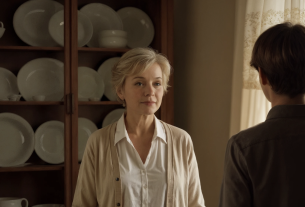
The key squealed as it turned in the lock, and the door swung inward with a heavy drag. Ekaterina almost floated into the hallway, tossing her bag—stuffed with folders—onto the small cabinet by the door. A whole day on her feet, endless reports, eyes aching from a glowing screen… all of that stayed outside. This was home. Her fortress. The place where she could finally exhale.
She drew in a breath—and caught a strange, foreign scent. Not her perfume, not the smell of dinner, but a sharp, expensive fragrance she couldn’t stand.
Her mother-in-law.
Katya’s heart gave a sick little jump. She froze, listening. From the living room came the steady tick of the wall clock. Nothing else.
“Alexey?” she called softly, stepping forward.
And then she saw her.
Valentina Ivanovna sat in the armchair by the window—Katya’s favorite chair—watching her with a cold, measuring stare. She was dressed as if she were heading to a gala: a strict suit, a pearl necklace. On the side table rested her designer leather bag, and beside it Katya’s mug, shoved toward the edge, still stained with dried coffee drips.
“Finally,” her mother-in-law said evenly, without a trace of hello. “It’s already eight. I was beginning to think you wouldn’t be coming home tonight.”
Katya swallowed hard. What was she doing here? And where was Lyosha?
“Valentina Ivanovna… I didn’t know you were— Is Alexey home?”
“Alexey isn’t here,” she cut her off. She rose slowly, spine straight, like a judge preparing to deliver a sentence. “And that’s for the best. We need to talk. Face to face.”
A cold shiver ran down Katya’s back. She crossed her arms over her chest instinctively, as if bracing herself.
“Go on,” she said. “I’m listening.”
Valentina Ivanovna stepped closer and stopped a couple of paces away, as if to underline the distance between them.
“Ekaterina, this situation is unpleasant, but life is life. You need to move out of this apartment.”
The air lodged in Katya’s lungs. For a second she honestly thought she’d misheard.
“What… what did you say?”
“You heard me perfectly,” her mother-in-law replied. “Pack your things and clear out. My son has found himself a wife. A better one than you.”
The last words were delivered with icy calm—so calm it carried the weight of long, deep contempt. Katya recoiled as if she’d been slapped.
“What wife? What are you talking about? Alexey and I are married! We’re still together—on paper, in reality, in everything!”
“A piece of paper,” Valentina Ivanovna said with a disdainful flick of her hand. “A formality. He’s met someone else. A girl from a good family. With prospects. And you…” her gaze skimmed Katya’s worn house sweatshirt, “…you were never his level. You drag him down. This farce has gone on long enough.”
Katya grabbed the doorframe so she wouldn’t collapse. The room swayed in front of her.
“Where is Alexey?” she managed, her voice wobbling. “I want to hear this from him. Right now.”
“He won’t be speaking to you,” Valentina Ivanovna said, turning as she reached for her purse. “He’s already told you with his recent behavior—you just chose not to see it. Don’t call him.”
She headed toward the door, as if the matter were settled.
“I’ll be back the day after tomorrow to check your progress. By the weekend this place should be cleared. The new owners shouldn’t have to live among someone else’s junk.”
New owners.
The phrase fell like a final verdict.
Without looking back, Valentina Ivanovna walked out into the stairwell. The door clicked shut with a soft, merciless sound.
Katya stood alone in the center of the hallway. The silence grew heavy, ringing in her ears. Slowly she slid down the wall onto the floor, her legs trembling too hard to hold her. Almost automatically, she pulled her phone from her jeans pocket. Her finger shook as she found one name in her contacts.
“Lyosha.”
She hit call.
The long rings sliced through the quiet. Once… twice… three times… and then a cheerful female voice said, “The subscriber is temporarily unavailable…”
Katya ended the call and tried again. Same result.
Her fingers moved on their own, typing out a message:
Where are you?! Your mother just…
She stopped. Tears blurred the screen. What was she supposed to write? …ordered me to move out? …said you found another woman? It sounded like the rambling of someone losing her mind.
She deleted the words, set the phone down on the floor, and hugged her knees to her chest.
Then the sobs broke loose—dull, helpless, tearing the silence of her collapsed world apart.
The dim hallway deepened into night. Katya didn’t know how many hours she sat on the cold floor with her back against the wall. The phone beside her stayed silent. That silence was louder than anything anyone could have said. It soaked up everything: the shock, the icy dread, and the black, sticky resentment slowly rising from the deepest part of her.
He didn’t answer. He didn’t call back.
That simple, brutal truth throbbed in her temples. Would an innocent man behave like that? If his mother had lied, wouldn’t he rush to defend his wife—deny it, fix it, make it right?
Fragments of the past months floated up—details she’d ignored, blaming exhaustion and work.
Yes. Alexey had been different lately. His phone, once left face-up on the table, was always flipped face-down now. He stayed late for “corporate events” and “last-minute meetings,” something that used to be rare. Their shared dinners faded into hurried snacks at different times. And his gaze… it often slid right past her, fixed on some private point in the distance. When she caught him, he’d look away at once, pretending he was simply lost in thought.
“Tired,” he’d say. “New project. Hard one.”
And she believed him. Because she loved him. Because they were supposed to be a team.
They’d met at a party through mutual friends. He wasn’t loud or showy, wasn’t trying to impress anyone. He just walked up, smiled, and started talking about something ordinary. Six months later, during a snowy walk through the park, he stopped, took her hands, and said, looking straight into her eyes:
“Katya… I can’t be without you. Let’s never separate. Let’s be a family.”
Back then they rented a tiny one-bedroom on the edge of town, dreaming of a place that was theirs. A mortgage felt impossible—until they found this option: a three-bedroom in a quiet neighborhood, old but full of potential. They stayed up nights doing the numbers with their modest savings. When Katya’s mother found out, she handed over the money she’d been saving for repairs in her own small apartment.
“The important thing is that you’re happy,” she’d said, hugging them both.
They moved in to bare walls. At first they slept on a mattress and ate off a cardboard box instead of a table. But they were together. He painted the kitchen walls himself, covered in white paint, and she stood on a stepladder hanging wallpaper in the living room. They laughed, dreamed of a nursery, a big bed, a life that was only just beginning.
“We’re forever, Katyusha,” he’d told her, arm around her shoulders as they admired the fresh wallpaper. “We’ll get through anything.”
Where was that man now? Where had he gone?
A hard vibration jolted her. The phone lit up in her hand, illuminating her tear-streaked face in the dark.
Lyosha.
Her heart jumped—hope and fear tangled together. She swallowed and answered.
“Hello?” Her voice sounded rough, uncertain.
She heard his voice—but not the warm, familiar one. This was a stranger’s voice: tired, annoyed, sharp at the edges.
“Katya, why are you trolling my mom?” he snapped. “I was in the middle of an important meeting!”
Her heart sank.
“I… she… she came here and said you found someone else. That I have to move out. Is it true?”
A pause.
Too long.
“Katya, no hysterics,” he finally said, irritation seeping through. “Yes. It happened. That’s just how it turned out.”
“‘How it turned out’?” she whispered, unable to believe what she was hearing. “Alexey, we’re married. What do you mean, ‘how it turned out’? Who is this Ira?”
“Listen, I didn’t want to hurt you. Honestly. But… Ira and I… it’s serious. And she’s pregnant.”
The words sounded like a sentence. The world crashed down for good. A baby. They couldn’t have one of their own—they’d gone to doctors, tests, appointments—and now, suddenly, there was a child… just not with her.
“You should have told me!” Her voice finally broke into anger, born straight out of despair. “To my face! Not through your mother!”
“Mom just wanted to help,” he said, as if that explained anything. “She wanted to speed things up. You need to move out, Katya. Understand? This is where my new family will live.”
“Your… new family?” Katya choked.
“And what about our apartment? Our years? The mortgage I poured every last ruble into? You can just erase it all?”
“I’ll pay you back for what you put in—don’t worry!” he blurted, and she heard relief in his voice, as if he’d found a neat solution. “Pack your things and I’ll transfer the money. Just—please—no scenes.”
“No scenes…” she echoed with a bitter little laugh. “Fine, Alexey. No scenes.”
“Good girl,” he said quickly. “I’ll call you later.”
He hung up.
Silence swallowed her again—but it wasn’t the same silence as before. There was no room left in it for tears or pleading. Now it was filled with something cold and crystalline: rage.
He thought she would simply collect her “things” and leave? Like an obedient pet? He spoke about “paying back her contributions” as if they were dividing an old closet.
Katya stood up slowly, straightened her back, and walked into the living room. Her eyes landed on a framed photo of them together—laughing, happy. She picked it up, looked at her own bright, naive face… then carefully, without a flicker of emotion, laid it face-down.
No.
This would not end that easily.
She didn’t sleep that night. She drifted from room to room in a feverish half-trance. Yesterday the apartment had been her fortress; today it felt like a cage haunted by the ghosts of what she thought she had. The photo remained face-down on the shelf, and she couldn’t bring herself to flip it over.
But with the first pale sunlight pushing through the blinds, something strange settled over her—an unnatural calm. Despair burned out, leaving behind cold, hard ash: resolve.
She wasn’t going to let them toss her aside like a worn-out toy. The idea of that Ira living here—breathing this air, touching these things—didn’t make Katya weep anymore. It made her furious.
Katya wasn’t a lawyer. She was an accountant; her world was numbers, rules, documents, proof. And now, those rules were the only rope she could grab.
She needed facts. A plan.
The only person she knew who could give her both was Olga—her friend from law school, blunt and sharp, never sugarcoating anything. They hadn’t seen each other in months, but Katya didn’t hesitate. At nine in the morning she dialed her number.
“Hello? Katya?” Olga’s bright voice answered. “Well, look who it is! What’s going on?”
“Ol, I need to see you. Urgently. Can I come over?”
Something in Katya’s tone made Olga go quiet instantly.
“Come. I have a gap until eleven. Same address.”
An hour later Katya sat on Olga’s sofa, gripping a cup of tea she wasn’t drinking. Words spilled out—jumbled, messy, raw. The mother-in-law’s visit. Alexey’s call. The other woman. The baby. The demand to be out by the weekend.
Olga listened without interrupting. Her expression darkened, her brows drawing into a hard line. When Katya finally fell silent, Olga stood and slammed her mug down on the table.
“Are they out of their minds?!” she burst out. “So this spineless man dumps you through his mother, and now they’ve decided they can just throw you out like trash? Idiots. Legally illiterate idiots.”
She sat back down beside Katya, her gaze sharp and professional now.
“Okay. We do this calmly—facts only. The apartment is mortgaged?”
“Yes.”
“Who are the co-borrowers? You and Alexey only?”
“Yes.”
“And the mortgage payments—who pays them?”
Katya hesitated, replaying the last year in her mind.
“We used to split it. I’d send him my half, and he’d pay the bank. But the last year…” Her throat tightened. “He kept saying work was unstable, salaries were delayed, crisis, all that. And I… I covered the full payments. From my card. So we wouldn’t default.”
Olga’s eyes lit up.
“And you can prove that with bank statements?”
“Everything is in the app. Every transfer.”
“Perfect.” Olga nodded, satisfied. “Now—ownership. The deed. Whose name is on it, and what shares?”
“Equal shares. Half and half. We’re both owners.”
Olga leaned in.
“Listen to me carefully, Katya. They cannot ‘kick you out.’ Not morally, not legally. That apartment is joint marital property. You’re a co-owner, a co-borrower. And you’ve been paying the mortgage alone—meaning you have strong evidence and strong leverage. They can’t just decide you don’t belong there anymore.”
“But how could they even think they could?” Katya whispered.
“Because they assumed you’d break,” Olga said coldly. “They counted on you being quiet, decent, conflict-averse—crying, packing, leaving. They thought ‘law’ is some abstract thing, and their word is a command. They were wrong.”
Olga put an arm around her shoulders.
“You didn’t rent a corner, Katya. You built this home. And we’re going to make sure they understand that.”
For the first time in twenty-four hours, something like a real breath returned to Katya’s chest.
“So… I can fight?”
“You’re not just allowed to,” Olga said. “You have to. For yourself. And I’ll help. First step: collect every document you have. Every last one.”
Katya nodded. She still didn’t know exactly what the fight would look like—but she no longer felt small and helpless.
She had the truth.
And now she had a plan.
The next two days blurred into frantic motion. Katya followed Olga’s instructions like a lifeline. She gathered everything: the mortgage contract, the property registry extract confirming her ownership share, bank statements showing her payments for the last year. She stacked it all into a neat folder. The weight of it felt oddly comforting—this wasn’t paper anymore. It was armor.
The apartment stayed quiet. No calls, no threats, no surprise visits. That quiet felt wrong, like a held breath before a strike.
The strike came Wednesday evening.
Katya was reheating dinner when the doorbell rang—hard, fast, impatient. Not once, but several times in a row. Her heart lurched. She stepped to the peephole.
Valentina Ivanovna stood outside.
And beside her was a young, slim woman with a sharp bob haircut and a chin lifted in practiced superiority.
Ira.
Katya inhaled slowly, hearing Olga’s words in her head: Don’t show fear. This is your home. They are the intruders.
She opened the door.
“About time,” Valentina Ivanovna snapped, pushing past her without invitation. She took off her coat and tossed it onto the rack like she owned the place.
Ira followed, scanning the hallway with the look of someone taking inventory.
“We’ve come to check your progress,” Valentina Ivanovna announced. “Packing up? Need a truck? Or maybe we should call a garbage pickup for all the old junk.”
Katya said nothing. She closed the door behind them and leaned lightly against the frame, arms crossed, forcing herself to stay steady.
Ira walked into the living room and looked around critically.
“That wall definitely has to go,” she said loudly, pointing—at a load-bearing wall. “We’ll do an arch. Make it brighter.”
“Agreed,” Valentina Ivanovna chimed in. “And that couch…” she jabbed a finger toward the corner where Katya and Alexey used to watch movies, “…straight to the dump. I’ve already seen a great sectional. Faux leather.”
They talked about Katya’s home and her things as if she were already gone, erased, removed.
A lump rose in her throat. She swallowed it down.
Her phone was in her pocket. Quietly, without drawing attention, she pressed the button to start recording—just as Olga had taught her.
“Ira,” Katya said softly but clearly.
The younger woman turned, eyebrow raised.
“What?”
“Do you know this apartment has two registered owners,” Katya asked, “and a major bank holding it as collateral? And do you know that the person currently paying the mortgage is me?”
For a second, the air went still.
Ira looked at Valentina Ivanovna, suddenly uncertain.
“What is she talking about?” the older woman snapped—but there was a crack of doubt in her voice.
“What I’m talking about is this,” Katya said, her voice gaining strength. “I’m the unloved wife you were trying to discard—and I’m also a co-borrower on the mortgage. Before you start knocking down walls, you might want to ask whether the bank will appreciate your ‘design ideas’ in a property with a legal encumbrance.”
Ira’s confidence drained out of her face.
Valentina Ivanovna bristled. “Alexey will handle it! He’ll transfer everything! He’ll fix it!”
“Let him,” Katya replied coolly. “Until he does, this is my home as much as his. And if you want to be technical, your presence here can be treated as unlawful interference with my right to peaceful enjoyment of my property. Unless you’d like me to call the police and explain why two women—one of them my husband’s mistress—have entered my apartment to pressure me into leaving?”
Ira went pale.
Katya lifted her phone slightly so they could see the recording screen.
“And for the record,” she added, “everything you’ve said about ‘new owners’ and throwing out my ‘junk’ is being recorded.”
That was the moment Ira broke.
She shot Valentina Ivanovna a furious look, snatched up her bag, and hurried out of the apartment as if the walls were closing in.
Valentina Ivanovna remained. Her eyes burned with hate.
“Greedy!” she hissed. “So you want to be the lady of the house! My son let you in out of pity, and now you’ve gotten uppity!”
“And do you know,” Katya said calmly, “that pressuring someone into ‘moving out’ of a home they legally own can have criminal consequences? Would you like to get to know the criminal code a little more closely?”
Valentina Ivanovna didn’t answer. She slammed the door behind her hard enough to rattle the frame.
Katya stood alone.
Her knees suddenly went weak, and she had to brace herself against the wall. The adrenaline ebbed, leaving tremors in its wake.
But underneath the shaking, something new rose—quiet pride.
She hadn’t cried. She hadn’t run.
She had fought back.
She looked at the recording still saved on her phone.
She had leverage now.
And she was ready to use it.
The next morning a message arrived—again not from Alexey, but from his mother.
“Ekaterina, let’s do this without unnecessary drama. Alexey is willing to reimburse you for your share. 500,000. A very decent sum, considering your contributions. Sign away your share, and the money is yours. Don’t make this harder than it needs to be.”
Katya stared at the number.
Five hundred thousand—for half of an apartment worth many millions? For her down payment, her mother’s savings, and a year of mortgage payments she covered alone?
It wasn’t an offer. It was an insult.
She didn’t reply. She saved it.
A few hours later, Alexey wrote himself, his tone tired, almost pitying.
“Katya, let’s finish this like civilized people. I don’t want to hurt you. 500,000 is good money—you can rent a decent place. Don’t force me to get tough. You need money, don’t you?”
She didn’t reply then either. She made a folder and stored every message inside it, exactly as Olga had instructed. Each “peaceful offer” was another proof of manipulation.
The real blow came on the fifth of the next month.
Katya opened her banking app to check her salary and send the mortgage payment. She checked the loan account history—and felt her blood turn to ice.
Alexey’s portion hadn’t arrived.
He always paid first. It had been their unwritten rule.
She called him. He rejected the call after one ring. She tried again. Rejected.
So she texted:
“Alexey, where is your mortgage payment? Today is the 5th. Tomorrow penalties start.”
His reply came immediately:
“Sorry, complications. Pay it yourself for now. I’ll pay you back later.”
She understood at once.
They were trying to squeeze her. If she couldn’t cover the payment, late fees would start. The bank would call. The debt would grow. And they hoped she’d panic and sign away her rights just to escape the pressure.
Panic clawed at her chest. Her salary alone barely covered the full payment. Paying it herself meant living on scraps. It meant burning through her emergency savings in a month.
But fear quickly hardened into clarity.
This was dirty and cruel, yes—but it was also predictable.
She called the bank, confirmed the exact payment amount and grace period. Then she opened job listings—remote work, night shifts, freelance, anything.
That evening, she went to her mother’s place. The shame nearly choked her, but she had no choice.
“Mom… can I borrow a little? Just until payday. The mortgage… it’s complicated.”
Her mother didn’t interrogate her. She didn’t demand details. She simply nodded and transferred the money.
“Your health matters,” she said, hugging Katya. “Money comes and goes.”
That night Katya paid the mortgage in full from her own account—and saved the receipt.
She added it to her growing folder. Proof of her responsibility. Proof of their sabotage.
Exhausted, she sat at the kitchen table with her laptop open to job listings and the paid receipt beside it. She felt wrung out.
But there was something else inside her now: a hard, steady calm.
They had shown who they really were.
Fine.
If the game had no rules, then she would stop being polite.
She opened a new document and began to type:
“Petition for division of marital property…”
The next move was hers.
The case went to court.
The thick folder Katya had built page by page landed on the desk like a weapon set down with quiet certainty. Olga kept her promise, moving with professional speed—filing papers, drafting notices, handling the formalities. Katya signed where she was told, feeling that with every signature she was closing one life and stepping into another: a life where she would no longer be pushed around.
Olga also sent an official letter to the bank, notifying them that one co-borrower—Alexey Petrov—was avoiding his mortgage obligations, and that the other—Ekaterina Sidorova—had been making payments alone.
It was a calculated strike.
Banks dislike instability. They dislike risk. They dislike people who don’t pay.
The response came fast.
Three days later, Katya’s phone exploded with calls. When she finally answered, Alexey sounded strangled with rage and panic.
“Katya! What did you do? The bank is calling me! Did you report me?”
“I informed the creditor of the facts,” Katya said evenly, standing by her window, looking at the darkening city. Her voice held no tremor now. “I’m a co-borrower. I have the right. I won’t be made responsible for your failure to pay.”
“But I told you I’d pay you back!” he snapped. “Have you lost your conscience? Now I’m having problems at work!”
“I’m sorry you have problems at work,” Katya replied, and there wasn’t an ounce of sympathy in her tone. “I have problems too. I’m working nights in a supermarket to keep our mortgage current while your ‘new family’ plans renovations.”
He muttered something incoherent and hung up.
Over the next day, his calls became more frequent and more frantic—switching from threats to pleading.
“Katya, please—tell the bank to back off! They’re going to ruin my credit! Ira is stressed, it’s bad for her!”
“And it’s good for me?” Katya asked flatly. “Alexey, you made this mess. Deal with it.”
The breaking point came Friday evening. Alexey sounded close to hysteria.
“The bank is demanding extra payments—early repayment of part of the debt or a higher monthly amount! I can’t do that! Ira is furious—she says I dragged her into some disaster! She’s leaving me!”
So that was the “serious relationship.” It didn’t survive its first real collision with consequences.
“I’m sorry,” Katya repeated, the same emotionless phrase. “But those are your problems. You wanted a new family—congratulations.”
“Katya, I can fix everything!” he rushed out. “I’ll break it off with her, we can—”
She cut him off, her voice quiet, steel-hard.
“Fix? Alexey, I already fixed my life. Without you. Speak to my lawyer. I have nothing to say to you.”
She ended the call, turned her phone off, and stood at the window.
Somewhere out there, a man she once shared a life with was watching his carefully built lie collapse like a house of cards.
Her world was still raw and unfinished—but it finally stood on something real: her dignity, and her rights.
The fight wasn’t over.
But the first round had gone to her.
The courthouse smelled of dust, wax, and bureaucracy. Katya sat on a hard wooden bench clutching her folder. Olga sat beside her, composed as stone.
Katya’s heart beat fast, loud in her ears. She hated public exposure. She dreaded the looks. She dreaded seeing Alexey again.
But fear was no longer the strongest feeling in her chest.
Resolve was.
They were called into the courtroom. Alexey sat at a separate table, pale and suddenly older. Beside him sat Valentina Ivanovna, rigid and proud, her eyes locked on Katya with open hatred the moment she entered.
The judge—a tired-looking woman with attentive eyes—opened the hearing. The petition was read: division of marital property, determination of rights of use for the apartment.
Alexey spoke first, his voice unsteady.
“Your Honor, I don’t understand why this is necessary. We offered Ekaterina Vasilievna fair compensation. She refused. The apartment was bought for our family, and now, since we’ve separated… I’m in a difficult financial situation. I have new responsibilities…”
“What responsibilities?” the judge asked, glancing at the documents.
“Personal,” Alexey said awkwardly.
“A child,” Olga stated clearly. “The respondent refers to the pregnancy of his new partner. But that does not override my client’s legal property rights acquired during marriage.”
Valentina Ivanovna couldn’t hold back.
“She’s to blame!” she snapped, standing up. “She couldn’t keep the marriage together! She didn’t give my son proper conditions! And now she wants to steal his apartment!”
“Mrs. Petrov, observe the rules,” the judge said sharply. “One more outburst and you’ll be removed.”
Katya watched them and felt something close to calm. These people who once terrified her now looked… small. In here, their weapons—pressure, shouting, manipulation—were useless.
Katya was called to speak.
She stood, inhaled deeply, and began. Her voice trembled at first, then steadied.
“Your Honor, I’m not asking for pity. I’m asking for fairness. Alexey and I purchased this apartment while legally married. I paid the down payment using my savings and money borrowed from my mother. Here are the receipts and account statements. Over the last year, I paid the mortgage alone because Alexey claimed financial difficulties. Here are the bank confirmations. I did not abandon my obligations—even after my husband started a new relationship and demanded I vacate the home.”
She opened the folder and passed the documents one by one. The stack was thick: receipts, statements, registry extracts. Her hand didn’t shake.
“And this,” Katya said, holding up her phone, “is an audio recording of Mrs. Petrov and the woman my husband is living with coming into my apartment to pressure me into leaving—while discussing renovations and the removal of my ‘junk.’”
The room went silent.
“Play it,” the judge ordered.
The speakers filled the courtroom with smug voices discussing walls and furniture—then Katya’s firm questions about ownership and the mortgage—then her mother-in-law’s furious outburst: “Greedy! You want to be the lady of the house!”
That was enough.
The judge nodded once. “The recording will be entered into evidence.”
After that, the arguments didn’t last long. Emotion collapsed under documentation. Threats became noise. Facts remained.
The judge left the room to deliberate. Half an hour later she returned.
The decision was read clearly, without softness.
The apartment remained joint property until the mortgage was fully paid. Given that Ekaterina Sidorova was the consistent payer and had been financially maintaining the property, her right to reside in the apartment was upheld. Alexey Petrov could pursue a separate motion to determine usage, but based on the payment evidence, his prospects were poor.
In other words:
Katya won.
She left the courtroom without looking at Alexey or his mother. Outside, the sun was bright, the air crisp. She drew in a deep breath.
There was no joy. Only bone-deep exhaustion—and a quiet, steady satisfaction.
She had defended her home.
Not by screaming.
By standing her ground.
Months passed.
Autumn gave way to winter. Snowflakes spun outside the windows. The apartment was quiet and warm. The thick folder of documents sat on the top shelf of the closet like a relic from a war.
Katya no longer worked night shifts—she didn’t have to. Under pressure from the bank and the court’s decision, Alexey had been forced to pay his share regularly.
Her life slowly took on new shape. She enrolled in Spanish classes she’d long dreamed about. She met her friends on Saturdays. The pain didn’t vanish completely—it became a distant hum in the background—but it no longer controlled her.
One evening the old landline rang, the one they’d installed “for appearance” and never used.
Katya answered, puzzled.
“Hello?”
“Katya, dear, it’s Lyudmila Stepanovna from downstairs,” her neighbor said. “Sorry to bother you, but your… mother-in-law, Valentina, stopped me outside. She asked me to tell you to call her. Says it’s important.”
Katya thanked her and hung up. She had no intention of calling Valentina Ivanovna.
Valentina Ivanovna found her mobile number herself.
“Ekaterina,” her voice sounded oddly gentle—almost flattering. “How are you? How’s your health?”
“I’m fine,” Katya said. “What do you want?”
“Well… I was thinking. You’re all alone. It must be hard. Maybe it’s time you and Lyosha made peace. He’s fallen apart without you. And that one… she left,” a note of spite crept into her voice. “As soon as she realized the apartment wasn’t simple and he’d have to keep paying, she got an abortion and disappeared. People make mistakes… Family is more important than anything, don’t you think?”
Katya listened, expressionless. No triumph, no pity. Only a faint disgust.
“Valentina Ivanovna,” she said calmly, “I don’t have a family with your son anymore. And I’m not discussing it. Goodbye.”
She ended the call and blocked the number.
The circle closed.
One Saturday she finally did what she’d been planning for weeks.
A new couch was delivered. Not the cheap faux-leather monstrosity her mother-in-law had dreamed of, but the one Katya had chosen for herself—soft, comfortable, gray velvet that practically begged for a book and a quiet evening. When the movers left, Katya stayed alone in the living room.
She sat down, ran her hand over the fabric, and looked around.
The room was filled with late sunlight, reflecting off the pale ceiling. Nothing remained that tied her to the past. The old couch—where she and Alexey had once sat together—was gone. The photos were put away. The air felt clean.
She walked to the window and watched the city settling into evening. Lights flickered on below. People hurried along, each carrying their own story, their own pain, their own hope.
She turned back and took in her apartment.
Her apartment.
The silence here no longer felt threatening. It felt peaceful—because it belonged only to her.
Sometimes home isn’t where you’re loved.
Sometimes it’s simply the walls you protected from people who never knew how to love you.
And there can be a harsh, honest kind of happiness in that.
Katya smiled—quietly.
Not for the past.
For the future.
It lay ahead like a blank page, and for the first time in a long time, that emptiness felt limitless—and beautiful.