Tanya’s suitcase had been standing by the door for two hours already. She kept pacing around the apartment, unable to believe this was happening to her.
“ Tanya, why are you dragging it out?” Volodya was nervously smoking on the balcony. “Mom’s waiting.”
Her mother-in-law was sitting in an armchair, staring at her with a cold look. Tatyana had known that look since the very first day they met thirty years ago.
“Volodya made the right decision,” Raisa Petrovna said. “Why do you need this apartment? You don’t even work.”
“What do you mean I don’t work?” Tatyana stopped in the middle of the room. “I work at the library…”
“You earn pennies,” her mother-in-law cut in. “Volodya needs to start a new family. And you… you’re not young anymore. What do you need all this for?”
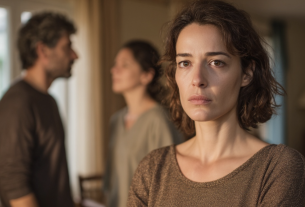
Tatyana looked at her husband. He turned away toward the window.
“Vol…” She stepped closer to the balcony door. “We agreed we’d divorce peacefully. You said you’d leave me the apartment.”
“Mom, maybe we still—” he began.
“No!” Raisa Petrovna stood up. “The apartment is registered in my name. I decide. Volodya needs to live, not dwell on the past.”
Tatyana felt the world around her starting to crack. Thirty years of marriage. Thirty years of washing, cooking, cleaning. Enduring her mother-in-law’s rudeness, staying silent when her husband came home drunk. Working at the library for a token salary because Volodya had said, “Why do you need a career? The home matters more.”
“But where am I supposed to go?”
“And why should we care?” her mother-in-law shrugged. “You’ve got that… what’s her name… Lena. You’ll stay with her.”
“Raisa Petrovna,” Tatyana tried to keep calm. “Lena lives in a one-room place with her daughter. There’s no space.”
“You’ll find space. You used to be smart, didn’t you?”
Volodya kept smoking. Tatyana understood: he wouldn’t stand up for her. He never had. His mother had always mattered more to him than his wife.
“Fine,” she said quietly. “Just at least let me pack my things.”
“What things?” her mother-in-law frowned. “My son bought everything. What could you buy with your library pennies?”
“My books…”
“They take up space. Volodya doesn’t need books.”
“My mother’s photos, my documents…”
“Take your documents. Don’t touch the rest.”
Tatyana stood there looking at them. Had they always been like this? Or had she simply not noticed? Thirty years of life had turned into one suitcase with documents and three dresses.
“Are you calling a taxi?” Volodya asked at last, turning to her.
“I’ll walk.”
“It’s far to Lena’s.”
“I’ll walk.”
She picked up the suitcase. It was light. Her whole life fit into one travel bag.
At the door she turned around. Volodya was already switching on the TV. Her mother-in-law was standing by the window.
“Raisa Petrovna,” Tatyana said. “What if I can’t manage alone?”
The older woman didn’t even turn around.
“So what? We’ve lived our lives. Now let Volodya find happiness.”
The door clicked shut. Tatyana stood on the landing thinking, Is this really happening to me?
The November evening was cold. She walked down the street with her suitcase and, for the first time in many years, she cried.
Lena opened the door in a robe and slippers.
“Tan’ka? What happened?”
“They kicked me out,” Tatyana set the suitcase in the hallway. “Completely kicked me out.”
“How is that possible?” Lena pulled her into the kitchen. “Tell me.”
Over tea, Tatyana poured everything out. Lena shook her head and cursed under her breath.
“Bastards. Absolute bastards. Tanya, I don’t have much space, but you’ll stay for now.”
“Len, it won’t be for long. I’ll find something.”
“What are you going to find on a library salary?”
Tatyana didn’t know. For the first time in her life, she truly didn’t know what to do next.
For a month she slept on Lena’s couch. She looked for work, but at fifty-eight no one was exactly lining up to hire her. And at the library they cut her position—crisis.
“Maybe you should go back to Volodya,” Lena asked one day.
“No,” Tatyana answered firmly. “Never.”
Help came unexpectedly.
Lena heard that a private children’s library had opened in the district. The owner was looking for an experienced librarian.
Irina Sergeyevna turned out to be a young, energetic woman.
“You have experience?” she asked at the interview.
“Thirty-five years.”
“Good. Can you work with a computer?”
Tatyana hesitated.
“Not really…”
“You’ll learn. The salary isn’t big, but it’s stable. Plus bonuses for events. Agreed?”
“Yes.”
The work was different. Irina demanded meetings with children, organizing contests, running social media. At first Tatyana was scared.
“Ira, maybe you should find someone younger,” she said in the first days.
“Tanechka, you’re a smart woman. You’ll learn everything.”
And she did. Computer courses for retirees, design workshops. Tatyana soaked it all up greedily. She hadn’t even suspected she’d find it interesting.
Six months later she rented a tiny studio. For the first time in her life she lived alone. It was quiet and calm. No one demanded dinner by six, no one criticized her every step.
At the library, children and parents came to love her. Tatyana invented quests, staged little theater performances. It turned out she had a talent for organizing celebrations.
“Tan, you’ve become completely different,” Lena said when they met a year after the divorce.
“Different?”
“You smile all the time. And you dress nicely.”
Tatyana looked at herself in the café mirror. It was true—she’d bought a new jacket, got her hair cut at a good salon. With her library wages she still had to be careful, but she’d started spending on herself.
“No men around?” Lena winked.
“Len, come on.”
“And why not? Life goes on.”
Life really did go on. Tatyana signed up for yoga, started going to the theater with colleagues. On weekends she went on excursions with the library club. For the first time she saw old estates near Moscow, visited monasteries.
“Can you imagine,” she told Lena, “Kolomenskoye is so beautiful! And I’ve lived in Moscow for thirty years and never knew.”
“With Volodya you just sat at home.”
“With Volodya I didn’t do a lot of things.”
Money was modest, but it was enough. Tatyana learned to cook simple meals, buy clothes on sale. But now everything belonged only to her.
The fifth year after the divorce began with a surprise. Tatyana was invited to the local history museum to work as a tour guide.
“You work with people so well,” the museum director, Anna Mikhailovna, told her.
“But I’m not a historian…”
“You’ll learn. You have a storyteller’s gift.”
Tatyana buried herself in books. She studied the district’s history, memorized dates and names. Her first tour was stiff, but people listened attentively.
“You tell things in such an interesting way,” an elderly visitor said. “Not like at school.”
A month later, Tatyana was giving tours regularly. She learned to joke with tourists, answer children’s tricky questions. At the museum they called her “our Tatyana Sergeyevna.”
On Saturday there was a city craft fair. The museum set up a stand, and Tatyana was supposed to talk about the area’s old crafts.
“Tan, you’ve become an actress,” Lena laughed when they met in the park. “I remember how you used to be afraid to say an extra word.”
“I’m surprised myself,” Tatyana admitted. “Turns out I like talking to people.”
The fair was crowded. Tatyana stood by the stand in a new blue dress, explaining pottery to schoolkids. Nearby, organizers bustled about, asking questions.
“And when did this appear in our district?” a young journalist asked.
“In the eighteenth century,” Tatyana answered. “Masters came from…”
“Tanya?”
She turned and froze. Volodya and his mother were standing by the stand. Raisa Petrovna looked at her in disbelief.
“Is that you?” the mother-in-law asked again.
“Hello,” Tatyana said calmly.
Volodya was silent. He had aged and gained weight. His mother looked older too.
“You… you work here?” Raisa Petrovna glanced at the stand.
“I help at the museum. I give tours.”
“Tatyana Sergeyevna,” Anna Mikhailovna came up, “television wants to film us. Are you ready to give an interview?”
“Of course.”
Her mother-in-law and Volodya stood and listened as the TV reporter asked Tatyana about her museum work.
“How many years have you been giving tours?”
“Not long. But I really like it. People thank me, kids ask questions. I feel useful.”
“And before that?”
“I worked as a librarian. I still do—at a children’s library. I combine both.”
When filming ended, Raisa Petrovna approached hesitantly.
“Tanya,” she began, “we didn’t think… I mean—how are you doing?”
“Good,” Tatyana replied. “Thank you for your concern.”
“Maybe we should meet sometime,” Volodya suddenly chimed in. “Talk.”
“About what?”
“Well… how life’s going.”
Tatyana looked at them carefully. Raisa Petrovna seemed unsettled. Volodya shifted awkwardly.
“My life really is good,” Tatyana said. “I like my work, I have friends. I’m content.”
“But still,” the mother-in-law persisted, “if you need anything…”
“I won’t need anything. Excuse me—people are waiting.”
A new group of visitors was approaching the stand. Tatyana turned toward them.
“Welcome! Now I’ll tell you about the amazing craftsmen of our region.”
Volodya and his mother stood for another minute, then walked deeper into the fair.
“Well, imagine that,” Tatyana heard Raisa Petrovna’s voice. “And we thought she’d be lost without us.”
Tatyana led two more tours after that meeting. She talked about potters and lace-makers, answered questions, smiled at tourists. But her thoughts kept circling back to Volodya and his mother.
“Are you okay?” Anna Mikhailovna asked when the fair ended. “You look a bit pensive.”
“Yes. I ran into my former relatives.”
“And how was it?”
“Strange,” Tatyana admitted. “They’ve aged. And I wasn’t afraid of them at all.”
Anna Mikhailovna smiled.
“Five years ago you would’ve hidden.”
“Five years ago I was a completely different person.”
Tatyana walked home on foot through the entire center. She wanted to think. In the square she ran into Lena with her granddaughter.
“Tan!” Lena shouted from afar. “How was the fair?”
“Fine. I saw Volodya.”
“Seriously? And what happened?”
“Nothing special. We talked and went our separate ways.”
Lena studied her friend’s face.
“You didn’t get upset?”
“Why would I?” Tatyana said, surprised. “My life is good. Why would I ruin my mood?”
“Exactly. You have a different life now.”
“A different one,” Tatyana agreed. “And I like it.”
At home she sat in her kitchen with tea and looked around her studio. Books on the shelves, photos from tours on the wall, flowers on the windowsill. Everything was hers, chosen by her.
The phone rang. It was a colleague from the library.
“Tan, there’s a dance night at the club tomorrow. Are you coming?”
“Of course. What time do we meet?”
“Seven at the metro.”
Tatyana hung up and thought: when was the last time she’d gone dancing? Probably at the neighbors’ wedding twenty years ago. Back then Raisa Petrovna had said, “At your age it’s indecent to hop around.”
And now she was fifty-eight. And she was going to dance.
In the evening at the club there was live music. Tatyana danced with different partners, laughed, drank fruit juice. Nearby her colleagues from the library and acquaintances from the museum were having fun.
“Tan,” Irina Sergeyevna said during a break, “do you remember what you were like five years ago?”
“I remember. Quiet as a mouse.”
“And now look at you. You give tours, you talk to people easily, you dance.”
“I can hardly believe it myself sometimes.”
“The divorce set you free,” Irina said. “You know what? You finally became your real self.”
Tatyana looked into the mirror behind the bar. Her reflection smiled back. Yes—she truly had become different. And she liked this new version of herself much more.
The music started again. An elderly man in an elegant suit approached and held out his hand.
“Dance?”
“With pleasure,” Tatyana replied.
They moved in circles to a slow melody, and she thought about everything that had happened over those years—fear, tears, her first independent steps, a new job, friends. And today’s meeting with a past that no longer frightened her.
“You dance beautifully,” her partner said.
“Thank you. I’m just learning again.”
“Again?”
“Yes. I’m learning a lot of things all over again.”
The evening ended. Tatyana sat on the bus and looked at the night city. Five years ago they had thrown her out of the apartment with a single suitcase. It had felt like life was over.
But now she knew: life had only just begun. The real one. Her own.