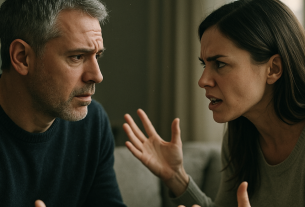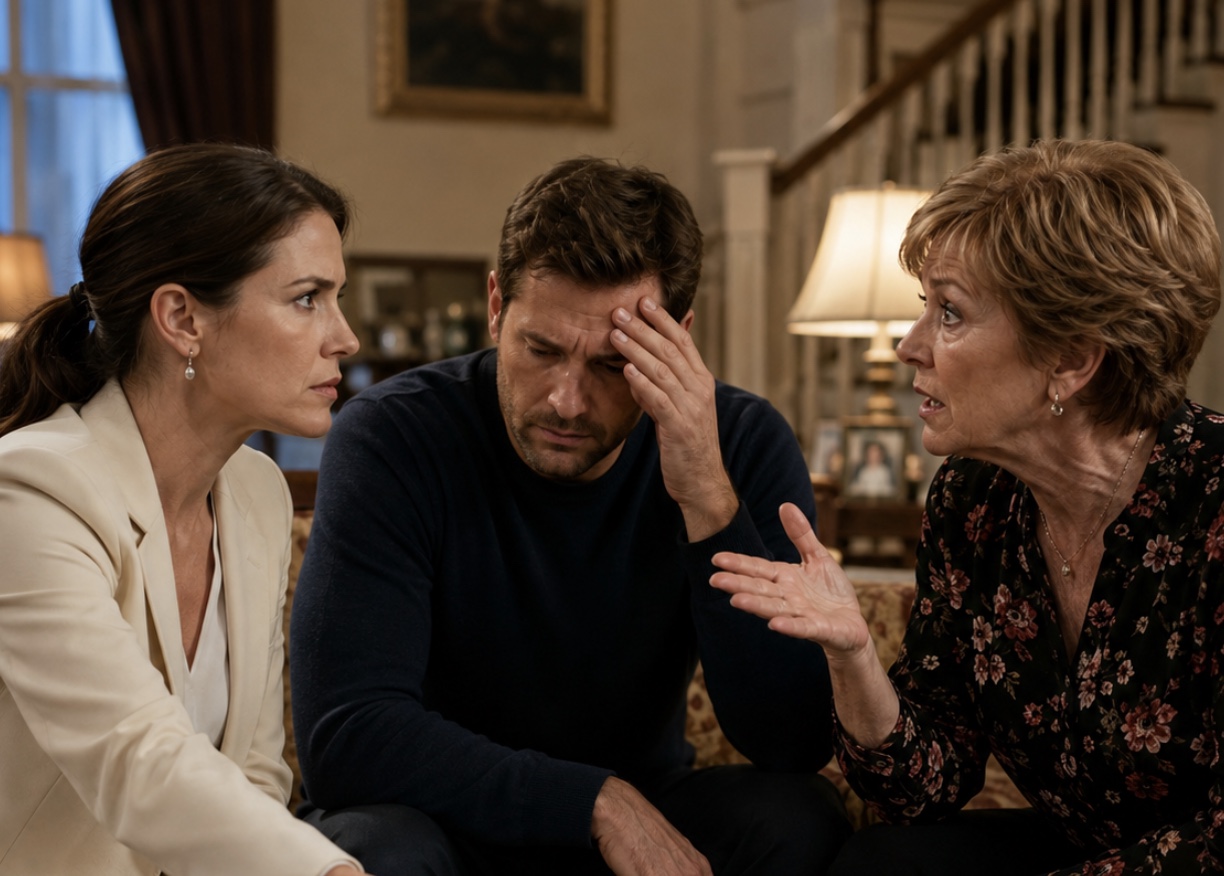
“Transfer everything into my name while that wife of yours is asleep. I’m your mother, after all—not some stranger.”
The whisper came through the half-open living room door—cold, businesslike, nothing like the sugary voice her mother-in-law usually used when other people were around.
Marina froze in the entryway of her own apartment, still clutching the keys in her hand. Her shift at the clinic had ended early. The department head had taken one look at her pale face and red eyes and told her to go home. The apartment should have been empty: Kirill was supposed to be at work until eight, and Marina had dropped their daughter off at her own mother’s place that morning.
But someone was in the living room.
Three people, in fact.
“The owner’s signature is required here,” said an unfamiliar male voice, calm and polished. “Your wife has no legal claim to this property. The house was registered solely in your name before the marriage.”
“You hear that, son? No claim at all. It’s yours. Your own family property. She has nothing to do with it.”
Marina leaned against the hallway wall. Her heart seemed to pound somewhere in her throat, and suddenly the air felt thick, as though there was no oxygen left in the apartment.
They were talking about the house.
The house in Sosnovka that Kirill’s grandfather had left him. It was old but solid, standing on a large plot with apple trees the old man had planted himself. Before he died, Grandfather had said plainly, in front of everyone:
“This is for you, Kiryusha. For you and your children. When you get married, live there. The air is good, and the kids will have plenty of room.”
The paperwork had simply been done in a hurry, several months before the wedding. Kirill had already proposed to Marina, they were choosing rings and had set a date. Grandfather had waved away the concern.
“What difference does it make? You’ll be a family soon anyway.”
So he had put only his grandson’s name on the documents.
Now someone was using that old technicality very skillfully.
“Kiryusha, why are you just sitting there?” Galina Petrovna, his mother, said again. “Arkady Lvovich is a busy man. He came here especially for this. You sign, and it’s settled.”
“Mom, maybe I should talk to Marina first?” Kirill’s voice was thin and uncertain, like a schoolboy caught doing something he knew was wrong.
“What is there to discuss with her? This was your grandfather’s house! She has nothing to do with it! You’re the owner. You decide.”
Silently, Marina slipped the keys into her coat pocket. She took off her boots and placed them by the wall.
Then she pushed open the living room door.
All three of them jumped.
Her mother-in-law was wearing a festive blouse, her hair carefully styled, her lipstick applied so perfectly that she looked as though she were attending a celebration.
Kirill was pale, a pen trembling between his fingers.
And beside him sat a stranger in an expensive suit, an open leather folder spread across the coffee table.
“Marina,” Kirill breathed. “You said you wouldn’t be back until eight…”
“What is going on here?” she asked quietly.
Galina Petrovna recovered first. Her expression changed instantly. The familiar smile appeared—the soft, warm smile she had perfected over the years.
“Marinochka, sweetheart, you’re home so early! Kirill and I were just taking care of a little family paperwork. Arkady Lvovich is an acquaintance of ours. He’s helping us organize some documents. Boring things, nothing you’d be interested in. Shall I put the kettle on?”
“What paperwork?”
“Oh, just formalities,” her mother-in-law said, waving the question away.
“What paperwork?” Marina repeated without moving.
The man in the suit cleared his throat and began gathering the papers.
“Perhaps I should come back another time.”
“Please stay,” Marina said evenly. “I want to know what my husband was about to sign while I wasn’t home.”
Galina Petrovna straightened. Her smile froze and became narrower, harder.
“Marinochka, really. This is none of your concern. The house belongs to Kirill, and he has every right to decide what happens to it.”
“What house?”
“Grandfather’s,” Kirill muttered, staring at the floor.
Marina walked over to the coffee table and picked up the top sheet. Her mother-in-law reached out to stop her but was too late.
Deed of Gift.
Donor: Kirill Andreevich.
Recipient: Galina Petrovna.
The house in Sosnovka.
He was giving it away.
To his mother.
Marina placed the document carefully back on the table. Her fingers trembled slightly, but her voice remained steady.
“Explain,” she said to her husband.
Kirill stared at the pattern in the carpet as though he had never noticed it before.
“Kirill. Please explain why you are giving your mother the house your grandfather left to you. To us. To our children.”
“Marinochka,” Galina Petrovna interrupted, “you don’t understand. Kiryusha wanted to do this himself, out of the goodness of his heart. He wants his mother to have some security in her old age. If anything happens, I could sell the house or rent it out. I’m not far from retirement…”
“You’re fifty-nine,” Marina cut in. “You run a department at a bank and earn twice what Kirill and I make together. What old age are you talking about?”
“Don’t you dare raise your voice at me!”
“And don’t you dare interfere in my family.”
A ringing filled Marina’s ears. For a second, the room seemed to tilt. She gripped the back of an armchair.
And suddenly, everything that had been weighing on her for years, everything she had swallowed in silence, broke loose.
Six years.
For six years she had tolerated this woman.
The three phone calls a day to Kirill.
The unannounced visits with a set of keys Galina Petrovna had secretly copied “just in case.”
The constant comments about the way Marina cooked soup, dressed her daughter, spent money.
Her mother-in-law would come in, open the refrigerator and shake her head.
“Marinochka, my son was raised on proper food. Everything you buy is processed.”
She would call at midnight.
“Kiryushenka, my heart is acting up. Come over.”
She bought their daughter expensive toys, then asked in a sweet voice:
“Would Mommy buy you something like this? No? Poor little thing.”
And Kirill was always caught in the middle.
Always smiling nervously at both of them.
“Marina, she’s my mother. Just be patient.”
Then to his mother:
“Mom, Marina is my wife. Don’t upset her.”
He never chose a side.
Not once in six years had he truly stood beside his wife.
And today, he had almost given away his children’s future to his mother.
Behind his wife’s back.
Because Mommy had asked.
Marina straightened and walked into the children’s room. She sat on the small bed with rabbits printed on the blanket and looked around.
Toys. Books. Childish drawings taped to the wall.
Polina was five years old.
In a year, she would start school.
In ten years, she would be a teenager.
In fifteen, she would have a life of her own.
And all that time, her father would still be a man who could not say no to his mother.
Marina closed her eyes.
Grandfather had always said:
“The most important thing is to have a corner that is truly yours, Marisha. A place no one can throw you out of or hold over your head. What is yours should stay yours.”
He knew what he was talking about. He had lived through barracks, dormitories and borrowed rooms. When he finally built his own house, he held on to it until his last breath.
That house was his gift to the next generation.
Their future.
And today Marina had almost lost it—not because of some stranger, but because her own husband had nearly signed it away.
She took out her phone.
“Mom, hi.”
“Marish? What happened? You don’t sound like yourself.”
“Mom, I need advice. I need a lawyer. Or a good notary.”
“What happened?”
Marina told her everything. Briefly. Calmly. No tears, no dramatics—only facts. Her mother-in-law would have cried, screamed and made a performance out of it.
Marina didn’t need one.
Her mother was quiet for a moment.
“I know someone. A very good notary. I’ll call her tomorrow. But Marina… think carefully. This is serious.”
“I have thought about it, Mom. For six years.”
“Then I’m with you.”
That evening Kirill came home alone.
Without his mother.
He stood in the hallway for a while, afraid to enter.
“Marina…”
“Come in. Polina is staying with my mother tonight.”
He sat opposite her. For a long time, neither of them spoke.
“I’m sorry.”
“For what exactly?”
“For the house. I shouldn’t have… Mom talked me into it, and I…”
“Kirill, you’re thirty-six years old. You’re not a schoolboy whose mother makes him do his homework. You are an adult man. You have a wife and a daughter.”
“I know.”
“Do you? Then why are you still living like a little boy attached to his mother’s skirt? Why is everything she says a command?”
“She’s my mother…”
“And who am I?”
He had no answer.
“Kirill, tell me the truth. Just the truth. Would you have signed?”
“I… I don’t know.”
“You do know. If I hadn’t come home early, you would have signed it.”
“Maybe.”
“I see.”
Marina stood, poured herself a glass of water, and sat back down.
“I’ve made a decision.”
Kirill tensed.
“What decision?”
“Polina and I are moving to Sosnovka. To Grandfather’s house.”
“Marina!”
“Don’t interrupt me. We’re moving into that house—the one that is legally registered in your name. And I want you to transfer ownership to Polina.”
“What? She’s a child.”
“We’ll handle it legally. Until she turns eighteen, we’ll act as her parents and guardians. But Polina will be the owner. And no one—not your mother, not anyone—will ever be able to take it away from her.”
Kirill was silent for a long time.
“And what about us?” he finally asked.
“We are a separate issue. I’m not filing for divorce today. But I will not live under the same roof with you until you decide who comes first in your life: your mother, or the family you created yourself. Do you understand?”
“Yes.”
“One more thing. Your mother will no longer enter my home. Not this apartment, and not the house. If you want to see her, meet at her place. Polina can visit her with you, on her territory. But she will not come into ours.”
“That’s harsh, Marina.”
“It’s fair. She tried to take away our daughter’s future. I won’t forgive that.”
He lowered his head.
“Think about it. You have time. I’m not disappearing. I’m simply moving into our house with our daughter. You can visit. You can visit often. You can even move in permanently. But not with your mother’s interference. No advice. No spare keys in her pocket.”
“And if I can’t?”
“Then we’ll divorce. You’ll see Polina according to an agreed schedule. That will be your choice, Kirill. Not mine.”
A week later, Marina and her daughter moved into the house.
It greeted them with dust, cobwebs in the corners and the stale smell of an empty building. The stove needed cleaning, the window frames had dried out, and the porch creaked as if complaining.
But it was their home.
More precisely, it was Polina’s.
Kirill transferred ownership without arguing. Marina insisted, and this time he didn’t resist.
Galina Petrovna called her son every day.
At first she cried.
Then she screamed.
Then she cried again.
She threatened never to “lift a finger for him again,” to remove him from her will, to forget she had ever had a son.
Kirill listened, nodded into the phone, but did not run back to her.
For a month, he lived alone in their old city apartment.
He came to Sosnovka on weekends, brought groceries, played with Polina, helped repair the porch and seal the windows.
In the evenings, he drove back to the city.
He and Marina talked.
Slowly.
Carefully.
Almost as if they were getting to know each other all over again.
“Marina, I made an appointment with a therapist,” he told her one day. “I’m going alone. I need to sort all of this out in my head.”
“Go.”
“I haven’t called Mom in two weeks. She keeps calling me, but I don’t answer.”
“How does it feel?”
“Strange. Like I’m breaking a habit. It’s difficult, but… I can breathe more freely.”
“I understand.”
He really was changing.
Slowly and unevenly, but genuinely.
One day he arrived carrying a bag of nails and a hand plane. Before he had even taken off his coat, he said:
“I talked to Mom about boundaries. I told her I’m not going to come running every time she calls. I told her I have my own family. She hung up on me. And you know what? It didn’t hurt as much as I expected.”
Marina was making soup on the old stove. The room smelled of smoke and dill.
Polina was sitting at the table drawing a house with a chimney and a yellow sun in the corner.
“Dad, look! This is our house!” she announced proudly. “With the apple trees!”
Kirill crouched beside her and hugged his daughter.
Watching them, Marina felt something tight inside her finally begin to loosen.
Two months later, Kirill arrived with his belongings.
No speeches.
No dramatic declarations.
He simply showed up on a Saturday carrying two bags and asked quietly:
“Can I stay? For good?”
Polina jumped around him excitedly.
“Daddy is staying with us forever! Daddy is staying with us forever!”
Marina looked at them—at her daughter clinging to her father and at the husband who had finally made a choice.
“You can,” she said.
Marina had not seen Galina Petrovna since the day the stranger in the expensive suit had opened his leather folder on their coffee table.
Her mother-in-law called Kirill less often now. Their conversations were neutral—weather, prices, everyday matters.
On Polina’s birthday, Galina Petrovna sent money.
Marina deposited it into the child’s savings account.
Then one day Galina Petrovna asked to meet.
Kirill looked at his wife.
“Marina, she wants to talk to you.”
“Why?”
“I think she wants to apologize.”
Marina considered it.
“All right. But not at our house. In the city, at a café. And you’ll be there.”
They met the following weekend.
Galina Petrovna was sitting at a table by the window.
She looked older, thinner.
No festive blouse.
No bright lipstick.
Underneath the familiar mask of the sweet, caring grandmother was something Marina had never really seen before.
Exhaustion.
Perhaps even understanding.
“Marina, I came to tell you I was wrong.”
“About what exactly?”
Her mother-in-law hesitated.
“Well… the house. I shouldn’t have done that.”
“What else?”
“Marina, I’m apologizing…”
“Galina Petrovna, I want you to be specific. What were you wrong about during those six years?”
Her lips tightened.
She looked at her son.
Kirill remained silent. He did not rush to rescue her.
Then she looked back at Marina.
Marina waited.
“I interfered,” Galina Petrovna finally admitted. “I called too often. I gave advice when no one asked for it. I made myself keys to your apartment. I… wanted Kirill to stay close to me the way he had when he was a child. I didn’t let you live your own lives.”
“Thank you,” Marina said. “That’s honest.”
“Can I see Polina?”
“Yes. In neutral places. At your home, in the park, in a café. With Kirill or with me present. Not alone—not until I trust you again. If you earn that trust back, we can reconsider.”
“All right.”
They finished their tea and left.
No hugs.
No tears.
No dramatic reconciliation.
Just an end to the war.
That evening, while putting Polina to bed, Marina sat on the edge of the mattress and stroked her daughter’s hair.
“Mommy, are we going to live here forever?”
“Forever, sweetheart.”
“And Daddy?”
“Daddy too.”
“And Grandma Galya?”
“Grandma will visit sometimes.”
Polina thought seriously for a moment, then sighed with all the gravity of an adult.
“It’s good that this house is mine. It’s the best house. It has apple trees.”
Marina smiled.
“The very best, sweetheart. Now go to sleep.”
She walked into the kitchen.
Kirill was sitting at the table with plans for a future veranda spread out in front of him. He was an engineer and loved planning everything carefully in advance.
“Marina.”
“What?”
“Thank you.”
“For what?”
“For not leaving completely. For giving me a second chance. And for not letting me hide from myself until I finally understood what I was doing.”
She sat beside him and rested her head on his shoulder.
“Kirill, we still have a lot ahead of us. There will be mistakes. There will be arguments. Just remember where your family is.”
“I remember.”
Outside the window, the first snow was falling, covering Grandfather’s apple trees in white.
Inside the house, it was warm and quiet.
The stove crackled.
The floorboards creaked beneath their feet.
There was still plenty of work to be done.
But it was a home.
A real home.
No outside orders.
No spare keys in someone else’s pocket.
No second woman secretly acting as mistress of the house.
Only Marina, Kirill and Polina.
And Grandfather’s memory was everywhere—in the apple trees beyond the window, in the strong walls, in the words he had repeated throughout his life:
The most important thing is to have a place of your own.
A place where no one can throw you out.
No one can make you feel indebted for being there.
No one can take it away.
Marina closed her eyes and listened to the silence.
And for the first time in six years, there was not a single unwanted voice in it.