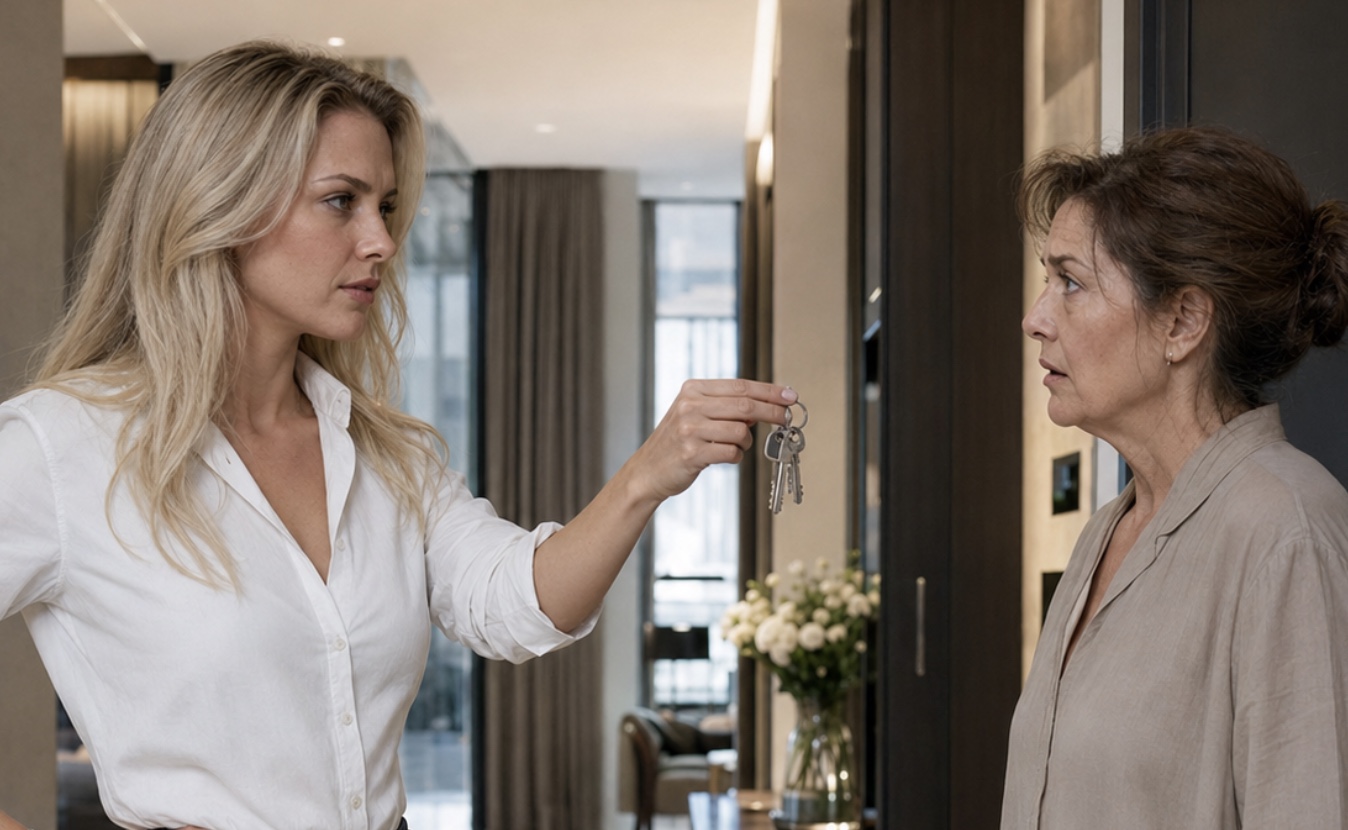
“Bring me every spare key. Today. And from now on, nobody enters this apartment without my permission,” the owner said.
Lada spoke quietly, standing in the middle of her own kitchen. On the table lay peaches she had not bought, a child’s cap decorated with a plastic dinosaur, and an open bag of charcoal for a barbecue.
She had returned home two days early.
Her business trip to Kazan had ended ahead of schedule. The contractor signed the documents without the usual haggling, her plane landed in St. Petersburg before noon, and by four o’clock Lada was already riding the elevator up to her apartment on Vasilyevsky Island.
She had imagined a cool, silent home and an empty refrigerator. She wanted to take a shower, order some food, and ignore everyone until evening.
The front door was unlocked.
Four unfamiliar pairs of shoes stood in the hallway. A television was playing in the living room. Someone on the balcony was loudly discussing how much meat they should buy for the weekend, and the washing machine was running in the bathroom.
The first person to notice Lada was a girl of about eight. She ran into the hallway wearing a wet swimsuit, nearly slipped on the tiles, and shouted:
“Grandma, some lady is here!”
A moment later, Danil’s mother, Raisa Mikhailovna, appeared from the kitchen. She was wearing Lada’s linen apron, the one her colleagues had given her for New Year’s. In one hand she held a knife, and in the other, half a melon.
Raisa Mikhailovna did not look frightened. She simply studied Lada, who was still holding her travel bag, and said:
“Why are you back today? Danya said you wouldn’t return until Sunday.”
Lada did not answer.
She walked into the living room and found Raisa Mikhailovna’s brother, his wife, their two children, and a folding table pushed toward the window. Towels covered the sofa. An inflatable swimming ring lay on the floor. The air conditioner was running at full power even though the balcony door was wide open.
On the coffee table, Lada noticed a sheet torn from a notepad. Danil had written down the building entry code, the Wi-Fi password, and a brief set of instructions in his own handwriting:
“Towels are in the cupboard. Bed linen is in the bottom drawer. Give the keys to Mom afterward.”
The final sentence had been underlined.
Lada placed her bag against the wall, shut the balcony door, and switched off the air conditioner.
Only then did she ask:
“Who has the keys?”
Raisa Mikhailovna shrugged.
“I do. Danya gave them to me. What’s the problem? We’re only staying for a few days. The pump at our country house broke, so there’s no water. It’s more comfortable for the children in the city. You were away anyway.”
Lada looked at Danil.
He stood by the window with his phone in his hand, clearly trying to decide what tone to use. They had lived together for almost three years. He knew perfectly well that raising his voice had no effect on Lada. Facts were what mattered to her, and at that moment, every fact was against him.
The apartment belonged to Lada.
It had not been inherited from her grandmother. It was not merely something she had bought before the relationship or was still paying off. She had purchased it four years earlier after selling a studio apartment in Murino and adding the money she had saved during eight years of working for an architectural design firm.
Danil came later.
He moved in with two suitcases, a coffee machine, and a promise that he had no intention of claiming anything that was not his.
During the first year, the arrangement worked well. He paid for groceries, occasionally covered utility bills, and ordered bottled water. Lada handled renovations, insurance, taxes, and everything connected to the apartment as property.
Gradually, Danil began speaking about the home as though it belonged to both of them.
At first, the comments sounded harmless.
“We have a wonderful view.”
“We chose a great neighborhood.”
Then he became more confident.
“We’ll have to replace the wardrobe in our bedroom.”
A few months earlier, he had even told friends that “they had bought an apartment on the island.”
Lada corrected him in front of everyone.
Danil was offended, but he did not argue.
Now she had discovered that he had made spare keys and handed them out without asking her.
“Bring me every spare key. Today. And from now on, nobody enters this apartment without my permission,” Lada repeated.
Raisa Mikhailovna placed the melon on the table.
“Don’t make a scene. We’re family.”
“You are Danil’s relatives.”
“And what is Danil to you?”
“A man who copied the keys to my apartment without my permission.”
Danil finally put his phone into his pocket.
“Lada, let’s not turn this into a circus. Mom asked for help. There are three rooms here, so there’s plenty of space. You weren’t home.”
“I was away for four days. Did the apartment stop belonging to me during that time?”
“Nobody said that.”
“You gave strangers the keys to it.”
“My mother.”
“She is your mother. To me, she is a person who entered my home without my consent and brought four more people with her.”
The kitchen fell silent.
Even the children stopped making noise.
Lada was not planning to throw everyone out that very second. It was not because she felt sorry for them or wanted to preserve a good relationship. She simply cared more about the result than the scandal.
She wanted to understand how far Danil had already gone.
“You have two hours to pack,” she told his relatives. “Arrange your own transportation. Take everything you brought with you. Leave the bed linen in the bathroom. The towels too.”
Raisa Mikhailovna smirked.
“Danya, do you hear that? She’s throwing your family out.”
“I hear,” he replied.
But he did not move.
Lada noticed that and became completely calm. The worst part had already happened. Now she only needed to distribute the consequences correctly.
While the guests packed, she walked through the apartment.
One of their suitcases was sitting directly on her office chair in the bedroom. Boxes containing documents had been moved inside the wardrobe. Her expensive shampoo was empty, and someone else’s razor lay on the bathroom shelf.
In her study, she found a cup of dried coffee on the windowsill beside an open folder containing her work drawings.
Lada photographed everything.
She did not do it for the police or to file a complaint. She did not need evidence for outsiders. She simply wanted to check later, when she was thinking clearly, whether anything was missing.
In the bottom drawer of her desk, she found an envelope.
“For appraisal,” someone had written on it.
Inside were a printed listing for a similar apartment in the same building, the contact information of a real estate agent, and a rough estimate of the property’s value.
Danil had circled the price on the first page and added a handwritten note:
“If we sell this place and buy a house, there will still be money left for renovations.”
Lada sat down at the desk.
At that moment, the situation stopped being ordinary family arrogance.
Danil could not sell her apartment. He understood that. He was not stupid, and he knew perfectly well whose name was on the ownership documents.
That meant he had expected to persuade her.
Perhaps he had already discussed it with his mother. Perhaps the relatives had not come merely because the water pump had broken.
Lada returned the papers to the envelope and placed it exactly where she had found it.
An hour and a half later, the apartment was empty.
Raisa Mikhailovna was the last to leave. She threw the keys onto the hallway cabinet.
“You’ll regret this,” she said. “This is not how you build a family.”
Lada counted the keys on the ring.
There were two: one for the upper lock and one for the lower lock.
“Where are the copies?”
“What copies?”
“The ones Danil had made.”
Raisa Mikhailovna looked at her son.
He turned away.
Lada understood that this was not the only set.
She did not argue.
When the door closed, Danil walked into the living room and dropped heavily onto the sofa.
“Are you happy now?”
“Not yet.”
“Mom won’t come here again. That’s it. The matter is over.”
“How many sets of keys did you make?”
“One.”
“Don’t lie.”
“Lada, I don’t have to report every single key to you.”
“When it belongs to my apartment, you do.”
He stood up.
“You constantly emphasize that everything here is yours. The apartment is yours, the furniture is yours, the renovation is yours. Then what am I?”
“A person who lives here with my permission.”
Lada said it calmly.
Danil turned paler than he would have if she had shouted.
“Wonderful. So I’m nobody.”
“We are not discussing your self-esteem right now. I asked how many sets you made.”
“Two. Mom had one. The second is in my car.”
“You’ll bring it upstairs.”
“And then what?”
“Then I’m replacing the lock cylinder.”
“Are you serious?”
“Completely.”
He gave a short laugh.
“Wonderful. After three years together, you’ve decided to change the lock to keep me out?”
“No. I’m changing it because I don’t know how many people you may have given copies to. You will receive a new key if we decide that you are still going to live here.”
That night, Danil slept in the living room.
Lada locked the bedroom door, but she did not fall asleep immediately. She did not mourn or replay their happiest memories in her head. Instead, she opened her banking app and reviewed their shared expenses from the previous few months.
They did not have a joint account. Danil had suggested opening one several times, but Lada had refused. Each of them paid for their own things, and they discussed major purchases in advance.
However, during the previous six months, Danil had repeatedly asked her to transfer money to him, claiming that his card offered better cashback on building supplies.
First, it had been paint for Raisa Mikhailovna’s country house. Then household appliances. Then furniture.
Lada had almost always refused.
Now she opened their old messages and found one from Danil:
“If we buy a house, you’ll have to sell the apartment anyway. I can start looking at options now.”
At the time, she had replied that she had no plans to buy a house.
Danil had sent an offended emoji and never mentioned the subject again.
At least not to her.
Lada woke at seven the next morning. Danil was still asleep. She measured the old lock cylinder, wrote down its dimensions, and drove to a hardware store that opened earlier than the others.
July had already heated St. Petersburg. The air shimmered above the pavement, and the minibus smelled of dust and sweet coffee in paper cups.
People were going to work, to their country houses, to medical appointments, and to attend to their ordinary lives.
None of them knew that during the previous twenty-four hours, Lada had quietly dismantled three years of her own life and discovered someone else’s plan hidden inside it.
She bought a high-quality new lock cylinder with five keys in a sealed package. She also purchased a small metal document box and several tamper-evident security stickers.
By nine o’clock, the lock had been replaced.
Lada placed the old cylinder in a bag and stored it in a cupboard. Danil watched her from the kitchen.
“You could at least have called a locksmith.”
“Why? It was only two screws.”
“You’re doing this to make a point.”
“I’m solving a problem.”
“Are you going to give me a key?”
Lada removed one key from the ring and placed it on the table.
“For now.”
He picked it up without thanking her.
Lada worked from home that day. Danil left, saying that he would return late.
Around lunchtime, an unfamiliar number called her.
The man introduced himself as Artyom, a real estate agent.
“Danil gave me your contact information. I wanted to ask when it would be convenient to inspect the property.”
“What property?”
“The three-room apartment on Vasilyevsky Island. He said you were considering selling closer to autumn.”
Lada looked toward the closed door of her study.
Now everything was perfectly clear.
“Danil is not the owner,” she said. “The apartment is not for sale. Do not contact me about this again.”
The agent apologized too quickly. He had probably already realized what kind of situation someone had tried to drag him into.
Ten minutes later, a message arrived from Danil:
“Why are you rude to people? I was only trying to find out the value.”
Lada did not respond.
That evening, he came home with flowers.
It was not even funny.
Danil rarely bought flowers, and when he did, he always chose them at the last minute: a supermarket bouquet, three branches of chrysanthemums, and a price sticker the cashier had forgotten to remove.
He placed the bouquet in the sink and said:
“Let’s talk like normal people.”
Lada closed her laptop.
“Go ahead.”
“I really was thinking about a house. Not just for myself. For us. It’s noisy here, there’s no parking, and it gets unbearably hot in summer. Mom found a good place near Vsevolozhsk. A large plot, a finished house. If we sold the apartment, we could buy it with almost no mortgage.”
“You arranged an appraisal of my apartment without asking me.”
“I didn’t arrange a sale. Only an appraisal.”
“You gave the agent my phone number.”
“Because you are the owner.”
“And you moved your relatives in so they could get used to the apartment?”
Danil fell silent.
Lada had hit the target.
Raisa Mikhailovna had dreamed for years of living closer to the city center. Her country house was suitable only in summer, while her two-room apartment in Kupchino belonged equally to her and her brother.
The brother who had just arrived with his family because of a supposedly broken water pump.
Lada could already see the plan.
The house near Vsevolozhsk would be bought with money from the sale of her apartment. She and Danil would move there. Raisa Mikhailovna would sell her share of the Kupchino apartment to her brother and put some of the money toward renovating the house.
In exchange, she would gain the right to live there whenever she wanted.
Meanwhile, her brother would probably have expected to use the city apartment more often until the transaction was completed.
A convenient family arrangement.
They had simply forgotten to inform Lada.
“Who would have owned the house?” she asked.
“We would.”
“In what proportions?”
“We would have discussed it.”
“With whom?”
“With everyone.”
“With everyone except the person whose money was supposed to pay for it.”
Danil frowned.
“You make it sound as if we were trying to rob you.”
“No. You were planning to convince me that your arrangement benefited me. To prepare me for that, you started treating my apartment as shared property, hoping I would gradually become used to it.”
“That’s paranoia.”
“Then show me the house listing.”
“What listing?”
“The wonderful house near Vsevolozhsk.”
He stared at her for a long moment before opening his phone.
The house really existed.
It had two floors, gray siding, a bathhouse, and twelve hundred square meters of land. The description claimed the owners needed a quick sale because they were moving. The asking price was below the market average.
Lada enlarged the photographs.
In the third picture, an electrical transmission tower could be seen behind the fence. In the fifth, water filled a roadside ditch even though the photographs had clearly been taken during dry weather.
“Is there an address?”
“You get it after calling the agent.”
“What is the cadastral number of the property?”
“I don’t know.”
“Who checked the documents?”
“Mom spoke to the seller.”
“So nobody.”
“You always look for problems.”
“That is exactly why I own an apartment, while your mother owns half an apartment with her brother and a summer house with a broken pump.”
He stood up sharply.
“Don’t you dare humiliate my mother.”
“I listed her property. If facts humiliate you, that isn’t my problem.”
The next day, Lada took time off work.
She had no intention of purchasing the house, but she wanted to understand why Danil was in such a hurry.
Using publicly available information, she identified the property from the photographs and the address of a nearby gardening community. The land was not designated for individual residential construction. It was classified as a garden plot. The house itself was officially registered as nonresidential.
Part of the property fell within the protected zone of the power lines.
In addition, there were two owners, one of whom was a minor.
There could be no quick and uncomplicated sale.
However, a neighboring plot belonged to an acquaintance of Raisa Mikhailovna.
Lada found the man’s surname in an old conversation with Danil. A year earlier, he had asked her to help his mother write an advertisement for the land, but they had never found a buyer.
At that point, everything finally came together.
The house was bait.
After Lada sold her apartment, they would suggest temporarily staying at the country house, then purchasing the acquaintance’s plot and starting construction “once more money became available.”
Part of the money would inevitably disappear into someone else’s debts, repairs to the country house, and various family expenses.
Danil probably did not consider it deception.
He sincerely believed that Lada’s money could be transformed into a shared future controlled by his family. In his imagination, she would resist at first, eventually agree, and later admit that they had made the right decision for her.
Lada did not stage a dramatic exposure.
Instead, she prepared.
First, she moved all important documents into a bank safe-deposit box. At home, she left copies and several outdated agreements that no longer mattered.
Then she checked her electronics, jewelry, and work materials.
Nothing was missing.
After that, she sent Danil a brief message:
“We are talking tonight at eight. Be home.”
He arrived on time.
Raisa Mikhailovna called him twice while he was taking off his shoes. Danil rejected both calls.
Three sheets of paper lay on the kitchen table.
The first contained the information Lada had found about the house.
The second showed details about the neighboring land owned by his mother’s acquaintance.
The third was an estimate of Danil’s expenses during the previous eight months.
Lada had not been deliberately monitoring him. She had simply collected the information he had mentioned himself: credit card debt, a car loan, installment payments for his phone, and money borrowed from a colleague.
The total was more than nine hundred thousand rubles.
“You investigated my debts?” Danil asked.
“No. I added up the things you never considered necessary to hide.”
“And what are you trying to prove?”
“That the house was not the goal. The goal was the money from selling my apartment.”
“That’s nonsense.”
“You owe almost a million rubles. Your mother has no money to repair her country house. Her acquaintance has been unable to sell his land for a year. Then suddenly, all of you find a house that cannot be purchased quickly or easily, but you still push me toward urgently selling a liquid city apartment.”
“Nobody was pushing you into anything.”
“You ordered an appraisal.”
“I only wanted to know the price.”
“You made copies of my keys and gave them to your mother.”
“We already discussed that.”
“No. We discussed the violation of my boundaries. Now I am informing you of my decision.”
Danil looked at her cautiously.
Lada took out a fourth sheet of paper.
It was not a contract or any kind of legal document. It was simply a list of Danil’s possessions currently inside the apartment: clothing, the coffee machine, his gaming console, tools, bicycle, dishes, and boxes of books.
“You have ten days to move out,” she said. “You may stay until the end of the month. You will return the key on your final day.”
For a moment, he did not understand.
“You’re throwing me out?”
“I’m ending our living arrangement.”
“Because of the keys?”
“Because the keys turned out to be part of a plan in which my property had already been distributed without me.”
“There was no plan.”
“Then it will be easy for you to explain to your mother why it failed.”
Danil walked around the kitchen.
He did not shout.
That was what made the conversation so difficult. He was searching for an argument that could restore everything to the way it had been, but every possible argument required him to admit at least part of the truth.
“I lived here for three years,” he finally said.
“Yes.”
“I contributed.”
“You paid for groceries and part of the utilities. That was your share of our common living expenses, not payment for ownership.”
“I assembled the wardrobe.”
“I bought the wardrobe.”
“I painted the walls.”
“I bought the paint. In exchange for your work, you lived here for three years without paying rent.”
“So all this time, you were calculating how much I owed you?”
“No. Until yesterday, I considered us a couple.”
Danil sat down and covered his face with his hands.
Lada felt no triumph.
The situation was unpleasant, but it did not hurt. Pain would have come if she had continued deceiving herself for another year or two, sold the apartment, invested in someone else’s project, and discovered that her right to make decisions had disappeared together with her money.
Danil moved out a week later.
He rented an apartment not far from his mother. He removed his belongings gradually and without scenes.
Raisa Mikhailovna came once, but Lada did not allow her past the entrance hall.
“I want to collect Danya’s coffee machine.”
“It is packed. He will pick it up this evening.”
“We need to talk.”
“No, we don’t.”
“You destroyed a family over something insignificant.”
“Your family is still intact. It simply will no longer control my apartment.”
Raisa Mikhailovna pressed her lips together.
“Danya did so much for you.”
“Tell him to make a list. I’ll compare it with the list of things your family tried to do at my expense.”
After that, the woman left.
On his final day, Danil brought back the key and placed it on the hallway cabinet.
Lada checked the ring.
“The second one is missing,” she said.
“What second one?”
“You received two new keys. You carried one and kept the other in the drawer.”
He remained silent for several seconds, then removed a key from his wallet.
“Do you keep track of everything?”
“Almost everything.”
“It must be exhausting to live like that.”
“It is much easier than discovering your own apartment listed among someone else’s assets.”
Danil left.
Lada waited until the elevator reached the ground floor, then replaced the lock cylinder again.
The previous one worked perfectly, but one of its keys had spent several days in the possession of someone she no longer trusted.
By evening, the work was complete.
Five new keys lay in a sealed package.
Lada attached one to her key ring. She gave another to her sister, who lived two blocks away and never visited without calling first. The remaining keys went into the metal document box.
A month later, Artyom, the real estate agent, called her again.
He apologized at length and explained that Danil had contacted him once more to ask about the apartment’s value. This time, he had introduced himself as the man who was “handling the matter with the owner.”
“I thought I should warn you,” Artyom said. “He asked me to find a house for both of you and wanted to arrange a preliminary viewing agreement.”
“Thank you. Do not search for anything.”
After the call, Lada blocked Danil’s number.
By the end of August, she finally did something she had been considering for a long time but had postponed because Danil disliked the idea.
She rented out one room as an office to an architect she knew.
The woman came three times a week, paid on time, and never left coffee cups on the windowsill.
With the extra income, Lada installed a new air conditioner, replaced the balcony windows, and bought herself a proper work desk.
One evening, her sister asked whether she regretted anything.
Lada looked out at the city.
Summer was ending. A pale sky stretched above the rooftops. Children in the courtyard were finishing slices of watermelon, and the smell of roasted peppers drifted from an open window nearby.
“I do,” Lada replied. “I regret not asking immediately how many sets of keys he had made.”
Her sister laughed, thinking it was a joke.
But Lada was not joking.
She understood that other people’s plans rarely begin with loud demands.
First, someone simply takes a spare key.
Then they bring in their relatives.
Then they begin calling your apartment “ours.”
Then they ask you to consider buying a house.
And when you finally notice that every decision has already been made, they explain that it was all done for the sake of the family.
That was why Lada did not seek revenge or try to prove that she was right.
She simply closed the door in time.
And put a new lock on it.