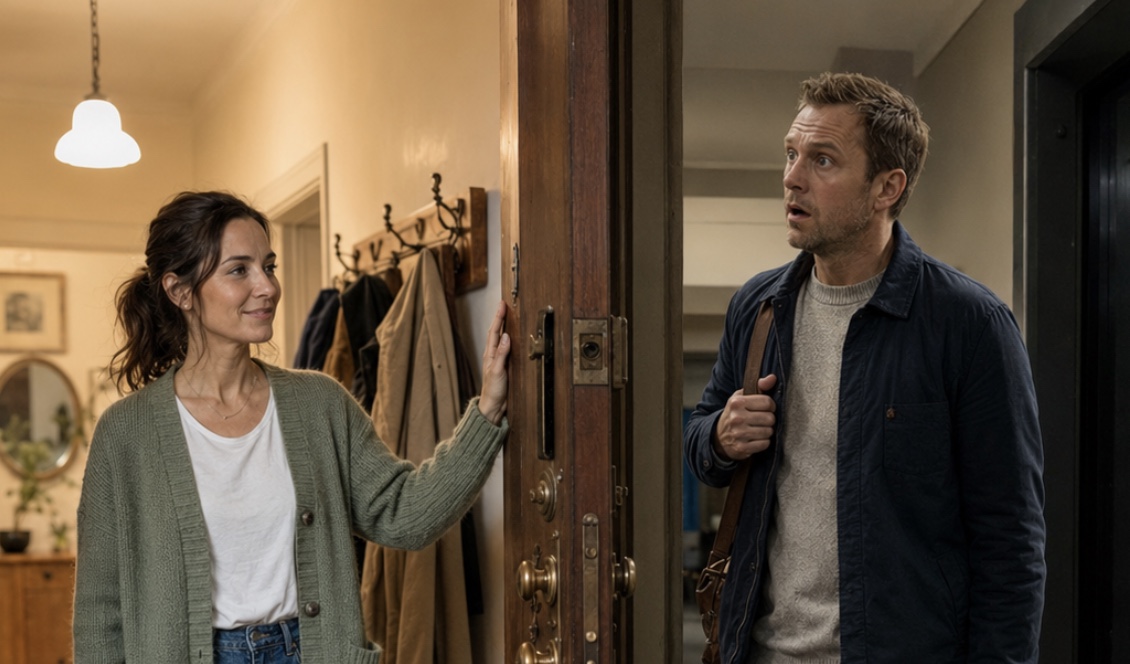
When Gleb packed his suitcase and asked her not to change the lock, Zinaida did not scream. Instead, she did something else—something he had never expected and could not have predicted during all fifteen years of their marriage.
The key lay on the little cabinet in the hallway. Not hanging from its usual hook, but resting on the cabinet beside the water bill and their daughter’s old hairbrush. Zinaida stared at it and thought that the key probably weighed no more than twenty grams.
And yet it seemed to contain their entire life.
Gleb stood by the door with a bag.
Not a suitcase, actually. It was a blue sports bag with a broken zipper on the side pocket. Zinaida had bought it for him three years earlier at Sportmaster, when he had suddenly decided to start swimming. His enthusiasm for the pool had lasted a month.
The bag had remained.
He spoke quietly, almost apologetically, though not quite. There was something else in his voice—the tone of a man who had already made his decision and now expected everyone around him to accept it.
“I’ll need to come back for some of my things,” he said. “My winter coat, for example. And the tools in the storage closet.”
Zinaida stood with one shoulder resting against the wall. The fingers of her right hand worried the edge of her sleeve. Her burgundy sweater, stretched at the elbows, smelled of laundry detergent and faintly of vanilla from the pastries she had baked that morning.
“All right,” she said.
Gleb blinked.
He had expected something else. Shouting, tears, perhaps a plate thrown at his face. Or at least the kind of silence that made your ears ring.
Instead, she had simply said, “All right,” and adjusted her sleeve.
“Seriously?”
“You asked. I answered.”
He remained there for another ten seconds. Then he nodded, lifted the bag and left.
The door closed softly behind him. No dramatic slam.
Zinaida listened to his footsteps on the stairs. At first they were quick, then slower, then quick again. It sounded as though he had stopped on the landing between floors and thought about something.
Then he had apparently decided not to think.
She went to the kitchen window.
It was February, half past five in the evening, and the sky was as gray as a wet newspaper. Gleb emerged from the building, climbed into his silver Škoda and drove away. His headlights flashed as he turned the corner.
That was all.
Zinaida returned to the hallway, picked up the key from the cabinet and slipped it into the pocket of her sweater.
Then she took out her phone.
Larisa answered after the third ring.
“Well?”
“He’s gone.”
“Where?”
“To her. I told you.”
There was a pause. Zinaida heard Larisa’s lighter clicking at the other end of the line. Larisa only smoked when she was nervous—or when she was worried about someone else.
“How long had he been planning it?”
“Three months. Maybe four. I could tell by the way he smelled.”
“By his smell?”
“He started smelling different. Not like another woman’s perfume. Just different. Like someone who no longer washes his clothes at home.”
Larisa exhaled smoke. Zinaida could almost hear it through the phone.
“And what did you do?”
“Nothing. He asked me not to change the lock. I agreed.”
“Have you lost your mind?”
“No. I’ve thought everything through.”
Larisa fell silent.
They had known each other for twenty-two years, ever since university. During that time, Larisa had learned one important rule: when Zinaida said, “I’ve thought everything through,” in a calm voice, it was best to sit down and make herself comfortable.
“Tell me.”
“Not over the phone. Come tomorrow.”
“Zina…”
“Tomorrow, Lar. I need the night.”
She ended the call and sat down on the stool in the hallway.
It was an old stool with a scratch on the left leg. Their daughter Polina had carved it with a fork when she was six, curious to see whether it would leave a mark.
It had.
Polina was fourteen now. She was spending the school holiday with her grandmother in Kaluga. Zinaida had deliberately sent her away for two weeks. She had not wanted her daughter to watch her father carry a bag out of their apartment.
There were things children did not need to witness.
At least, not like that.
Zinaida had first become suspicious in October.
There had been no single obvious reason. Gleb had not started coming home late from work. He did not hide his phone or change his password.
He had simply become different.
Like a piece of furniture that someone had shifted by a few inches. Everything appeared to be in its proper place, yet you kept walking into it.
He stopped touching her shoulder when he passed her.
Before, it had been automatic and unconscious. He would walk past her in the kitchen and briefly rest his hand on her shoulder.
Are you still here?
Yes.
Good.
In October, he stopped doing it.
Then, in November, she found the receipt.
Not in his pocket. She discovered it in the glove compartment of his car while looking for tissues.
The Veranda restaurant on Pokrovka Street.
Two glasses of wine, a salad, pasta and dessert.
Four thousand seven hundred rubles.
Zinaida had never been to the Veranda restaurant on Pokrovka Street.
She folded the receipt in half and placed it back exactly where she had found it. Her hands remained dry. Not a single muscle trembled.
She took the tissues, closed the glove compartment and went home.
That evening she made borscht.
The beetroot stained her fingers brownish red, and she scrubbed them with a brush over the sink while Gleb sat in the living room watching something on his phone.
He laughed quietly.
It was an unfamiliar laugh. Light and carefree.
Not the laugh she had known for fifteen years.
She did not check his phone.
She did not ask questions.
Instead, she began calculating.
The money in their accounts. Their savings. The mortgage they had finished paying off two years earlier. The apartment, which was registered in her name and had been purchased before the marriage with money from her mother.
The car belonged to him.
The country house in the Tula region was jointly owned, though Zinaida had invested more money in it.
There would also be child support for Polina until she turned eighteen.
Zinaida was an accountant.
Calculating was her profession.
When she had added up everything—his salary, her salary, the value of the apartment and the likely outcome of dividing the country house—she realized that she would survive.
More than that.
She would live better.
The discovery did not make her happy.
But it calmed her.
It was like anesthesia before surgery: the pain would come later, but for now, she could breathe.
Larisa arrived the following morning at eleven. She brought a Prague cake from the delicatessen and a bottle of red wine.
Zinaida put the kettle on but did not take out wineglasses.
“It’s too early for wine.”
“Zin, your husband has left you for another woman. This is exactly the right time for wine.”
“He left yesterday. I started preparing in November.”
Larisa placed the bottle on the table and sat down.
The kitchen was small, only nine square meters, with a window overlooking the courtyard. A pot of African violets stood on the windowsill. The flowers had been blooming continuously for three months, almost out of spite.
“In November?”
“That’s when I realized he was seeing someone. I didn’t cause a scene. I went to a lawyer.”
Zinaida poured the tea.
The mugs were white with thin blue rims. She had bought them to replace the old cracked ones.
It was one of the little things people did when their lives changed: they bought new mugs, threw away his toothbrush and moved the bed to another wall.
“The lawyer said the apartment belongs to me,” Zinaida continued. “Completely and unquestionably, because I bought it before the marriage.”
“And the country house?”
“We’ll divide it. But I invested more money, and I have documents for every building material, every repair and every receipt from the past seven years. Gleb never kept receipts. He’s not the kind of person who keeps anything.”
Larisa took a sip of tea and burned her tongue. She grimaced and blew across the surface.
“What about the lock?”
“That’s the interesting part.”
Zinaida took the key from the pocket of her sweater.
The same key that had been lying on the hallway cabinet.
“He asked me not to change the lock. I told him I wouldn’t. And I didn’t lie.”
“What do you mean?”
“I’m not changing the lock. I’m changing the door.”
Larisa put down her mug.
“The entire door?”
“The entire thing. A steel security door. The workers are coming at three today. New door, new lock, new peephole. His key won’t fit. But I haven’t changed the lock, have I? I’ve changed the door. That’s different.”
Larisa stared at her for five seconds.
Then she began to laugh.
Quietly at first, then louder, until tears ran down her face.
“Zinka, you’re a genius.”
“I’m an accountant. We work with precise wording.”
The installers arrived at exactly three o’clock.
Two men in work overalls appeared with tools and a steel door that barely fit inside the elevator. Zinaida opened the old door for them, showed them the frame and went into the kitchen to make coffee.
The noise was deafening.
Nina Pavlovna, the neighbor from the fourth floor, came downstairs to find out what was happening. She was sixty-seven, knew everything about everyone in the building and saw no reason to conceal it.
“Renovating?” she asked, peering into the apartment.
“I’m replacing the door,” Zinaida replied.
“And where is Gleb Sergeyevich? Usually husbands handle things like this…”
“Gleb Sergeyevich lives somewhere else now.”
Nina Pavlovna opened her mouth.
Closed it.
Then opened it again.
“Since when?”
“Since yesterday.”
“Good heavens. And you’re so calm.”
“Nina Pavlovna, would you like some coffee?”
The neighbor did.
They sat in the kitchen, drinking coffee from the new white mugs while two men in the hallway removed the old wooden door from its hinges and installed the new one.
Steel.
Heavy.
With a lock that no old key could open.
Nina Pavlovna drank her coffee in tiny sips and watched Zinaida over the rim of her mug. She was trying to determine whether Zinaida had been crying.
She had not.
Zinaida ate the Prague cake Larisa had brought and thought that it tasted better than usual.
Perhaps freedom improved the flavor.
Or perhaps Larisa had simply bought it from that particularly good delicatessen on Sadovaya Street.
Gleb called four days later.
It was Sunday morning. Zinaida was standing at the stove making syrniki. Outside, large wet snowflakes stuck to the windows.
“Zin, I’m coming by for my coat.”
“Come.”
“I’ll be there in about two hours.”
She ended the call, turned over a syrnik and smiled.
Not cruelly.
Not triumphantly.
She smiled simply because she knew what would happen next.
He arrived at noon.
He took the elevator upstairs, walked toward the apartment and stopped.
The door was different.
Zinaida stood on the other side and watched him through the new peephole. Gleb stood on the landing, examining the steel door with its matte handle and unfamiliar doorbell.
Before, there had been an old Soviet bell with a yellow button.
Now everything was new.
He pressed the bell.
The sound was unfamiliar—melodic, with two notes. Nothing like the harsh buzzing crackle he had heard for years.
Zinaida opened the door.
“Hello.”
“You… replaced the door?”
“Yes. The old one had dried out completely. There was a draft coming through the cracks.”
“But you said you wouldn’t change the lock.”
“I didn’t change the lock. I replaced the door. The lock is new because it comes with the new door. It’s a set.”
Gleb stared at her.
He had the expression of a man who had just watched a magic trick and been asked to explain how it worked.
“Zin…”
“Your coat is in the wardrobe. Wait here. I’ll bring it.”
She closed the door.
She did not slam it.
She simply closed it.
She went into the bedroom and took his winter coat from the wardrobe. It was a black down jacket, size fifty-two, with a hood. It smelled of his cologne and faintly of mothballs.
For one second, she lifted it toward her face.
Then she lowered it and returned to the entrance.
She opened the door and handed him the coat.
“Here.”
“Thank you. Zin, listen…”
“If you need anything else, make a list. I’ll pack everything and pass it to you. I can send it through Larisa or leave it with the concierge.”
“We don’t have a concierge.”
“We will in March. The residents have already agreed.”
He took the coat.
He stood there holding it with both hands as though it were something fragile.
Then he nodded and walked toward the elevator.
Zinaida closed the door.
She turned the key.
The new lock clicked clearly, producing a clean and satisfying metallic sound.
Like a full stop at the end of a sentence.
That evening, she sat in the kitchen with her laptop and began calculating again.
This time, she was not calculating money.
She was making a list of everything she wanted to change in the apartment.
Replace the bedroom wallpaper. The beige wallpaper Gleb had chosen would be replaced with a deep green.
Throw away his armchair in the living room—the sagging chair where he had spent every evening.
Put a bookcase in its place.
She had wanted a proper bookcase for years.
The list grew.
Replace the curtains.
Repair the bathroom faucet, which had been dripping for two years while Gleb continually promised, “I’ll do it this weekend.”
Install a shelf in the kitchen.
Buy a proper bread knife instead of the blunt one he used for everything and never sharpened.
By midnight, the list contained twenty-three items.
Zinaida read through it, closed the laptop and went to the bathroom.
As she brushed her teeth, she studied herself in the mirror.
Light brown hair pulled into a ponytail. Fine lines around her eyes. Forty-two years old. Five feet five. Thin wrists. A small mole above her left eyebrow.
She looked like a woman whose husband had left her.
And at the same time, she did not.
Something in her expression had changed, though she could not identify exactly what.
It was as though muscles that had been tense for years had finally relaxed.
Zinaida switched off the light and went to bed.
The bed was wide and made for two people.
For the first time in fifteen years, she slept in the middle.
Polina returned from Kaluga a week later.
Zinaida met her at the railway station. Her daughter stepped off the train carrying a backpack and a huge bag filled with her grandmother’s homemade preserves.
“Mom, Grandma sent you four jars. Cherry and gooseberry.”
“Thank you, Polya.”
In the car, Polina fastened her seat belt, looked at her mother and asked:
“Is Dad at home?”
Zinaida kept driving.
Her hands remained steady on the steering wheel.
She had rehearsed this conversation for three days. She had thought carefully about the wording, her tone and how much truth a fourteen-year-old could handle.
In the end, she had decided to tell her all of it.
“Dad doesn’t live with us anymore. He moved out.”
“Where?”
Zinaida turned at the traffic light. The windshield wipers scraped across the glass. Wet snow was falling again.
“He’s renting an apartment on Butyrskaya Street.”
“Are you getting divorced?”
“Yes.”
Polina remained silent for a full minute.
Zinaida counted the seconds in her head.
One.
Two.
Three.
At forty-eight seconds, her daughter finally spoke.
“Because of that woman?”
The car jerked as Zinaida pressed the brake more sharply than necessary.
“You knew?”
“Mom, I can see who he follows on social media. He likes every single photo she posts. He’s been doing it since September.”
Zinaida tightened her grip on the steering wheel. Her knuckles turned white.
Since September.
She had noticed in October.
Her daughter had known earlier.
“Why didn’t you tell me?”
“What would you have done? Checked everything and started crying.”
“I wouldn’t have cried.”
“Mom.”
There was so much contained in that single word that Zinaida nearly missed the turn into their courtyard.
“All right. Maybe I would have cried. But I didn’t.”
“I know.”
They finished the journey in silence.
They went upstairs. Polina entered the apartment, noticed the new door and ran her hand over the metal.
“Wow. A steel door.”
“Yes.”
“Cool.”
She kicked off her boots, walked into her room and dropped her backpack on the bed.
Then she returned to the kitchen.
“Where’s Dad’s chair?”
“I threw it away. I’m putting a bookcase there.”
Polina looked at the empty corner where the armchair had once stood.
Then she looked at her mother.
“You should have done that years ago.”
Zinaida put the kettle on.
She took out the jars of her mother’s homemade preserves and opened the cherry one.
The kitchen filled with the scent of summer, garden soil and warm earth after rain.
She spooned some jam into a small glass dish. The thick, dark-red syrup settled smoothly, with a single cherry resting in the center.
“Polya, are you all right?”
“Are you?”
“I’m all right.”
“Then I’m all right too.”
They sat in the kitchen and ate cherry preserves with white bread.
Outside, snow continued to fall.
The armchair was gone.
The door was new.
Gleb called again a week later.
His voice was different now. It was neither apologetic nor confident.
It was simply tired.
“Zin, we need to talk. About the country house. About dividing everything.”
“I know. My lawyer will contact you.”
“Your lawyer? You hired a lawyer?”
“In November.”
“In November?!”
There was a pause.
Zinaida could hear him breathing heavily through his nose, the way he always did when he was nervous.
“You knew in November?”
“I suspected. Then I became certain.”
“And you didn’t say anything?”
“What was I supposed to say, Gleb? ‘Please don’t leave me’? You had already left. Mentally. I was simply waiting for you to leave physically.”
He remained silent.
In the background, she could hear noise. A television, music or perhaps someone’s voice.
A young woman’s voice.
“Zin, I didn’t want it to happen this way.”
“It always happens the way people want it to. They simply don’t always admit what they wanted.”
“I thought we would talk.”
“We are talking. Right now.”
“No, I mean… properly. Like normal people.”
“We are normal people, Gleb. We’re simply different people now. And we live in different places. My lawyer will contact you.”
She ended the call.
Her hands did not tremble.
She went to the kitchen, switched on the kettle and took a mug from the cupboard.
White with a blue rim.
Just one.
March arrived almost unnoticed.
The snow began to melt, puddles appeared in the courtyard, and the elderly women who gathered on the bench outside the building started coming out an hour earlier than they had in winter.
Zinaida completed fourteen of the twenty-three tasks on her list.
The bedroom wallpaper was now a deep forest green, the color of pine needles.
The faucet was repaired by a plumber named Olga, whom Zinaida found through an advertisement in the building’s online group. Olga was a woman in her fifties with short hair and capable hands that clearly knew what they were doing.
The bookcase arrived during the third week of February, and Polina helped arrange the books.
“Mom, what’s this?” her daughter asked, holding up an old book without a cover.
“The Master and Margarita. It was your father’s copy.”
“Should we keep it?”
“We’ll keep it. The book isn’t responsible.”
Polina placed it on the top shelf.
Zinaida watched her daughter rise onto her toes to reach it. She was five feet four now, with long arms and slender fingers.
Just like her mother.
They hung new curtains.
They were made of pale blue-gray linen and moved gently in the draft. They changed the light in the room, making it softer and more diffused, as though filtered through tracing paper.
The apartment was changing.
Not immediately.
Not overnight.
But it was changing.
Then her mother-in-law called.
Her former mother-in-law.
Tamara Ivanovna was sixty-nine years old, had a voice like sandpaper and a habit of beginning every conversation without saying hello.
“Zinaida, what have you done to my son?”
“Hello, Tamara Ivanovna.”
“He calls me every day and complains. He says you threw him out of the apartment.”
“He left voluntarily. For another woman. She’s twenty-six, in case you’re interested.”
“I’m not interested. I’m interested in why you replaced the door.”
“The old one had dried out.”
“Zinaida!”
“Tamara Ivanovna, I have always treated you well, and I’ll continue to do so. But your son made his decision. I made mine. This is between the two of us.”
“There’s a child between the two of you!”
“Polina lives with me. Gleb can see her whenever he wants. I’m not preventing him.”
Tamara Ivanovna began breathing noisily into the phone.
Zinaida pictured her sitting in the kitchen of her apartment near Voykovskaya, wearing a floral dressing gown. There would be a cup of cold tea in front of her and an ashtray nearby, even though she had supposedly quit smoking five years earlier.
Or perhaps she had never really quit.
“All right. Fine. But remember this: he’ll come back. They always come back.”
“Perhaps. But the door is already new.”
Zinaida ended the call.
Only then did she realize how hard her heart was beating.
Not from fear.
From something else.
It felt like the pounding after a long run, as though her body was reminding her that she was alive.
In April, Zinaida sat in a café across the street from her office, drinking a cappuccino and waiting for Larisa.
Outside the window, the early lilacs were in bloom. Their purple clusters were so thick that the branches bent under their weight.
Larisa arrived twenty minutes late.
She burst inside carrying a handbag, a wet umbrella and an expression that clearly announced: I have news.
“Sit down,” Zinaida said.
“I saw Gleb.”
“Where?”
“At the Pyaterochka supermarket on Butyrskaya Street. He was standing in line with her.”
Zinaida took a sip of coffee.
The foam had already collapsed.
“What is she like?”
“Young. Long blond hair. Tall. High heels. Red jacket.”
“Is she beautiful?”
“Ordinary. The ordinary beauty of a twenty-six-year-old.”
Zinaida nodded.
Her hands rested loosely on the table.
She thought about how, in November, those words would have twisted something inside her into a painful knot.
Now she heard them like a weather forecast.
Information.
Nothing more.
“And what did he look like?”
“Exhausted. Dark circles under his eyes. He was wearing his winter coat, even though it’s already April.”
“The same coat?”
“The same one.”
Zinaida smiled.
The coat.
She remembered lifting it toward her face.
Cologne and mothballs.
The scent of her former life.
“Lar, I want to tell you something.”
“What?”
“I’m happy.”
Larisa studied her carefully, like a doctor examining a patient who claimed the pain had disappeared.
“Really?”
“Really. Not happy in the sense of ‘I’m fine, I’ll survive.’ I mean genuinely happy. I like my apartment. I like my wallpaper. I like that the faucet no longer drips and that Polina puts books on the top shelf. And I like sleeping in the middle of the bed.”
Larisa reached across the table and took her hand.
“Zinka.”
“What?”
“I’m happy for you. Truly.”
They finished their coffee.
Outside, the air smelled of damp earth and lilacs.
Zinaida left the café, fastened her coat and walked toward the metro station.
Her heels struck the pavement with a steady rhythm.
Like a metronome.
In May, Gleb sent her a message.
He did not call. He wrote three lines:
“Zin, I want to talk. Not through the lawyers. In person. Is that possible?”
She read the message.
Then she placed her phone on the table and looked out of the window.
It was May. The temperature was twenty-two degrees Celsius. Children were playing football in the courtyard. Polina was in her room doing homework and listening to something through her headphones.
Zinaida typed a reply:
“Yes. Saturday at noon. At a café on Pokrovka Street.”
Not the Veranda.
Another café across the street.
She had checked the reviews. It served good coffee and had tables by the window.
He answered a minute later:
“All right.”
She put the phone away and went into the kitchen.
She opened the final jar of her mother’s homemade preserves.
Gooseberry.
She spooned some into a small dish. The jam was thick and greenish amber, with tiny seeds inside the berries.
Polina came out of her room.
“Mom, is that jam?”
“Grandma’s. The last jar.”
“Gooseberry?”
“Yeah.”
“Give me some too.”
They sat in the kitchen eating the preserves.
Outside, the weather was warm.
The curtains moved in the breeze.
The bookcase stood in the corner where the armchair had once been.
On the top shelf rested the coverless copy of The Master and Margarita.
Zinaida looked at her daughter.
Polina was eating jam and scrolling through something on her phone.
Ordinary.
Alive.
All right.
“Polya.”
“What?”
“Nothing.”
Zinaida had wanted to say thank you.
But she did not.
Some things did not need to be spoken.
They were simply understood.
On Saturday, Zinaida put on the gray dress she had bought in March.
She tied back her hair and applied mascara, something she had not done for almost three months.
Then she studied herself in the hallway mirror.
The mirror was new.
She had removed the old one, with its darkened edges, during the second week after Gleb left. The new one was larger and framed in pale wood.
She looked different in it.
Or perhaps the difference was not in the mirror.
She left the apartment and closed the door.
The new lock clicked.
Gleb was already sitting in the café when she arrived.
He was wearing the same winter coat, although it was nineteen degrees outside. The coat was open, revealing a white shirt underneath.
He looked older than he had six months earlier.
Not dramatically older.
But noticeably.
The lines around his mouth were deeper, and the shadows beneath his eyes were darker.
“Hello,” he said.
“Hello.”
She sat across from him.
A waitress brought the menus. Zinaida ordered a cappuccino.
Gleb asked for water.
“Zin, I wanted…”
“Wait. I’ll speak first.”
He stopped.
She placed her hands on the table, palms down.
Her fingers were relaxed.
“I’m not angry with you. I was angry in November, when I found out. Then I stopped.”
“Because you forgave me?”
“No. Because I found more important things to do.”
“What things?”
“To live.”
He blinked.
Then he rubbed the bridge of his nose.
It was a habit she had known for fifteen years. He always rubbed the bridge of his nose when he could not find the right words.
“I thought you would hate me.”
“I don’t have time.”
“Zin…”
“What did you want to say?”
He looked at her for a long time.
It was as though he were trying to find the woman who had once stood at the sink scrubbing beetroot stains from her fingers while he laughed at his phone in the next room.
He could not find her.
“I don’t know,” he admitted. “I suppose I imagined I would come here and say something important. But now I’m sitting here, and I don’t know what to say.”
“That happens.”
“Things are difficult with her, Zin.”
Zinaida took a sip of coffee.
The foam was hot, decorated with the shape of a leaf.
It was beautiful.
“That isn’t my problem, Gleb.”
“I know.”
“Pay the child support on time. Take Polina on weekends when she wants to go with you. We’ll divide the country house through the lawyers. There is nothing else for us to discuss.”
He nodded slowly, like a man finally understanding something that could no longer be changed.
“You’ve changed.”
“No. I simply stopped waiting.”
“For what?”
“For you to notice me.”
She finished her coffee, left some money on the table and stood.
She put on her jacket.
It was light, beige and suitable for spring.
“Goodbye, Gleb.”
“Goodbye.”
She walked outside.
Pokrovka Street was flooded with sunlight. The air smelled of poplar trees and pavement after the previous night’s rain. Music played somewhere nearby. Children ate ice cream. A man walked a dachshund dressed in a checked coat.
Zinaida headed toward the metro station.
As she walked, she remembered that she needed to call her mother and ask for more preserves.
Gooseberry.
Polina had finished the last jar.
She descended into the metro.
The train was warm and crowded. Beside her stood a young woman of about twenty-five with long blond hair. Photographs flashed across the screen of her phone.
Zinaida glanced at her.
Then she looked away.
Three stops.
The exit.
The escalator.
The courtyard.
The entrance.
The elevator.
Fourth floor.
She took out her key.
The new key to the new door.
It was shiny, with two deep grooves along the metal.
She inserted it into the lock and turned it.
The lock clicked.
She entered.
The door closed behind her softly and firmly, leaving no gap.
Exactly as a good door should close.
A door behind which lived people who no longer needed to wait.