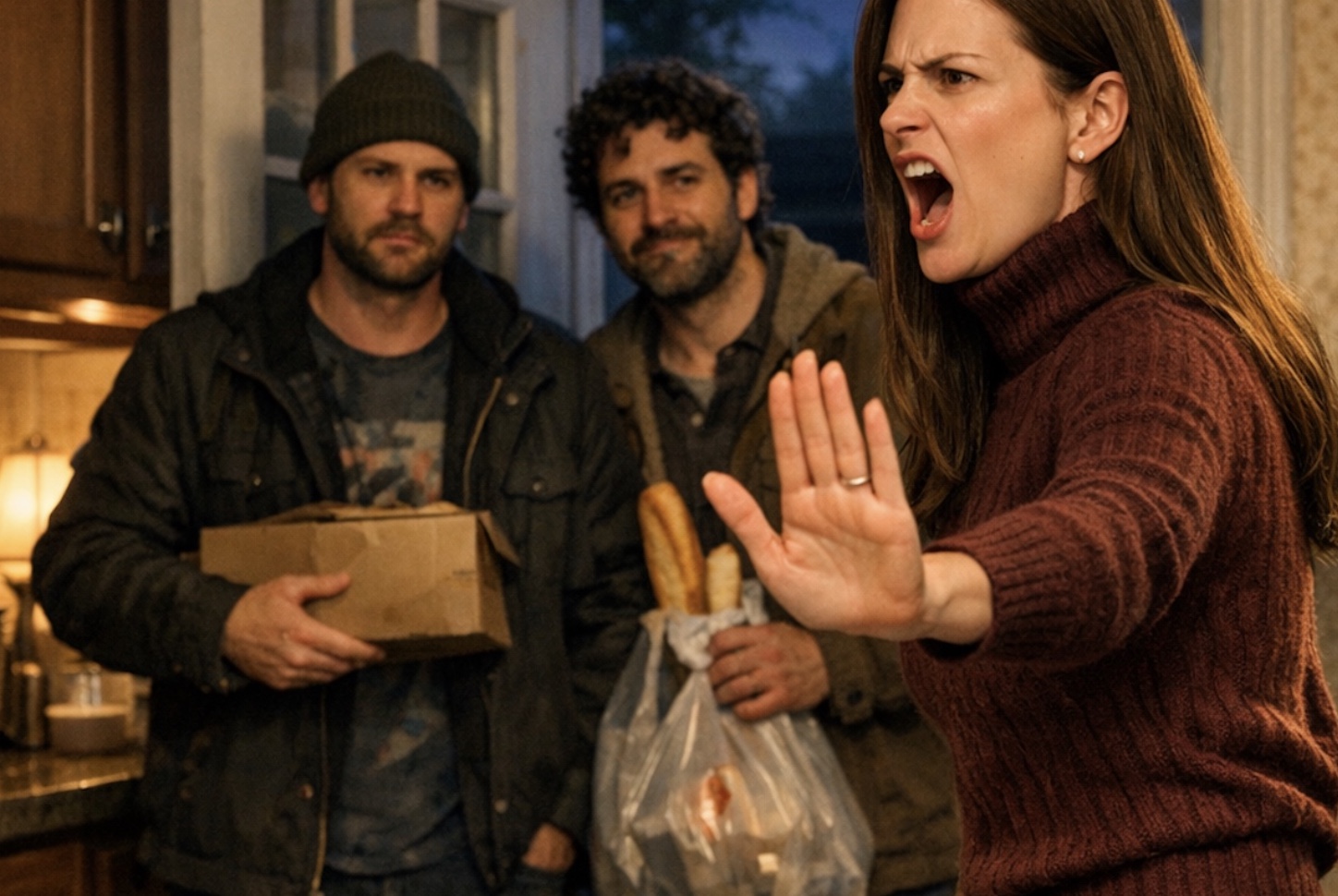
By Friday evening, when the phone rang, I already knew who it was. I knew with the same uncanny certainty with which you sense a toothache coming on or the start of a long, miserable stretch of rain.
“Hello, Lena, it’s me!” Oleg, my husband Andrey’s brother, sounded as breezy as ever. “Listen, we were thinking… maybe we could come out to your place for the weekend? You’re heading to the dacha, right?”
I glanced over at Andrey, who was kneeling in the hallway by an open suitcase, packing for our trip to the country. He looked up, met my eyes, and understood instantly. A shadow passed over his face, something between irritation and resignation.
“Oleg wants to come,” I mouthed silently.
Andrey sighed and nodded. Of course he nodded. Oleg was his brother, after all. His younger brother. The one who was always “between things,” always drowning in some new financial mess.
“Yes, we’re going,” I said into the phone, keeping my voice carefully neutral. “We’re leaving tomorrow morning.”
“Perfect! We’ll come too. We should get there around two. Tanya’s been missing your Masha, keeps asking when we’ll all get together. And Dima’s thrilled. He loves the dacha!”
Dima was their seven-year-old son, a little whirlwind with a sweet tooth. Masha was our ten-year-old daughter, who somehow always ended up with broken toys and torn books after every visit from her cousin.
“All right, we’ll be waiting,” I said, and hung up.
“Again?” Andrey asked, though he already knew the answer.
“Again.”
We sat in silence for a moment. Outside, the April dusk was deepening. Somewhere below, a building door slammed, and a woman walked past with a dog. It could have been one of those peaceful Friday evenings that make you breathe easier just knowing the weekend has begun. Instead, the air felt heavy.
“Lena, he’s my brother…”
“I know,” I cut in. “I know exactly who he is to you. I also know that last time we went bowling, you paid the entire bill. Eight thousand rubles. For everyone. Because Oleg, quote, ‘didn’t have any money on him, but would pay you back later.’ Did he?”
Andrey gave a guilty little shrug.
“And when we went to the movies and they just happened to be at the same mall? Four movie tickets, then the café, where Dima ordered three desserts and Tanya had a shrimp salad. Seven and a half thousand. Your seven and a half thousand, Andrey.”
“Lena, I can’t tell my brother I don’t have money…”
“Why should you have to?” I felt that familiar anger rising inside me, the kind that had been building for months, maybe years. “Why is it always you? Because you earn more? Because you finished university and he dropped out after two years of vocational school? Because you didn’t drink away three different jobs and bury yourself in debt?”
“He hasn’t had a drink in six months,” Andrey said quietly.
“That’s wonderful. Truly wonderful. But why are we the ones expected to finance his sobriety?”
Andrey sat down on the couch and rubbed his face with both hands. In moments like that, he looked older than thirty-eight. The lines around his eyes deepened, and the gray in his temples seemed more visible.
“I don’t know how to say no,” he admitted at last. “Every time he calls, I think about when we were kids. About how I promised Mom I’d look after him. Before she died, she said, ‘You’re the older one, Andryusha. You have to…’”
There it was. That old burden placed on the eldest child in so many families. You have to. You’re the older one. As if being born four years earlier signs you up for a lifetime of rescuing your younger sibling.
I sighed, sat down beside him, and took his hand.
“Listen to me. Your mother was a wonderful woman. God rest her soul. But she couldn’t have known that at forty, Oleg would still be acting like a teenager, pushing responsibility onto everyone else. Helping someone is one thing. Letting yourself be used as a free resource is something else entirely.”
We left early the next morning, just as planned. I got up at six on purpose so I could pack everything before Masha woke up. As I loaded grocery bags into the car, I counted portions with deliberate care.
Three pieces of meat for shashlik. One pack of sausages, six total. Three tomatoes. Three cucumbers. Bread, cheese, butter, everything measured for exactly three people. Two bottles of wine, one for Andrey and me in the evening, one extra just in case. Juice for Masha. No extras.
Andrey glanced into the trunk and frowned.
“Doesn’t that seem a little… light? You know Oleg and his family are coming.”
“I know,” I said calmly, closing the trunk. “That’s exactly why I only packed enough for us.”
“Lena…”
“Andrey, I have a plan. Trust me. Please.”
He looked at me for a long moment, and I could see a mix of anxiety and something else in his eyes. Relief, maybe. Perhaps he was tired too, but just didn’t know how to stop it.
The dacha was about one hundred and twenty kilometers from the city, in the village of Sosnovka. It was an old log house that had belonged to Andrey’s parents, with a wood stove, a well, and a bathhouse. Every spring we came out to open the season, tidy things up, and enjoy the quiet and the fresh air.
Or at least try to.
Oleg and his family arrived exactly at two, just as promised. Their battered old Lada rattled into the yard, kicking up dust and scattering the neighbors’ chickens.
“We’re here!” Dima yelled happily, tumbling out of the car. “Hi, Masha! Do you have anything yummy?”
No hello. No how are you. Straight to: do you have anything good to eat?
Tanya, Oleg’s wife, climbed out after him, tugging at a faded T-shirt stretched over her heavyset frame. She was thirty-five but looked ten years older, perpetually tired, with dull eyes and lips always set in mild discontent.
“Oh, getting here was awful,” she complained instead of greeting us. “The traffic was terrible. I’m exhausted.”
“Come in, get settled,” Andrey said, helping them unload their things.
I noticed immediately that they hadn’t brought any food. Not a single grocery bag. Just two worn backpacks with clothes and Dima’s soccer ball.
We sat on the veranda, and I put the kettle on. I brought out cookies, exactly ten of them: two each for me, Andrey, and Masha, with four extra.
“Don’t you have any better tea?” Tanya asked, looking disapprovingly at the Greenfield tea bags. “That stuff gives me heartburn. Maybe some herbal tea?”
“No,” I said shortly. “Just this.”
Oleg slapped his brother on the shoulder.
“So, guys, how about we do some шашлык tonight? Huh? I can already picture it, meat, smoke, a little drink…”
“Sounds good,” Andrey said automatically, already beginning to think through the logistics.
“Great idea,” I said. “We bought meat, actually. Enough for three. Did you bring your own?”
An awkward silence settled over the veranda. Oleg blinked at me, confused.
“What do you mean… enough for three?”
“For us,” I said. “For me, Andrey, and Masha. Didn’t you bring food with you?”
Tanya stared at me as if I’d started speaking another language.
“We thought… well… usually you always… I mean, it’s always been…”
“It’s always been the same,” I said, taking a sip of tea. “We buy the food. We feed everyone. We pay. For bowling, for movies, for cafés, for picnics. Andrey always reaches for his wallet, and somehow yours is always left at home. Or you ‘don’t have cash right now.’ Or ‘your card isn’t working.’ The details change, but the pattern doesn’t.”
“Lena,” Andrey said, placing a hand on my shoulder, but I gently moved away.
“No, Andrey. Let me finish.” I looked from Tanya to Oleg. “We came here to relax at our dacha. We brought food for our family. If you wanted to join us, fine, you’re relatives, we don’t mind guests. But grown adults don’t show up empty-handed. Or at the very least, they bring food for themselves. Especially if they’re coming as a family of three and planning to stay all weekend.”
Oleg’s face flushed dark red.
“You’re serious? We’re family!”
“And precisely because we’re family, I’m saying this openly,” I replied calmly. “Because I’m tired of swallowing resentment and then exploding later. I’m tired of watching Andrey struggle to say no while you take shameless advantage of that. And I’m tired of explaining to Masha why her toys always end up broken after Dima comes over, and why we stay quiet because ‘he’s just a child’ and ‘you shouldn’t upset family.’”
“Mama,” Masha tugged at my sleeve. “Can I go outside?”
“Of course, sweetheart.”
The children ran off into the yard, and the four of us remained at the table. Tanya swallowed hard, Oleg stared at the tabletop, and Andrey kept looking at his hands.
“I didn’t want this to turn into a confrontation,” I said more quietly. “Honestly. But at some point, enough is enough. Remember that picnic by the reservoir last month?”
“Well…” Tanya mumbled.
“Andrey spent twelve thousand on food. Meat, fish, vegetables, fruit, drinks. I was up until two in the morning making salads. And you showed up empty-handed and brought your friends Katya and Misha without even warning us. In the end, there was barely enough food, and Andrey had to drive out and buy beer because your friend Misha ‘doesn’t drink wine, only beer.’”
“We didn’t think you’d count every penny,” Tanya snapped. “You have money. You’ve got a three-room apartment, a new car…”
“We have money because we earn it and know how to manage it,” I said, hearing the steel in my own voice. “Andrey works twelve-hour days. I juggle a job and a child. We don’t blow through our salaries in the first week, we don’t take out loans for new iPhones, and we don’t trade in cars every two years at a loss. We save, we plan, we live within our means. Yes, we have a financial cushion. That does not mean it exists for someone else to use.”
“But you just said we’re family!” Oleg finally lifted his head. “Family is supposed to help each other!”
“Oleg,” Andrey said at last, speaking up. “Lena’s right. I’ve felt for a long time that this wasn’t okay, but I didn’t know how to say it. Helping someone means supporting them through a hard time. Once, twice, maybe three times. But when it becomes the norm…”
“Right. Got it,” Tanya said, jumping to her feet. “So now you’re rich and looking down on us. We’re trash to you now, is that it?”
“That’s manipulation,” I said tiredly. “Classic manipulation. The moment someone asks you to stop treating them like an ATM, suddenly they become arrogant and stingy. Tanya, I’m thirty-six years old. I’ve seen enough of life not to fall for that.”
We sat in thick silence. Somewhere in the distance, the children were laughing as they kicked a ball around. The wind moved the curtains on the veranda and carried in the warm scent of sunbaked earth and freshly cut grass.
“So what now?” Oleg finally asked. “We’re just supposed to sit here?”
“Whoever brought what, eats what they brought,” I told the uninvited freeloaders. “There’s a village store three kilometers away. It’s open until eight. You can drive there and buy dinner and breakfast for tomorrow. Or you can head back to the city. Your choice.”
Tanya’s face went slack.
“You mean… you really won’t share?”
“We have three pieces of meat,” I said patiently. “Three. One per person. We have six sausages, two each for breakfast. We brought enough food for three people for three days. If we share, we won’t have enough. How is that fair?”
“But we came all the way here! We spent money on gas!”
“No one forced you to come. You called and announced it. You didn’t ask whether it was convenient. You didn’t ask what to bring. You just assumed things would go the way they always had. That you’d show up and we’d provide everything. Like always.”
Oleg looked pleadingly at his brother.
“Andryukha, come on, say something to her…”
“Lena is my wife,” Andrey said quietly. “And she’s right. I should have said this myself a long time ago. I’m ashamed that I kept making her do it for me.”
“Traitor,” Oleg hissed. “Your woman has filled your head with nonsense, and now you’re betraying your own brother.”
“That’s enough,” Andrey cut him off sharply, and there was steel in his voice I rarely heard. “Stop blaming everyone else for your problems. Lena didn’t fill my head with anything. She made me see what I didn’t want to admit. Do you really think you can spend your whole life riding on someone else’s back? That somebody will always pay for you, feed you, solve things for you?”
“Easy for you to say!” Oleg jumped to his feet. “You got an education, a respectable job, connections! What did I get? Nothing!”
“You got exactly the same things I did,” Andrey said, standing too. “The same parents. The same apartment. The same inheritance. I chose to study. You chose to mess around. I chose to build a career. You chose to jump from one job to another. I saved money. You spent it. Those were your choices, Oleg. Yours. So stop hanging the consequences on me.”
The silence that followed rang in the air. Tanya sniffled, then quickly tried to compose herself. Oleg stood there breathing hard, staring at his brother.
“Fine,” he threw out at last. “Come on, Tanya. Let’s go to your precious little store and buy food. We’ve still got three thousand with us.”
It was almost five by the time they came back. They brought bread, cheap sausage, pickles, potatoes, and a bottle of fortified wine. Their mood was sour, but they tried to act like everything was normal.
We lit the grill. I cooked our marinated shashlik, the air filling with the wonderful smell of smoke and spices. Oleg fried potatoes in a pan.
The children ate together. I had no intention of letting Dima go hungry. Masha shared her juice and some of her shashlik with him. Then the two of them ran off to play again, while the adults sat on opposite sides of the yard.
By nine o’clock, it had gotten chilly, and we all went inside. Oleg and his family took the tiny room upstairs. We stayed in the larger bedroom downstairs.
When we got into bed, Andrey wrapped his arms around me and held me close.
“Thank you,” he whispered into the dark.
“For what?”
“For doing what I couldn’t. For saying what I should have said years ago. For loving me enough to be the bad one in their eyes for the sake of our family.”
“I’m not the bad one,” I said.
“No. You just set boundaries.”
“That’s right.”
“But it’s easier for them to think you’re cruel than to admit they were wrong.”
We lay there in silence, listening to the sounds of the village at night, a dog barking somewhere far away, leaves brushing softly against the window, the creak of floorboards overhead.
“Do you think they’ll stay until Sunday?” Andrey asked.
“I don’t know. But if they do, it’ll be under different rules.”
The next morning, we woke to the sound of a car pulling out. I looked out the window and saw Oleg’s old Lada driving away in a cloud of dust. The house was quiet. They had left without even saying goodbye.
On the veranda table, Tanya had left a note in her crooked handwriting:
“Thanks for the hospitality. We won’t bother you again.”
Masha wandered out in her pajamas, yawning.
“Where’s Dima?”
“They left,” Andrey said. “Early this morning.”
“Oh,” Masha shrugged and reached for the breadbox. “Can I have two slices? I’m really hungry.”
“Take three,” I said with a smile. “Today we have enough food for everyone.”
We had a wonderful weekend after that. We walked in the woods, picked the first snowdrops of spring, heated the bathhouse, and read on the veranda. Andrey made Masha a swing out of old boards and rope. I cooked what I wanted, without worrying about anyone else’s tastes or appetites. We talked, laughed, and made plans for summer.
On Sunday evening, as we drove back to the city, Andrey said:
“Oleg texted me today.”
“And?”
“He said I betrayed the family. That Mom would never have approved. That I’ve changed, and not for the better.”
“What did you say?”
“That I have changed. That I’ve learned how to say no. And that if Mom were still alive, she’d be proud of me for protecting my wife and child.”
I took his hand and squeezed it.
“It’ll hurt him for a while,” Andrey went on. “He’s used to things being different. But maybe that’s a good thing. Maybe now he’ll finally start changing something in his own life.”
“Or maybe he won’t,” I said realistically. “Maybe he’ll just find someone else to sponsor him. Or stay offended forever.”
“But that’s not our responsibility anymore, is it?”
“No,” I said. “It isn’t.”
Whoever brings it, eats it.
There was more wisdom in that simple phrase than I had ever realized, and it was a lesson I knew I would carry with me for the rest of my life.