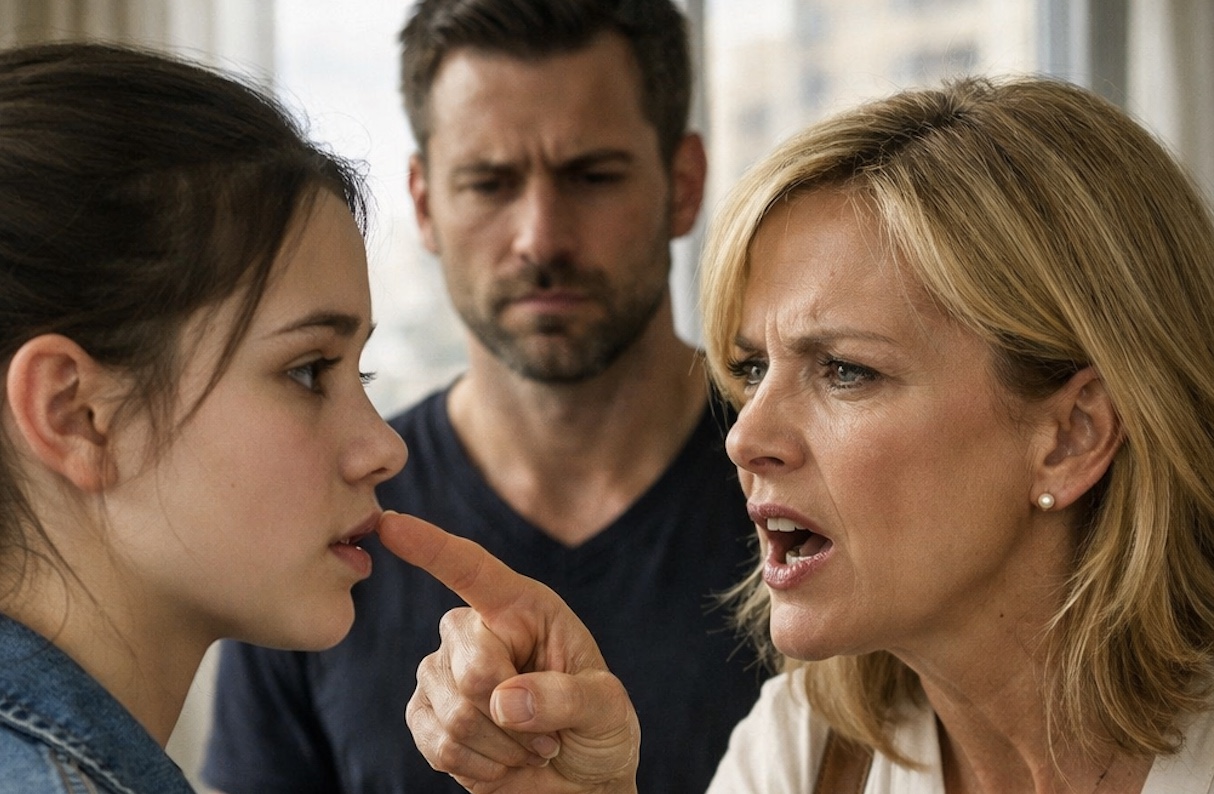
“Mom, I’ll call you back—we’re loading up.”
Oleg pinned the phone between his shoulder and ear and tossed a box of tools into the bed of the pickup. Tanya was packing bags into the car, glancing at her husband now and then. Nearby, Nastya fussed with her giant stuffed rabbit, trying to wrestle it into the back seat.
“Mom, is Bunny coming with me too?”
“He is, sweetheart. Put him on the seat for now.”
One look at Oleg’s face was enough to tell Tanya the conversation wasn’t simple.
“Yeah, I got it, I got it. Is Marina there? Put her on.”
Tanya froze with a bag in her hands. Whenever his sister got involved in a call, it usually meant someone wanted something.
“Hi, Marina. Uh-huh. Well…” Oleg rubbed the bridge of his nose. “Listen, I’ll talk it over with Tanya and call you back, okay? Yeah, got it. Bye.”
He ended the call and turned to his wife.
“So, here’s the situation. Natasha is coming to the city to apply for school, and she has nowhere to stay. Marina’s asking if she can live at our place for a while. We’ll be gone all summer anyway.”
Tanya slowly set the bag down on the seat.
“Natasha? The one who was in ninth grade?”
“She’s in eleventh now. Says she’s applying somewhere—I didn’t really catch where. She needs time to study, take exams, all that. Mom says she can also keep an eye on the flowers.”
“Oleg, we haven’t seen her in ages. What is she even like?”
“She’s fine. Quiet girl. She’s from the village, not some city kid. She’ll sit with her books, get ready for exams. What could she possibly do?”
Tanya folded her arms.
“I don’t know. I’m not thrilled about leaving our apartment to someone I barely know.”
“Someone you barely know? She’s my niece.” Oleg stepped closer and rested his hands on her shoulders. “Tanya, what could happen in a couple of months? The girl needs help. Marina said she’d send over vegetables, fruit, berries, preserves from the garden. And come on, I’m her uncle. I’m supposed to help family.”
“Does your mother think so too?”
“She reminded me how I stayed with Uncle Kolya when I was applying to school. Said he helped me a lot. God rest his soul.”
Tanya sighed. The mention of Uncle Kolya always hit the mark—Oleg really had lived with him for two years, and he still spoke of him with gratitude.
“All right,” she said at last. “But if anything goes wrong…”
“It won’t. I’m telling you, she’s quiet. She’ll read, water the flowers, keep to herself. It’s perfect.”
Oleg kissed her forehead and pulled out his phone to call his sister back.
He dictated the code to the lockbox with the spare key while they were already driving out of town. Natasha listened carefully and asked him to repeat it.
“You wrote it down? Good. There’s some food in the fridge—finish whatever’s there. Water the flowers every three days, the ones on the windowsill. And keep the place tidy, okay? That apartment is under mortgage. We’ve got ten more years of payments.”
“Of course, Uncle Oleg. Don’t worry. I’ll be quiet. I need to study anyway.”
“Great. Call if anything comes up.”
He hung up and turned to Tanya.
“She sounds fine. Says she’ll be studying.”
Tanya nodded, but the uneasiness inside her didn’t go away. Nastya was watching cartoons on her tablet in the back seat, and Tanya didn’t want to start an argument over his niece.
The village where Tanya’s mother lived was eighty kilometers away. The road was familiar, worn smooth by years of travel—every turn, every gas station, every sign. Oleg drove easily, steering with one hand and flipping through radio stations with the other.
Her mother met them at the gate in a bright floral apron, a dish towel slung over her shoulder.
“Well, finally! Nastya, come to Grandma, my sunshine!”
The little girl jumped out of the car and ran into her grandmother’s arms. Tanya smiled. That scene warmed her every time.
“Oleg, come in, I made borscht,” her mother said, already tugging her son-in-law by the sleeve. “You can look at the roof later. It’s not going anywhere.”
“Lyudmila Petrovna, at least let us unload first.”
“You can unload on a full stomach. Come on, come on.”
After lunch, Oleg finally escaped to inspect the damage. Tanya went with him—she wanted to understand how bad it really was. The house was old, her father’s house, and plenty had built up over the years.
Oleg climbed the ladder, tapped at the rafters, and shook his head.
“Tanya, this isn’t just patchwork. Part of the sheathing has to be replaced. See that? It’s rotting.”
“Will it take long?”
“Three weeks for the roof if the weather holds. Another three for the siding. But I’ll make it look beautiful, don’t worry.”
Tanya watched him move through the inspection with calm confidence—testing boards, measuring, estimating. In moments like that, she loved him most of all. For that steady certainty. For those hands that could fix anything. Oleg could repair a leaking pipe, an engine, anything at all. Her mother called him her “golden son-in-law” and never tired of saying how lucky Tanya was.
By evening, Nastya had made friends with the neighbor’s cat, explored the entire garden, and managed to get dirt from head to toe. Tanya’s mother washed her in a basin in the summer kitchen, clucking her tongue about city children who never saw real grass.
“Mom, she goes to preschool, they have a playground there too,” Tanya laughed.
“A playground! That’s not a playground. Here she’s got space. Let her run around, get some sun, put some color in those cheeks.”
Oleg sat on the porch drinking tea from an oversized mug painted with strawberries, squinting into the sunset. Tanya sat beside him and rested her head on his shoulder.
“It’s nice here.”
“Yeah.”
“Do you think Natasha can handle it? The apartment, I mean.”
“She’ll be fine. She’s practically an adult. What’s there to handle? Water flowers, keep things neat. She’s not a child.”
A week later Natasha sent a photo of the watered plants and a short message: “Everything’s fine, I’m studying.” Tanya showed it to Oleg. He just shrugged, as if to say, See? Told you.
The summer dragged on in that sweet, slow way summers do. Oleg worked on the roof from morning till evening, tanning almost black, his arms covered in tiny cuts and scratches. Tanya helped her mother in the garden, cooked jam, canned compotes. Nastya tore around the yard, fed the chickens, and collected beetles in a jar.
In the evenings they sat on the veranda eating watermelon and watching the sun sink behind the distant forest. Tanya’s mother told them village gossip—who was feuding with whom, who got drunk again, how Mikhailych had sung until midnight. Oleg smirked. Tanya shook her head.
Natasha texted every few days—brief, practical messages. “Everything’s okay.” “Flowers are fine.” “Passed my first exam.” Tanya gradually relaxed and stopped thinking about the apartment. Everything was under control. A quiet girl studying. What could possibly go wrong?
By mid-August the roof was nearly finished. Oleg had completed the gable cladding and moved on to the veranda as a bonus project, as he put it. Tanya’s mother walked around admiring everything.
“It looks gorgeous! Like a brand-new house. Oleg, you’re a magician.”
“Lyudmila Petrovna, I’m just doing my job.”
“Your job! I’d pay strangers two hundred thousand for work like this, no less!”
“But I’m not a stranger,” Oleg said with a smile. “Just covering materials and doing it family-style is enough.”
“Family-style, he says! You could’ve charged twice as much and it still would’ve been a gift.”
Tanya stood nearby, looking at the renovated house, thinking: Soon we’ll go home. Another week, maybe two, and we’ll be back in our apartment. Back to our life. Back to our own walls.
She had no idea those walls had long since stopped being hers.
A few days later, Tanya was scrolling on her phone while Nastya played with the neighbor’s cat in the yard. Oleg was up on the roof hammering, the sound echoing through the whole village. Her mother had gone next door to get some seedlings.
Tanya opened the building chat group. She hadn’t checked it in ages—usually it was nothing but notices about water shutoffs and arguments over parking. She scrolled down and went still.
“Apt. 325, maybe stop making noise at night already? It’s the second night in a row, the music is blasting, people are stomping through the hallway. Have you no shame at all?”
The message was from the upstairs neighbor, Valentina Grigoryevna. Tanya felt an icy chill spread down her back.
She kept scrolling.
“I agree. Same thing yesterday till three in the morning. Time to complain to building management.”
And another one:
“Who’s even living there now? It used to be quiet.”
She read the messages three times. Apartment 325 was theirs. Quiet Natasha, the girl who was supposedly studying and watering flowers.
Tanya stood up and walked toward the house.
“Oleg! Come down!”
“What?” he shouted, peering over the roof ridge.
“Come down. I need you.”
He climbed down the ladder, wiping his hands on his pants. Tanya silently shoved the phone toward him. He read, frowned, scrolled.
“Are you sure this is our apartment?”
“Three twenty-five, Oleg. Ours.”
“Maybe they got confused? Maybe it’s the neighbors?”
“The neighbors on the right are an eighty-year-old woman. On the left, a family with a newborn. Who exactly is partying till two in the morning?”
Oleg pulled out his phone and called Natasha. Ringing. Ringing. Ringing. She declined the call.
He tried again. On the third attempt she picked up.
“Hello, Uncle Oleg?”
“Natasha, people in the building chat are saying there’s noise in our apartment at night. What’s going on over there?”
“Nothing,” she said in a calm voice, almost offended. “A friend came by once, we sat for a bit. The neighbors are exaggerating. That old lady upstairs is crazy—she imagines noise everywhere.”
“Once?”
“Well… maybe twice. Uncle, I’m not living in a convent. I need to relax sometimes too. I’m studying, I get tired.”
Oleg looked at Tanya. She folded her arms.
“All right,” he said. “But no more of that, understood? This is our home, not a hostel.”
“Yeah, okay, okay.”
He hung up and spread his hands helplessly.
“She says a friend came over. She’s young. These things happen.”
“These things happen?” Tanya snatched the phone back. “Oleg, they’re talking about nights, music, people in the building. That’s not ‘a friend stopped by.’”
“So what am I supposed to do, drive back there right now?”
“Maybe you should.”
“Tanya, I still have a ton of work here. Once I finish, you can go check on it every single day if you want.”
Tanya went into the house and sat in the kitchen. One thought kept circling in her mind: I knew it. From the very beginning I knew this was a bad idea. But she had stayed quiet, given in, just to avoid a fight.
That evening her mother-in-law called.
“Tanya, why are you making such a big fuss?” Zinaida Fyodorovna’s voice was calm, even gentle. “She’s a young girl. So she sat with a friend once. What’s the big deal?”
“Zinaida Fyodorovna, the neighbors are about to file a complaint.”
“Oh, come on. Neighbors are always unhappy. Natasha is a good girl, she’s from the village, she’s modest. She’s just getting used to the city.”
There was a rustle in the receiver, and then Marina took over.
“Tanya, hi. Listen, don’t blow this out of proportion, okay? Natasha called me crying. Says you’re treating her like a criminal.”
“Crying?” Tanya felt anger rise inside her. “Marina, we have a mortgage. If the neighbors file a complaint, it will become our problem.”
“What kind of problem? She made a little noise once, that’s all. Oleg was young once too, remember? He probably went out and had fun.”
Tanya wanted to respond, but stopped herself. Pointless. They had their version of the truth, and words wouldn’t change it.
“Fine,” she said. “We’ll handle it.”
The next few days were tense. Oleg kept working on the roof, and every morning Tanya checked the building chat. There were no new complaints, and she almost calmed down. Almost.
A couple of days later she couldn’t take it anymore and decided to drive back herself. Oleg stayed behind to work. She got in the car and left.
The eighty kilometers flew by. She parked by the building, went upstairs, and reached her floor. She took out her key and slid it into the lock.
It wouldn’t turn.
She tried again. The key went in, but the lock wouldn’t open.
Tanya stepped back and stared at the door. Their door. Their mat. Their apartment number. But the lock was different.
She called Natasha. Ringing. Declined. Again. Ringing. Declined.
Then she called Oleg.
“Tanya? What happened?”
“The lock’s been changed.”
“What?”
“The lock, Oleg. I’m standing outside my own apartment and I can’t get in. Natasha won’t answer.”
“Wait, I’ll call her.”
Five minutes. Ten. Oleg called back.
“She’s not picking up. I’ll call Marina.”
Another twenty minutes passed. Tanya sat on the stairs, looking at her own door and feeling something heavy and dark building inside her. Her home. Her apartment. And she was sitting here like a beggar.
Oleg called again.
“Marina says Natasha is in class. She’ll call back when she’s done.”
“What class? What classes are happening this late?”
“I don’t know, Tanya. Just wait a little.”
Wait. She had already been waiting for two months. Waiting for the niece to “stay for a little while.” Waiting for the neighbors to calm down. Waiting for Oleg to finish the roof. And now she was sitting on a staircase outside her own front door, waiting again.
By evening she had moved to a bench outside the building. The sun had gone down, the streetlamps were on. She sipped vending machine coffee and stared at the entrance.
Around nine, a group came laughing toward the building—three boys, two girls, music blasting from a phone. Natasha was in front, wearing a short skirt and bright makeup, nothing like the quiet modest girl from the village.
Tanya stood up. Natasha saw her and stopped. The smile vanished from her face.
“Aunt Tanya? What are you… doing here?”
“What am I doing here?” Tanya stepped toward her. “What are you doing here? With a crowd, at nine in the evening, after changing my lock?”
“Aunt Tanya, I can explain…”
“Upstairs. Now. And you,” Tanya said to the group, “you can leave.”
The boys and girls shuffled awkwardly and exchanged looks. Natasha nodded at them, and they turned and headed back out. One of them even snickered.
They went upstairs. Natasha unlocked the door with her key, and Tanya walked into her own apartment.
The smell hit first—stale air mixed with tobacco. Tanya flicked on the light and froze.
There were strangers’ sneakers in the hallway, random shopping bags, a crumpled jacket. In the kitchen, a mountain of dirty dishes in the sink, a sticky table, empty bottles lined up against the wall. Tanya stepped into the room and stopped again.
In the corner stood a ring light on a tripod. Beside it, a microphone on a stand, cords everywhere. A bright poster hung on the wall—one that had never been there before.
“What is this? Some kind of studio?”
“I stream,” Natasha said with a shrug. “Online. You can make money doing it.”
“Streaming. With people coming over at night. In our apartment.”
“It’s just content, we weren’t—”
Tanya lifted her hand, and Natasha fell silent. On the couch was a dark burned patch with ragged edges. Someone had stubbed out a cigarette right on the upholstery.
“What is that?” Tanya asked softly, almost too softly.
“That… that wasn’t me. Arsen fell asleep with a cigarette. I put it out right away…”
Tanya didn’t answer. She walked to the window, where her ficus used to stand—the one she had brought from her mother’s place three years earlier, the one she had nursed from a tiny cutting. Its stem was snapped, the leaves yellowed and curled.
“And this?”
“It just fell over, I don’t know how…”
Tanya opened the balcony door. Beer cans. Ash-filled jars. Apparently even an ashtray hadn’t been enough. There were marks on the railing from a hookah.
She went back into the room and looked over the shelves. Something was missing. The vase. The blue vase with the gold trim—the one Oleg had given her on March 8th during the first year of their marriage.
“Where’s the vase?”
Natasha lowered her eyes.
“What vase?”
“The blue one. It was right here.”
“Oh. That one. We dropped it by accident. I wanted to buy the same one, but I couldn’t find it…”
Tanya turned to her.
“Why did you change the lock?”
“The key got lost. One of the guys must’ve taken it or something, I don’t know who. I had to replace it, just in case…”
“Just in case,” Tanya repeated. “And calling me to tell me never crossed your mind?”
Natasha said nothing. She picked at the wallpaper with her fingernail.
“You really made a mess of things,” Tanya said, sweeping her hand around the room. “You burned the couch, killed the plant, broke the vase. Some thank-you.”
“I didn’t mean to… I’ll fix everything, I’ll—”
“Do whatever you want, call your mother or whoever you need, but I want you out of here today. Do you understand?” Tanya was barely holding her anger in.
Natasha nodded frantically, grabbed her phone, and rushed onto the balcony. Through the glass Tanya could see her talking, gesturing wildly, nearly crying.
Twenty minutes later Oleg called.
“Tanya, what exactly are you doing over there? Marina and Mom have been blowing up my phone.”
“Did you see what your perfect little niece did to our apartment?”
“What do you mean?”
“The couch is burned. The plant I brought from my mother’s is broken and dried up. The vase you gave me is gone. The balcony is a trash heap. The whole apartment smells like a dorm room. Did they tell you that?”
Silence.
“So tell them to come get her. She’s not staying here another day.”
“Okay. I’ll call you back.”
Half an hour later he did.
“I talked to Marina. She’s hysterical. Says you attacked a child.”
“A child? She’s nearly eighteen. What child?”
“Well, you know…”
“I know enough. Tell her to come and clean up after her child. And tell your mother the same thing.”
Before she could finish, her phone rang again. Her mother-in-law.
“Tanya, what is wrong with you?” Zinaida Fyodorovna’s voice trembled with outrage. “The girl is crying, saying you’re throwing her out!”
“Zinaida Fyodorovna, maybe you should first come see what that girl did to our home.”
“What could she possibly have done? She’s young, maybe she made a bit of noise…”
“She burned the couch, broke the vase, killed the plant, changed the lock without permission. The balcony is a dump, and the apartment reeks. Is that your idea of ‘a bit of noise’?”
Her mother-in-law went quiet for a second.
“Well… things happen. Probably by accident.”
“By accident. Fine, Zinaida Fyodorovna. Come here and clean up after your granddaughter. I’d love to watch.”
“Tanya, how dare you speak to me like that—”
“Exactly the way you deserve.”
She hung up. Marina called immediately after.
“Tanya, have you completely lost it? You’re throwing a child into the street?”
“I let your child into my home to help her. And she trashed my apartment in return. And that’s before I’ve even sent you the bill.”
“The bill? Are you insane?”
“The couch is fifty thousand at least. The vase was a gift from my husband—priceless. We can keep counting if you want.”
Marina gasped and hung up.
Natasha stood in the hallway with a bag, red-eyed and sniffling.
“I’ll go,” she said quietly.
Tanya looked at her, then at the dark window. It was already ten at night.
“Where are you going this late? Stay until morning.”
“Really?”
“Really. But first, you’re helping clean up the mess you made.”
They scrubbed the apartment together until midnight. Natasha mopped floors, took out trash, scrubbed the stove. Silently, without looking up. Tanya cleaned the balcony, threw away cans and ashtrays, wiped down the railing.
By one in the morning, the apartment looked like itself again. It smelled of bleach and cool air from the open window. Tanya covered the burned patch on the couch with a blanket. She would deal with that later.
In the morning Natasha stood at the door with her bag.
“Tanya…” She kept her eyes on the floor. “I’m sorry. I really didn’t mean for this to happen. I thought you’d never find out… Stupid, right?”
“Very,” Tanya said. “But at least that’s honest.”
Natasha nodded and left. The door closed behind her.
Tanya sat down in the kitchen and poured herself some tea. Her phone was silent. Her mother-in-law didn’t call. Marina didn’t call. They were offended. Fine.
By lunchtime she was back at her mother’s house. Nastya ran toward her and wrapped herself around Tanya’s neck.
“Mommy, Mommy! Grandma and I baked a pie!”
“Good job, sweetheart.”
Oleg stood on the porch looking guilty.
“Well?” he said when Nastya ran back inside. “Tell me everything.”
Tanya told him. About the couch. The vase. The lock. The calls from his mother and sister. Oleg listened, his face growing darker.
“And that’s not even all of it. She was streaming from our living room. Ring light, microphone, people over at night. So much for quiet Natasha.”
“I’m sorry,” he said at last. “This is my fault. I should’ve said no from the start.”
“You should have. But I’m not letting this go.”
“What do you mean?”
“Marina should pay for the damage.”
Oleg raised his eyebrows.
“Tanya, come on… really?”
“What? Are we supposed to just absorb the cost of someone else’s mistakes? They burned the couch—let them pay. They broke the vase—let them pay. I want fairness.”
“But they’re family…”
“Family who wrecked our apartment and then got offended when we weren’t grateful.”
Oleg fell silent. Then he sighed.
“Do what you think is right.”
That evening Tanya sat down at the table and made a list.
Couch — sixty thousand rubles.
Lock — two thousand.
Carpet cleaning — three thousand.
Vase — priceless, but let’s say ten thousand.
Total: seventy-five thousand rubles.
She took a photo of the list and sent it to Marina with a message: “This is the minimum. Waiting for the transfer.”
Marina read it immediately. Typing… typing… then nothing. Tanya refreshed the chat. Delivered, but no reply. She opened Marina’s profile—blocked.
Ten minutes later her mother-in-law called. Tanya looked at the screen, at the name “Zinaida Fyodorovna,” and declined it.
She called again. Tanya declined again.
Once more. Tanya declined once more.
Then silence.
Tanya set the phone aside and stepped out onto the veranda. Oleg was sitting on the steps, watching the sunset.
“Well?” he asked.
“Marina blocked me. Your mother called—I declined.”
“And now what?”
Tanya sat beside him and looked at the pink sky above the forest.
“Now? Nothing. That’s the end of that.”
Oleg was quiet for a moment, then put his arm around her shoulders.
“You know what hurts the most?” she said. “We wanted to help. Do the decent thing. Treat family like family. And somehow we’re the ones at fault.”
“We’re not at fault.”
“To them, we are. Because we wouldn’t let them walk all over us and thank them for it.”
Inside the house, Nastya laughed, and Tanya’s mother answered her. The air smelled of cut grass and smoke from the neighbor’s grill.
“All right,” Tanya said, getting to her feet. “Let’s go eat. I’m done talking about this.”
She went into the house, and the door closed behind her with a soft creak. Her phone stayed behind on the railing—dark and silent. No calls. No messages.
That was the whole family for you.