Sometimes, in the darkest hour, you realize the truth has been there all along—quietly resting inside a folder, waiting for the moment it would finally matter.
Chapter 1. “You’ll Leave With What You Came With”
“You’ll leave with what you came with,” Rostislav said with a smirk, as if he could already see me walking out of our apartment in an old coat, clutching a worn shopping bag.
He stood in the middle of the room in a freshly ironed shirt that carried the scent of someone else’s perfume, drumming his fingers on the back of a chair. Too confident. Too arrogant. His voice rang in my temples like the toll of a bell—heavy, cold, merciless.
I stayed silent.
A thick folder rested on my lap—plain, office-style, with corners rubbed soft by time. Rostislav glanced at it, ready to throw another mocking remark my way, but suddenly the color drained from his face. He knew what was inside. He knew, and that was why he stopped so abruptly, as if something had caught in his throat.
“What… what is that?” he asked, nodding toward the folder, his voice faltering.
I rose slowly from the chair, as though afraid to disturb the moment. Without answering, I walked into the kitchen. The metallic smell of the old kettle, the faint scent of slightly burnt pasta in the pot, the hoarse voice of a TV host from the next room—it all struck me with painful clarity. Ordinary life, masking the collapse of a twenty-five-year marriage.
Rostislav followed me.
In the kitchen, where a small bowl of apples sat on the table beside a dried sprig of dill, he leaned against the wall and tried to recover his usual tone.
“You have to understand, Mila, this is better for everyone. The apartment isn’t yours—it’s my mother’s. The car is mine. So really, think about it. What will you even have left?”
“What will I have left?” I lifted my eyes to him. “What I have always had.”
He let out a dry laugh.
“You have nothing except your clothes and that accountant’s salary. You live in my house. You use my money. So don’t try to act like the victim.”
I slowly ran my palm over the rough cover of the folder. My whole life was inside it: ten years of transfers, payments, receipts, bank statements. My sleepless nights. My loans. My sacrifices. My silent humiliations—everything stacked in neat piles.
I could have thrown it all in his face right then.
But I didn’t.
Instead, I took out the kettle, set it on the stove, and asked in a calm, almost everyday tone,
“Do you want some tea?”
Rostislav hesitated, clearly not expecting me to stay composed.
“No… I’m leaving,” he muttered, then disappeared into the hallway, slamming the door behind him.
I remained alone. Behind the wall, the neighbors’ children were laughing. Somewhere downstairs, the front door of the building banged shut. I sat in the silence and felt my heart pounding far too hard.
The folder lay on the kitchen table.
My invisible shield.
My quiet advantage.
And in that moment, I decided to let him believe, for now, that he had won.
But he was wrong.
Chapter 2. “Everything Was On My Shoulders”
That night, I couldn’t sleep for a long time. I lay on the sofa, listening to the old wardrobe creak in the next room—from a draft, perhaps, or maybe because the house itself had dried and aged—and I replayed the past over and over in my mind.
The same image kept returning: me climbing to the fifth floor with heavy shopping bags in my hands, no elevator, no help. Back then Rostislav was already “working for himself”—pretty words hiding empty days and emptier pockets. I was the one carrying everything: accounting work in the morning, a part-time job at the store in the evening, and reports and spreadsheets at night just to close the quarter on time.
I remember one day when my mother-in-law sat in our kitchen, flipping through a newspaper and clicking her tongue loudly.
“A woman must know how to endure,” she said. “The man is the head of the home. And money… money should belong to him. Don’t get used to counting every penny, Militsa. That’s sinful.”
I said nothing, even though I was the one paying for her medicine, the utilities, and Rostislav’s credit-card debts. How many times had I transferred him money straight from my salary card so he wouldn’t “lose face” in front of his friends? How many times had I taken out loans myself to cover his overdue payments? And what did he bring home in return? New fishing gear. Invitations for his friends to come celebrate another “great investment.”
I remember him once saying, half-jokingly,
“You’re an accountant. Why would you care? Money passes through your hands all the time anyway.”
And I smiled back then, even though something inside me broke.
Those years blurred into one endless chain of utility bills, receipts, and bank statements. I kept filing everything into one folder automatically, without even thinking about it. Probably out of habit. Out of my need to save everything. I never imagined that one day this folder would become the thing that saved me.
…I turned onto my other side, pulled the blanket up to my chin, and heard the television murmuring behind the neighbors’ wall. It seemed like an ordinary night, but inside my chest one thought pounded louder and louder: all those years, I had been living someone else’s life, placing myself into hands that never valued me.
But that was about to change.
I looked at the folder standing neatly on the nightstand. It seemed to have been waiting for this moment alongside me.
Chapter 3. “Mother-in-Law Knows Best”
The morning began with a heavy knock on the door. I knew that knock well: slow but insistent, spaced out as though I were being given time to “compose myself” and greet the guest properly.
Yadviga Petrovna stepped inside without waiting for an invitation. Her headscarf was tied tightly under her chin, her coat sleeves shiny with wear, a grocery bag hanging from her arm. She always liked to make it look as if she brought generosity and concern into the house, though in truth all she usually brought was her opinion.
“Mila,” she said sweetly as she slipped off her shoes. “I thought we should talk.”
We sat down in the kitchen. Yesterday’s unfinished tea had gone cold on the table, and beside it stood that same folder, pushed neatly toward the wall. Yadviga noticed it but said nothing—her eyes narrowed for a second, though her voice remained soft.
“Rostik is upset,” she began, pouring herself tea as if she owned the place. “He made the right decision. You’re a sensible woman, you should understand. The apartment is mine. The papers are in my name. The car belongs to him. And as for you… it would be best if you stepped aside peacefully.”
I said nothing, turning the spoon slowly between my fingers.
“I’ll tell you this as a mother,” my mother-in-law continued, lowering her voice. “Leave the apartment to my son. He needs to live. He needs to build a new family. You’ve already had your time.”
The words struck like ice.
You’ve already had your time.
And that was coming from a woman I had spent years helping—driving to doctors’ appointments, buying medicine, tolerating her sharp little insults.
“Yadviga Petrovna,” I replied, trying to keep my voice even, “I never took the apartment away from anyone. It’s already in your name.”
“Exactly!” she said, suddenly brightening. “So let it stay that way. No scenes, no piles of papers, no court. You’re a respectable woman.”
I placed my hand lightly on the folder. So lightly it might have gone unnoticed.
But Yadviga noticed. She jerked, as if stung.
“What is that?” she asked sharply.
“My work,” I said curtly.
We sat in silence for several seconds. The kitchen clock ticked. A crow cawed outside the window. Somewhere downstairs, someone was taking out the trash. It felt as though the whole building had gone still, listening to us.
“Rostik is right,” she said again, but now her voice trembled. “You’ll leave with what you came with. That’s what’s best for everyone.”
I looked her straight in the eye and answered,
“We’ll see, Yadviga Petrovna. We’ll see.”
Chapter 4. “Advice From Friends”
After my mother-in-law’s visit, a heavy silence settled over the apartment. Even the kettle, when I put it on the stove that evening, seemed to hiss with reproach. I sat in the kitchen leafing through the folder, constantly asking myself the same question: should I tell him now, or wait a little longer?
Then the phone rang.
It was Elizara. Her voice was always loud and fiery, as though she had spent her whole life arguing with the world.
“Mila! You’ve got to be kidding me!” she burst out before I could say hello. “You still haven’t shown him anything? What are you waiting for, until he signs the apartment over to some neighbor’s cat?”
I smiled, even though I wasn’t in the mood to laugh.
“I’m waiting for the right moment, Liza,” I said. “He needs to corner himself first.”
“Oh, come on!” she shot back. “Men like that aren’t afraid of corners. They always wriggle out. You’ve got a bomb in your hands—set it off!”
We argued for a long time. Liza always pushed me toward action, but deep down I knew: if I fired too early, I could lose everything.
The next day I ran into Gordey in the hallway. He was standing by the mailboxes with a newspaper in one hand and a plastic bag with bread in the other. The same as always—quiet, kind, with gentle lines around his eyes.
“Militsa,” he said, glancing at my tired face, “things aren’t always as bad as they seem.”
“Oh really?” I let out a bitter laugh. “My husband is throwing me out, and my mother-in-law is backing him up. What exactly is good about that?”
Gordey was silent for a moment, then scratched the back of his head.
“You know,” he said at last, “I noticed a long time ago that your Rostislav talks too much. He brags left and right. Don’t rush. Let him say too much himself—in front of witnesses. Then you show him your papers.”
I froze.
There was something so simple and so wise in what he said. I suddenly saw it clearly: Rostislav boasting to his friends about his “victory,” and then me opening the folder and watching his certainty collapse in an instant.
“You think it’ll work?” I asked.
“Try it,” Gordey said calmly. “Sometimes silence does more than words ever can.”
We went back to our apartments, but his words stayed with me like a nail driven into wood: let him expose himself.
And that night, for the first time, I fell asleep with the faintest smile on my lips.
Chapter 5. “A Man’s Idea of Division”
Rostislav came home in the evening smelling of cologne, wearing a satisfied grin. He tossed his jacket onto a chair and kicked off his shoes in the hallway, leaving dirty boots on the rug. Out of habit, I was already setting the table: soup, salad, bread. Everything as usual, as if nothing were falling apart.
“I had a meeting,” he announced with the smugness of a winner. “The guys and I discussed the best way to handle the split.”
I didn’t ask what kind of “meeting” he meant. I simply placed the plate in front of him.
“Mother will leave the apartment to me,” he continued between spoonfuls of soup. “The car stays mine too. The money in the account… well, you understand, it was always mine anyway. You’ll leave with what you came with. That’s fair.”
He ate with an appetite, barely noticing that I sat across from him with a face gone cold. Inside, though, everything was boiling.
After dinner he went into the other room, and I stayed in the kitchen washing dishes and clearing the table. The water ran into the sink, and then I heard his voice. He was on the phone, speaking loudly, confidently:
“Mom, everything’s under control! I told her she’s leaving with nothing. Let her sit there and stay quiet. The apartment is yours—for now. We’ll transfer it to me later, and then… well, you know. And if she starts making trouble, we’ll have witnesses. I’ve already told my friends everything. They all know she’s got nothing.”
I froze with a plate in my hands.
Witnesses. Friends. He was digging his own grave.
My heart pounded so hard it seemed louder than the water in the sink. So Yadviga Petrovna was planning to transfer the apartment. They were preparing the ground. But so was I.
I dried my hands on a towel, sat down at the kitchen table, and pulled the folder in front of me.
Its spine gleamed under the lamp like the edge of a blade.
Soon. Just a little longer, and I would lay my cards on the table.
Rostislav fell silent in the hallway. I could hear him pacing, muttering to himself, pleased and self-satisfied. He had no idea that every word he spoke was bringing him closer to his own downfall.
And I sat there in the kitchen, feeling it with absolute certainty:
the moment was near.
Very near.
Chapter 6. “The Folder Opens”
Rostislav himself chose the day for the meeting. He insisted everything should be done “like adults”—with his mother present and two of his friends there as “witnesses.” I didn’t object. I quietly pinned up my hair, put on my plain, fitted dress, and slipped the folder into my bag.
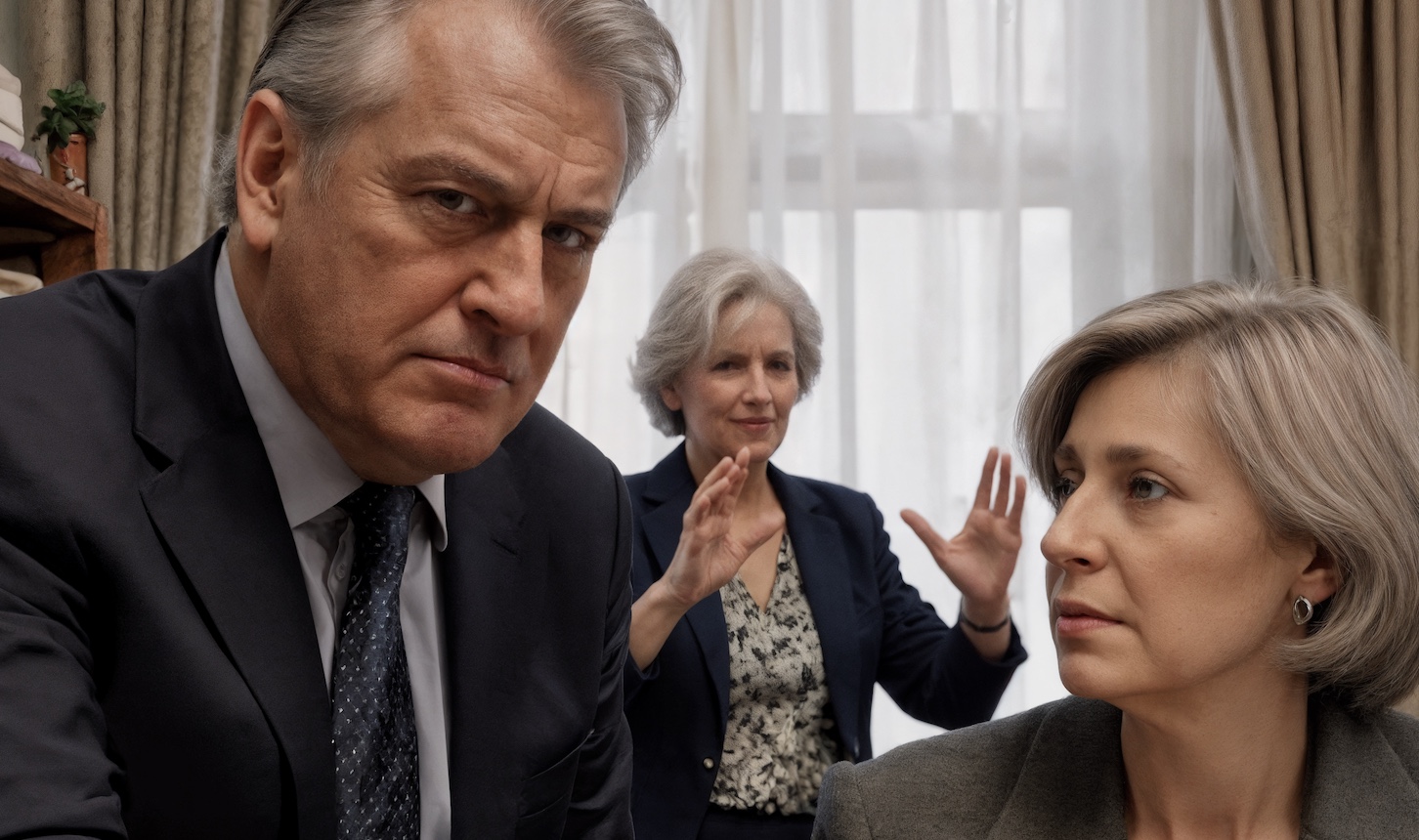
The room smelled of tobacco and cheap brandy. My husband sat in an armchair with his shoulders squared, Yadviga Petrovna beside him in her favorite wool vest. On the sofa, a little farther away, lounged two of his friends: one already flushed in the face, the other pretending to look serious.
“Well then,” Rostislav began, surveying everyone smugly, “today we settle things once and for all. As they say, everyone gets what belongs to them.”
Yadviga nodded eagerly.
“Mila,” she said in a honeyed voice, though her eyes gleamed sharply, “you understand, of course. The apartment is mine, according to the papers. The car belongs to my son. And you… well, you’ll leave with dignity.”
The friends exchanged glances. One even smirked.
I slowly took out the folder and placed it on the table. At first no one paid much attention—they probably assumed it was paperwork for the divorce. But when I opened it and spread out the first receipts, the room fell silent.
“What is this?” Rostislav asked hoarsely.
“Payments,” I replied calmly. “For the apartment. Utility bills. Medicine for your mother. Loans I took out to cover your debts.”
Yadviga went pale and reached for the papers, but I drew them closer to myself.
“It’s all here,” I continued. “Ten years of my work. Every transfer. Every receipt. Every signature—mine.”
I laid out several bank statements and receipts, and the air in the room turned thick, like the moment before a storm.
Rostislav flushed dark red. He opened his mouth, but the words wouldn’t come. His friends looked at one another and suddenly grew very serious.
“You’re lying,” he managed at last. “Those are fake.”
I looked straight into his eyes.
“You really want to claim that I forged banks, notaries, and official receipts for ten years?”
Silence.
Only the ticking clock on the wall kept count of the seconds.
“All this time,” I said quietly, “I was the one carrying this family. And now you want to say I should walk away with nothing?”
For the first time, Yadviga had no answer. She looked away, as if she had suddenly become deeply interested in the old mittens lying on the chair.
Rostislav sat there with his fists clenched, and I could see his confidence draining from him second by second.
At that moment, I knew.
I had won.
Chapter 7. “Freedom In My Hands”
Silence filled the room. Outside, the building door slammed shut, and somewhere upstairs a child began to cry. Everyone sat frozen. Yadviga worried the edge of her vest between her fingers. His friends avoided my eyes, as if regretting ever agreeing to be his “witnesses.”
I calmly gathered the papers back into the folder. Every movement was steady and unhurried, as if I were not putting away documents but carefully arranging my own life back into order.
“That’s enough for today,” I said evenly. “Everyone understands now.”
Rostislav jerked as if he wanted to shout something, but only a rasp came out. For the first time in many years, he no longer looked like the master of the situation. His face had gone gray, like dust on old curtains.
I stood and slipped my bag onto my shoulder. The folder rested lightly in my hands, no longer a burden but a key.
“Militsa, where are you going?” Yadviga asked, suddenly frightened.
“Home,” I answered calmly. “My real home. The one where there is no lying and no humiliation.”
I looked at all of them one last time.
No one found anything to say.
Not even Rostislav. He only clenched his fists and turned away.
The hallway smelled of dust and stale tobacco. I put on my old boots, took my coat, and opened the door. Outside, the building was alive with ordinary sounds: someone dragging grocery bags upstairs, a neighbor scolding her children, the metal flap of the trash chute creaking shut. Life was going on as usual.
Only mine was beginning again.
I stepped outside. The air was cool and ringing-clear. Dusk was settling over the buildings, and warm yellow lights were appearing in the windows. I held the folder tighter against my chest and suddenly felt unbelievably light.
I was free.
A road stretched ahead of me, and I still did not know where it would lead. But for the first time in many years, it was my road.
I kept walking, my steps steady and firm.
Behind me remained the house where, at last, goodness had prevailed and cruelty had been answered.
And this was only the beginning.