“Natasha, wait, did you say Saturday?” Galina asked again, although she had heard perfectly well. She simply needed a second to take in what had just been said.
“Yes, Saturday. We’ll get there around noon, maybe a little earlier. Make something decent, will you? It’s not your first time. Lyosha and Nikita will handle the barbecue — they’ll marinate the meat and bring it. And you understand the rest.”
Galina said nothing. She only replied, “All right, I understand,” and hung up.
She stood in the kitchen of her city apartment, looking out the window. A few drops from the morning rain clung to the glass. Galina watched one of them slowly slide downward and thought about what the word “decent” meant when Natalia said it. It meant a very specific program: cold appetizers, a hot dish, two salads, and something sweet for tea. For six adults and two children. At her dacha. Paid for with her money. Prepared by hands that, for six years, had not known a single real day off during any family gathering.
The dacha had passed to Galina from her parents three years earlier. It was a small house outside the city — fifty minutes by car if there was no traffic — with thirty hundred square meters of land, an old orchard with apple trees, and blackcurrant bushes along the fence. Her father had planted all of it himself back in the nineties, when land was only just beginning to truly belong to people. He had been a careful man: every tree planted with thought, every path laid so that no unnecessary steps had to be taken. They had built the house gradually — first one floor, then the attic, then a bathhouse in the corner of the plot. Her mother had taken care of the flowers and the vegetable garden. Galina remembered helping her weed the beds as a child and thinking it was punishment. Now she would not have thought so.
Her mother died first. Her father followed a year and a half later. Galina was their only child, so the house and land passed to her without arguments. She handled the paperwork herself, entered into inheritance rights, and transferred everything into her name. It all happened quietly, practically.
For Galina, the dacha was not just property. Her childhood had lived here — every summer, from June until the end of August. Here was the bench under the apple tree where her father used to read in the evenings. Here was the old shed where she hid her bicycle when she did not want to wash it. Here was the smell of blackcurrant leaves, a smell she could have recognized among a thousand others. After her parents died, she did not come here as one goes to a country house. She came as one comes home. To sit. To breathe. To be near what remained.
At first, her husband Oleg enjoyed the dacha sincerely. He was a city man, raised in a two-room apartment, and a house outside the city seemed special to him — space, a different rhythm, the chance to do things with his hands. During the first two summers, they spent time there together. Galina worked in the garden, while Oleg repaired the fence, the porch steps, or the gate that slipped off its hinges every summer. In the evenings, they sat on the veranda, drank tea, and listened to the red-haired dog named Grom rustling around behind the neighbor’s fence — at least that was how neighbor Vitya explained it, coming out especially to greet them over the fence. Those were good weekends. Quiet, shared, their own.
Then the relatives began to appear.
The first to come was Natalia, Oleg’s sister, with her husband Lyosha and their two teenage sons. “Just to have a look, we’ve wanted to for ages.” Galina set the table, served food, and everything went peacefully, even pleasantly. She had nothing against it. The dacha was large; there was enough room.
Three weeks later, they came again, this time staying overnight. Then they brought Gennady Ivanovich and Lyudmila Stepanovna, Oleg’s parents. Then they began calling in advance: “We’re coming to your place this weekend, all right?” Galina would say yes.
Even she could not have explained why she had not said no from the very beginning. Perhaps because it felt awkward. Or because the dacha was big, so why be stingy? Or because Oleg looked at her each time with that special expression of a person who has not yet said anything but is already hoping very much. Galina knew how to read that look. And she said yes.
Gradually, the nature of the visits changed. At first, Natalia would bring something — not much, but still something. Then she began arriving empty-handed. “Galya, you probably have everything anyway. We didn’t think of it.” Galina would nod and go to the refrigerator, calculating whether what she had bought for herself and Oleg would be enough. It was enough. She stretched it. She cooked more.
Slowly, weekends at the dacha became steady, almost ritualistic. The relatives arrived as if it were natural. The men grilled the meat — and that was considered their main and complete contribution. The children ran around the plot, knocking the edges off the garden beds. Natalia occasionally helped with the dishes, but in such a way that it would have been better if she had not helped at all: she would stand nearby and tell some long story while Galina washed, dried, and put everything away.
Galina cooked everything else. On Friday evening, she bought groceries. She made a list in her head, estimating who liked what and how much each person would eat. On Saturday morning, she got up earlier than everyone else and started cooking. She chopped, boiled, arranged food on plates. After lunch, she cleaned up — there were many dishes. Then she put the kettle on again, brought out something sweet, and cleaned again. By the time the guests finally gathered themselves into their cars, Galina had only one thought: to sit down and not get up for at least an hour.
With every new visit, she caught herself having the same thought on the way to the dacha. Not anticipation, but preparation. Not “this will be nice,” but “today I’ll need to do this, that, and that.” She ran through the menu in her head, remembered what was in the refrigerator. It happened automatically, effortlessly — it had simply become the way things were. One day she realized she was going to her own dacha as if going to work. And no one noticed — not Oleg, not Natalia, not her in-laws. That was simply how it was, and that was all.
There was one moment she remembered clearly. It had happened last summer, in July, when an especially large number of people came — about ten, including some acquaintances of Natalia’s with children, whom Galina only found out about on the day they arrived. She spent the entire day in the kitchen, from eight in the morning until eight in the evening — twelve hours, with breaks only to carry food out to the table.
In the middle of the day, she came out onto the veranda to collect an empty serving dish. Everyone was sitting in a noisy crowd; glasses clinked. Galina reached for the dish and heard Natalia saying to her friend, “Galya has golden hands. She cooks so well, it’s unbelievable.” The friend praised her. Several people nodded.
Galina took the dish and returned to the kitchen. There she stood by the stove for several minutes before she could begin doing anything. She simply stood there. Outside the window, the company was laughing and talking. No one came in to ask whether she needed help.
In the beginning, when the relatives had only just started coming, she sometimes tried to hint — not directly, but the way people hint when they do not want to offend anyone. Once or twice, she said she had not had time to buy groceries and looked at Natalia. Natalia answered, “Oh, that’s all right, whatever there is will be fine.” And that evening she ate heartily from what Galina had still managed to prepare from whatever she found. Another time Galina told Oleg she was tired. Oleg said, “Of course, you’re amazing,” and switched to the news. Galina understood that hints did not work here.
Natalia was not a bad woman — Galina admitted that honestly. She simply had a special talent for not noticing what was inconvenient to notice. She was not pretending; she truly did not see that Galina spent the entire day at the stove while everyone else sat on the veranda. She did not think about the money spent on groceries — not because she was stingy, but because she did not think about it at all. That was her nature: the comfort other people created for her was something she accepted like a natural phenomenon. Like good weather.
That autumn, Galina understood for the first time that she was tired. Not of the dacha — she loved the dacha. She was tired of what the trips there had become.
Natalia’s call on Thursday evening turned out to be the last one under the old arrangement.
After it, Galina was not angry. She simply understood something very calmly and very clearly. She understood that nothing would change on its own. That if she said “all right” again, the same thing would happen next time, and again in a month, and again the following summer. That the role assigned to her had become so familiar that no one even noticed it anymore. They simply believed that was how the world worked.
She took a shower, went to bed, and could not sleep for a long time. Oleg breathed evenly beside her. Galina stared into the darkness and thought not about Saturday, but about how long ago she had allowed all this to begin. About how, at some point, she had stopped saying, “This is inconvenient,” and had begun saying, “It’s fine, I’ll manage.” About how she herself would have to end it, because no one else would.
On Friday evening, she said nothing to her husband. On Saturday morning, she got up before him, made coffee, and stepped out onto the balcony. The sky was whitish, without any definite color — the kind of sky that appears at the end of October. Galina held the mug with both hands and thought that today everything would be different. Not because she was angry. Because it could no longer continue otherwise.
Oleg came out half an hour later, combed and in a good mood.
“So, shall we leave in about two hours? There are still some potatoes left from last week. We’ll take them,” he said, stretching.
“We’ll go,” Galina answered.
They arrived before the guests. Galina opened the house, aired the rooms, and walked around the plot. The October morning was cold but clear. The apple trees stood almost bare; the late leaves had fallen, with only a few still clinging to the highest branches. The ground underfoot was firm and smelled of rotting leaves and a little smoke from a neighboring plot.
She walked along the path, straightened a board that had long needed nailing down, checked whether the tap by the well was closed. Then she stopped in the middle of the yard and simply stood there, listening to the silence — a silence different from the city’s. Dense, familiar, her own.
The relatives arrived just after noon: Natalia with Lyosha, their two teenage sons, Gennady Ivanovich, and Lyudmila Stepanovna. Everyone had bags, everyone was cheerful, noisy after the road.
“Galya!” Natalia hugged her at the doorway. “What wonderful weather! We brought the meat. Lyosha will handle the grill. And what do we have for the table?”
“Nothing yet,” Galina said.
Natalia laughed, deciding it was a joke.
“Oh, don’t be modest. All right, we’ll settle in. Don’t wait for us.”
They walked into the house as usual. Gennady Ivanovich headed for the veranda. Lyudmila Stepanovna began examining the jars of jam on the shelf in the entryway. Natalia’s sons ran out into the yard. Lyosha carried the bag with the meat toward the grill.
Galina stood by the door and watched it all. Not with irritation — she simply watched. As one watches something familiar, knowing it is the last time one will see it exactly this way.
Then she turned to Oleg. He stood beside her, looking at his relatives with the warm, relaxed smile of a man who was pleased with everything.
“Oleg, tell her not to take too long!” Natalia called from the kitchen.
Oleg nodded and turned to Galina.
“Everything as usual,” he said quietly. “Nothing complicated.”
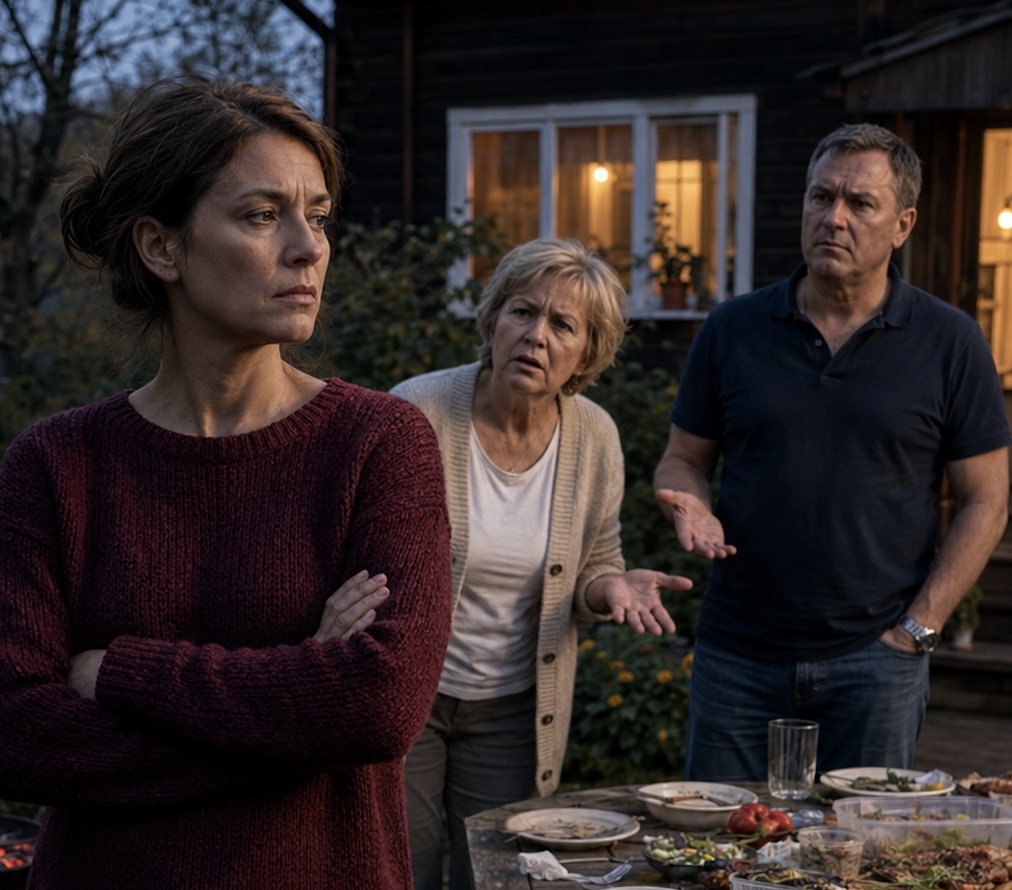
Galina looked at him for a second. Then she stepped into the middle of the living room, where everyone could see her.
“Wait,” she said. Not loudly, but in a way that made everyone turn.
Natalia looked out from the kitchen. Gennady Ivanovich raised his head. Lyosha froze in the doorway with the grill tongs in his hand.
“If you want a celebration, cook it yourselves. I am not going to serve anyone at my own dacha.”
A special kind of silence fell over the room — the kind that comes when everyone has heard something but has not yet decided how to react.
“Galya, what’s wrong with you?” Natalia began cautiously. “We’ve always done it this way…”
“Exactly. Always.” Galina’s voice remained even. “You come here and rest, while I spend the whole day in the kitchen. This is my dacha. I am the owner here, not a cook and not a maid. If you want to eat, the groceries are in the bags and the kitchen is free. If you want a holiday, divide the work among yourselves.”
Lyudmila Stepanovna opened her mouth, then closed it again. Lyosha carefully placed the tongs on the floor.
“Well, that doesn’t seem very family-like,” Gennady Ivanovich said from the veranda.
“Family-like means the work is shared fairly,” Galina answered. “Not one person cooking while everyone else rests.”
Oleg stood by the wall and said nothing. Galina turned to him — calmly, without challenge. He did not answer. He simply stood there with the confused look of a man whose familiar order of things was falling apart before his eyes, while he had not yet had time to think what to do about it.
When Galina had stepped into the middle of the room, she had felt neither fear nor anger. There was only one thing: clarity. That special clarity that comes when you have postponed something important for a long time, and then suddenly understand that there is nothing left to postpone. She had not rehearsed those words. They came out by themselves — short, exactly what needed to be said.
“I’ll be in the garden,” Galina said. “If you need anything, you’ll find it.”
She went out onto the porch and closed the door behind her. She did not slam it. She simply closed it.
The plot smelled of autumn and bitter smoke drifting from somewhere beyond the fence. Galina walked to the far corner, where the old apple tree her father had planted in the nineties stood, and sat down on the wooden bench beside it. The board bent under her in the familiar way.
From the house came voices — muffled, uncertain. Then dishes clinked. Then one of Natalia’s sons laughed; he clearly did not care what was happening among the adults.
Galina stretched out her legs and looked up. The sky above the garden was pale and even. The apple tree stood bare, with only a few leaves clinging to the thinnest branches.
About twenty minutes later, Oleg came out of the house. He walked over and stopped two steps away.
“Galya, why like that? They didn’t expect it. It turned awkward.”
“Let them get used to it,” she said without turning.
“You could have talked to me beforehand. I would have explained it to them…”
“Oleg.” She looked at him. “Six years. You had six years to explain. You didn’t.”
He was silent for a moment, looking somewhere toward the fence.
“I suppose I didn’t notice.”
“Exactly.”
Oleg stood there a second longer, then returned to the house. Galina remained on the bench.
While he grilled the meat, Galina thought that the strangest thing in this whole situation was not Natalia. Natalia was predictable: she always took as much as she was given. The strangest one was Oleg. He was a good man — she knew that and did not doubt it. He loved her. But he had that special blindness to another person’s labor — not malice, just the habit of looking past it. The work existed, but Oleg did not see it. The way people do not see water from the tap — it is always there, and therefore it is almost as if it does not exist.
That could be explained. But it could not be allowed to continue.
By lunchtime, everything somehow arranged itself. Not the way it had before, but it arranged itself. Natalia set the table — unevenly, not the way Galina usually did it, but she set it. Lyosha managed the barbecue. Lyudmila Stepanovna sliced what was in the bags. No one came to ask Galina to do anything. Or perhaps they wanted to, but then decided to do it themselves.
Galina entered the house when they called everyone to the table. She ate. She answered questions. She watched Natalia’s sons argue over the last piece of meat. It was an ordinary family lunch — noisy, a little awkward, but ordinary. Only one thing was different: she sat at that table as the hostess, not as a servant.
Natalia did not approach her privately even once that day. She simply worked hard to pretend that everything was normal. Gennady Ivanovich was somewhat cold, but polite. Lyudmila Stepanovna accepted the situation as a fact — she was a practical woman and knew how to adapt.
After everyone left, Galina walked around the plot. She locked the gate latch, checked the tap, closed the bathhouse door. She picked up a plastic cup that had rolled under the bench. She straightened the edge board of a garden bed that someone had shifted.
Then she stood in the middle of the yard and looked at the house. The windows were glowing — Oleg was inside. The smoke from the grill had almost disappeared. The plot was quiet.
Autumn was doing its work: the ground had darkened, the grass lay flattened, and only the currant bushes along the fence still held their last leaves, yellow and slightly transparent in the sunset light. Galina touched a branch and felt the familiar roughness of the bark. Her father had always said that blackcurrants were the least demanding. Plant them and forget them; they will grow on their own. She had not forgotten. She never forgot anything here.
That evening, she and Oleg sat together on the veranda for a long time. They drank tea. They talked quietly, without hurry. Oleg spoke about what he had failed to notice. Galina spoke about what she had kept silent. It was not a scandal and not a confrontation — rather, it was a quiet inventory, when two people look at the same thing and finally call it by the same name.
“Are you angry with me?” Oleg asked.
“No,” Galina said. “But it was important to me that you saw it. Not just heard it from me — saw it yourself.”
Oleg was silent for a while.
“I saw it,” he said.
Galina watched the sky darken over the garden. The apple trees turned into dark silhouettes. Somewhere behind the fence, an unfamiliar dog went quiet. It became truly still — that special late-evening peace that exists only here, outside the city, when everything from the day has finally ended.
The conversation with Natalia was still ahead. She would call — Galina knew that. But now Galina also knew what she would answer. Calmly, without unnecessary words. That “in a good way” meant in a good way for everyone. And that this was not up for discussion.
There was one other small episode Galina had never forgotten. Once, late in the evening, after the guests had dispersed, she was washing dishes when Natalia came into the kitchen with an empty glass. She saw the mountain of plates, was silent for a moment, and said, “Galya, you should have at least asked someone to help.” Galina said nothing. She simply kept washing. Natalia stood there for a second, placed the glass beside the sink, and left. A few minutes later, her laughter came from the living room — someone was telling a funny story. Galina turned off the water, dried her hands, and thought: this is exactly how it works. You can notice and leave. Or you can notice and stay to help. Natalia always chose the first — not out of cruelty, simply because it was more convenient.
Galina stood up, picked up a broken apple branch from the grass, and placed it on the woodpile by the wall.
“Let’s go inside,” she said. “It’s getting cold.”
Natalia called on Monday. Her voice was a little offended, a little cautious — the way people speak when they have not yet decided whether to be angry or not. Galina answered briefly and calmly. She explained: this was not an attack, not a war, just a new order. If you come, you participate equally. You bring food with you or cook together, and you clean your own dishes. Everything else remains as before. Natalia was silent for a while, then said, “Well, all right,” and hung up. It was not reconciliation. It was the beginning of a new arrangement.
Galina put away her phone and took her jacket. She had to go to the dacha — in October, the currants needed to be covered for winter.
She drove along the empty road, looking at the bare fields on either side, and thought about how easily a person could live for years without saying the simplest thing aloud. Not out of cowardice — simply because each time it seems: not yet, it will pass, I can endure a little longer. And then one Saturday afternoon, you stand in the middle of your own living room and say it out loud — and it turns out not to be as frightening as it seemed. The world does not collapse. People can hear.
The dacha welcomed her with silence and the smell of autumn earth. Galina opened the gate, walked along the path to the currant bushes, and set to work. One could have called it a victory. But Galina did not think of it that way.
It was simply the restoration of what should have been normal from the very beginning — only no one had taken the trouble to name it aloud. Now it had been named. Now everyone knew. The rest would be a matter of time and habit.
Galina pulled on her gloves, knelt before the currant bush, and began tying up the branches. The earth under her hands was cold and damp. Good earth. Her father used to say that good earth holds warmth until the very end.
Galina worked until darkness fell. Then she stood up, took off her gloves, and looked over the plot. The currants were covered. The house stood dark — Oleg had not arrived yet. Galina locked the gate, started the car, and drove home.
Tomorrow she would come here again. The day after tomorrow, too.
This was her place.
And she was responsible for it.