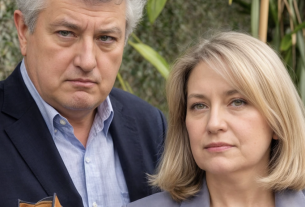
Marina sat in the kitchen in a worn robe with a fraying sash, absentmindedly pushing cold buckwheat around her plate with a fork. The sun flooded through the window so brightly that, for a second, it almost felt as if they were living somewhere warm and glamorous, not on the rundown outskirts of Moscow in a peeling apartment block. But of course that was just an illusion. In reality, it was an old two-room flat filled with furniture from the nineties, most of it bought by Pavel’s parents long before Marina had come into the picture. Everything was exactly as you would expect: a glossy cherry-colored kitchen set, a squeaky couch in the living room, and a refrigerator old enough to have a longer history than their marriage.
Marina unlocked her phone and, almost automatically, opened her banking app. Then she froze.
The balance showed zero rubles and zero kopeks.
“Pash, did you take money from the account?” she asked, not even lifting her eyes from the screen.
At that moment Pavel was fussing with the coffee machine. He wore a sleeveless undershirt, and his stomach—steadily growing despite his endless claims that it was “just water retention”—pressed against the fabric. He shrugged carelessly.
“What money?”
“Two hundred thousand. Our savings.” Marina finally turned to him, squinting. “Don’t play games with me.”
Pavel went rigid, like a schoolboy caught doing something he shouldn’t. Then he bent over the machine and pretended to be deeply interested in the filter.
“Marinochka, please, don’t start first thing in the morning. Everything’s fine.”
“Fine?” She raised an eyebrow. “I live on a nurse’s salary, you survive on an accountant’s paycheck, and somehow this is your idea of fine? Two hundred thousand doesn’t just disappear!”
He glanced at her, shifted awkwardly, and finally muttered:
“Mom took it.”
Marina felt her throat go dry.
“What?”
“She… she needed it urgently. She said she’d return it.”
“Pavel, have you completely lost your mind?” Marina jumped up so sharply that the chair behind her crashed onto the tile. “You let my mother-in-law take our money?”
“I didn’t exactly let her…” he mumbled. “She said it was temporary. She always knows what she’s doing.”
“Knows what she’s doing?!” Marina let out a laugh so sharp it frightened even her. “You mean the same woman who borrowed forty thousand three years ago ‘for dental work’ and has been ‘repaying’ us ever since with pots of borscht?”
Pavel hunched his shoulders, as though he wanted to disappear into the sink.
“Don’t exaggerate. She’s my mother. She understands these things better.”
“Oh, naturally,” Marina said, dropping back into her chair and pressing her hands to her temples. “Mother is sacred. Wife is just a temporary add-on.”
Just then, as if on cue, came a sing-song voice from the doorway.
“Pavlusha, sweetheart!” Galina Petrovna leaned inside as though the home still belonged to her. “I was passing by and thought we could have some tea.”
Marina got to her feet and planted herself in the kitchen doorway, arms folded across her chest.
“What perfect timing, Galina Petrovna. Maybe now would be a good moment to discuss where our money went.”
Galina Petrovna blinked and instantly put on a mask of confusion.
“What money, dear?”
“The two hundred thousand you ‘borrowed temporarily.’”
Her mother-in-law threw up her hands in theatrical outrage.
“Oh, good heavens, what a drama! I took it for something important. For the family!”
“For which family?” Marina stepped closer. “Yours or ours?”
“You’re still young,” Galina Petrovna replied with patronizing sweetness. “You don’t understand. That money is an investment. I’ve already signed papers on an apartment in a new building. For Pavlusha.”
A cold wave ran down Marina’s back.
“For Pavel?” Her voice shook. “So, for your son. Not for his wife.”
“And why would you need it?” her mother-in-law asked in the same syrupy tone. “You’re a woman. Today you’re here, tomorrow—who knows? But an apartment is for my boy. So he’ll always have security.”
“So that’s what I am?” Marina’s fists tightened until her nails bit into her skin. “A temporary attachment? Eight years of marriage, a joint account, and I’m nobody?”
Pavel stood against the wall like a piece of furniture. Not a word. Only his eyes kept darting from one woman to the other.
“Pavel!” Marina shouted. “Say something!”
He swallowed.
“Marinochka… Mom is right. The apartment is still for us.”
“For us?” Marina turned sharply toward him. “Is my name anywhere on those documents?”
Galina Petrovna gave a contemptuous snort.
“My dear girl, you want far too much. I’m doing all of this for your sake, and all I get are complaints.”
“For our sake?” Marina grabbed a cup from the windowsill and slammed it onto the table so hard tea sloshed over the rim. “You’re doing it for yourself. So you can keep us on a leash!”
“You’re the one tearing this family apart!” Galina Petrovna cried, gesturing wildly. “With these hysterics!”
Marina laughed again, but now the sound trembled.
“So the daughter-in-law asking for honesty is the one destroying the family? Not the mother who steals money?”
Pavel took a step forward and tried to touch her hand.
“That’s enough, calm down… it’ll sort itself out.”
Marina jerked her hand away.
“No, Pavel. This is not going to sort itself out.”
She looked at her mother-in-law, who stood there clutching her bag of tangerines to her chest like ammunition. Then she looked at her husband, shrinking into himself again. And in that moment she understood: this was the first real betrayal. Not the money itself, but the silence. The fact that he had chosen a side.
Marina left the kitchen without slamming the door. On the contrary, she pulled it shut softly, almost politely. And somehow that quiet gesture was far more chilling than any shouted argument could have been. A slammed door still meant emotion. A gently closed one meant something else entirely: finality. A full stop. A cold emptiness settling inside.
She went into the bedroom, yanked open the closet, and began throwing things into a bag at random. Jeans. A sweater. Underwear. A few of Pavel’s T-shirts she couldn’t stand but still stuffed in anyway. Only one thought pounded in her head:
Had I really spent eight years living inside a lie?
From the hallway she could hear Pavel whispering to his mother, trying to soothe her, while Galina Petrovna sniffled dramatically.
“So this is what it’s come to… I do everything for them, and she calls me a thief…”
Marina clenched her teeth, shoved her phone charger into the bag, and came back out.
“I’m staying at Sveta’s,” she said, not even glancing at her husband.
“Marish…” Pavel stretched out a hand, but she stepped away.
“No, Pash. I need to leave right now. Otherwise I’m going to do something I’ll regret later.”
Her mother-in-law immediately brightened.
“Oh, wonderful! Go cool off, think things over. At least Pavlusha will finally be able to breathe without all this drama.”
Marina looked at her with such intensity that, if a stare could kill, there would already have been a body on the carpet.
“Are you happy now?” she asked quietly. “You got to keep him.”
Then she walked out.
Sveta’s place was always cramped and cozy at the same time—books piled everywhere, a mutt sprawled across the couch, and the constant smell of coffee in the air. Sveta worked as a lawyer and had seen all kinds of human ugliness, but when Marina told her about the missing money and the apartment in the new building, she gave a long whistle.
“This isn’t just a classic evil mother-in-law situation,” she said. “This is practically a family law textbook. Do you realize that if the apartment is registered only in Pavel’s name, then legally you’re nobody there?”
Marina sat with a mug of cold latte pressed against her palms.
“I suspected that. But hearing someone else say it out loud makes me sick.”
“Exactly.” Sveta scratched the dog behind the ears. “So, option one: accept it and wait for your mama’s boy to finally grow a backbone. Option two: turn into a fighter.”
“And what exactly does that mean?”
“Police. Court. A marriage contract, maybe. You do have proof the money was joint, right?”
“Well… we both transferred money onto that card.”
“Perfect. That’s your leverage. The only question is: are you ready to go all the way?”
Marina said nothing. For the first time in eight years, she allowed herself to truly imagine it—what life might look like without Pavel. Without that apartment. Without the idea of “us.” Just her. Just her own life.
The next day Pavel showed up at Sveta’s anyway. He stood in the doorway, twisting his cap in his hands like a teenager apologizing for a broken window.
“Marish, please don’t leave. Mom… she only meant well.”
“For who?” Marina didn’t even lift her eyes from the laptop in front of her.
“For us.”
“For us?” She snapped the laptop shut. “Pavel, do you even understand that if something happened to me tomorrow, you would be living in that new apartment and I would be nothing? I wouldn’t even be registered there.”
He swallowed, shifting awkwardly from foot to foot.
“Well… we could add that later…”
“Later?” Marina stood and stepped closer. “Do you even hear yourself? Our shared money was stolen, and all you can say is later.”
“Marish, I’m torn between the two of you. You know Mom is alone…”
“And what am I? Nobody too?”
Her voice cracked, and for the first time since this began, Pavel raised his voice.
“You’re driving me into an early grave with these scandals!”
“Scandals?” Marina slammed her palm against the table. “This is called demanding respect!”
At that very moment, the apartment door flew open and Galina Petrovna strode in. Yes—she had actually come to Sveta’s place as if she owned that too.
“Pavlusha, let’s go, don’t humiliate yourself!” she barked. Then she turned to Marina. “And you, my dear, if you think you’re so clever, go find another fool who’ll dance to your tune!”
Sveta rushed out of the room and stepped between them.
“Madam, are you out of your mind? This is my apartment. Get out. Now.”
Galina Petrovna looked her over with open contempt.
“Oh, these little divorce-encouraging girlfriends. Never mind. We can settle this without you.”
For one split second, something inside Marina snapped. She stepped forward and, for the first time in her life, raised her hand. She did not strike her—but she grabbed her mother-in-law by the wrist and shoved her toward the door.
“Out.” Her voice shook, but it was firm. “This is my life. Not yours.”
Pavel rushed to his mother, wrapped an arm around her shoulders.
“Mom, let’s go…”
They left.
Marina collapsed onto the couch and buried her face in her hands.
Sveta sat down beside her in silence and placed a hand on her shoulder.
“So,” she said softly, “shall we turn on fighter mode?”
Marina nodded without uncovering her face.
Two days later she was sitting in a notary’s office. A folder full of documents lay open in front of her. Sveta sat beside her, businesslike, flipping through the pages.
“Look,” her friend said, tapping the contract with a pen. “It’s all neat and clean. The apartment is registered in Pavel’s name only, and there isn’t even a trace of joint ownership on paper.”
Marina clenched her hands.
“So court it is.”
“Yes,” Sveta said. “And get ready. It’s going to be brutal.”
At that moment Marina understood something she had never fully admitted before: her marriage was not a partnership. It was a battlefield.
The turning point came that evening when Pavel called. His voice sounded strange, tight with tension.
“Marish… Mom said that if you go to court, she’ll transfer the apartment into her own name.”
Marina let out a short, cold laugh.
“So that’s what this is now. Blackmail.”
“Don’t call it that…”
“What else should I call it?” she cut in. “She stole our money and now she’s setting conditions?”
“Marish, just try to understand…”
“No, Pavel. You’re the one who needs to understand. I’m going all the way.”
She ended the call. And for the first time in a very long while, she felt not helplessness but strength.
Marina had never imagined her life would begin to resemble some courtroom drama with a painfully bad cast. But there she was, sitting in the courtroom. Across from her sat Pavel and his mother, and beside them was some polished lawyer in his fifties with a sleek suit, a neat folder, and the kind of half-smile that suggested professional cynicism.
The judge read in a flat voice: a claim seeking recognition of the deposit as joint marital property and the inclusion of the apartment among the couple’s shared assets. Marina listened and realized that over the past months she had stopped crying. The tears were gone. In their place remained anger and a cold, cutting sarcasm.
Pavel sat staring at the floor. Galina Petrovna was composed as ever, posture flawless, as though she were competing in some contest called Miss Eternal Control. Every now and then she shot Marina a triumphant glance that seemed to say, So, girl, you thought you could challenge me?
The judge stepped out, then came back.
The ruling was simple: the deposit would be recognized, but the apartment would remain Pavel’s. Marina was entitled to compensation—one hundred thousand rubles. Half of the money that had been taken.
Galina Petrovna gave a satisfied nod. Pavel looked as though he had just been publicly whipped. And Marina…
Marina smiled.
That smile unsettled both of them more than any tears or hysterics ever could.
A week later she packed the rest of her things for good. No screaming. No drama. No slammed doors. She rented a small one-room apartment near the metro. The walls were white, the furniture plain, but the place felt full of air and freedom.
Pavel called a few times. He said the same old things: “Mom is upset,” “Maybe we can still fix this.” On the other end of the line was the voice of a grown man, but the meaning behind it was childish babble.
“Pasha,” Marina said calmly, “your mother won. You got the apartment. But you lost me. Now it’s just the two of you in your little alliance. Let her iron your shirts and fry your cutlets.”
He fell silent. She hung up.
A month later Marina happened to run into him near their old building. He looked older, with gray shadows under his eyes.
“Well?” she asked with the faintest hint of a smile.
He shrugged.
“It feels empty there. Mom refused to move in with me. Said she’s more comfortable in her own place. And I’m… alone.”
Marina looked him straight in the eyes.
“That,” she said, “is your golden cage, Pasha. An apartment, but no family.”
Then she turned and walked away. Her bag hung lightly from her shoulder, and in her pocket were the keys to her own tiny but free apartment. And for the first time in a very long time, she felt light.