Part 1. Warning Signals
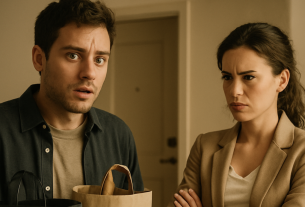
Nadezhda sat in the kitchen, staring at the dinner that had already gone cold.
Her mind, usually trained to follow precise emergency-response procedures, was now in complete disarray. She worked as a senior specialist in civil defense and emergency preparedness. Her world was built on evacuation plans, warning protocols, gas masks, and training drills. In her line of work, order meant survival.
But at home, inside the three-room apartment she shared with Sergey, a disaster was taking shape—one no instruction manual could stop.
Sergey came back late from a work site. He smelled of dust, cheap tobacco, and that stubborn blend of electrical tape and rosin that followed him everywhere like a second skin. He worked with low-voltage systems—pulling Ethernet cable, installing motion detectors, wiring surveillance cameras. He fancied himself some kind of master of electrical signals, though in truth he mostly drilled walls and crimped connectors.
“Why do you look so miserable, Nadya?” Sergey asked, tossing his tool bag into the hallway even though he knew it annoyed her. “What, your uniformed bosses chew you out again?”
Nadezhda slowly looked up.
“A letter came,” she said. “Registered mail.”
“A fine?” He strolled into the kitchen and lifted the pot lid as if he owned the place. “Or taxes?”
“An inheritance,” she said quietly. “My aunt Augusta. Remember her? The one who lived in the port city.”
“The one who never had kids?” Sergey froze with the ladle in his hand. His eyes, usually dull with fatigue, suddenly lit up with a greedy shine. “So what is it? Some rotten shack or something real?”
“Warehouse buildings,” Nadezhda replied. “A hangar. And the land under it. Industrial area.”
Sergey carefully put the ladle back. He even sat down, forgetting he had not washed his hands.
“Warehouses?” he said. “Nadya… do you even realize how much that could be worth? That’s rental income. Passive income. That’s… goodbye hammer drill, hello easy life!”
Nadezhda looked at her husband and saw the calculation already running behind his eyes. There was no sympathy for her dead relative. No “How are you feeling?” No concern at all.
Only numbers.
“It’s my inheritance, Sergey.”
“What do you mean, your inheritance?” he laughed, though his gaze had turned sharp. “Come on, Nadya, don’t start that. We’re family. Everything comes into one household. One shared pile. Have you forgotten how we live?”
Nadezhda said nothing.
She remembered.
She remembered very well.
And that memory was burning in her chest harder than fire.
Part 2. The Shadow of the Old Ural
Three years earlier, Sergey’s grandfather on his mother’s side had died. The man had been stingy, but he loved his grandson. Sergey inherited a garage out in the region and an old Ural motorcycle with a sidecar—rusted, nonfunctional, and looking more like a pile of scrap than a machine.
Back then, Sergey treated that motorcycle like a sacred relic.
“It’s a vintage classic!” he had shouted. “I’ll restore it and sell it to collectors for serious money!”
Nadezhda had offered to help pay for the restoration, but Sergey had proudly refused. In the end, he spent six months fooling around in the garage, burned through a pile of family money on useless parts that didn’t even fit, and then dumped the whole thing at a scrap yard and sold some pieces to secondhand parts dealers.
For all his effort, he got twenty-five thousand rubles.
Almost nothing.
But the way he staged the whole thing, you would have thought he had made a fortune.
He came home carrying supermarket bags stuffed with the most expensive sausage, elite alcohol, and caviar.
“There!” he had declared, dropping it all onto the table. “I sold my grandfather’s inheritance. This is for the family. I’m not some rat who hides money from his wife. What’s mine is ours. I contributed!”
Nadezhda had smiled then.
“Seryozha, you spent more on gas getting to that garage than you made from selling the thing.”
“Don’t count pennies!” he had snapped, lifting a finger self-righteously. “That’s not the point. The point is the principle. I’m a man—I earned it, I brought it home. Remember this day, Nadya. I shared my inheritance with you down to the last ruble.”
That twenty-five thousand disappeared within a week.
But the drama of it lasted for years.
In every argument, in every fight, Sergey threw that Ural in her face.
“I sold my grandfather’s memory for this family!”
“I gave everything I had!”
“I shared my inheritance!”
And now, sitting across from her, he was pulling that same tired trump card out again.
“Nadya, let’s not do this selfish nonsense. I sold the Ural, didn’t I? I brought the money home, didn’t I? I did the fair thing. Like family. Now it’s your turn.”
“You’re comparing five kilos of deli meat with commercial real estate worth tens of millions?” Nadezhda asked in a calm, professionally controlled voice.
“What difference does it make?” Sergey snapped. “It’s the same principle! Scale doesn’t matter. It’s the attitude that matters! Or do you take me for an idiot? When I had pennies, I was ‘good old Sergey,’ but now that you’ve got millions, suddenly it’s ‘keep out’? Not a chance.”
At that exact moment, Sergey’s phone beeped.
A message from his mother appeared:
So? Did she tell you the good news?
He did not even try to hide it.
Part 3. The Blast Zone
By the weekend, a full invasion force had descended on their apartment.
Sergey’s mother, Rimma Ivanovna, and his grandmother, Valentina Zakharovna—known as Baba Valya—arrived “for tea,” though they behaved more like an assessment committee inspecting newly discovered assets.
Baba Valya, a frail old woman with a predatory stare, immediately took over Nadezhda’s favorite chair.
“Well then, dear daughter-in-law,” she began without preamble, tapping her cane against the floor, “we heard about your good fortune. God has blessed you. Now the main thing is not to waste it. Our Seryozha is clever, he understands technical matters—let him manage those warehouses. You’re a woman. Those tenants will deceive you in no time. Crooks, every last one of them.”
Rimma Ivanovna, a heavyset woman whose permanent eyebrow makeup left her looking permanently offended and hostile, eagerly nodded along.
“Exactly. Nadya, this all needs to be handled properly. Sergey has a sole proprietorship—let management be transferred to him. The income gets split. Into the family budget, naturally. Our car is falling apart, and your place…” She picked at the cheap vinyl wallpaper in the hallway with visible disgust. “These walls are embarrassing.”
“Sergey put that wallpaper up,” Nadezhda said while pouring tea. “Three years ago.”
“That’s because you don’t know how to inspire a man,” Rimma Ivanovna shot back. “A husband needs motivation. Now that there’s real money, he’ll finally spread his wings.”
Then the doorbell rang.
It was Olga, Nadezhda’s older sister, along with Lena, Sergey’s sister. Lena was the odd one out in Sergey’s family—the only sane person among them. Quiet, decent, a veterinarian by profession, and thoroughly disgusted by her mother’s and grandmother’s scheming.
“Hi,” Lena said softly, giving Nadezhda an apologetic smile. “I knew this was turning into a war council. I came to support you.”
Olga, broad-shouldered and fearless, sized up the room instantly.
“Oh, look at that,” she said loudly as she removed her coat. “The vultures have gathered. Dividing up the skin before the hangar is even dead.”
“Mind your language, Olga!” Rimma Ivanovna screeched. “We’re discussing family matters!”
“Family matters?” Olga stepped into the room. “It’s Nadezhda’s inheritance. What exactly does Sergey have to do with it?”
“EVERYTHING!” Sergey slammed his fist on the table. “I’m the husband! Everything in this marriage is shared! I sold my motorcycle for us!”
“Oh no, not the motorcycle again,” Olga groaned. “You sold that heap for a case of booze and a few snacks.”
“THAT’S NOT THE POINT!” Sergey shouted. “I gave everything I had! That gives me a moral right! Nadya, tell them! Tell them we split everything fifty-fifty!”
Silently, Nadezhda set her cup down on the table.
The porcelain gave a sharp little ring.
Part 4. Civil Defense Siren
“You want to know what I think?” Nadezhda rose to her feet.
She was not shouting. But her voice filled the room so completely it became difficult to breathe. It was the voice of someone explaining that a shell will land here in three minutes, and panic is not an option.
“So, Sergey,” she said, “you believe that twenty-five thousand rubles and three sticks of sausage entitle you to half of an asset worth forty million?”
“Yes!” he barked, encouraged by the support of his mother and grandmother behind him. “Because that’s what family means! I fed this house for a month with that money!”
“A week,” Nadezhda cut in. “You spent one week stuffing yourself with delicacies while I paid the utility bills, paid your loans for tools you barely use, and paid for treatment for the back you ‘injured’ while lying on the couch.”
“Don’t you dare insult my son!” Rimma Ivanovna demanded.
“SILENCE!” Nadezhda roared so sharply that Rimma Ivanovna hiccupped and collapsed back into her seat.
Nadezhda had reached the breaking point—but this was not some pathetic meltdown with smeared mascara and trembling sobs.
This was controlled demolition.
A calculated explosion aimed at flattening every rotten structure of lies around her.
“All of you are sitting here dividing up something that has absolutely nothing to do with you!” she said. Then she pointed straight at her husband. “And you—you’re a pathetic, envious miser. You didn’t ‘invest in the family.’ You got rid of junk and demanded a medal for it. You spent years whining that you were underpaid, but never once lifted a finger to improve yourself. Yet the moment the smell of my money hit the air, suddenly you were ready to become a ‘manager’?”
“Nadya, you’ll regret this,” Baba Valya hissed. “You’ll end up alone! Who will want you then?”
“BETTER ALONE THAN WITH PARASITES LIKE YOU!” Nadezhda burst into harsh laughter, and it was more frightening than screaming. It was bitter, cruel, contemptuous. “Do you think I don’t see it? You’ve hated me all these years. The only reason you tolerated me was because my salary was steady and my apartment was spacious.”
“You bitch…” Sergey jumped to his feet. “I’ll drag you to court! I’ll prove we ran a joint household! I’ll sue you for half, do you hear me? Half! By law! I’ll hire lawyers!”
“With what money, you pathetic little man?” Nadezhda looked at him with naked contempt. “Will you borrow it from your mother? Or steal more cable from a construction site?”
“You want MY INHERITANCE?” Nadezhda leaned toward his face, and the icy rage in her eyes made Sergey instinctively recoil. “And what exactly does it have to do with you? You—you can’t even fix an outlet without scorching the wallpaper. And you want to manage a logistics center?”
“I have rights! I’m your husband!”
“RIGHTS HAVE TO BE EARNED!” she screamed. “And the only thing you’ve earned is a kick out the door! GET OUT! All of you! Right now! Or I’ll call in a response team—not the police, my rescue unit. They’ll carry you out like sandbags!”
Olga stood up beside her sister, arms folded across her chest. Lena, Sergey’s sister, sat quietly in the corner with her eyes lowered, ashamed of her own relatives.
Sergey stood there gulping air. He had not expected resistance like this. He was used to Nadya being the one who endured everything, the one who smoothed over conflicts and searched for compromise.
But now she was coming at him like a tank.
“You… you’ll come craw—” he began, reaching for some tired old threat.
“SHUT UP AND GET OUT!” Nadezhda thundered. “I’m filing for divorce. Tomorrow.”
Muttering curses, the relatives dragged themselves toward the door. Sergey was the last to leave.
“You won’t get anything good out of that hangar, do you hear me? Not one happy kopeck! I’ll make your life such hell, you’ll hand me half yourself!”
“Keep walking, provider,” Olga spat after him.
Part 5. Independent Operation
A month passed.
Sergey was living with his mother. Together, he and Rimma Ivanovna came up with what they believed was a brilliant plan. They found a lawyer—some shady acquaintance of Baba Valya’s—who assured them that since Sergey had contributed to the household budget with his salary and that infamous motorcycle money, he could claim a share in the increase of his wife’s wealth, even if the inheritance itself was technically personal property.
It was absurd, of course.
But Sergey believed it.
He bombarded Nadezhda with messages:
Let’s settle this peacefully. Transfer me 50% of the LLC that owns the hangar, and I won’t file for division of the apartment and the car.
The car, incidentally, had been bought by Nadezhda, and the apartment had ended up in their family through a complicated exchange arrangement involving Sergey’s paternal grandfather, Pyotr Ilyich.
Nadezhda said nothing.
At last, the day came for the meeting at the notary’s office. Sergey arrived with his lawyer, sweaty, nervous, but smug. In his head, he had already bought himself an SUV.
Nadezhda came alone.
She looked calm. Almost indifferent.
“Well then, Nadezhda Viktorovna,” Sergey’s lawyer began, “we have prepared an agreement. You voluntarily allocate a share to your spouse…”
“Stop,” Nadezhda said, raising her hand. “I agree.”
“What?” Sergey nearly jumped. “You agree?”
“Yes,” she said. “You wanted justice so badly. You screamed so much about that motorcycle and how your grandfather’s inheritance should serve the family. I decided to honor your greed.”
She laid a folder on the table.
“I reviewed the documents. My aunt Augusta was an eccentric woman. But even more eccentric was your grandfather, Pyotr Ilyich.”
“My grandfather?” Sergey frowned. “What does he have to do with this? He died five years ago.”
“Yes,” said Nadezhda. “But before his death, he left a sealed testamentary instruction. One that came into effect only under certain circumstances. Or after a certain amount of time.”
She opened the folder.
“That Ural motorcycle was the only thing your grandfather left directly to you himself. He wanted to test what kind of person you really were. Rotten or decent. You sold your grandfather’s memory for groceries. He expected exactly that.”
“That’s nonsense,” Sergey scoffed. “Get to the hangar.”
“The hangar…” Nadezhda smiled faintly. “My aunt Augusta was once close to your grandfather Pyotr. Very close. They had an affair in their youth. The land and hangar I supposedly inherited actually belonged to your grandfather. He transferred them to Augusta on paper to hide the assets from your grandmother Valya and your mother, whom he deeply despised for their greed.”
Sergey went pale.
“Aunt Augusta’s will says the property passes to me. But there is a clause. If my husband, Sergey, demands division of that property, then an additional packet of documents must be opened.”
Nadezhda pulled out an old yellowed envelope.
“This is your grandfather Pyotr’s final instruction. It says: If my grandson Sergey reveals his rotten nature and tries to take from his wife what does not belong to him under family law, but was given as a gift, then I deprive him even of what he already has.”
“What can he take from me?” Sergey shrieked. “I don’t have anything!”
“The apartment we lived in,” Nadezhda said calmly. “You thought it was privatized in both our names? Did you ever bother reading the paperwork properly, cable boy? The apartment remained your grandfather’s property. He arranged a lifetime maintenance contract in my favor, with ownership rights transferring to me after five years of marriage—provided that I did not throw you out myself. But if you became the one to initiate division, then the apartment became mine outright, with no right of residence for you.”
Sergey sat there with his mouth hanging open.
“And one more thing,” Nadezhda added, sliding another page toward him. “About the hangar. Your dream has come true. I’m giving you a share.”
“Really?” Hope flickered in Sergey’s eyes again.
“Yes,” she said. “But there’s a detail. Along with ownership of 50% of the hangar comes 50% of the obligations. The hangar was built illegally. There is already a court order requiring its demolition and the cleanup of the land because chemical waste was stored there in the 1990s. The fine and demolition costs come to around eighteen million rubles. Aunt Augusta never officially accepted the inheritance because of that. I did. And now I’m willing to share that burden with you, dear husband.”
Nadezhda set a pen on the table.
“Go ahead. Sign. You wanted half the inheritance? Here it is. Half the debt—nine million rubles. And half the criminal liability if the waste isn’t removed within a month. But at least it’ll be yours. Just like the motorcycle.”
Sergey stared at the papers as though they were a venomous snake.
“A-and if I refuse?”
“Then you sign a written waiver of all claims to the inheritance. And you get out of my apartment, because it is now legally my separate property, transferred to me through a gratuitous transaction by your grandfather. Either way,” Nadezhda said, closing the folder, “you walk away with nothing. Or with debt. Choose, strategist.”
Sergey looked helplessly at his lawyer.
The man only spread his hands and lowered his eyes.
“This is a setup…” Sergey whispered. “This is betrayal.”
“NO,” Nadezhda barked so sharply that even the notary flinched. “This is civil defense and emergency response. Warning and elimination of the consequences of a natural disaster. You are the natural disaster, Sergey. And I neutralized you.”
With a trembling hand, Sergey signed the waiver.
He stepped out of the office into the street. The sun was shining. People were hurrying along on their ordinary errands. And he stood there realizing that he had just lost his wife, his home, the millions he had dreamed of, and even the last scraps of his self-respect.
All because of that cursed motorcycle he had sold—the shadow of it stretching across his whole life.
He had tried to profit from someone else’s fortune, and in the end he was shocked by the current of his own greed, like a schoolboy sticking his fingers into an outlet.
And as for the hangar—the land rights were perfectly real. But Sergey was so terrified by then that he never even bothered to find out more.