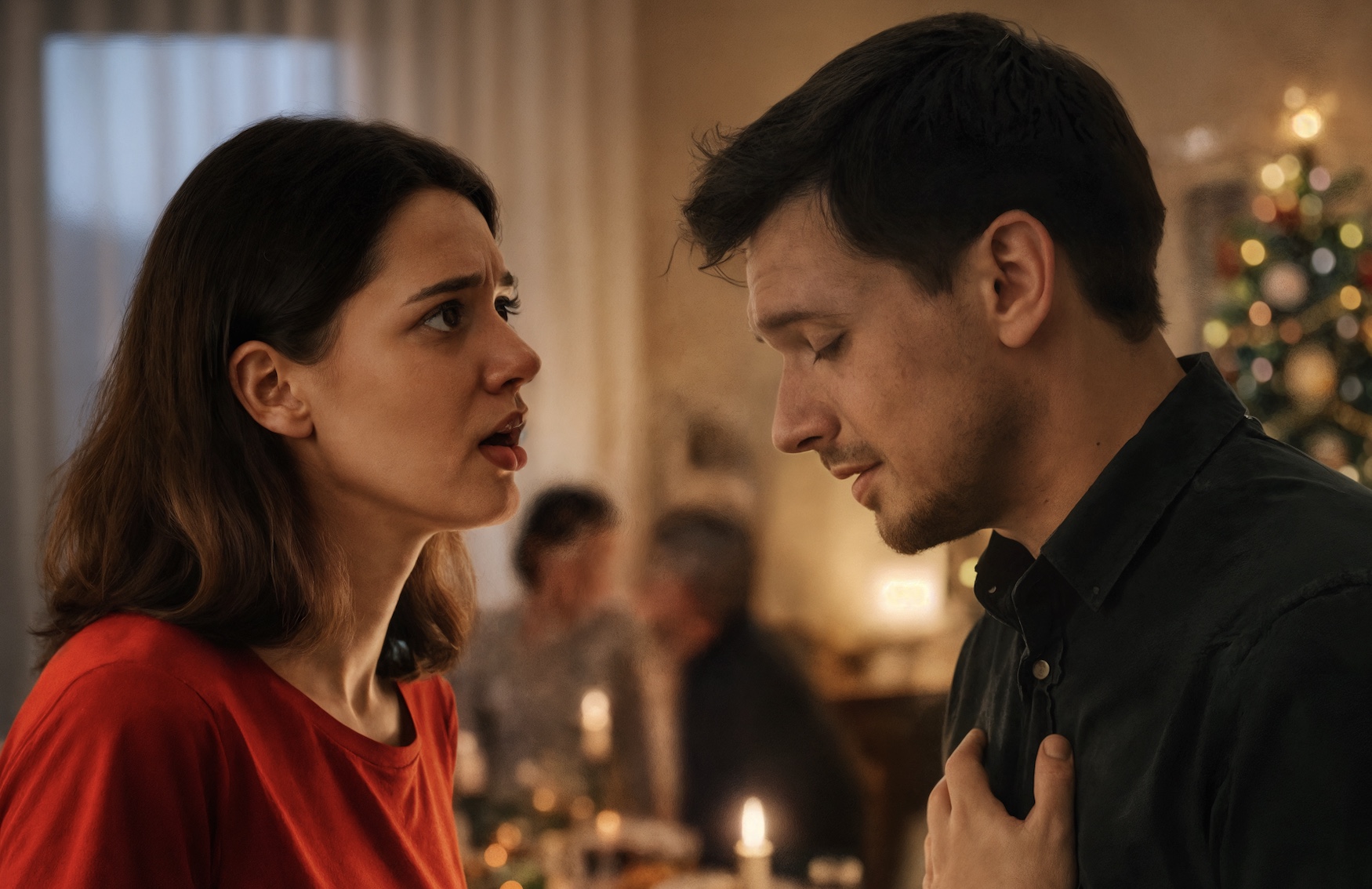
Natalya sat at the kitchen table with her phone in her hand, staring as if the screen had to be lying. The notification was perfectly clear:
“Consumer loan approved for 100,000 rubles. Funds have been credited to your account.”
Her fingers went icy. Something in her chest dropped hard.
She read it again. Then again. No—there was no misunderstanding. The loan was issued in her name. Today. An hour ago.
“Scammers,” Natalya whispered, a cold shiver running down her spine. “God… how could this happen?”
She opened the banking app at once, typing her password with shaking hands. The information confirmed it: the loan was real, and the money was already sitting in her account. Everything looked as if she had done it herself.
But she hadn’t. Not even remotely.
“Dima!” she called, fighting to keep her voice steady. “Dima, come here!”
Dmitry walked out of the room still wearing his headphones, with the absent look of someone who’d been interrupted in the middle of something important.
“What is it?” he asked, pulling the headphones off.
“Look,” Natalya held out the phone. “Someone took out a loan in my name. One hundred thousand! Some fraudsters issued it under my name!”
Dmitry took the phone and stared at the screen. His face shifted in a strange, telling way—first it drained of color, then blotched red. He ran a hand through his hair and looked away.
“It’s not fraudsters,” he muttered.
“What?” Natalya blinked. “What do you mean?”
“It was me.” Dima lifted his eyes. There was so much guilt in them that Natalya instantly knew he wasn’t lying. “I took out the loan in your name. I wanted to impress my relatives with a lavish holiday table,” he admitted quietly.
Natalya went silent. For a few seconds she just stared, as if her brain refused to translate the words.
“You… what?” she finally forced out. “You took out a loan? Under my name? Without telling me?”
“Natalya, I know your data, your passwords—I logged in from the computer and filed the application. I thought it would take longer to get approved…” He spoke quickly, stumbling. “I didn’t think it was a big deal—we’re married. I just wanted to do something nice!”
“Something nice?!” Her voice cracked into a shout. “You opened a loan in my name for a hundred thousand rubles and you call that ‘nice’?!”
“Natasha, please, wait—let me explain!” Dima held his hands out in a placating gesture. “Listen, I invited my whole family for New Year’s. Mom, my sister and her husband, the kids. They’re coming the day after tomorrow. And I wanted… I wanted them to see we’re doing well. That everything is fine with us.”
“We are fine!”
“Yes, but you know what they’re like…” Dima paced across the kitchen, tense. “Mom hints every single time that I chose the wrong profession, that I don’t earn enough. And my sister is always talking about how Valera is building his career, what kind of bonus he got. And I wanted to show that we’re doing great too!”
“And you thought a loan was the way to do that?!”
“I wanted to buy red caviar,” Dmitry’s voice turned almost pleading. “And all those ‘noble’ cheeses—brie, camembert, blue cheese. A proper Italian wine, not that cheap supermarket stuff. King prawns. Marbled beef. Can’t you picture the table? They would’ve seen I can provide, that I’m not a failure.”
Natalya lowered herself into a chair. Her head was pounding.
A hundred thousand rubles. A loan. In her name. A debt that would now be hers to pay.
“Dima,” she said slowly, forcing calm into her voice, “they’ll figure out how we live the second they see the furniture and the unfinished repairs. Do you think caviar will blind them so much they won’t notice our old couch? Or the wallpaper we still can’t afford to replace? Or that we still don’t have a dishwasher?”
Dmitry stayed silent, eyes down.
“And what am I supposed to do now—pay this loan back?” she went on. “Did you even calculate the monthly payments? With interest?”
“I’ll help, of course I’ll help,” he rushed out. “We’ll pay it together…”
“We can barely make ends meet as it is! We’ve been putting off renovations for two years. You wanted to buy a new computer for work…” Her voice trembled. “And now there’s a loan on top of everything.”
Natalya stood and went to the window. Outside, it was already getting dark. New Year’s was almost here, and she felt as if the holiday had been ruined beyond repair.
“Listen,” she said, turning back to him. “Is it really that important to you?”
“What?” Dima looked confused.
“To prove something to them. To show you’re successful.”
He was quiet for a moment, then nodded.
“Yes. I know it sounds stupid. But I’m tired—tired of Mom’s hints, tired of Svetka constantly showing off. I’m thirty-two, and I still feel like a kid who has to prove he’s worth something.”
Natalya sighed. She knew his family. She knew how his mother—hard, commanding—never missed a chance to remind her son that he’d made “the wrong choice.” She knew how his sister Svetlana, who’d married a businessman, loved to underline how comfortable her life was.
“Alright,” Natalya said at last. “I’ve got an idea. We’re going to them.”
“Where?” Dmitry frowned.
“To your family. We’ll visit them ourselves.”
“But I already invited them here! They were going to come to us!”
“Call and say something happened. A burst pipe, the apartment flooded, emergency repairs—anything. Tell them we’ll come instead. To your mom’s place in Nizhnekalinovsk.”
“But…” Dima stared at her, lost. “Why?”
“You’ll see.” For the first time in the whole conversation, Natalya gave a small, tired smile. “Trust me. And we’re not touching that loan. We’ll send part of the money back right away, and you’ll close the rest the moment you get paid.”
December 31st. Dmitry’s old Lada rolled along the snow-packed highway toward Nizhnekalinovsk. The back seat was filled with bags of groceries and gifts—Natalya insisted they bring everything they needed with them.
“Are you sure this is a good idea?” Dima asked again, for what felt like the tenth time. “Maybe we should turn back?”
“No,” Natalya said firmly. “We’re going.”
He gave her an uncertain smile. Two days had passed since the argument, and he still couldn’t figure out what she was planning. But one thing was clear: she wasn’t yelling anymore. The disappointment in her eyes, somehow, was worse than yelling.
Nizhnekalinovsk welcomed them with sleepy pre-holiday stillness—a small town where everyone knew everyone, where time moved slower than it did in the capital. Dmitry’s mother lived on the edge of town in a simple house with a little front garden buried under snow.
Maria Petrovna met them on the doorstep. Tall, composed, with cold gray eyes.
“So,” she said instead of hello. “You did come after all. I was starting to think you’d forgotten us in your Moscow life.”
“Hello, Mom,” Dima kissed her cheek. “Sorry about the invitation. We really did have problems come up.”
“Mm. Problems,” Maria Petrovna grunted, but she stepped aside to let them in. “Come in, then.”
The house smelled of pies and pine needles. In the corner stood a small real Christmas tree decorated with old Soviet ornaments. At the table, Dmitry’s sister Svetlana was bustling around—an overfed woman in her forties with a permanently dissatisfied look.
“Oh! The big-city guests!” she straightened, wiping her hands on her apron. “How was the drive?”
“Fine,” Dima said, setting the bags down. “Hi, Sveta.”
“Valera got stuck at work,” Svetlana explained, not even letting her brother hug her. “He has a business, you know. Not like… well. You know.”
Natalya caught her husband’s glance—old hurt, familiar pain. She squeezed his hand.
“We brought a few things,” she said loudly. “For the holiday table.”
“Oh, don’t bother,” Maria Petrovna sniffed skeptically. “We’ve got everything. Bought chicken, herring, made salads.”
But Natalya was already unpacking the bags. Homemade pies they’d baked all night. Tangerines. A jar of apple jam with cinnamon. A box of good tea. Gingerbread cookies she’d decorated with icing herself.
“Good grief, you dragged half the store in here,” Maria Petrovna grumbled, though her eyes softened. “Fine. Put it on the table.”
Evening came quickly. Everyone gathered. Valera—Svetlana’s husband—turned out to be an unexpectedly pleasant, simple guy, nothing like the puffed-up peacock Svetlana always made him sound like. The nephews, two boys around ten and twelve, darted between rooms, peeking under the tree.
They set the table together. Maria Petrovna brought out her signature pickled mushrooms, “herring under a fur coat,” Olivier salad, and aspic. Svetlana carried in roast chicken with potatoes, so fragrant it made Natalya’s stomach rumble. Natalya laid out her pies, peeled tangerines, and brewed tea.
“No caviar,” Maria Petrovna remarked suddenly, scanning the table. “We always had caviar for New Year’s before.”
“Oh, Mom,” Svetlana waved it away. “Do you know what it costs now? Better to buy another chicken.”
“I’m not saying we should’ve,” Maria Petrovna answered immediately. “I just noticed. We’ll manage.”
Dmitry sat silently, staring at his plate. Natalya saw his jaw twitch—his sure sign of tension.
“Our Valera got a bonus last year,” Svetlana began, arranging napkins. “One hundred and fifty thousand! We bought a new fridge right away and we’re saving for vacation too.”
“Sveta, stop,” Valera muttered. “Not the time.”
But Svetlana didn’t slow down.
“So what? I’m proud of my husband. He gets things done, unlike those programmers who sit at their computers all day…”
“Svetlana!” Maria Petrovna’s voice snapped. “Enough. Don’t spoil the holiday.”
An awkward silence settled over the table. Dmitry rose.
“Excuse me,” he mumbled. “I’m stepping out for air.”
Natalya followed. He stood on the porch, staring into the distance.
“Dima,” she wrapped an arm around his shoulders. “It’s alright.”
“Alright?” he gave a bitter laugh. “Did you hear her? She started again. And Mom… Mom just stayed quiet while Svetka put me down.”
“Your mother stopped her.”
“After five minutes!” he snapped, taking a drag. “God, why did I come here at all? We should’ve stayed home. Just the two of us. On the couch. With delivery pizza.”
“Look over there,” Natalya nodded toward the window.
Through the glass they could see the family inside. Maria Petrovna was straightening the tablecloth. Svetlana was setting plates. Valera was helping the boys hang the last ornaments on the tree. The table was covered with simple, hearty food—nothing fancy. No caviar. No gourmet cheeses.
“And?” Dmitry didn’t understand.
“Look at them closely,” Natalya insisted. “This is a normal family. They argue, they bicker, your sister says stupid things sometimes. But they’re together. Your mom cooked all day to feed you. She baked your favorite cabbage pie—I saw it on the table. Svetka brought the chicken even though she has three mouths of her own to feed. They’re just glad you came. In their clumsy way, maybe, but they’re glad.”
Dmitry didn’t answer, staring through the window.
“You wanted to impress them with a lavish table,” Natalya continued. “Caviar, wine, delicacies. You thought that would make them see you as successful. But look—they don’t need that. They need you. Just you. Their son. Their brother.”
“But Svetka—”
“Svetka shows off because that’s who she is. It’s how she talks. And Valera gets embarrassed when she does it—you saw that, didn’t you? The boys don’t care at all. And your mom… yes, she can be harsh. But she worries about you. A long time ago she decided programming wasn’t a serious profession. She was wrong, but in her day plenty of people thought that way. It doesn’t mean she doesn’t love you.”
Dmitry stubbed out his cigarette. He was silent for a long moment.
“I’m an idiot, aren’t I?” he said finally.
“A little,” Natalya smiled. “But you’re my idiot.”
“I took out a hundred-thousand-ruble loan just to buy caviar for people who don’t even need caviar.”
“Yep.”
“I thought expensive food would prove I was worth something.”
“Mm-hm.”
“And all they wanted was for me to show up.”
“Exactly.” Natalya kissed his cheek. “It’s simpler than you thought. Why perform for honest, decent people?”
They went back inside. Everyone was already seated, waiting. Maria Petrovna poured champagne into old—but beautiful—cut-crystal glasses that had stood in the cabinet since Soviet times.
“Well,” she said, “it’s five minutes to midnight. The chimes will start soon.”
Dmitry sat down beside his mother.
“Mom,” he said quietly. “I’m sorry I come so редко.”
Maria Petrovna looked at him sternly, then—unexpectedly—ruffled his hair like she used to when he was a child.
“Alright,” she said. “You work, you’re busy. The main thing is you’re here now. With your wife.” She nodded toward Natalya. “You’ve got a good wife, Dima. Don’t you forget it.”
“I know,” he answered seriously. “I do.”
The TV counted down the last minutes of the year. Outside, the first firecrackers began popping. The kids ran around with sparklers. Valera opened the champagne. Svetlana spooned salads onto plates.
The clock chimes found them all holding up their glasses. Twelve strikes—and the New Year arrived.
“Happy New Year!” the nephews yelled.
“Happy New Year, my dears!” Maria Petrovna clinked glasses with everyone. “Health to you, happiness!”
After midnight the real celebration began. They ate, drank, laughed. Maria Petrovna told stories from Dima and Svetka’s childhood. Valera shared work tales, and it turned out he was genuinely funny. Svetlana stopped bragging and simply enjoyed the night. The kids raced around the house, begging for permission to set off fireworks.
Dmitry watched it all and felt something warm spreading inside him—old bitterness melting, the tension he’d carried for years finally loosening.
“Natalya,” Maria Petrovna called, “come here, dear.”
Natalya walked over. Maria Petrovna hugged her.
“Thank you for coming,” she said. “I know it was you who convinced him. Without you, he wouldn’t have come—my stubborn boy.”
“Oh, it just happened that way,” Natalya said, embarrassed.
“Nothing ‘just happens,’” Maria Petrovna replied wisely. “You’re good for him. Take care of him.”
The night stretched on. No one wanted to sleep. They played board games, watched old Soviet films, laughed at silly New Year’s jokes. Around three in the morning the nephews finally passed out on the couch. The adults sat in the kitchen drinking tea with Natalya’s gingerbread cookies.
“Tasty,” Svetlana admitted. “Mine never come out like this. Will you teach me?”
“Of course,” Natalya smiled. “The recipe is actually really simple.”
“And I make a great borscht,” Svetlana said suddenly. “Come in the summer, I’ll feed you. My Valera likes it with lots of sour cream.”
“Yeah—about a kilo per bowl,” Valera laughed. “You can’t even see the borscht under the sour cream.”
They laughed, and Dmitry realized—suddenly, clearly—that he felt good. Simply good. Here, in the house where he’d grown up, with a family that loved him—awkwardly, imperfectly, but truly.
On January 2nd they drove back to Moscow. Maria Petrovna baked pies for the road. Svetlana handed them a jar of her pickled cucumbers. The nephews made Dmitry promise they would come again.
“We will,” Dmitry promised. “We definitely will.”
The car was warm and quiet. Natalya dozed in the passenger seat. Dmitry drove and thought.
When they got home, he went straight to his desk without a word, opened a drawer, took out an envelope, and handed it to Natalya.
“What’s this?” she asked, confused.
“Money,” he said. “Everything we saved for my new computer. And what I’ll get as an advance next week. Pay off the loan early. All of it. Let all of this—” he waved his hand, “stay in last year. Along with my stupidity.”
Natalya took the envelope and looked at him.
“Dima…”
“I’m at fault,” he said simply. “I let some childish complexes get the better of me and almost dragged us into debt. It was idiotic. I’m ashamed.”
“I don’t need apologies,” Natalya said gently. “I need you to understand.”
“I do,” he nodded. “I really do. They didn’t need luxury. They needed me. And I…” he hesitated, “…I needed them too. I’d just forgotten. Forgotten that what’s real can’t be measured in money. That love isn’t caviar and wine. Love is cabbage pies Mom bakes because she knows I like them. It’s Svetka’s pickles for the road. It’s… everything else.”
Natalya hugged him.
“You’re not an idiot,” she said. “You just forgot something important. But you remembered again. That’s what matters.”
They stood in the middle of their small apartment—the old couch, the wallpaper they still couldn’t replace. A kitchen barely three square meters. Windows facing a narrow courtyard. But in that moment, it felt right. Home. Together.
“You know,” Dmitry said, “next year we’ll finally do the renovations. No loans. We’ll set aside a little at a time and do it. It might not be expensive, but it’ll be the way we want it.”
“Deal,” Natalya smiled.
And on the table lay the envelope of money—the last reminder of the loan taken to impress someone, a loan that turned out to be completely unnecessary. Because the most important things in life can’t be bought or sold. They’re simply there—if you know how to see them.