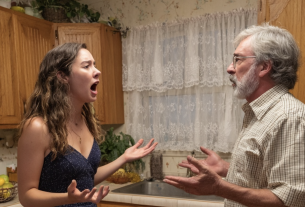
Lena stood in the middle of the living room, staring at the empty space by the window where her Dyson had been the day before. A cordless, portable, top-of-the-line model—she’d spent three weeks comparing options before buying it with her performance bonus. Twenty-eight thousand rubles. It couldn’t have just disappeared.
“Max, are you absolutely sure you haven’t seen the vacuum?” she asked for the third time.
Without lifting his eyes from his phone, her husband gave a small shrug.
“Haven’t seen it, Len. Maybe you put it in the storage closet?”
It wasn’t in the closet. Not in the bathroom, not in the bedroom, not on the balcony. Lena checked the entire apartment methodically—her apartment, the one she’d bought a year before the wedding. The vacuum was gone as if it had evaporated.
The New Year holidays had only just ended. Max’s relatives had left three days ago—his mother Galina Petrovna, his sister Oksana with her husband Vadim, and their teenage son Kirill. They’d come from Max’s hometown specifically to meet the new wife and celebrate New Year’s in the capital. Lena hadn’t agreed to it right away. She’d wanted their first holiday as a married couple to be quiet and cozy, just the two of them. But Max pleaded—promising it was only for three days, insisting his mother had dreamed of meeting her for ages…
Within minutes, Lena realized she’d made a mistake.
Galina Petrovna stepped into the apartment, swept a quick glance around the entryway, and before she’d even properly greeted Lena, she blurted out:
“Wow! How much does a place like this cost in Moscow?”
Lena felt thrown off. Max’s mother didn’t introduce herself, didn’t hug, didn’t smile—only that measuring look and a shamelessly blunt question.
“Mom, don’t start like that…” Max tried to step in, but Galina Petrovna had already marched into the living room.
“Is the laminate imported? Was the kitchen custom-made? Max said you have a good job. What do you earn, if it’s not a secret?”
Oksana and her family were no better. A large woman with bright lipstick and a sharp voice, she immediately planted herself on the sofa, kicked off her shoes, and stretched her legs onto Lena’s coffee table—glass, Italian, the one Lena had paid fifteen thousand rubles for.
“Oh wow, it’s so pretty in here!” Oksana exclaimed. “Vadim, look at all this tech! That’s the newest iPhone, right? Max, you really hit the jackpot!”
Lena clenched her jaw. The overly familiar tone, the constant appraisal, the complete lack of boundaries—it all made her skin crawl. They inspected her apartment and her belongings like they were pricing items at a flea market.
Dinner was even worse. Kirill, a sullen fifteen-year-old, grabbed food with his hands, dropped it on the floor, and never once said thank you. Vadim made crude jokes and roared with laughter at his own punchlines. Galina Petrovna kept pressing:
“Is that an induction stove? Expensive, I bet. And that fridge with the screen—what does something like that cost? And the built-in oven?”
Lena forced herself to endure it. Short answers. Tight smile. Max acted like he didn’t notice. Once, when they were alone in the kitchen, she tried to say something.
“Max, this is uncomfortable… they keep talking about money and prices nonstop…”
“Oh, come on,” he brushed her off. “They’re just simple people. They don’t mean anything by it—they’re just not used to this kind of life. Back home it’s different. You know that.”
Lena didn’t know that. She’d grown up in a family where you didn’t ask what someone’s things cost, where even close relatives respected boundaries.
On the second day, Oksana “accidentally” wandered into the bedroom while Lena was in the bathroom and spotted the vanity covered in cosmetics.
“Oh! What’s this cream?” she said, picking up a jar of La Mer. “How much did you pay for that little thing—five thousand?”
“Nine,” Lena replied flatly, taking it out of her hands.
Oksana whistled.
“Nine thousand for cream! Where we live, you could survive a whole month on that!”
Meanwhile, Kirill drifted through the apartment with his phone, opening cabinets, touching whatever he pleased. Lena caught him turning her Canon camera over in his hands—the one on the shelf. A good camera with interchangeable lenses, a gift she’d bought herself for her thirtieth birthday. Eighty thousand rubles.
“Kirill, put it down. That isn’t yours,” she said, her voice firm.
He shrugged and slammed the camera back onto the shelf. Lena winced and checked it—miraculously, it hadn’t been damaged.
They celebrated New Year’s loudly. Galina Petrovna got drunk and decided it was time for “heart-to-heart” honesty.
“You know, Lenochka, at first I was worried—our Max is a simple guy, hardworking, but not rich. I kept thinking, how’s he supposed to support a fancy Moscow girl like you? But now I see—you earned all this yourself. Good girl! Only… when are you going to have kids? At thirty, it’s already time. Career women end up infertile, you know!”
Max said nothing. Lena felt herself boiling inside but swallowed it.
One more day. Just one more.
On the morning of January third, the relatives finally left. Lena exhaled in relief as the door shut behind them. The apartment looked like a storm had swept through: trash everywhere, dirty dishes, stains on the sofa, and a mountain of unwashed plates in the sink.
“Couldn’t they at least clean up after themselves?” she asked, drained.
“Lena, enough,” Max snapped, already irritated. “They were guests! Stop being such a stick-in-the-mud. They tried, they wanted to make us happy, they brought so much food…”
“Food worth three thousand rubles,” Lena thought, “but they ate and drank twenty thousand.”
She began cleaning—and then noticed the Dyson wasn’t there. Then she realized her Sony wireless headphones were missing too—a gift from coworkers, twelve thousand rubles. She sprinted into the bedroom.
The camera.
The camera was gone.
Her heartbeat turned sharp and frantic. Lena tore through closets, checked under the bed, opened boxes in the storage closet. Nothing. It was as if her belongings had melted into the air.
“Max!” she called. “Max, something’s missing!”
He stepped out of the bathroom looking annoyed.
“What now?”
“The vacuum, the headphones, the camera. All of it is gone.”
“Nothing could be gone,” he grumbled. “You probably put it somewhere and forgot.”
“I didn’t forget! The vacuum was by the window. The camera was on the shelf. The headphones were on the nightstand!”
“Lena, stop making a scene over nothing.”
“It’s not nothing!” her voice broke. “That’s over a hundred thousand rubles!”
Max looked at her with irritation.
“And what exactly are you trying to imply?”
“I’m not implying anything. I want my things back.”
But the things didn’t appear. Lena searched for two more days—every corner, every shelf, every cabinet. Nothing.
On the fourth day she sat down at her laptop to check the price of the Dyson. She opened Avito and typed in the model. The prices were painful—an identical one was listed for twenty-five thousand. She scrolled… and froze.
On the screen was her vacuum.
Not just the same model—hers. The same scratch on the handle she’d made on the first day. And it was photographed against a wall inside her apartment. A corner of the living room she could recognize instantly.
Her hands started trembling. She clicked the seller profile.
Olga Vadimovna.
And there were more listings beneath it. Her Sony headphones. Her Canon camera. Even her new Massimo Dutti sweater—bought in December, worn once.
Lena didn’t remember scrolling to the bottom. There were another ten items—her items. Cosmetics. Perfume. A portable speaker. An e-reader. Anything that had been out in the open, anything someone could grab and carry away.
They’d stolen from her. Max’s relatives had robbed her.
Lena sat staring at the screen, unable to move. Inside her, anger surged—alongside a stunned emptiness. How? How do people come into someone’s home as guests and steal? How can anyone be that brazen?
She took screenshots of every listing and saved them in a separate folder. Then she called Max. He was at work.
“Max, we need to talk. Urgently.”
“Len, I’m in a meeting…”
“Maxim. Now.”
He came home two hours later, gloomy and irritated.
“What happened?”
Lena turned the laptop around and showed him the screen.
“This happened. This is my apartment. This is my vacuum. My headphones. All of it is being sold by your relative. How do you think my things ended up with her?”
Max went pale. He stared at the screen for a long time, then at Lena, then back again.
“This… this must be some kind of mistake…”
“What mistake, Max?!” Lena snapped. “Look at the scratch—see it? Look at the photo—my living room corner! They came into our home and carried out everything they could!”
“Wait,” he said, rubbing his face. “Wait. Maybe they thought… maybe they thought you were giving it to them…”
“Giving it?!” Lena couldn’t believe what she’d just heard. “I’m giving them a sixty-thousand-ruble camera?”
“I don’t know! How else do you explain it? Maybe they figured you wouldn’t care, that you have plenty, that you—”
“Max,” Lena said, her whole body shaking now. “Your relatives stole more than a hundred thousand rubles’ worth of my things. Call them. Right now. Tell them to bring everything back.”
He stayed silent, staring at the floor, jaw clenched.
“Well?” she pressed. “Call them.”
“I can’t just call and accuse them of stealing.”
“Why not? They’re thieves!”
“They’re my family!”
“And what does that change? Does that make them not thieves?”
Max jumped up and started pacing.
“Lena, think about it. Yes, it looks bad, yes, they acted wrong. But what now—start a scandal? Blow up relationships? That’s my mother, my sister!”
“And who am I?” Lena asked softly. “Who am I to you, Max?”
“You’re my wife. But…”
“But your family can rob me and you’re not going to do anything?”
“Oh, come on, not this ‘rob’ talk!” he exploded. “What are you—poor? Did they take your last coin? You have a three-room apartment in central Moscow, you make three hundred thousand a month! You’ll buy another vacuum. You’ll buy new headphones. But what about them?! They have no money. They came here and saw how you live!”
Lena felt her voice disappear. She stared at Max—her husband, the man she’d married four months ago, the man she’d planned children and a future with—and she didn’t recognize him.
“So you believe that if I have money, I can be stolen from?” she said slowly.
“That’s not what I said!”
“It’s exactly what you said. That I won’t miss it. That I’ll replace it. That because they have it hard, they’re allowed to steal.”
“Lena, you’re exaggerating…”
“I’m not exaggerating!” she shot to her feet. “They came into my home and took my things! Mine, Max! I bought them with money I earned! And instead of protecting me, you’re protecting them!”
“I’m not protecting anyone! I’m just trying to be objective!”
“Objective? Objectively, they’re thieves. Objectively, you should call them and demand they return everything. Or better—go there and take it back yourself!”
Max’s hands curled into fists.
“I’m not going. And I’m not calling. It’s petty, Lena. It’s humiliating—to make a big scene over stuff!”
“Over a hundred thousand rubles!”
“You have that money!”
“That’s not the point!”
“Then what is the point?!” he shouted. “That you can’t forgive my family for being poor? That you can’t stand being near them? I saw the way you looked at them for three days—like they were dirt!”
Lena recoiled as if he’d slapped her.
“Are you serious?”
“Completely. I get it—they’re not as refined as your colleagues. They don’t go to theaters and drink wine that costs five thousand a bottle. But they’re my people. And if you can’t accept them the way they are, then maybe we shouldn’t have gotten married at all!”
Silence fell. Lena stared at him and understood: something had shifted between them—finally and permanently.
“Alright,” she said, very calmly. “Let me explain. Poor people don’t disgust me. Thieves disgust me. People who come into someone’s home and steal from their hosts disgust me. And people who justify it disgust me even more.”
“Lena…”
“I’m not finished. I grew up in an ordinary family. My father is an engineer, my mother is a teacher. We never had much money. But we had manners. We were taught that you don’t take what isn’t yours. That guests respect the home they’ve been invited into. Your family doesn’t know that. But the worst part isn’t even that. The worst part is that you—my husband—are choosing not to stand with me.”
“I just don’t want to fight with my relatives over nonsense…”
“This isn’t nonsense, Maxim. This is a matter of principle. And your choice has told me everything.”
She walked into the bedroom, pulled out a bag, and started packing.
“What are you doing?” Max asked, confused.
“Going to my friend’s for a couple of days. I need time to think.”
“Because of this? Lena, this is stupid!”
She turned and looked at him for a long moment—carefully, as if seeing him for the first time.
“You know what the scariest part is? I thought I was marrying a man who would protect me. And it turns out you’re willing to protect anyone—except me. Your mother, who called me an infertile career woman. Your sister, who robbed our home. Even your nephew, who threw my camera onto the shelf.”
“You’re blowing it out of proportion…”
“I’m not. I’m just seeing things clearly for the first time.”
Lena spent three days at her friend Katya’s place. She cried, drank wine, and told her everything from the start. Katya listened and shook her head.
“Run,” she finally said. “If he didn’t choose your side in a situation this obvious, he never will. It’s about choices, Len. And he didn’t choose you.”
Max called. Texted. Asked her to come back, to talk, to work it out. Lena didn’t answer. She was thinking.
Thinking about the future she’d painted in her head—children, shared dinners, trips, mutual support. And now she pictured birthdays where Galina Petrovna would show up and spit cruelty. Family holidays with Oksana, who would steal again. Max, always defending them, never her.
On the fourth day, Lena returned home. Max was there. He rushed toward her.
“Len, thank God! I’ve been so worried! Let’s talk calmly, please…”
“There’s nothing to talk about,” she said. “I’m filing for divorce.”
He froze.
“What?”
“You heard me. I want a divorce.”
“Over what? Over that vacuum nonsense?!”
“Because we’re not headed in the same direction. Because our values are different. Because you didn’t stand with me when it mattered.”
“God, I didn’t think you’d take it this seriously!”
“How else was I supposed to take it, Max? Your family robbed me—and you decided it was acceptable.”
“I didn’t say it was acceptable! I just… I just didn’t want to blow up a conflict…”
“Exactly. You didn’t want conflict. It was easier for you to sacrifice me—my peace, my safety, my property—than argue with your mother and sister.”
“Lena, but they’re family…”
“I was supposed to be your family too. Apparently, I never became that.”
She walked to the closet and started pulling his clothes out.
“Pack your things. This is my apartment, and I want you to move out.”
“You can’t kick me out! I’m your husband!”
“Not for much longer.”
Max tried to argue, to plead, even to shout. Lena didn’t budge. The next day he moved in with a friend. A week later Lena filed the paperwork.
Her mother called, trying to understand what had happened. Lena told her everything.
“My girl,” her mother said slowly, “he didn’t protect you. If a man doesn’t protect his wife now, he won’t protect her later either. You did the right thing.”
The divorce took two months. Max didn’t believe she was serious until the very end. He kept texting, suggesting they “start over.” Once he even showed up with flowers and apologies. He claimed he’d called his mother and “settled it.”
But the things were never returned.
“You see… they already sold them,” he said awkwardly. “They spent the money. They’ve got renovations, loans…”
“I understand,” Lena replied. “Goodbye, Maxim.”
The divorce was finalized in March. Lena replaced the stolen items—simply because she needed them. But every time she picked up the new vacuum or put on her headphones, she didn’t think about the money she’d lost.
She thought about how easy it is to be wrong about someone. How in four months of marriage she’d learned more about her husband than in two years of dating. How a person’s real value isn’t revealed during celebrations and love confessions, but in the moments when a choice must be made—when you have to pick a side, when you have to decide what matters most.
Max chose comfort.
Lena chose dignity.
And she never regretted it—not once.