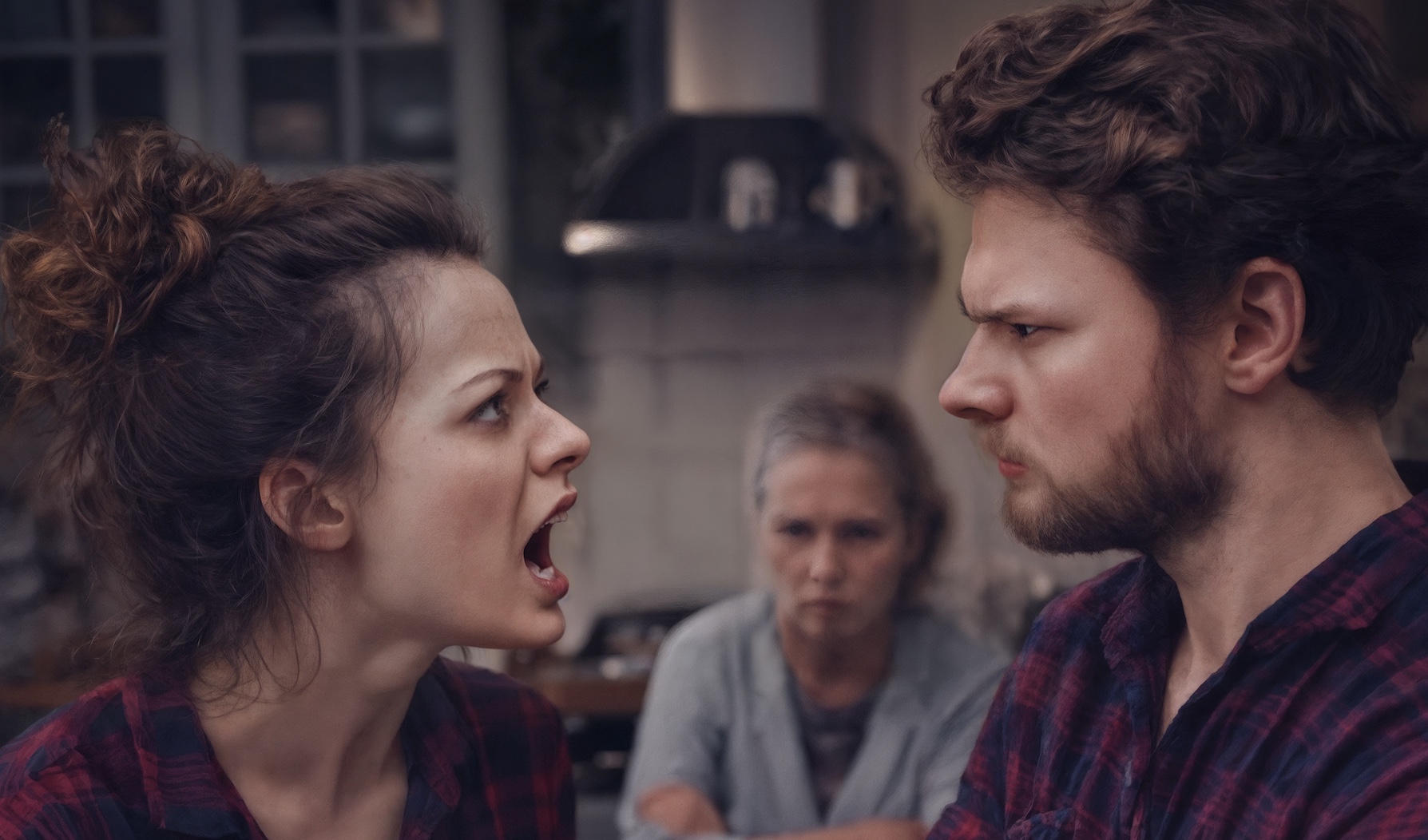
“Cut some bread. And get the butter—this is going down dry. The potatoes are fine, but you overcooked the meat. It’s tough as a boot sole.”
Yevgeny shoved his plate away, making it look like he was doing her a favor by eating dinner at all. He sat sprawled out, legs wide, wearing a stretched-out T-shirt with a fresh sauce stain spreading across the front. Varvara got up without a word, pulled the butter dish from the fridge, and started slicing the loaf. The knife knocked against the wooden cutting board—hard, rhythmic, blunt. That dry tapping was the only sound cutting through the steady drone of the range hood.
She’d only just gotten home from a ten-hour day. Her head still throbbed; the quarterly report charts were still floating in front of her eyes—the same report that had kept the whole analytics team in panic mode all week. She wanted silence and a scorching shower, not complaints about how her beef was cooked. But in Yevgeny’s mind, his shift at the auto parts warehouse was the labor of Hercules, while her work was “shuffling papers in air conditioning.”
“I don’t hear a thank you,” he grunted, slathering butter on thick.
“You’re welcome,” Varvara answered evenly, pouring herself a glass of plain water. She didn’t feel like eating. Watching her husband chew with his mouth open, smacking and sucking at his food, made nausea rise in her throat.
Yevgeny swallowed, took a sip of his sweet tea, and—without even looking at her, as casually as if he were reading a weather report—said:
“Mom’s moving in tomorrow. They’ll bring her in the morning. I already hauled some of her stuff over while you were sitting in your little meeting warming a chair. I booked a van for eight, so get up early and meet them.”
Varvara froze with the glass in her hand. The water wobbled but didn’t spill. Slowly she set it on the table.
“What do you mean, moving in?” Her voice was quiet, completely flat. “Galina Petrovna lives in her own two-bedroom place. We paid for her renovation a year ago. She’s settled there. Why would she move here?”
Yevgeny scratched his stomach, staring at the TV bolted to the wall. The news was on.
“Her legs are swollen. She can barely walk. Called yesterday—said even getting to the bathroom is a whole ordeal. Her blood pressure’s all over the place. Bottom line, she can’t be alone anymore. She needs care. Someone around all the time. Hand her water, empty the bedpan, wash her. You know how it is—old age isn’t a picnic.”
“I understand,” Varvara nodded, feeling a cold, ringing wire tighten inside her. “So we hire a caregiver. Or we find a proper private facility with medical support. I can ask my colleagues—Irina’s mom stayed at a place like that after her stroke, the conditions were excellent.”
Yevgeny snorted and finally turned his head toward her. His eyes held genuine disbelief… mixed with contempt, as if her suggestion was stupid.
“What facility, Var?” he scoffed. “Have you seen the prices? A hundred thousand a month, minimum. And a caregiver? Some stranger in our home who’ll steal spoons and sleep on the couch for our money? No. We don’t have extra cash. I’ve done the math.”
He paused like he was delivering a grand finale, speared a piece of bread with his fork, and put it in his mouth.
“You’re quitting.”
The kitchen fell so silent she could hear the refrigerator compressor kick in. Varvara stared at him, searching his face for even the tiniest hint that he was joking. But he wasn’t. He was serious—solid, immovable, unbreakably serious. He didn’t even look guilty or embarrassed. He looked like a man announcing a plan he considered the only possible outcome.
“Did I mishear you?” she asked, icy cold sliding down her spine. “You want me to quit? Now? When my promotion and bonus were just approved?”
“Oh, your bonus,” Yevgeny waved it off. “Pennies. Mom is sacred. She needs care twenty-four seven. I work. I’m the man. I feed the family. And you sit in an office, wasting time in skirts. So you’ll finally be useful at home. You’ll look after Mom, cook diet meals, do laundry. That’s a woman’s job—showing mercy.”
Varvara stood. Her chair scraped over the tile with an ugly screech. She walked to the window and stared into the dark courtyard. In the glass, the kitchen reflected back at her: warm, modern, comfortable—furnished with the money she’d earned over the years, biting down on every contract and dragging it home through sheer will. And at the table sat a man who treated all of it like it had simply appeared for him.
She thought of Galina Petrovna: the permanently pursed lips, the predatory stare. The woman who’d announced at their wedding, loud enough for guests to hear, “Well, at least it’s someone—since decent girls won’t take him.” The woman who called Varvara “dried fish” because she was thin. The woman who threw Varvara’s gifts into the trash with a sneer—“Cheap synthetic garbage.” The woman who, in seven years, had never called her by name—only “that one” or “your wife.”
“So you’ve decided everything,” Varvara said, turning back. Her face looked carved from pale marble. “You’ve decided my career belongs in a garbage chute. You’ve decided we’ll live on your warehouse salary—barely enough for utilities and gas for your old Toyota. And you’ve decided I’ll be an unpaid servant to someone who despises me.”
“Don’t start,” Yevgeny grimaced. “She’s old. She has a personality. You’ll deal with it. You’re young, healthy—you won’t fall apart. You need humility, Var.”
Varvara stepped right up to the table and planted both palms on the counter, leaning over her husband as he kept chewing. Her eyes held no hysteria, no pleading—only a cold, annihilating rage.
“So I’m supposed to quit a good job I’ve worked myself raw for five years, and become a caregiver for your mother—who hates me and smears me at every corner—while you come home to everything done and pretend that’s normal? No, sweetheart. Go find your fools in the mirror.”
Yevgeny stopped chewing. The bread froze in his cheek. He lifted his eyes slowly, and angry surprise began to flare there. He wasn’t used to being spoken to like that. Varvara usually stayed quiet, smoothed things over, endured.
“How dare you talk to your husband like that?” he hissed, crushing the fork in his fist until his knuckles went white. “I told you in plain Russian: there’s no money. We can’t afford a caregiver. There are no options. Unless you want my mother thrown out on the street.”
“There are plenty of options, Zhenya,” Varvara straightened and crossed her arms. “You can get a second job. You can sell your car. You can take out a loan. You can quit and take care of your mother yourself if she’s so ‘sacred.’ Why is the sacrifice always mine?”
“Because you’re a woman!” Yevgeny bellowed, hurling the fork onto his plate. The porcelain clinked miserably; greasy sauce splattered across the table. “Your place is the hearth—not twisting your ass around offices! I decide how we live and what we live on! And if I said my mother is living here and you’ll be emptying her chamber pot—then that’s what’s going to happen!”
He breathed hard, nostrils flaring. His face turned blotchy red, a vein rising on his forehead. This was the Yevgeny she’d tried not to see for years: a petty domestic tyrant convinced he had the right to rule simply because of what was between his legs.
“Have you lost your mind?” Varvara asked very softly. “Did you forget who pays for this ‘hearth’? Did you forget whose money bought this apartment, this food, this furniture?”
“It’s a family!” he screamed, spitting. “Money in marriage is shared! Don’t wave your wallet at me! You’re spoiled, Varvara—completely detached from reality. Nothing, Mom will move in and she’ll straighten your head out fast. Teach you to respect your elders.”
He shoved his chair back and stormed out of the kitchen, deliberately bumping her shoulder as he passed.
“Tomorrow you put your resignation on your boss’s desk. And you’d better be downstairs at eight sharp. The van won’t wait.”
Varvara remained in the middle of the kitchen, staring at the grease splashes on the table, the half-eaten bread, the dirty plate. Inside her, something clicked—and broke for good. The patience she’d been running on for seven years seized and died. The gears ground to a halt.
“Sit down,” she said.
Her voice came out unexpectedly loud—sharp as a ruler snapped across a desk.
Yevgeny stopped in the doorway. His wide back tightened under the washed-out T-shirt. He turned slowly, wearing the irritated boredom of someone being interrupted by nonsense.
“What now? I told you—the conversation’s over. Tomorrow’s a hard day. I need sleep.”
“The conversation isn’t over until I’m finished,” Varvara said, not moving from the window. Her posture looked forged from steel. “You want me to quit? Fine. Let’s pretend, for one second, that I’ve lost my mind and agreed. Let’s use your favorite logic, Zhenya.”
She stepped to the table, picked up her phone, unlocked it, and opened her banking app.
“Sit. I said sit. We’re going to count. You hate keeping the books, so I’ll do it for you.”
With a heavy sigh, Yevgeny came back and dropped into his chair, rolling his eyes for effect.
“There you go again with your numbers. There’s nothing human left in you, Var. Just debits and credits rattling around your skull. My mother is practically dying and you’re counting pennies.”
“This isn’t pennies, Zhenya. This is our life. Look.” She shoved the phone toward him; he turned his head away. “Fine, I’ll say it out loud. Mortgage: forty-eight thousand a month. Utilities, internet, concierge: another nine. Gas and maintenance for your car—the one you drag yourself to work in—fifteen a month on average, considering it’s falling apart. Groceries: thirty-five. And we’re not living it up, Zhenya. That’s the baseline.”
She paused, watching his profile. He stared at the wall, his leg twitching.
“Total: one hundred and seven thousand a month in mandatory expenses. Just to avoid ending up on the street and starving. Now tell me your salary. Out loud.”
Yevgeny said nothing. His jaw worked.
“Silent? I’ll remind you. Fifty-five thousand. And that’s with bonuses you’ll lose in a month for being late. If I resign tomorrow, our household income becomes fifty-five. Our expenses stay one hundred and seven. Plus medication for Galina Petrovna, diapers, pads, special nutrition—another thirty at least.”
“We’ll tighten our belts!” Yevgeny snapped, slamming his palm on the table. “People live on less! We’ve got bread and potatoes! Stop acting like you’re eating foie gras! We’ll sell your car—you’ll be home anyway. We’ll take mortgage breaks! We’ll manage! The main thing is the family stays together!”
Varvara looked at him with a disgust she couldn’t—and wouldn’t—hide anymore. A grown man sat in front of her offering poverty as a perfectly acceptable plan, as long as he didn’t have to strain himself.
“Tighten our belts?” she repeated, her voice like ice. “So you want me to sell my car—the one I bought before the marriage—to feed your mother? You want me living on plain potatoes and debt so you can play the noble son? And did you forget, Zhenya, who that woman is—the one I’m supposed to sacrifice everything for?”
“She’s my mother!”
“She’s the person who looked me in the eye on the second day after our wedding and called me ‘a barren weed.’ She’s the one who called me an ‘office rat’ when I got my first promotion. She gave me wrinkle cream for my birthday and said, ‘Maybe you’ll look a little more human—otherwise Zhenya will start cheating soon.’”
Varvara spoke calmly, never raising her voice, but each sentence dropped into the kitchen silence like a stone.
“I tolerated her visits. I tolerated her six-a.m. calls to ‘check on us.’ I kept my mouth shut when she lectured me about borscht and poured my soup into the toilet. But living with her? Washing her? Enduring her around the clock—her presence, her insults—and paying for it myself? Are you out of your mind?”
Yevgeny jumped up. Red blotches climbed his face. He hated being reminded of his own inadequacy. He hated the calm, steady confidence in his wife’s voice—the strength he’d never had.
“Shut up!” he screamed, spraying spit. “You’re just a vindictive bitch! She’s old, she’s difficult—fine! But she lived a life, she raised me! And you? What have you done? Written a pile of reports? Made some charts? To hell with your job! That’s not work! Work is breaking your back the way I do! And you sit in warmth, drinking coffee, and you still dare to throw money in my face!”
He stepped in close, looming, trying to crush her by sheer bulk now that his arguments had run out.
“You’ve gotten spoiled, Varvara. You forgot you’re a woman. Your purpose is care. Compassion. And you’re a walking calculator. You’ve got a cash counter where your heart should be. It’s disgusting. I’m bringing Mom here so you finally thaw out—so you remember what it means to be a woman, not some director.”
Varvara didn’t move an inch. She stared straight into his bloodshot eyes and saw only emptiness—and an inflated, bottomless selfishness.
“My job, Zhenya, is what lets you eat meat every night and sleep on an orthopedic mattress. My job paid your dental work last month. My job covered the loan on that TV you drool at every evening. You devalue the very thing you live off. That’s not masculinity—that’s паразитизм.”
“I said you’ll quit!” Yevgeny shrieked again. “I’m the husband—my word is law! Don’t like it? Get out! But Mom will be here tomorrow and you’ll take care of her! Or I’ll make your life so miserable you’ll beg for mercy!”
“Threatening me?” Varvara gave a crooked half-smile. “Interesting. And what will you live on if I leave? Your fifty-five? Minus your mother’s medication? You’ll be crying in a month when collectors start calling about the mortgage.”
“You won’t leave,” Yevgeny said with smug certainty, and triumph crept into his voice. “Who needs you at thirty-something? The apartment’s shared, the mortgage is shared. You put so much into it you’ll cling to it with your teeth. So stop bluffing. Tomorrow you meet Mom, you smile, and you start paying back your debt to the family. I’m going to bed. I have a schedule.”
He turned and shuffled out of the kitchen in his slippers. Varvara stayed standing, ears ringing with his words—“barren weed,” “not work.” He truly believed himself. He genuinely thought he had the right to control her life, her time, her money—simply because his chromosomes came in a different arrangement.
She looked down at her hands. Her fingers trembled—not from fear, but from adrenaline overload. A cold fire burned in her chest. The last illusion was gone. The man in that apartment was not a partner, not a friend, not even just a roommate.
He was an enemy.
A stupid, greedy, cruel enemy who had decided to sacrifice her comfort to preserve his own.
Varvara exhaled slowly. The self-pity that tried to rise somewhere deep inside was strangled instantly. This wasn’t the moment for pity. This was the moment for calculation—the very thing he hated her for.
She left the kitchen, the floor under her feet suddenly feeling unsteady, like the deck of a ship in a storm. She needed her office—the small room she’d fought for during the apartment planning. Surrounded by professional books and her powerful computer, it had been her bunker. Her fortress. The place that earned the money Yevgeny spent so easily and so automatically.
The office door was slightly open. Varvara pushed it wider—and stopped on the threshold. The air jammed in her throat like a thorn.
The room was gone.
The walls were still there, but everything that made it hers—everything that made it safe—had been stripped out. Her expensive ergonomic chair was shoved into a corner and buried under bulky bags. Her monitor—her working instrument—sat on the floor facing the wall, precariously balanced on a nest of cables. And on her wide oak desk, where everything was usually lined up with perfect order, there were boxes. Dusty cardboard boxes that stank of stale closets and mothballs. Through a flap she could see old dishes, stacks of yellowed bedding, and piles of rags.
“Well? What are you standing there for?” Yevgeny’s voice sounded right behind her. He’d come up silently, wearing the satisfied smirk of an owner inspecting his territory. “I told you—I started moving her stuff. Tomorrow we bring her bed, and then Mom herself.”
Varvara turned her head slowly. Her gaze landed on the shelf where her awards and certificates used to stand. Now they were shoved into a messy pile like trash. In their place sat a cheap icon in a gaudy frame and a stack of old “Health” magazines.
“You touched my things?” she asked softly—but there was more menace in that whisper than in any scream. “You took apart my workspace? Zhenya, this is my office. We have a guest room. Why can’t your mother stay there?”
Yevgeny walked in, kicked a box like he was testing it, and spread his hands.
“The guest room faces north—too dark and drafty. And the bathroom’s far, she’d have to hobble the whole corridor. Here is perfect. Morning sun, the bathroom’s right behind the wall. Mom will be comfortable. She needs air, light. And I’ll take the guest room for myself—make it a workshop. I’ve wanted a workbench for ages.”
“A workbench?” Varvara felt reality begin to split at the seams. “So you’re evicting me from the room where I work so you can put in a workbench you won’t touch for years? And where, exactly, am I supposed to work? Or did you forget the mortgage is paid by my computer, not your imaginary workbench?”
Yevgeny winced as if from toothache. He tapped her powerless desktop tower with a careless finger; it too had been left on the floor.
“There you go again. I told you—you’re quitting. You don’t need an office anymore. What does a housewife need an office for? Looking up borscht recipes? You can do that in the kitchen on your phone. Or sit on the balcony—there’s a folding table. In summer it’s nice, birds singing. In winter you can sit at the kitchen table while the soup’s simmering.”
He said it completely seriously. In his world her job was just an overgrown hobby—something that could be shut down now that “real problems” had arrived. He didn’t just want his mother moved in.
He wanted Varvara erased.
Turned into staff. Stripped of territory, stripped of identity.
“You dumped my monitor on the floor,” Varvara stepped over a box labeled “Books/Dishes.” “Do you understand that equipment costs more than all the furniture in your mother’s apartment? If you broke it—”
“I don’t give a damn about your monitor!” Yevgeny exploded, his fake calm collapsing. “You care more about metal junk than a living person! Selfish! Cold, heartless selfish woman! Mom’s sick—she needs peace—and you’re shaking over your crap! Rot with your reports, Varvara. They won’t warm anyone at night!”
He grabbed one of her document folders and threw it to the floor. Papers flew across the room, mixing with dust from the boxes.
“That’s the value of your work!” he snarled. “Trash! Paper! And family is sacred! If I have to, you’ll sleep on a doormat by the door, but my mother will be comfortable—because I said so. I’m the husband here!”
Varvara stared at the scattered pages. A quarterly report—two weeks of sleepless nights. And strangely, she felt no pain. The anger that had boiled in her in the kitchen crystallized into something colder: clarity. Absolute, surgical clarity.
This wasn’t a fight.
This was a takeover.
A hostile takeover of her life.
Yevgeny wasn’t stupid—he knew exactly what he was doing. He was destroying her base, her independence, so she would be chained to him and his mother for good. No money. No space. No leverage. No will. Convenient. Free. Silent.
“So… a doormat?” she repeated, lifting her eyes.
Something in her look made Yevgeny falter for half a second. He’d expected tears, screams, hysteria—anything. Instead, she stood straight, her calm almost frightening.
“Don’t dramatize,” he muttered, avoiding her gaze. “You’ll sleep with me in the bedroom. But during the day—figure it out. Mom will live here, end of discussion. Get used to it. And clean up this mess,” he nodded at her papers. “By morning it needs to be spotless. Mom can’t stand dust.”
He turned and left, deliberately shuffling his feet loud enough to make it clear: the conversation was over and his word was final.
Varvara stood for another minute, listening to him turn on the TV in the living room. The sound of a soccer match filled the apartment. For him, life continued as usual. He’d “won,” put the woman in her place, and now he deserved to relax.
She bent down—but not to pick up the papers. She stepped over them, walked to the closet he hadn’t yet crammed full of his mother’s junk, and yanked the doors open.
She didn’t need to think. A plan assembled itself instantly—clean, ruthless, precise as code. No negotiations. No compromises. You don’t bargain with terrorists.
Varvara left the office and went to the bedroom. From the storage closet she pulled out a large rolling suitcase. The sound of the zipper ripping through the quiet was sharp, like a gunshot. She opened it on the floor.
Hearing the noise, Yevgeny called from the living room: “What are you dragging around in there? Go to bed! Tomorrow we’re up before dawn!”
Varvara didn’t answer. Methodically, stack by stack, she began pulling out her things. Underwear. A business suit. Jeans. Sweaters. Only essentials. Only what would let her walk into the office tomorrow looking like a person—not like someone broken.
Her hands didn’t shake. There was no hesitation. The apartment she’d loved—the walls she’d painted, the curtains she’d chosen—suddenly felt чужой, poisoned by the presence of a man who had just dragged her life through dirt.
She swept her medication, chargers, and documents into a toiletry bag. Passport. Diploma. Car papers. Everything that proved she was Varvara—a lead analyst, a self-contained adult human being—not an accessory to a sick old woman and her failed son.
Yevgeny appeared in the bedroom doorway, holding a can of beer and leaning on the frame. A patronizing smile floated on his face.
“Oh, here we go,” he drawled after a sip. “A performance? Trying to scare Mom? ‘I’m leaving to my mother’s’? Where to? That suitcase is a bit small for a brand-new life.”
Varvara silently laid her laptop on top of the clothes and fastened the inner straps.
“Well? Why are you quiet?” Yevgeny smirked, feeling victorious. “You think I’ll run after you? Beg? Not happening. Go cool off and you’ll come back. Where are you going to go—from a submarine? The apartment’s yours too. Bet you hate the idea of losing it.”
He was sure she was bluffing, staging drama to bargain for better terms. He didn’t see that the woman zipping a suitcase wasn’t his wife anymore. She was a stranger checking out of a hotel with terrible service.
The lock on the suitcase snapped shut, loud in the bedroom—like a starter pistol. Varvara straightened, adjusted the strap of her laptop bag, and without looking at her husband, pulled up the handle. The wheels rumbled softly over the laminate.
Yevgeny, who’d been watching lazily with beer in hand, pushed off the doorframe. The smug amusement on his face shifted—stretched, uncertain. He still didn’t believe it. In his universe, wives didn’t leave at night with a single suitcase, abandoning the home they’d poured their soul into. Wives cried, threw plates, yelled, then went back to the kitchen and warmed dinner like they always did.
“You’re serious?” he stepped in front of her. “Var, stop the circus. It’s the middle of the night. Where are you going? To your girlfriends to sob? I’ll call Svetka right now, tell her not to indulge your nonsense.”
“Move,” Varvara said calmly.
There was no steel, no ice in her tone—only exhaustion and indifference, like brushing away an annoying fly.
She went around him without even bumping his shoulder, as if he were just badly placed furniture. Stunned by being ignored, Yevgeny rushed after her into the entryway. Varvara was already putting on her coat, automatically checking her pockets for keys and phone.
“Are you deaf?” his voice rose, hysteria creeping in. It was starting to sink in that the script wasn’t going his way. “I’m talking to you! Get back in the room! Mom’s coming tomorrow and the place is a disaster—nothing’s ready! You have to meet her, help unpack! I can’t do it alone—I’ve got work!”
Varvara laced up her boots. Zipped them. Wrapped her scarf. Her phone screen lit up with a notification: “Your taxi is waiting. Black Octavia, plate 564.”
“I’m not hearing an answer!” Yevgeny grabbed her coat sleeve and tried to pull her around. “You planning to live on my money? Or you think I’m paying for your little stunt? Put the card on the table! And the car keys—this is family property!”
Varvara slowly, with visible disgust, peeled his fingers off her sleeve.
“Your money?” she repeated, looking not into his eyes but right at the bridge of his nose. “Zhenya, your money ended three days ago—when you bought beer and new seat covers. Right now we eat, drink, and live on mine. But that’s over.”
At that exact moment the intercom buzzed—sharp, demanding—splitting the tension like a knife. Yevgeny flinched, glanced at the handset, then at the clock.
“Who the hell—” he muttered and hit the button. “Yeah?”
A familiar, eternally displeased voice crackled through the speaker—one Varvara could recognize out of a thousand.
“Zhenya! Why aren’t you answering? We’re here! The movers are rude, charging a fortune, your freight elevator isn’t working! Come down right now—I can’t stand in this draft, my back is killing me! And call Varvara—let her take the bag of medicines, it’s heavy!”
Yevgeny’s eyes went wide. He lunged toward the door, then toward Varvara, smoothing his hair in a panic.
“Mom’s here… earlier than planned… Probably came tonight to avoid traffic…” he babbled, forcing a look of “man of the house” concern onto his face. “Okay, Var, that’s enough. Games are over. Take off the coat. Mom’s downstairs. Don’t embarrass me in front of her. Help bring things up, make her bed, warm some tea. We’ll talk tomorrow.”
Varvara gave a short, crooked smirk—not even a smile, more like a grimace of bitter triumph. Fate could be cruelly theatrical.
“Open the door, Zhenya,” she said.
Thinking she’d come to her senses, Yevgeny sighed with relief and flung the door wide.
Two sweaty movers were already on the threshold, wedging huge taped-up bags into the narrow hallway. Behind them, leaning on a cane like she owned the building, floated in Galina Petrovna herself—exactly as Varvara remembered: pursed lips, a sharp assessing stare, a permanent complaint written across her face.
“Finally!” the older woman announced, not even greeting them. “We waited forever for the elevator. Zhenya, why does your apartment smell damp? And what is that?” She stared at Varvara in her coat with a suitcase in hand. “Where are you going at this hour? Guests are greeted in an apron, not in street clothes. Take my bag—my shoulder’s going numb.”
Varvara tightened her grip on her suitcase handle. The movers cursed under their breath while dragging an old dresser inside, scraping the wallpaper. Yevgeny darted between his mother and the furniture, trying to play foreman.
“Mom, come in, we’ll set everything up… Varvara just… stepped out to the store,” he lied, pathetically.
Varvara took one step forward, forcing Galina Petrovna to move aside.
“Not the store, Zhenya,” she said loudly, clearly, her voice cutting above the furniture noise. “I’m moving out.”
Silence slammed down in the hallway—broken only by the movers’ heavy breathing. Galina Petrovna opened her mouth, gearing up for a tirade, but Varvara didn’t let her get a single word out. She turned to her husband.
“Listen carefully, because I’m not repeating myself. I rented an apartment downtown, near my office. Lease signed, payment done—on my card. The same card, Zhenya, that has been paying this mortgage, your groceries, and the utilities. I cut off your access to my account exactly five minutes ago.”
Yevgeny went pale. He looked like a fish thrown onto shore—mouth opening and closing, no sound coming out.
“Mortgage is due on the twentieth. Forty-eight thousand. Electricity and water bills at the end of the month. There’s half a loaf and some soup in the fridge. You’ll last a couple days. After that—figure it out.”
“You… you can’t…” Yevgeny rasped, grabbing the doorframe. “How am I supposed to pay? I don’t have that kind of money! You’re leaving me with a sick mother? With nothing?”
“But you’re the man, Zhenya. The provider. The head of the family,” Varvara said, and her smile held nothing but cold metal. “You wanted me to clear space for your mother? I did. An entire office—and half the apartment, as a bonus. Enjoy your quality time together. You’ll have plenty of it now. No one will distract you with ‘office nonsense.’”
“Varvara!” Galina Petrovna shrieked, finally realizing the free caregiver was slipping away. “How dare you! This is your duty! Come back right now! Zhenya, tell her!”
Varvara stepped over one of the older woman’s bags sitting in the doorway. She felt unbelievably light—like someone had lifted a concrete slab off her shoulders that she’d been hauling for seven years.
“Have a nice life,” she tossed over her shoulder. “And yes, Zhenya— I’m filing for divorce online. Don’t look for me.”
She walked out onto the landing and pressed the elevator button. The apartment door stayed open behind her. From inside came Galina Petrovna’s screeching—already tearing into her son for “letting the woman get away”—and Yevgeny’s pathetic, stunned muttering as he finally understood he’d been left alone with debts, an enraged mother, and an empty refrigerator.
The elevator arrived almost immediately. Varvara stepped into the cabin and hit the button for the ground floor. In the narrowing slit as the doors slid shut, she saw Yevgeny lurch forward as if to chase her—then trip over his mother’s dresser.
The doors closed. The shouting vanished, cut off cleanly.
Varvara rested her forehead against the elevator’s cold mirror and drew a deep breath for the first time all evening.
She was going down—but she knew with absolute certainty:
from this moment on, her life was rising.